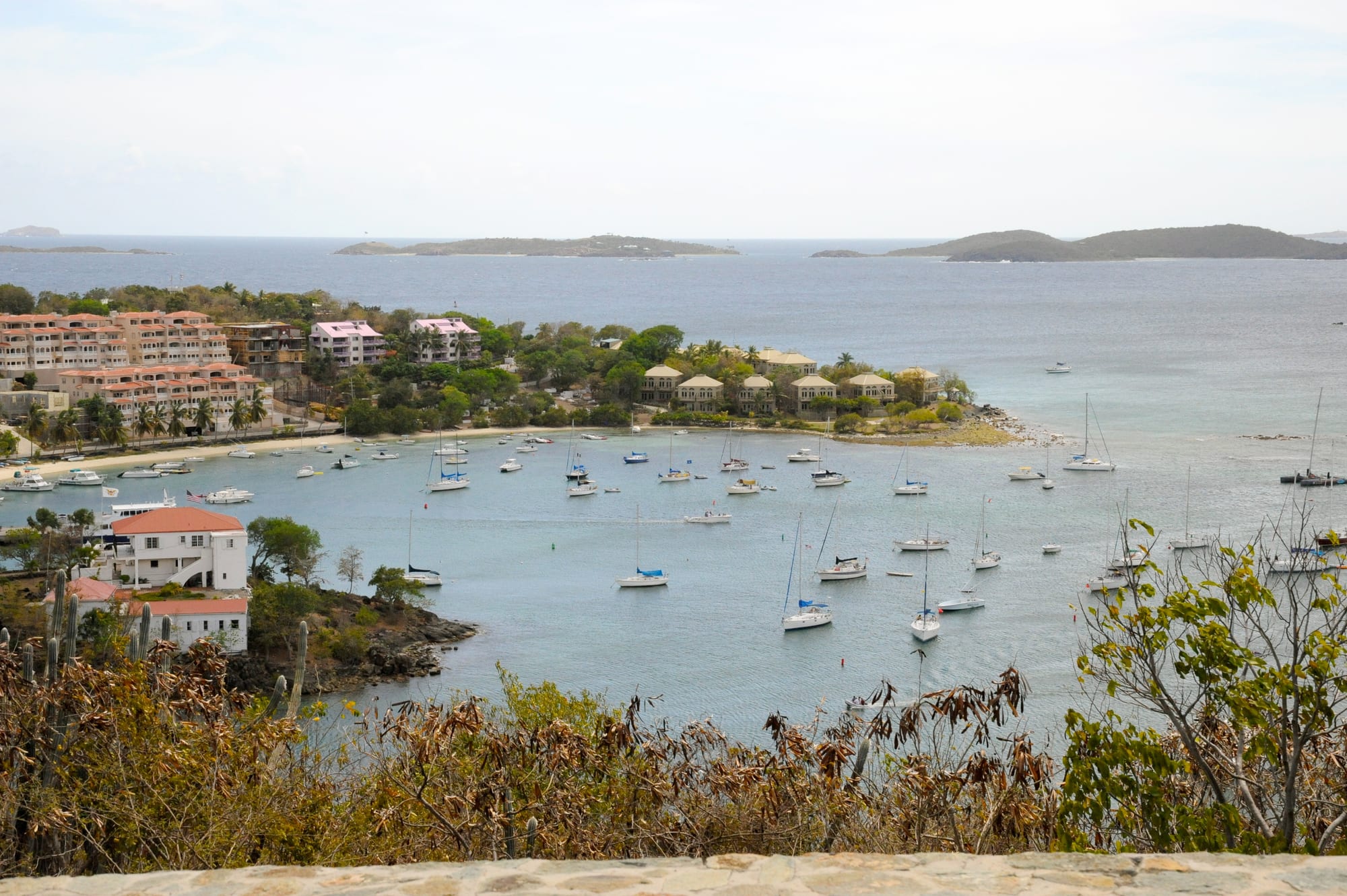
Sailing boats moored in a calm blue bay below Cruz Bay's hillside buildings, with small islands on the horizon

United States Virgin Islands

Cruz Bay

The harbour at Cruz Bay on St John. (Fred Hsu / Wikimedia Commons · CC BY-SA 3.0)

The main town and port of St John, the smallest of the three main US Virgin Islands, on its west coast facing St Thomas. Established by the Danes in 1766, it grew into the island's gateway after a national park took in most of the island in 1956; today ferries, shops, bars and the park's visitor centre crowd a small harbour full of sailing boats.

Neighbourhoods

  • The town centre and ferry dock
    • First-time visitors
    • Nightlife
    • Close to the ferry

    The small square behind the ferry dock is the centre of commerce, with bars, restaurants and shops a few steps from the boats, the taxi line and the bus stop. The town beach, with soft white sand and a marked swimming area, is lined with beach bars, and car hire offices are within easy walking distance.

    Open in Maps
  • Mongoose Junction and the park visitor centre
    • Shopping
    • Best for food
    • National park access

    The quieter, shadier end of town, where Mongoose Junction's shops, galleries, restaurants and bars are set around garden courtyards in stone buildings opposite the national park's visitor centre. It is the natural starting point for the north-shore road to the beaches.

    Open in Maps
  • Coral Bay
    • Quiet and residential
    • Local life

    The island's other settlement, on the south-east side, once its commercial centre and now a small community of outdoor restaurants, grocery stores and tourism services. Those staying here, or in rented houses outside town, need a car.

    Open in Maps

Things to do

The national park

  • Virgin Islands National Parkpark

    The national park that protects about 60 per cent of St John's land and more than 5,500 acres of the surrounding sea, known for snorkelling, diving and miles of hiking trails; its visitor centre is in Cruz Bay.

    Open in Maps
  • Annaberglandmark

    The uninhabited ruins of a sugar factory and plantation on the north shore, part of a historic district within the national park.

    Open in Maps
  • Reef Bay Trail petroglyphstrail

    Carvings in the rock above a pool on the Reef Bay Trail, most often thought to be the work of the island's pre-Columbian Taíno inhabitants.

    Open in Maps

Beaches

  • Trunk Baybeach

    A beach within the national park, named after the leatherback turtles locally called 'trunks', with lifeguards and an underwater snorkelling trail across its coral reef.

    Open in Maps
  • Cinnamon Baybeach

    A bay and beach on the north shore within the national park, near the ruins of a sugar mill.

    Open in Maps
  • Cruz Bay beachbeach

    The town's own beach, with soft white sand, a marked swimming area and beach bars, beside the anchorage for day boats.

    Open in Maps

Around the town

  • Mongoose Junctionattraction

    A cluster of shops, art galleries, restaurants and bars in stone buildings around garden courtyards, across from the park's visitor centre.

    Open in Maps
  • Coral Bayneighborhood

    The small settlement on the far side of the island, once St John's commercial centre and site of its largest plantation, reached by the island's hourly bus over Centerline Road.

    Open in Maps

Seasonal events

  • St John CarnivalJune–July

    The island's own multi-day carnival, one of three held across the territory each year.

Eat and drink

Long-standing places and food districts in Cruz Bay. Hours, ratings and directions come from your maps app, always current.

Food and drink in town

  • Mongoose Junctionneighborhood

    Restaurants and bars around shady courtyards at the quieter end of town.

    Open in Maps
  • Woody'scafe

    A bar a short walk from the ferry dock, popular for its happy hour.

    Open in Maps
  • Restaurants around the town squareneighborhood

    The small bars and restaurants around the square and along the beach, where people sit outside with rum drinks.

    Open in Maps

Experience Cruz Bay

History

St John was a Danish plantation island before Cruz Bay existed. By 1733 there were 109 plantations, 21 of them producing sugar, and that year the enslaved, led by people from the Akwamu kingdom of West Africa — among them a leader remembered as Breffu — overpowered the soldiers of the island's Danish fort and took control of most of the island; planters did not regain it until the end of May 1734. Cruz Bay itself was laid out in 1766 on the west coast, facing St Thomas, with a small fortification, the Battery.

The enslaved population peaked at about 2,600 in 1804. After emancipation the plantation economy declined; the island's population fell by 70 per cent between 1845 and 1945, and the last sugar factory closed in 1908. For a long time Coral Bay, on the far side of the island, was the commercial centre, and its people had easier links to Tortola than to St Thomas.

That changed in the 20th century. Investors bought old estates, and in 1956 Laurance Rockefeller gave his lands to the National Park Service on condition that they be protected from development. With the park's visitor centre and the ferries from St Thomas, Cruz Bay became the island's gateway. The Cruz Bay Town Historic District was listed on the National Register of Historic Places in 2016. In September 2017 Hurricane Irma struck the island and Maria followed; the park reopened that December, but visitor numbers fell to about 112,000 in 2018, against an average of more than 450,000 a year in the previous decade.

Culture & Customs

St John calls itself Love City, and Cruz Bay has the easy, small-town manner of a place where residents, boat crews and visitors share the same few streets. The culture is Afro-Caribbean, rooted in the island's plantation past and in memory of the 1733 revolt, one of the earliest large uprisings of the enslaved in the Americas.

Carnival is the island's great celebration. While St Thomas holds its carnival in April and May and St Croix in December and January, St John's comes in June and July, with the parades, food fairs and J'ouvert morning celebrations found across the territory. Quelbe, the traditional music of the Virgin Islands, also called scratch or fungi music, is heard across the territory.

Much of the island's identity is bound up with the national park, which covers most of its land and shapes everything from where houses can be built to how the beaches are run. The harbour is filled with sailing boats from around the world.

Daily Life

Cruz Bay had 2,772 people at the 2020 census, out of 3,881 on the whole of St John. It is the island's largest commercial centre and its main port, with a post office, the public library, the headquarters of the National Park Service and the offices of US Customs and Immigration all close to the waterfront.

The economy depends almost entirely on tourism, and the shops and restaurants of the town serve residents and visitors alike. The waterfront is busy all day: barges carry cars across from Red Hook, passenger ferries arrive hourly from St Thomas, and in winter cruise passengers come ashore by tender from ships anchored offshore.

Because most of the island is national park, Cruz Bay and Coral Bay hold most of its shops and services. The weekday bus over Centerline Road links the two settlements every hour. St John lies about four miles east of St Thomas and four miles south-west of Tortola.

Food

Cruz Bay eats as the rest of the Virgin Islands does. Fungi, pronounced "foon-gee", is a stiff cornmeal dish served with boiled fish or saltfish; callaloo is a soup of leafy greens; and for snacks there is paté, fried dough filled with beef, chicken, conch or saltfish, and johnnycake, fried dough originally known as "journey cake". Paté is often compared to an empanada, and conch fritters are another island snack.

The town's restaurants range from beach bars and casual places near the ferry dock to the restaurants of Mongoose Junction. Rum drinks are taken at outdoor tables around the square, and duty-free liquor is sold in town. Popular cold drinks include maubi, brewed from tree bark, sorrel, soursop, sea moss and passion fruit juice.

Many visitors renting houses stock up at the supermarket within walking distance of the dock, and Trunk Bay, inside the national park, has its own snack bar beside the beach.

Planning tools

Budget

St John is an expensive island, and Cruz Bay's rooms and restaurants are priced for visitors. A jeep and the ferry from St Thomas are part of most visits; the national park's beaches and trails cost nothing to use. Many people stay on St Thomas and come over for the day to keep costs down.

Daily Budget Midrange
USD 250–450 (hotel or villa share, jeep hire, restaurant dinners, ferries)
Daily Budget Shoestring
USD 100–170 (guesthouse room or a day trip from St Thomas, beach picnics, the island bus and ferries)

Pack snorkel gear, water and food for days on the beaches and trails.

Best Time to Visit

December to April is the drier, busier season across the islands, with the highest prices around the winter holidays and cruise passengers arriving by tender. May to November is hotter and wetter and overlaps the Atlantic hurricane season. The island's carnival comes in June and July.

Suggested Number of Days

Two or three days give time for the town and the nearest beaches and trails. Allow four to six for the far side of the island and boat trips. Many visitors come for a single day from St Thomas, which leaves little time beyond one beach.

First Visit
2–3 days
With Surroundings
4–6 days

Transportation

The island is very hilly and traffic drives on the left. Most visitors hire a jeep or other four-wheel-drive vehicle, from offices near the ferry dock; open-air taxis wait by the terminal and serve the beaches. The VITRAN bus runs hourly on weekdays from Cruz Bay over Centerline Road to Coral Bay and Salt Pond Bay, passing many trailheads.

Lock valuables away and never leave a wallet in a car at a beach or trailhead.

Airport & Station Connections

St John has no airport; visitors fly to Cyril E. King Airport on St Thomas, which also serves St John, and cross by sea. Ferries run hourly from Red Hook at the east end of St Thomas, a ride of about 20 minutes, with less frequent boats from Charlotte Amalie; car ferries also cross. Ferries link Cruz Bay with Tortola, Virgin Gorda and Jost Van Dyke in the British Virgin Islands, and US customs and immigration have an office in town.

Walkability

The town is small and easy to cover on foot — the ferry dock, the square, the beach and Mongoose Junction are a few minutes apart. Beyond it the roads are steep, narrow and without pavements, so the beaches are reached by car, taxi or bus, or on park trails.

Safety

The USVI have a higher violent-crime rate than most US states, concentrated in parts of Charlotte Amalie and away from the tourist areas and largely tied to the drug trade; robberies and car break-ins affect visitors occasionally. St John is very safe. Theft from parked cars at beaches, strong currents and the hurricane season are the main concerns.

Leave nothing valuable in parked cars at beaches or trailheads, swim where lifeguards are posted when seas are rough, and watch the forecast in hurricane season. Check current official travel advice before travelling.

Climate

Tropical, warm and breezy all year, with temperatures across the islands around 82–88°F. Cruz Bay has a tropical savanna climate, and on 31 July 1988 it recorded 99°F, the highest temperature ever measured in the territory.

Summer
May to November is hotter and wetter, with temperatures across the islands around 82–88°F, and overlaps the Atlantic hurricane season
Winter
December to April is the drier season, warm and breezy, with temperatures across the islands still around 82–88°F

Local Customs

St John's nickname is Love City. Life is relaxed and small-scale, and most land is national park, so park rules apply on the beaches and trails. Virgin Islands Creole English is the everyday language. The history of the plantations and the 1733 revolt of the enslaved is part of local identity.

Cover up from beachwear when walking around town, ask before photographing residents, and leave ruins and petroglyphs untouched.

Common Payment Methods

The currency is the US dollar. Cards are accepted in most shops, restaurants and car hire offices; small bills are useful for taxis, the bus and beach stands. Shops in town sell duty-free liquor.