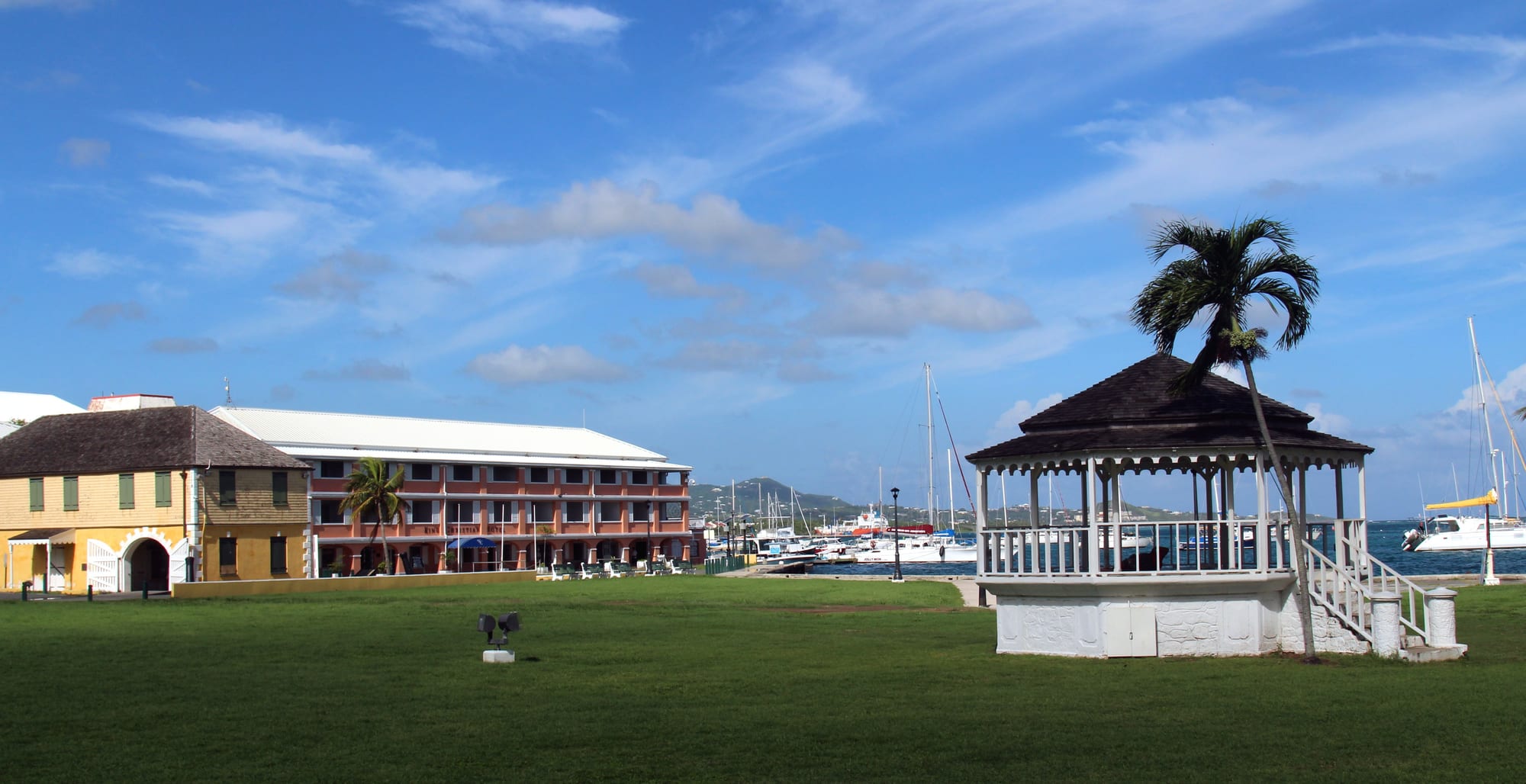
A green lawn with a white gazebo beside Christiansted's harbour, a yellow Danish-era building and moored sailing boats

United States Virgin Islands

Christiansted

The waterfront green beside the harbour in Christiansted, St Croix. (Prayitno / Wikimedia Commons · CC BY 2.0)

The largest town on St Croix, on the island's north shore, founded by the Danes in 1733 and for more than a century the capital of the Danish West Indies. Pastel stone buildings, cobblestone pavements and a yellow-brick fort survive around the harbour, now a national historic site, with a boardwalk of shops and restaurants and boats out to Buck Island's reef.

Neighbourhoods

  • The waterfront and the historic site
    • First-time visitors
    • Historic district
    • Boat trips

    The harbour front where the Danes built their fort, warehouse, customs house and government offices, now a national historic site with lawns along the water. The boardwalk beside it holds jewellers, galleries, dive shops and restaurants, and boats leave from the wharf for the reefs.

    Open in Maps
  • King Street and Company Street
    • Shopping
    • Best for food
    • Architecture

    The commercial heart of town, on a grid of streets running at right angles to the waterfront, lined with 18th-century stone buildings in pastel colours with red tile roofs and cobblestone pavements. Studios, galleries and boutiques sell the work of local artists.

    Open in Maps
  • The hillside residential quarters
    • Quiet and residential
    • Local life

    Streets that climb inland and uphill from the commercial area, including parts that were first laid out as settlements for free Black residents in the Danish era. Quieter than the waterfront and mostly lived in by islanders.

    Open in Maps

Things to do

The historic town

  • Fort Christiansværn and the national historic sitelandmark

    A group of six Danish colonial buildings on the waterfront — the yellow fort, the company warehouse, the Steeple Building church of 1753, the customs house, the scale house and Government House — that tell the story of the Danish colony.

    Open in Maps
  • Danish West India and Guinea Company Warehouselandmark

    The company's warehouse of 1749, built of yellow brick imported from Denmark around an inner courtyard, where enslaved Africans were auctioned until the trade was outlawed in 1803.

    Open in Maps
  • The boardwalkattraction

    A waterfront walk lined with jewellers that make their own designs, galleries, dive shops and restaurants.

    Open in Maps
  • Protestant Caybeach

    A four-acre islet in the harbour, about 200 yards from the town, with the closest beach to downtown, reached by a ferry of about two minutes.

    Open in Maps

Short trips from the town

  • Buck Island Reef National Monumentpark

    An uninhabited island off St Croix's north-east coast and the reefs around it, a protected area since 1948 and a national monument since 1961, with a marked underwater snorkelling trail — one of only three in the United States — reached on licensed boat trips.

    Open in Maps
  • Salt River Bay National Historical Park and Ecological Preservepark

    Mangroves, an estuary and the Columbus Landing Site, the only known place where members of a Columbus expedition set foot on what is now United States territory.

    Open in Maps
  • Point Udallviewpoint

    The eastern tip of St Croix, the easternmost point of the United States by travel, marked by a sundial monument built for the year 2000, with a trail down to the point.

    Open in Maps

Seasonal events

  • Crucian Christmas CarnivalDecember–January

    St Croix's largest festival, a carnival running across the Christmas and New Year holidays.

  • Agricultural and Food Fairmid-February

    St Croix's annual showcase of local farming and food.

  • Jump-Upseveral times a year

    A night-time street festival in Christiansted.

Eat and drink

Long-standing places and food districts in Christiansted. Hours, ratings and directions come from your maps app, always current.

Christiansted classics

  • The boardwalk restaurantsneighborhood

    Waterfront restaurants and bars facing the harbour, where seaplanes take off and fishing boats bring in the day's catch.

    Open in Maps
  • Rumrunnersrestaurant

    A waterfront restaurant on the harbour mixing local and American cooking, known for its Sunday brunch with steel pan music.

    Open in Maps
  • Brew STXrestaurant

    A microbrewery, pub and restaurant on King's Alley Walk by the water.

    Open in Maps

Experience Christiansted

History

Christiansted was founded in 1733 by Frederik Moth, the newly appointed Danish governor of St Croix, whose party cleared a site for Fort Christiansværn that September. On 8 January 1734, beside the fort, France formally handed the island to the Danish West India and Guinea Company. The town was named after King Christian VI. The company divided St Croix into plantations for sugar and cotton and set up a sugar refinery and distillery; by 1754 there were 7,566 enslaved people on the island and 83 white inhabitants in the town.

From the 1750s until 1871 Christiansted was the capital of the Danish West Indies, and St Croix had the richest economy of the three islands. Enslaved Africans built the town, giving it African as well as Danish influences in its design, and the company sold enslaved people at auction in its yellow-brick warehouse until the slave trade was outlawed in 1803. The young Alexander Hamilton lived here from 1765 before leaving for New York.

After emancipation in 1848 labour conditions remained harsh, and "Queen" Mary Thomas, one of the leaders of the 1878 Fireburn revolt, was later imprisoned in the town from 1887 to 1905. Its 18th-century waterfront core is now a national historic site. Hurricanes Irma and Maria in 2017 hit hard: the town's population fell by almost 30 per cent between 2010 and 2020.

Culture & Customs

Christiansted's identity is bound up with its buildings — pastel stone houses with red tile roofs and cobblestone pavements, built by enslaved Africans and sometimes called one of the world's few "African-Danish" towns. The national historic site at its centre tells the story of the colony, from trade and plantations to slavery and emancipation.

The wider island culture is Crucian. Islanders debate who counts as a native Crucian, and the island's long history of migration from the eastern Caribbean, Puerto Rico and beyond has shaped its music, food and speech. The Crucian Christmas Carnival, held over Christmas and New Year, is the island's largest festival, and the Agricultural and Food Fair in mid-February celebrates its farming. Several times a year a night-time street festival called Jump-Up fills Christiansted's streets.

The town is also an artists' base, with galleries, studios and jewellers along the boardwalk and the old streets. The comedian and pianist Victor Borge lived here for many years, the poet Audre Lorde died in the town, and the basketball player Tim Duncan was born here.

Daily Life

Christiansted had 1,770 people at the 2020 census, down by almost 30 per cent since 2010 after the 2017 hurricanes, though it remains the largest town on St Croix.

The town thrives on tourism. Jewellers making their own designs, galleries, boutiques, small hotels, many restaurants and several dive shops line the waterfront and the streets behind it, and the wharf gives easy access to dive sites on the north side of the island. Most islanders whose families go back generations work for the territorial government, while others are in tourism, law and medicine. The island's economy was badly hit when the large oil refinery shut down in 2012 with the loss of many jobs; agriculture has seen a slow revival as demand for local produce has grown.

Daily life follows the harbour — seaplanes landing, the ferry to Protestant Cay crossing back and forth, and fishing boats tying up beside the waterfront restaurants.

Food

St Croix shares the cooking of the rest of the Virgin Islands. Fungi, pronounced "foon-gee", is a stiff cornmeal dish served with boiled fish or saltfish; callaloo, sometimes spelled kallaloo, is a soup of leafy greens; and paté, fried dough filled with beef, chicken, conch or saltfish and often compared to an empanada, and johnnycake, fried dough originally known as "journey cake", are the everyday snacks.

Fresh fish comes in at the docks beside the waterfront restaurants, where fishing boats tie up with the day's catch. The restaurants along the boardwalk mix local and American cooking, and there is a microbrewery on King's Alley Walk.

St Croix is a rum island, and rum distilled there is the base of many drinks served in town. Popular cold drinks include maubi, brewed from tree bark, sorrel, soursop, sea moss and passion fruit juice. The Agricultural and Food Fair each February celebrates the island's farming and food.

Planning tools

Budget

Christiansted is priced like the United States. Small hotels and guesthouses in town keep costs down; a hire car, boat trips to Buck Island and the ferry or seaplane to St Thomas are the extra costs.

Daily Budget Midrange
USD 200–400 (small hotel, waterfront dinners, a hire car, a reef trip)
Daily Budget Shoestring
USD 90–150 (guesthouse room, local cafés, walking and shared taxis)

The national historic site's waterfront, the boardwalk and the old streets can all be enjoyed on foot at no cost.

Best Time to Visit

December to April is the drier, busier season across the islands, and the Crucian Christmas Carnival and the February agricultural fair fall within it. May to November is hotter and wetter and overlaps the Atlantic hurricane season, which is most active from August to October.

Suggested Number of Days

The historic town can be covered in a day or two. Allow four to six days to see the rest of St Croix, including the western end of the island and a reef trip; the island is the largest of the three and its sights are spread out.

First Visit
1–2 days
With Surroundings
4–6 days

Transportation

The town centre is walkable, but St Croix's sights are spread across the island, and a hire car is the usual way to reach them. Traffic drives on the left. Taxis serve the airport and the main routes, and short ferry rides cross the harbour to Protestant Cay. Boat operators on the wharf run trips to Buck Island.

Book Buck Island trips with one of the licensed operators; the island itself is closed from sunset to sunrise to protect nesting turtles.

Airport & Station Connections

Henry E. Rohlsen Airport is about six miles south-west of Christiansted, with flights from the US mainland and the other islands. A ferry links the marine terminal at Gallows Bay with Charlotte Amalie on St Thomas, and a seaplane shuttle flies between the two harbours.

Walkability

Very good in the centre. The grid of streets at right angles to the waterfront, cobblestone pavements and the boardwalk make the historic town easy to cover on foot, and its symmetry has made it a favourite for walking tours. Beaches and sights beyond the town need a car.

Safety

The USVI have a higher violent-crime rate than most US states, concentrated in parts of Charlotte Amalie and away from the tourist areas and largely tied to the drug trade; robberies and car break-ins affect visitors occasionally. Ocean hazards and hurricane season are the other concerns on St Croix.

Stay on busy, well-lit streets at night, leave nothing in parked cars at beaches and sights, and watch the forecast in hurricane season. Check current official travel advice before travelling.

Climate

Christiansted has a tropical savanna climate. On St Croix temperatures range from the mid-70s to the high 80s °F, with an average of about 80°F; the drier season across the islands is December to April and the wetter, hotter months are May to November.

Summer
hotter and wetter from May to November, within the island's mid-70s to high-80s °F range, and the season of hurricane risk
Winter
drier and breezy from December to April, with temperatures on St Croix still in the mid-70s to high 80s °F

Local Customs

People from St Croix are Crucians, and anyone 'bahn ya' — born here — can claim the name. Virgin Islands Creole English, called Crucian on the island, is the everyday language, and many islanders of Puerto Rican descent mix Spanish with it. The town's slave-auction history is part of the national historic site's story and is treated with seriousness.

Ask before photographing residents, and dress more fully than beachwear away from the waterfront.

Common Payment Methods

The currency is the US dollar. Cards are widely accepted in shops, restaurants and hotels; small bills are useful for taxis and the harbour ferry. ATMs are found in town.