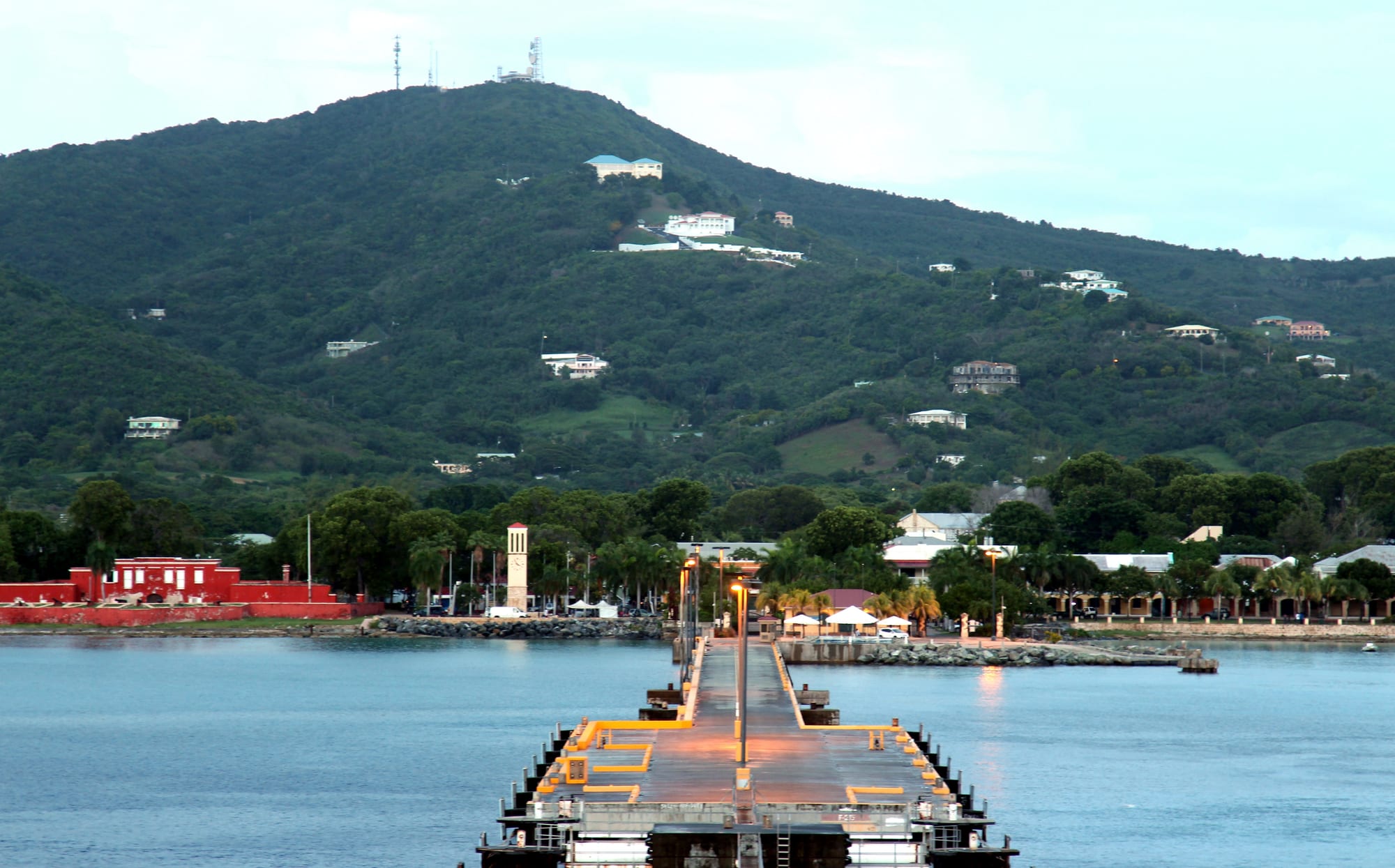
The long Frederiksted pier leading to a palm-lined waterfront, the red walls of Fort Frederik and green hills above the town

United States Virgin Islands

Frederiksted

The Frederiksted Pier and the town's waterfront on St Croix. (Prayitno / Wikimedia Commons · CC BY 2.0)

A small grid-planned town on the calm western shore of St Croix, laid out by the Danes in 1751 around a deep-water harbour and Fort Frederik, where the emancipation of the enslaved was proclaimed in 1848. Burned in the 1878 Fireburn and rebuilt with Victorian detailing, it is now a quiet place of Victorian-era streets, sunsets and a cruise pier famous for diving.

Neighbourhoods

  • The historic town
    • First-time visitors
    • Historic district
    • Architecture

    The original grid of streets laid out in 1751, with Fort Frederik at its northern edge and the customs house nearby. Much of it was rebuilt after the 1878 Fireburn, so Georgian and Victorian detailing marks many of its buildings, and government offices occupy several historic buildings.

    Open in Maps
  • The waterfront and the pier
    • Cruise passengers
    • Diving
    • Sunsets

    The sheltered western shore, where the cruise pier reaches out into calm, deep water and a rebuilt waterfront park runs past the fort. A shopping area lies within walking distance of the pier, and dive boats leave from its landing platforms.

    Open in Maps

Things to do

The town and the water

  • Fort Frederiklandmark

    The red-and-white fort built between 1752 and 1760, where Governor-General Peter von Scholten proclaimed the emancipation of the enslaved on 3 July 1848; a National Historic Landmark with a museum and art gallery.

    Open in Maps
  • Frederiksted Pierattraction

    The 1,526-foot cruise pier, rebuilt after Hurricane Hugo destroyed the original in 1989; its pilings form an artificial reef, and it is said to be one of the best wildlife dives in the Caribbean, a shallow dive with octopus, eels and seahorses.

    Open in Maps

Short trips from the town

  • Whim estatemuseum

    A former sugar plantation about 1.7 miles south-east of town, with a Great House of about 1794 unusual for its curved ends, steam engines and other estate buildings.

    Open in Maps
  • Sandy Point National Wildlife Refugepark

    Two miles of sandy beach on the south-western corner of St Croix, protected as a nesting ground for leatherback sea turtles, open to the public at limited weekend hours outside the nesting season; the last scene of The Shawshank Redemption was filmed here.

    Open in Maps
  • St. George Village Botanical Gardenpark

    Gardens set around the buildings and ruins of a former Danish sugar plantation, a short drive from Frederiksted.

    Open in Maps

Seasonal events

  • Crucian Christmas CarnivalDecember–January

    St Croix's largest festival; in Frederiksted the carnival comes in January.

  • Sunset Jazzmonthly

    A monthly evening of local jazz musicians playing on Frederiksted Beach.

Eat and drink

Long-standing places and food districts in Frederiksted. Hours, ratings and directions come from your maps app, always current.

Food and drink in town

  • The waterfront near the pierneighborhood

    The bars, restaurants and shops within walking distance of the pier, busiest on cruise days.

    Open in Maps
  • Restaurants in the historic townneighborhood

    Small places to eat among the streets of the old grid.

    Open in Maps

Experience Frederiksted

History

The Danes laid out Frederiksted in 1751 on the leeward western shore of St Croix, where calm water and a naturally deep port made up for the shallow reef that limited trade at the older town of Christiansted. The surveyor Jens Beckfor planned a grid of 14 by 14 blocks, though only seven by seven were built. Fort Frederik went up between 1752 and 1760 to guard the anchorage from pirates and rivals and to stop ships slipping away without paying dues; it was named after King Frederick V. In 1776, the fort is said to have fired the first salute from foreign soil to the flag of the new United States.

On 3 July 1848 the freed craftsman Moses Gottlieb, remembered as "General Buddhoe", led enslaved people from the West End plantations in a march on the town, and Governor-General Peter von Scholten proclaimed emancipation at the fort. The town suffered again in 1867, when an earthquake and tsunami beached the warship USS Monongahela and killed at least five people.

On 1 October 1878, Contract Day, a protest by plantation labourers against the harsh contracts that had replaced slavery became the Fireburn, led by four women remembered as the "Four Queens": Mary Thomas, Axelene Salomon, Mathilda McBean and Susanna Abramsen. Much of the town was burned. It was rebuilt with Georgian and Victorian detailing, which still defines its streets. Hurricane Hugo destroyed the old pier in 1989, Marilyn caused heavy damage in 1995, and Maria passed about ten miles south of the island in 2017.

Culture & Customs

Locals call Frederiksted "Freedom City", and the 1848 emancipation is the heart of its identity: the fort where it was proclaimed stands at the edge of town, and the memory of General Buddhoe and of the Fireburn's "Four Queens" is a source of pride across St Croix.

The town has a slower pace than Christiansted, and its two great moments of noise are carnival in January and the days when cruise ships dock. Every month local jazz musicians play on Frederiksted Beach at the Sunset Jazz evenings.

Community life is built on volunteering. A local group organises clean-ups, mural and garden projects, and with the island's artists' guild has installed dozens of painted rum barrels around town as rubbish bins; the guild has also added murals and paintings. The town has attracted film-makers too: scenes from Trading Places and The Island of Dr. Moreau were shot here, and the final scene of The Shawshank Redemption was filmed on the beach at Sandy Point to the south.

Daily Life

Frederiksted proper is very small — 732 people at the 2000 census, and fewer than 1,000 today — but it is also one of the two administrative districts of St Croix, and nearly 10,000 people live on the island's western side. Several government offices occupy the town's historic buildings.

The economy turns on the pier, the island's only cruise port. On ship days passengers fill the waterfront, taxis and tour buses line up for round-the-island trips, and the shopping area near the pier is busy; on other days the town is quiet. Dive operators use the pier's landing platforms, and the island's other deep-water port, the South Port, holds the tank farm of the former oil refinery and an industrial park.

Redevelopment has been slow but steady: a first phase rebuilt the waterfront park with natural stonework in keeping with the old town, and later plans cover the shore north of the fort, the beach and the sports stadium. The trade winds, calm western seas and sunsets that come as late as ten past seven in summer set the rhythm of the evenings.

Food

Frederiksted eats as the rest of the Virgin Islands does. Fungi, pronounced "foon-gee", is a stiff cornmeal dish served with boiled fish or saltfish; callaloo, sometimes spelled kallaloo, is a soup of leafy greens; and the everyday snacks are paté, fried dough filled with beef, chicken, conch or saltfish and often compared to an empanada, and johnnycake, fried dough originally known as "journey cake".

The town's places to eat are small and close together, around the old grid and the waterfront near the pier, and they are busiest on cruise days. Fungi is the main staple of the traditional Virgin Islands diet, and fish, conch and saltfish are the usual fillings and partners for it.

St Croix is a rum island: a distillery near Frederiksted offers tours and tastings, and its rum, including some flavours not sold on the US mainland, turns up in the drinks served in town. Popular cold drinks include maubi, brewed from tree bark, sorrel, soursop, sea moss and passion fruit juice.

Planning tools

Budget

Frederiksted is priced like the United States but is quieter and less busy than Christiansted. A hire car is the main extra cost, as the island's sights are spread out; diving off the pier is a popular paid activity.

Daily Budget Midrange
USD 200–380 (small hotel, restaurant dinners, a hire car, a guided dive)
Daily Budget Shoestring
USD 90–150 (guesthouse room, local food, beach days and shared taxis)

The fort's grounds, the waterfront park, the pier at sunset and the beach cost nothing to enjoy.

Best Time to Visit

December to April is the drier season across the islands, and the carnival brings the town to life in January. May to November is hotter and wetter and overlaps the Atlantic hurricane season. Sandy Point's beaches close to the public from April to August for the nesting turtles.

Suggested Number of Days

The town itself needs a day or two. Allow three to five days to include the western side of St Croix and a dive or two; staying on days without a cruise ship keeps the town quiet.

First Visit
1–2 days
With Surroundings
3–5 days

Transportation

The grid of the old town is easily covered on foot. Beyond it, a hire car is the practical way to explore, and is the best way to reach the town from the airport; taxis and tour buses meet cruise ships at the pier and run round-the-island trips and journeys to Christiansted. Traffic drives on the left.

Pick up a hire car at the airport; it is the easiest way to reach the town and the western side of the island.

Airport & Station Connections

Henry E. Rohlsen Airport, south-west of Christiansted, is the island's airport, and the town is best reached from there by hire car. Cruise ships dock at the Frederiksted Pier, the island's only cruise port; ferries and seaplanes to St Thomas leave from Christiansted.

Walkability

The old town is a compact grid of seven by seven blocks, so everything from the fort to the pier and the waterfront park is a short walk. The heat is the main obstacle at midday, and sights outside town need a car.

Safety

The USVI have a higher violent-crime rate than most US states, concentrated in parts of Charlotte Amalie and away from the tourist areas and largely tied to the drug trade; robberies and car break-ins affect visitors occasionally.

Keep to the busier streets at night, leave nothing in parked cars, dive with a guide off the pier, and watch the forecast in hurricane season. Check current official travel advice before travelling.

Climate

A tropical savanna climate, very warm to hot all year, with temperatures on St Croix ranging from the mid-70s to the high 80s °F. Steady easterly trade winds cool the island, and the town on the leeward side has calm seas; the hills behind it gather enough moisture for rainforest.

Summer
hotter and wetter from May to November, with temperatures on St Croix up to the high 80s °F and the risk of hurricanes
Winter
drier and breezy from December to April, with temperatures on St Croix from the mid-70s °F

Local Customs

Locals call the town Freedom City, after the 1848 emancipation proclaimed at the fort, and the date is remembered with pride. People from St Croix are Crucians, and Virgin Islands Creole English is the everyday language. Community volunteering is a strong local tradition, from clean-ups to murals.

Ask before photographing residents, and dress more fully than beachwear in the town streets.

Common Payment Methods

The currency is the US dollar. Cards are accepted in most shops and restaurants; small bills are useful for taxis and stalls.