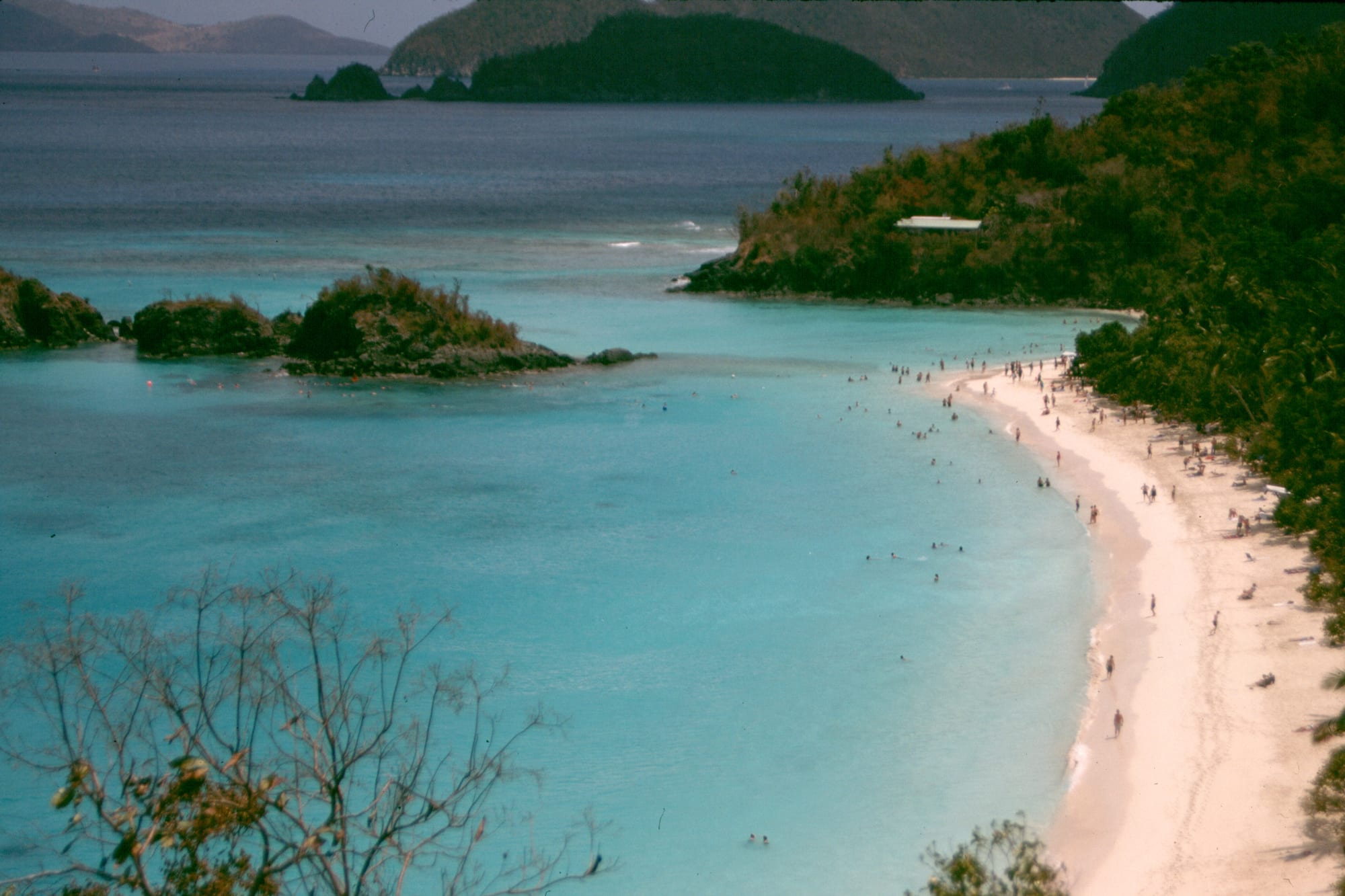
A crescent of white-sand beach and vivid turquoise water backed by green hills, seen from a clifftop viewpoint

United States Virgin Islands

Trunk Bay on St John, within Virgin Islands National Park, which covers most of the island. (Koichi Shibata / Wikimedia Commons · CC BY-SA 3.0)

Three main Caribbean islands east of Puerto Rico — St Thomas, St Croix, and St John — that were the Danish West Indies until the United States bought them in 1917. Their roughly 87,000 people are US citizens who cannot vote for president.

Explore United States Virgin Islands

History

The islands were home to Taíno and later Kalinago peoples. After brief attempts by several European powers, Denmark colonised them from the 1670s as the Danish West Indies, developing intensive sugar plantations — St Croix became a major producer — worked by enslaved Africans under one of the harshest regimes in the Caribbean. In 1733 enslaved people, many of them Akwamu from West Africa, seized St John and held it for around six months, one of the earliest and longest slave revolts in the Americas.

In 1848, a mass uprising at Frederiksted on St Croix, led by the man remembered as "General Buddhoe", forced the Danish governor to declare emancipation on the spot. Labour conditions afterwards remained oppressive, and the 1878 "Fireburn" revolt on St Croix — led by women remembered as the "Queens" — burned much of Frederiksted and the plantations.

The United States, worried about German U-boats gaining a Caribbean base in the First World War, bought the islands from Denmark in 1917 for 25 million dollars in gold; the handover is still marked as Transfer Day. The US Navy governed until 1931, and a series of federal laws brought US citizenship (1927/1932) and, eventually, an elected governor (from 1970) and a non-voting delegate to Congress; residents cannot vote for president. Hurricanes Irma and Maria, two Category 5 storms two weeks apart in September 2017, devastated all three islands, and recovery — of housing, schools, the hospital, and the power grid — has been slow.

  • US Virgin Islands: The Islands America Bought — Three Caribbean islands that were Danish for two and a half centuries — a sugar-and-slavery colony with one of the New World's largest slave revolts, sold to the United States in 1917 to keep Germany out of the Caribbean, and still not a state

Culture & Customs

Virgin Islands culture is Afro-Caribbean, shaped by the Danish colonial era, US influence, and migration from across the eastern Caribbean, Puerto Rico, and the Dominican Republic. Quelbe (also called scratch or fungi music), played on homemade instruments, is the traditional string-band sound and the official music of the territory; bamboula drumming and dance carry older African roots.

Carnival is the great cultural event — on St Thomas in April or May and on St Croix over Christmas and the new year — with calypso competitions, "mocko jumbie" stilt dancers, costumed troupes, and street parades. Danish traces linger in place names, architecture (the yellow warehouses of Christiansted, the "step streets" of Charlotte Amalie), and the habit of driving on the left.

Church, family, the fish market, the "lime" (hanging out), and the annual Carnival build-up organise social life, and there is a strong local pride in Crucian (St Croix) versus "Thomian" identity.

Daily Life

About 87,000 people live in the USVI, the population having declined since 2010 through emigration to the US mainland, worsened by the 2017 hurricanes. St Thomas holds the capital, Charlotte Amalie, and the busiest cruise port; St Croix, the largest and flattest island, has the towns of Christiansted and Frederiksted; and St John, most of which is national park, is the smallest and least developed.

The economy is dominated by tourism — cruise calls, stopover visitors, and yachting — along with rum (Cruzan and a large Captain Morgan distillery on St Croix, the latter underwritten by federal excise rebates), and a big government sector with a serious public-pension shortfall. The huge St Croix oil refinery, once among the world's largest, closed in 2012, badly hurting that island's economy, served afterwards as a storage terminal and restarted only briefly in 2021 before shutting again over unsafe emissions.

Daily life is American in its systems and Caribbean in its rhythm, tied to the cruise and ferry schedules, the beach, and the weather.

  • US Virgin Islands: Driving on the Left in America — American paperwork and a Caribbean pace, a population still recovering from two 2017 hurricanes, and the strange daily fact of driving American cars, steering wheel on the left, down roads that keep to the left

Food

Virgin Islands cooking centres on fungi — a stiff cornmeal-and-okra polenta — served with stewed or "boil" fish, or with saltfish. Callaloo (a soupy dish of dasheen leaves, served with fungi on the side), conch, and roti, adopted from Trinidad, are staples.

Street and market food includes pâté (a fried turnover filled with meat, conch or saltfish), johnnycakes (fried dough), and dumb bread, a yeast-free bread often filled with cheese, while open-air markets sell local produce and fish. Kallaloo is the traditional Old Year's Night (New Year's Eve) dish, and maubi — a foamy drink brewed from tree bark, ginger, and sugar — is the local soft drink.

Cruzan rum and other local rums, Caribbean beers, and fresh tropical juices are the usual drinks, along with the ubiquitous rum punch.

Attractions & Natural Wonders

St John is largely Virgin Islands National Park, thanks to a 1950s land donation by Laurance Rockefeller: Trunk Bay with its underwater snorkelling trail, Cinnamon and Maho bays, the ruined Annaberg sugar mill, the petroglyphs on the Reef Bay trail, and a network of hiking paths through dry forest.

St Thomas centres on Charlotte Amalie — Fort Christian, the "99 Steps", Blackbeard's Castle, and the sand-floored St Thomas Synagogue, built in 1833 and the second-oldest synagogue in the United States — with Magens Bay's long beach on the north shore and a gondola up to Paradise Point above the harbour. Water Island, a short ferry ride, is nicknamed the "Last Virgin", having stayed in Danish hands until 1944.

St Croix has the Danish colonial cores of Christiansted (Fort Christiansvaern and the yellow warehouse district, a national historic site) and Frederiksted (Fort Frederik, where emancipation was declared), the offshore Buck Island Reef National Monument with its barrier-reef snorkel trail, the rainforest and the Estate Whim plantation museum in the west, the rum distilleries, and Point Udall, often cited as the easternmost point of the United States.

Planning basics

Budget

The USVI are priced like the US, and St John in particular is expensive. Guesthouses, self-catering condos, the food trucks and roadside barbecue, and public beaches keep costs down against the resorts and the restaurant scene. A rental car (or, on St John, a jeep) is standard, and ferries between the islands add up.

Daily Budget Midrange
USD 220–450 (hotel, restaurants with tips, jeep hire and fuel, inter-island ferries and a boat trip)
Daily Budget Shoestring
USD 90–150 (guesthouse or condo, self-catering and food trucks, shared rental car and public beaches)

Base on St Thomas or St Croix and day-trip to St John by ferry; hire a jeep and use the National Park's free beaches and trails.

Visa Requirements

The US Virgin Islands are US territory, so US entry rules apply — ESTA under the Visa Waiver Program for eligible nationalities, or a US visa otherwise. There are no immigration formalities on arrivals from the US mainland or Puerto Rico, and US citizens travelling from within the United States do not need a passport — though carrying one is wise, as a hop to the nearby British Virgin Islands does require it.

Typical Stay
As for the US: 90 days on ESTA (Visa Waiver Program), or a US visa

Apply for ESTA (or a US visa) before travelling from abroad; US citizens need no passport to fly in from the mainland, but take one if you plan a day trip to the British Virgin Islands.

Safety

The USVI have a higher violent-crime rate than most US states, concentrated in parts of Charlotte Amalie and away from the tourist areas and largely tied to the drug trade; robberies and car break-ins affect visitors occasionally. St John is very safe. Ocean hazards — rip currents and rough north-shore surf — and hurricane season are the other concerns.

Health
Tap water is generally safe but many people drink filtered or bottled (much is desalinated or cistern-collected); dengue occurs; the sun and currents are the main hazards

Avoid unfamiliar parts of Charlotte Amalie at night, don't leave valuables in cars at trailheads and beaches, check surf on the north shore, and watch the forecast in hurricane season.

Climate

Tropical, warm and breezy year-round, around 82–88°F. The drier season runs December to April; the wetter, hotter months are May to November, overlapping the Atlantic hurricane season — Hurricanes Irma and Maria both struck in September 2017.

Dry Season
December–April
Wet Season
May–November (Atlantic hurricane season June–November)

Transportation

Cyril E. King Airport on St Thomas and Henry E. Rohlsen Airport on St Croix have flights from the US mainland and Puerto Rico; flights and ferries link St Thomas and St Croix, and frequent ferries run St Thomas–St John. Shared open-air taxi trucks work the main routes; a rental car or jeep is best for exploring, especially on hilly St John and St Thomas.

Rent a jeep for St John and St Thomas (the USVI are the only US jurisdiction that drives on the left), and take the Red Hook ferry for the short hop to St John.

Best Time to Visit

December to April is the peak — dry, sunny, and busy, with the highest prices around the winter holidays. May, June, and November are quieter shoulder months. Hurricane risk is highest from August to October.

Events
St Thomas Carnival (April or May) and St Croix's Crucian Christmas Carnival (December–January), both with parades, calypso, and 'jump-ups'; Transfer Day (31 March), marking the 1917 handover; Emancipation Day (3 July)

Currency

The currency is the US dollar. Cards are accepted almost everywhere; carry small bills for taxis (shared open-air "safari" trucks), food vans, and tips.

Symbol
$
Currency Code
USD — United States dollar

Language

English is the official language and is spoken by everyone, in a local Virgin Islands Creole English in everyday use. Spanish is widely spoken, especially on St Croix, given long-standing Puerto Rican and Dominican communities, and there is a small French Creole-speaking community on St Thomas.

Also Spoken
Virgin Islands Creole English; Spanish; French Creole
Official Language
English