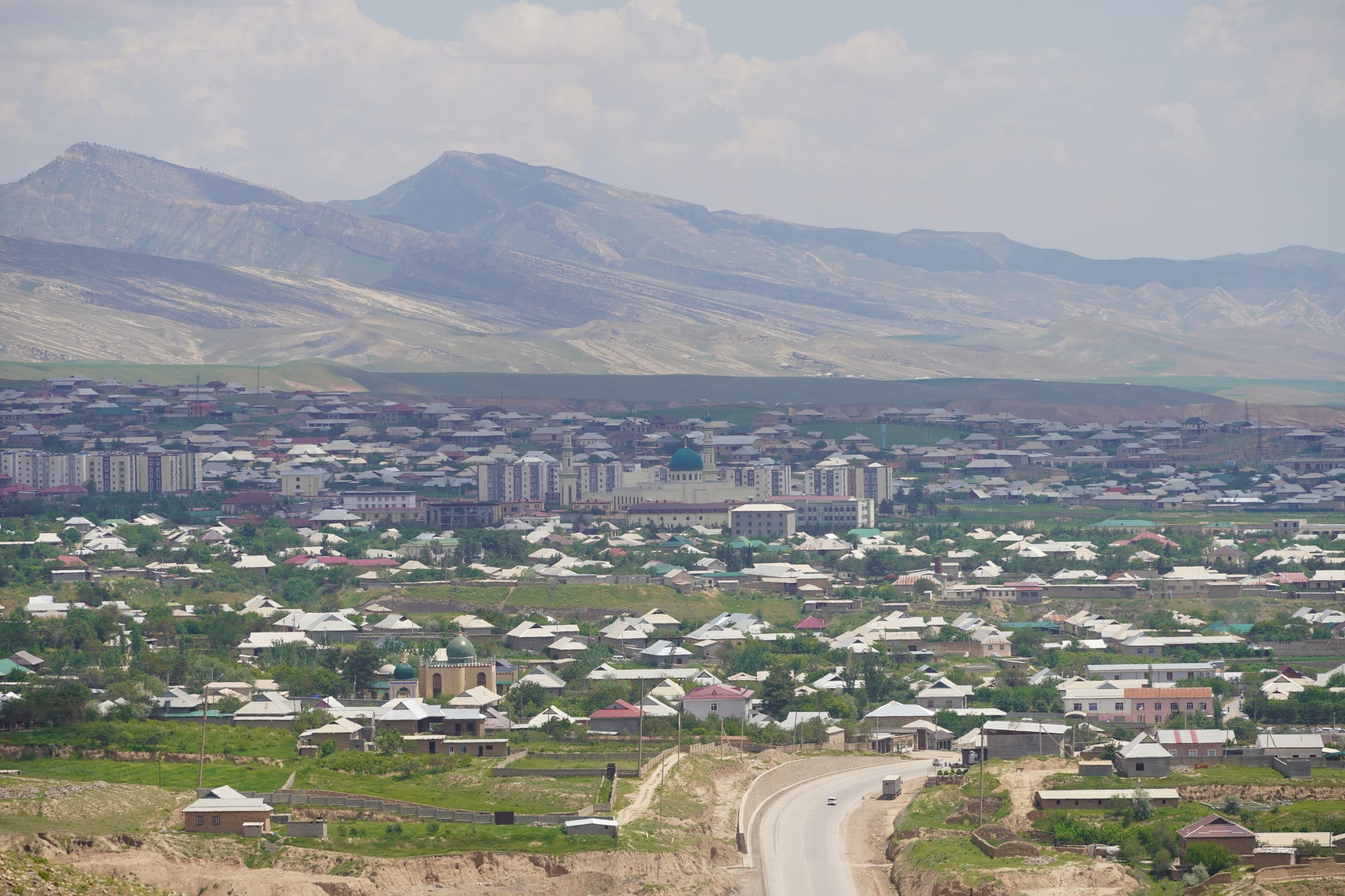
A low town of white-roofed houses and a green-domed mosque spread across a valley floor, with bare ridges rising behind it

Termez & the South, Uzbekistan

Boysun

Boysun seen from above, with bare ridges rising behind the town. (Iaa2023 / Wikimedia Commons · CC BY 4.0)

A small town in Uzbekistan's southern Surxondaryo province, set in a bowl of hills between the steppe and the Hissar mountains on the road and railway from Qarshi to Termez. Its songs, rituals, crafts and healers were recognised by UNESCO in 2001, and the gorges and villages around it hold caves known to archaeologists and cavers alike.

Neighbourhoods

  • The town centre
    • First-time visitors
    • Bazaar
    • Close to transport

    A short grid of low buildings around the administrative offices, the mosque and the bazaar, where the shared taxis and buses for Termez and Qarshi wait. Almost everything a visitor needs in the town itself is within a few hundred metres.

    Open in Maps
  • The mahallas
    • Local life
    • Quiet and residential
    • Crafts

    The residential quarters spreading up the slopes from the centre, made of single-storey courtyard houses behind mud-brick and breeze-block walls, with vines, fruit trees and small plots. This is where the embroidery, weaving and music that made the district's name are still practised at home.

    Open in Maps
  • The valley road and the railway side
    • Views
    • Walks

    The edges of town where the highway and the Tashguzar–Boysun–Kumkurgan railway pass through on their way south, with open ground, grazing land and views up to the ridges. Guesthouses and the road out to the mountain villages are on this side.

    Open in Maps

Things to do

Caves and mountains

  • Teshik-Tashattraction

    A rock shelter in the hills near Boysun where a Neanderthal child's burial was excavated in 1938, one of the best-known Palaeolithic finds in Central Asia.

    Open in Maps
  • Boybuloqattraction

    A cave in the limestone of the Hissar range above the town, the deepest known cave in Central Asia and explored by expeditions over several decades.

    Open in Maps

Short trips from the town

  • Dalverzin Tepelandmark

    The mud-brick remains of a Kushan-era city east of Boysun, where a celebrated hoard of gold objects was found.

    Open in Maps
  • Denovattraction

    A busy district centre in the valleys east of Boysun, the closest large town to the Dalverzin Tepe and Kalchayan ruins.

    Open in Maps
  • Sherobodattraction

    A district town on the hot plain south of Boysun, on the road towards Termez and the Amu Darya.

    Open in Maps
  • Termezattraction

    The provincial capital on the Afghan border, with Buddhist monastery ruins, Sufi shrines and an archaeological museum, a long drive or train ride south.

    Open in Maps

Seasonal events

  • Spring folklore festivalspring

    A folklore gathering held in and around the town, with music, epic singing, wrestling and horse games drawn from the traditions that UNESCO recognised.

  • Navruzaround 21 March

    The spring new year, marked with cooking, music and visiting; the making of sumalak from sprouted wheat runs through the night before.

Eat and drink

Long-standing places and food districts in Boysun. Hours, ratings and directions come from your maps app, always current.

Boysun classics

  • Boysun bazaarmarket

    The town market, at its fullest in the morning, with bread from tandir ovens, mountain honey, dried apricots, qurt and sacks of rice and flour.

    Open in Maps
  • Chaikhanas on the main roadcafe

    Tea houses along the through road where drivers and traders stop for green tea, bread and shashlik at raised platforms set with cushions.

    Open in Maps
  • Village homestays above the townrestaurant

    Family houses in the mountain villages that feed guests what the household eats — soup, mutton, home-baked bread, fresh cheese and fruit from the garden.

    Open in Maps

Experience Boysun

History

The valley around Boysun has been occupied for a very long time. In 1938 the archaeologist Alexey Okladnikov excavated the rock shelter of Teshik-Tash in the hills nearby and found the burial of a Neanderthal child surrounded by ibex horns — a discovery that put the district into every account of Central Asian prehistory and is still argued over by specialists. The limestone above the town is riddled with caves, among them Boybuloq, the deepest known cave in Central Asia, which Soviet and later Russian speleological expeditions have pushed further into over decades.

The town grew where the mountain route between the Kashkadarya steppe and the Surxondaryo plain crosses a fertile bowl of orchards and pasture. It was part of ancient Bactria, then of the successive Islamic states of the region, and by the nineteenth century belonged to the Emirate of Bukhara, whose grip on these upland districts was loose. Distance from any capital is much of the reason its customs survived: songs, healing rituals, epic recitation, weaving and embroidery persisted here after they faded in the cities, and in 2001 UNESCO proclaimed the Boysun cultural space a Masterpiece of the Oral and Intangible Heritage of Humanity.

Soviet rule brought schools, a hospital, collective farms and the exploration of coal and other minerals in the district. Since independence the biggest change has been the railway: the Tashguzar–Boysun–Kumkurgan line carries traffic between Tashkent and the Afghan border entirely within Uzbekistan and passes through the town.

Culture & Customs

Boysun's reputation rests on what its people have kept. The district's repertoire of epic songs performed by bakhshi singers to the two-stringed dutar, its wedding and seasonal rituals, its shamanic healing practices and its weaving and embroidery were the basis of the 2001 UNESCO proclamation, and later of the district's inscription on the wider lists of intangible heritage. Ethnographers and folklorists have been coming here since Soviet times, and the attention has helped keep the traditions in daily use rather than on a stage.

The best-known expression of this is the spring folklore festival held in and around the town, which brings singers, wrestlers, horsemen and craftspeople together and draws visitors from across Uzbekistan. Horse games, including the rough contest played with a goat carcass known here as kupkari or uloq, belong to weddings and holidays as much as to festivals.

The population is mixed: Uzbeks of once semi-nomadic tribal descent, Tajik speakers in the mountain villages, and families with roots in the wider south. Households are large, extended and organised around the mahalla, the neighbourhood association that arranges weddings, funerals and mutual help. Religious practice is unshowy but steady, and shrines in the hills attract local pilgrimage. Visitors are treated as guests of the whole street, which usually means more tea and more food than they expected.

Daily Life

About 28,000 people live in the town, with several times that number in the surrounding district of villages, pastures and orchards. Life runs on agriculture: wheat and barley on the slopes, orchards of apricot, apple and walnut, vineyards, and above all sheep and goats taken up to high pasture in summer. Honey from the mountain villages is a local speciality and a useful cash crop, as are dried fruit and nuts.

The day starts early, with the bazaar busiest in the first hours after dawn and the tea houses along the road filling with drivers and traders. Public jobs — the school, the hospital, the district administration — and the railway account for much of the salaried work. Coal and other minerals have been worked in the district, and a steady trickle of trade moves through on the Termez road.

The pressures here are those of rural southern Uzbekistan: low incomes, large families and young men leaving for work in Tashkent, Kazakhstan or Russia, with their remittances visible in new brick houses and metal roofs. Water, electricity and gas supply can be uneven in winter, and snow can cut off the higher villages for days. Tourism is small but growing, built on the festival, the mountains and the caves, and a handful of families now take paying guests.

Food

Boysun eats the food of the southern mountains, which is plainer and more mutton-centred than the elaborate cooking of Samarkand or Bukhara. Tandir go'sht, mutton sealed into a clay tandir oven and roasted slowly in its own fat, is the dish for a celebration, and shashlik grilled over charcoal is the everyday version. Shurpa, a broth of mutton with potato, carrot and onion, appears at almost every table, and plov of rice, meat and carrots cooked in a cast-iron kazan is what a wedding or a funeral feast requires.

Dairy from the flocks shapes the rest. Qurt, strained yoghurt salted and rolled into hard white balls, dries in the sun and keeps for months, and it is eaten as a snack or crumbled into soup; fresh soft cheeses, sour milk and clotted cream go with bread at breakfast. That bread is obi non, a round disc stamped in the centre and baked against the wall of a tandir, and it is bought daily.

The orchards supply the sweet end: apricots eaten fresh in June and dried for winter, apples, walnuts, mulberries and grapes, along with mountain honey. Green tea is drunk all day, poured first back into the pot and then into small bowls, and it is set in front of a guest before anything else is discussed.

Planning tools

Budget

Boysun is inexpensive even by Uzbek standards. Accommodation means simple hotels in the town or homestays in the villages, food comes from the bazaar and the tea houses, and the main expense is a car with a driver, since the caves, gorges and higher villages are hard to reach otherwise. Costs rise during the spring festival, when rooms are scarce.

Daily Budget Midrange
USD 45–90 (the best hotel in town or a comfortable homestay, a car and driver for the mountains, a local guide)
Daily Budget Shoestring
USD 20–35 (simple hotel or homestay, bazaar food, shared taxis and the train)

Carry enough som in cash for the whole stay, agree a price with a driver before setting out, and arrange a village homestay in advance through a guesthouse in town.

Best Time to Visit

April to early June, when the hills are green, the orchards are in blossom and the spring festival falls, and September to October, when the heat has broken and the fruit harvest is in. Midsummer is hot on the plain below, though noticeably cooler at altitude. Winter brings snow to the passes and closes the higher villages for weeks at a time.

Suggested Number of Days

The town itself is easily covered in a day. Two or three more allow the mountain villages, the gorges and the caves, which need a driver and unhurried time. A visit timed to the spring festival is worth an extra night.

First Visit
1–2 days
With Surroundings
3–4 days

Transportation

Shared taxis are the everyday transport, leaving from near the bazaar for Termez, Denov and Qarshi when they fill. Trains on the Tashguzar–Boysun–Kumkurgan line stop at the town's station on the route between Tashkent and Termez. Within Boysun everything is close enough to walk, but the villages, caves and pastures above the town need a hired car, and rough tracks call for a four-wheel drive.

Hire a driver for a full day rather than trying to reach the mountain villages by public transport, and allow for slow going on unpaved roads after rain or snow.

Airport & Station Connections

Boysun sits on the main road and railway between Qarshi and Termez, roughly halfway along. Most visitors arrive by shared taxi or train from Termez, a few hours to the south, or from Qarshi and Samarkand to the north; the nearest airports with flights from Tashkent are at Termez and Qarshi. The drive from Samarkand takes the best part of a day.

Walkability

The centre is small and flat enough to cross on foot in fifteen minutes, and walking is the normal way to reach the bazaar, the mosque and the offices. Pavements give out quickly in the mahallas, where lanes are unpaved, dusty in summer and muddy after rain, and the ground rises steadily towards the hills. Anything beyond the edge of town is a walk of hours rather than minutes.

Safety

Boysun is a quiet town with low crime and a visible but unobtrusive police presence, and foreign visitors are rare enough to attract friendly curiosity. The real risks are environmental: summer heat on the plain, cold and snow in the mountains, rough and remote roads, and caves that should only be entered with experienced people. Medical facilities are basic, and the nearest hospitals of any size are in Termez.

A passport is needed at road checkpoints, water and warm layers are essential in the mountains, the caves should only be entered with a qualified guide, and someone in town should know the route before a party sets out. Check current official travel advice before travelling.

Climate

A Mediterranean-type climate softened by altitude, with hot dry summers and cool winters: the town lies high enough above the Surxondaryo plain to escape the worst of the southern heat, with warm days, cool nights and most of the year's modest rainfall arriving between late autumn and spring.

Summer
hot and very dry, around 30°C by day, but cooler than Termez on the plain and noticeably fresher in the mountains above
Winter
cool, with days a few degrees above 0°C, frosts at night, snow on the ridges and passes and occasional falls in the town

Local Customs

This is a conservative, rural district where religion and family custom carry weight. Modest dress is expected, especially at mosques and shrines, where shoes come off and women usually cover their heads. Guests are pressed with tea, bread and fruit and refusing outright causes offence; taking a small gift to a household is normal. Bread is treated with respect and never placed face down or thrown away.

Ask before photographing people, particularly women, at the bazaar or a ceremony; tipping is not expected, though rounding up a driver's fare is welcome.

Common Payment Methods

The currency is the Uzbek som. Boysun is a cash economy: cards are of little use outside a bank, and homestays, taxis and the bazaar all expect notes. There are ATMs in the town but they are unreliable, so it is safer to draw cash in Termez, Qarshi or Samarkand before arriving, keeping some small notes for tea houses and shared taxis.