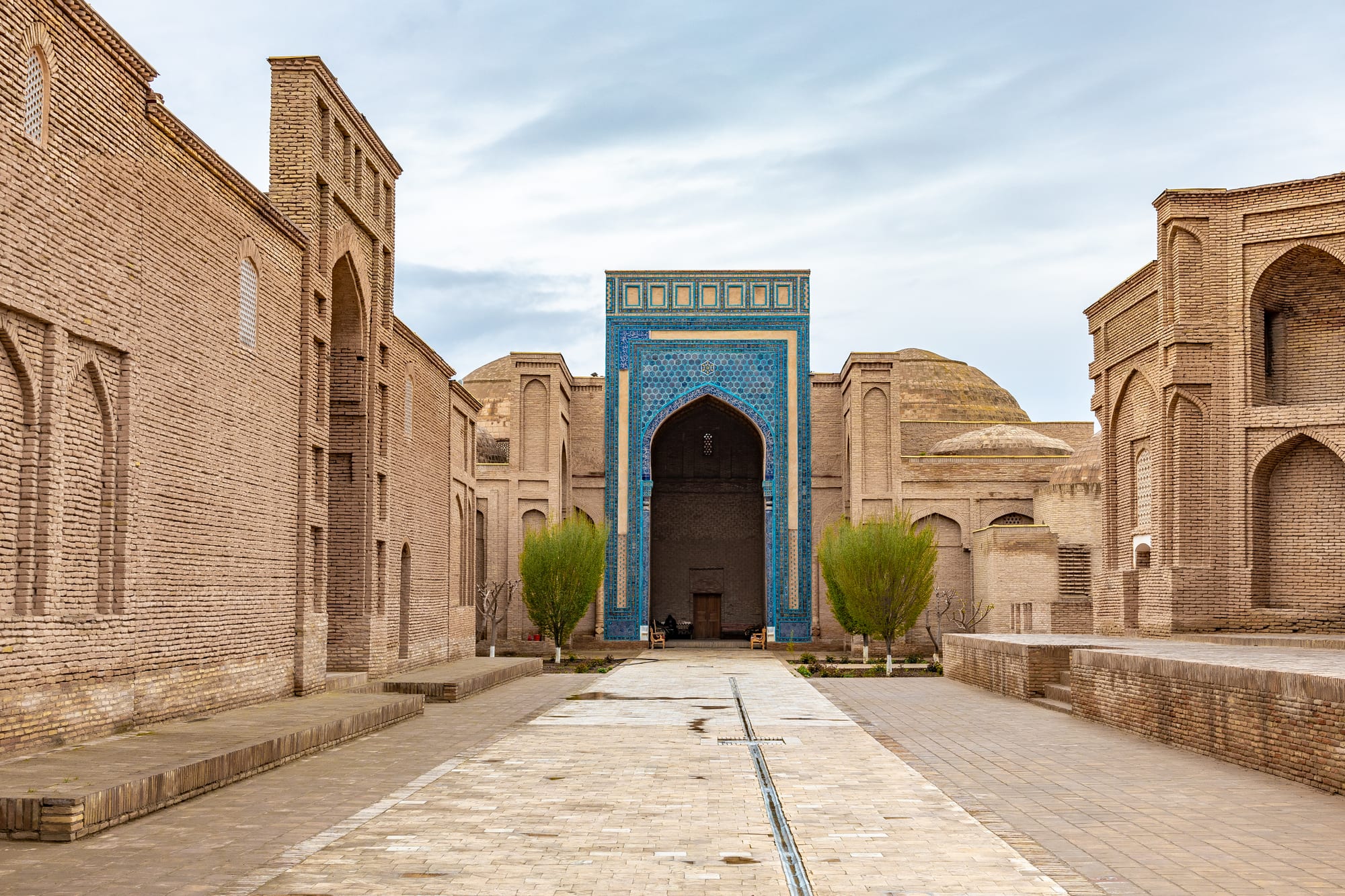
A paved courtyard between plain brick mausolea leading to a tall arched portal faced in blue tilework under a pale sky

Termez & the South, Uzbekistan

Termez

The Sultan Saodat memorial complex, a group of mausolea of the Termez sayyids, in Termez. (Farkhod Sayd / Wikimedia Commons · CC0)

Uzbekistan's southernmost city, on the north bank of the Amu Darya facing Afghanistan, and the capital of Surxondaryo province. Ancient Bactrian Termez was a Buddhist centre under the Kushans and later a seat of Islamic learning; the modern city, laid out by Russian troops in the 1890s, is a hot, low-rise garrison and trading town ringed by excavated ruins.

Neighbourhoods

  • The central avenues
    • First-time visitors
    • Close to public transport
    • Parks and green space

    The Russian-planned grid of wide, tree-lined streets at the heart of the modern city, with the provincial offices, hotels, a central park and the main shopping streets. Most visitors stay here, and taxis to the outlying ruins are easy to arrange.

    Open in Maps
  • The museum quarter
    • Museums
    • Arts and culture

    The area around the large provincial archaeological museum on the western side of the centre, where the finds from the Buddhist and Kushan sites are displayed. Nearby are the theatre, administrative buildings and quiet residential streets.

    Open in Maps
  • The bazaar and the trading edge
    • Local life
    • Best for food
    • Markets

    The market district north-east of the centre, busy with fruit, melons and cheap goods, much of it moving on towards the Afghan border. Shared taxis for Denov, Boysun and Qarshi gather here, along with grill stalls and teahouses.

    Open in Maps
  • The archaeological outskirts
    • Historic sites
    • Day trips

    The flat, dusty land north and west of the city, where Old Termez, the Buddhist monastery sites, the Kyrk Kyz fortress and the Sultan Saodat tombs stand among fields and scrub. Distances between them are several kilometres, and a car is needed.

    Open in Maps

Things to do

Buddhist and Kushan sites

  • Fayaz Tepeattraction

    A Buddhist monastery of courtyards and cells beside its own stupa, dating mostly from the 1st to 3rd centuries AD and excavated from 1968.

    Open in Maps
  • Kara Tepeattraction

    A complex of cave chambers and built shrines cut into sandstone hills near the river, used by Buddhist monks in the first centuries AD.

    Open in Maps
  • Zurmala Stupalandmark

    The eroded brick core of the largest Buddhist stupa of the region, a Kushan-era mound standing alone in fields east of the city.

    Open in Maps
  • Old Termezattraction

    The mounded ruins of the ancient and medieval city on the river bank, destroyed by Genghis Khan's army in 1220 and never rebuilt on the same ground.

    Open in Maps

Shrines and monuments

  • Sultan Saodat complexlandmark

    A long courtyard of brick mausolea, mosques and khanaqas formed between the 10th and 17th centuries as the necropolis of the Termez sayyids, a family claiming descent from the Prophet.

    Open in Maps
  • Mausoleum of al-Hakim at-Termizilandmark

    The shrine of a 9th-century Sufi thinker, one of the most revered pilgrimage places in southern Uzbekistan, standing above the Amu Darya floodplain.

    Open in Maps
  • Kyrk Kyzlandmark

    A square brick building of the early Islamic centuries, its name meaning forty girls, set in open ground north of the city and still the subject of local legend.

    Open in Maps

Museums and city sights

  • Termez Archaeological Museummuseum

    The provincial museum, opened in 2002 for the city's 2,500th anniversary, holding Buddhist sculpture, Bactrian and Kushan finds, coins and manuscripts from the sites around the city.

    Open in Maps
  • The central park and avenuespark

    Shaded walks, fountains and cafés in the planned centre, where the city gathers once the afternoon heat has passed.

    Open in Maps
  • Termez bazaarmarket

    The city market, piled with melons, pomegranates, figs and apricots from the Surxondaryo valley, along with spices, rice and grilled meat.

    Open in Maps

Short trips from the city

  • Kampir Tepeattraction

    A river fortress and port west of the city, begun in the 4th century BC and rebuilt by the Kushans, argued by its excavators to be the Alexandria on the Oxus described by Ptolemy.

    Open in Maps
  • Jarkurgan Minaretlandmark

    A fluted brick minaret built in 1108–09 in a village north-east of Termez, unusual in Central Asia for its bundled half-round shafts; 21.6 metres of an original 40 survive.

    Open in Maps
  • Boysunattraction

    A mountain town north of Termez whose songs, rituals and crafts were proclaimed a UNESCO Masterpiece of intangible heritage in 2001.

    Open in Maps

Seasonal events

  • Navruzlate March

    The spring new year, when the city parks fill with music, wrestling and sumalak cooked overnight in large pans.

  • Boysun Bahorispring

    A folklore festival in the Boysun mountains north of the city, bringing together singers, craftspeople and horse games from the southern districts.

  • Fruit harvestJune to October

    The long season when Surxondaryo's melons, figs, grapes and pomegranates reach the bazaars, the region's best-known produce.

Eat and drink

Long-standing places and food districts in Termez. Hours, ratings and directions come from your maps app, always current.

Termez classics

  • Tandir go'shtrestaurant

    Mutton roasted for hours in a sealed clay oven, a southern speciality served in pieces with bread, onion and green tea.

    Open in Maps
  • Shashlik and teahouses in the centrecafe

    Charcoal grills and teahouses along the central avenues serve skewered mutton, shurpa and pots of green tea into the evening, when the heat drops.

    Open in Maps

Markets and food streets

  • Termez bazaarmarket

    Melons, pomegranates, figs, apricots and grapes in season, alongside rice, spices, dairy and butchers' stalls with grills at the back.

    Open in Maps
  • Roadside melon standsmarket

    Stands on the roads out of the city sell the long-keeping melons that Surxondaryo grows in its hot, irrigated valley.

    Open in Maps

Experience Termez

History

Termez is one of the oldest continuously inhabited places in Uzbekistan, founded on the north bank of the Amu Darya — the Oxus of antiquity — where the river could be crossed on the road between India and Central Asia. It lay in Bactria, ruled in turn by the Achaemenid Persians, by Alexander the Great's successors and by the Greco-Bactrian kings, and the excavated river fortress of Kampir Tepe to the west preserves a Hellenistic town of that period.

Under the Kushan Empire, in the first centuries AD, Termez became a Buddhist centre. Monks cut chambers into the sandstone at Kara Tepe, built the monastery of Fayaz Tepe with its stupa and refectory, and raised the great stupa whose brick core survives at Zurmala; sculpture and finds from these sites are the core of the city's museum, which opened in 2002, while the excavated wall paintings are displayed in Tashkent. Buddhism faded after the Sasanian and Hephthalite invasions, and the Arab conquest in the 8th century made Termez a Muslim city and, in time, a place of Islamic scholarship — the Sufi thinker al-Hakim at-Termizi lived and was buried here in the 9th century, and the Termez sayyids built their long line of tombs at Sultan Saodat.

Genghis Khan's army destroyed the old city in 1220, and it was never rebuilt on the same site. The modern city dates from the 1890s, when Russian troops established a garrison beside the village of Pattakesar on the frontier of the empire; the settlement took the ancient name Termez in 1928. In Soviet times it became the base for the war in Afghanistan: the Friendship Bridge over the Amu Darya opened in 1982, and the last Soviet troops crossed it home in 1989. Since independence Termez has become the country's main gateway for trade with Afghanistan, with cargo terminals and rail links carrying much of that traffic.

Culture & Customs

Termez is a border city, and that shapes it. Uniforms are a normal sight, customs and freight work are ordinary jobs, and families have long-standing ties across the river as well as with Tajikistan to the east. The tone is provincial and conservative — more so than Samarkand or Tashkent — with large extended households, early marriages and a strong role for religious observance in daily life.

Pilgrimage is the city's most visible religious tradition. The shrine of al-Hakim at-Termizi above the river and the Sultan Saodat complex draw visitors from across the south, and the association with a scholar of the early Sufi tradition gives Termez standing among Uzbek Muslims well beyond its size. At the same time the city has built a second identity as a place of Buddhist archaeology, hosting scholarly gatherings and displaying finds that connect it to a religious history quite unlike its present.

Surxondaryo's wider culture is that of the Uzbek south: descendants of once semi-nomadic tribes, Tajik-speaking villages in the mountains, and the songs, rituals and crafts of the Boysun district, recognised by UNESCO in 2001. Kupkari, the horseback game played for a goat carcass, is held at weddings and holidays, and music at celebrations runs on doira drums and surnay pipes. Greetings are formal, a hand on the heart, elders addressed first, and a guest is fed before anything else is discussed.

Daily Life

About 180,000 people live in Termez, the administrative centre of Surxondaryo province. The city is low-rise and green, with Russian-planned avenues shaded by plane trees, Soviet apartment blocks and large districts of courtyard houses on the outskirts. Air conditioning, thick walls and shaded yards are what make summer life possible; in the hottest months the streets empty from late morning until the early evening.

The economy rests on cross-border trade and transport, on the military and administrative presence, and on the produce of one of the country's most fertile hot valleys — cotton, wheat, melons, grapes, figs and pomegranates, much of it sent north to Tashkent. Rail and road terminals handle Afghan freight, and cargo movement is a significant employer. Incomes are low, birth rates high, and many young men from the province work in Russia or the capital and send money home.

Life follows the heat and the calendar of the harvest. Bazaars open at dawn and are busiest before nine; the evening brings families out to the central park and the teahouses. What people talk about is water and electricity in summer, the price of fruit, the state of the roads over the passes to the north, and the situation across the river, which affects trade, jobs and the movement of goods through the city.

Food

Termez eats like the Uzbek south: mutton, bread, dairy and an unusual abundance of fruit. Tandir go'sht, mutton sealed into a clay oven and roasted for hours until it pulls apart, is the dish the region is known for, served in pieces with flat bread, raw onion and tea. Plov is cooked in wide kazans for weddings and guests; shurpa, a broth of mutton with big pieces of potato, carrot and turnip, is the everyday soup; and dimlama, meat and vegetables layered in a sealed pot, is a common family meal.

Grills work along the avenues from late afternoon, turning skewers of mutton and fat over charcoal, and samsa baked against the wall of a tandoor are sold from mid-morning. Bread is round, stamped at the centre and broken by hand; qurt, hard salty balls of dried strained yoghurt, and fresh sheep's cheese come down from the mountain villages, along with honey and walnuts.

The Surxondaryo valley's long, fierce growing season is the city's pride. Melons and watermelons ripen from early summer and are stacked at the roadsides; figs, pomegranates, grapes and apricots follow, and much of the crop is dried for winter. Green tea is drunk all day, poured back into the pot before serving and taken in bowls with navat sugar crystals, and a guest is offered tea, bread and dried fruit before any conversation begins.

Planning tools

Budget

Termez is among the cheapest cities in Uzbekistan and one of the least visited, with plain hotels, low restaurant prices and small museum charges. The single real expense is transport: the archaeological sites are scattered over the plain around the city, and a car with a driver for a full day is the practical way to see them.

Daily Budget Midrange
USD 50–110 (better hotel, restaurant meals, a car and driver for the sites, a local guide)
Daily Budget Shoestring
USD 20–35 (simple hotel, bazaar and canteen food, shared taxis and trains)

Carry som in cash, since cards work only in the larger hotels, and negotiate a day rate with a driver rather than paying per site.

Best Time to Visit

March to May and October to November, when the heat is bearable and the light on the ruins is good. Winter is mild here by Uzbek standards and perfectly workable, with cool, clear days. July and August are gruelling — the summers here are among the hottest in Uzbekistan — and midday sightseeing is close to impossible.

Suggested Number of Days

Two days cover the museum, the shrines and the main archaeological sites, which lie apart from one another and take driving time between them. Three or four allow the mountains and the outlying ruins to the north. Summer heat reduces how much fits into a day.

First Visit
2 days
With Surroundings
3–4 days

Transportation

The central grid is walkable, but almost every site of interest is several kilometres out, so taxis, hired by the trip or by the day, are how visitors move; ride-hailing apps work in the city. Buses and marshrutkas serve the residential districts, and shared cars leave the bazaar for Denov, Boysun, Sherobod and Qarshi. Roads towards the river pass through checkpoints.

Hire a driver for a full day to link the scattered sites, and keep a passport to hand for police checks on roads near the frontier.

Airport & Station Connections

Termez International Airport, on the edge of the city, has regular flights from Tashkent and from some Russian cities. Trains link the city with Tashkent and the rest of the country, an overnight journey from the capital. The road from Samarkand is long and crosses mountain passes, so most travellers fly or take the train. The Friendship Bridge, 12 kilometres east of the city, is the only fixed crossing between Uzbekistan and Afghanistan and carries road and rail traffic over the Amu Darya.

Walkability

The Soviet and Russian-era centre is flat, shaded by avenues of trees and easy to cross on foot, with the park, hotels and restaurants close together. Distances between districts are long, pavements fade at the edges of town, and the archaeological sites are unreachable on foot. Walking is only sensible early or late in summer.

Safety

The city is calm and crime is low, but this is a border region with Afghanistan and Tajikistan. The Afghan frontier along the Amu Darya is a closed military zone, with checkpoints on the roads, restricted areas and sensitivity about photography near the bridge and border posts. Summer heat is the other real danger, and some ruins lie in open ground with no shade or water.

Carry a passport at all times, stay away from the border strip and follow instructions at checkpoints, and avoid midday sightseeing in summer. Check current official travel advice before travelling.

Climate

A desert climate of long, sweltering summers and short, cool winters, softened a little by the river valley. Rain falls almost entirely between December and April, spring is brief and green, and the summer is long, dry and relentless.

Summer
extremely hot, often 40–45°C by day, with hot nights and dust in the air
Winter
mild, around 3–14°C by day, with occasional frost but rarely snow that lies

Local Customs

Surxondaryo is among the more conservative provinces, and dress is modest: shoulders and knees covered, and women cover their hair at shrines, where shoes are removed at prayer halls. Hospitality is emphatic, and tea, bread and fruit come before conversation. Military installations, border posts, the bridge and checkpoints must not be photographed, and discretion about border matters is wise.

Ask before photographing people or pilgrims, avoid any photography near military or border sites, and accept tea when a host offers it.

Common Payment Methods

The currency is the Uzbek som (UZS). Larger hotels take cards, but the bazaar, taxis, small restaurants and site tickets are cash. ATMs exist in the centre and at banks, though they are not always stocked, so it is worth drawing a few days' worth of som at once and keeping small notes.