History
The region between the Amu Darya and Syr Darya rivers — ancient Transoxiana — was the land of the Sogdians, Silk Road merchants whose oasis cities grew rich on the caravan trade between China, Persia, India, and the Mediterranean. Alexander the Great passed through; the Arab conquest of the eighth century brought Islam; and under the Persian Samanid dynasty, Bukhara became a centre of learning.
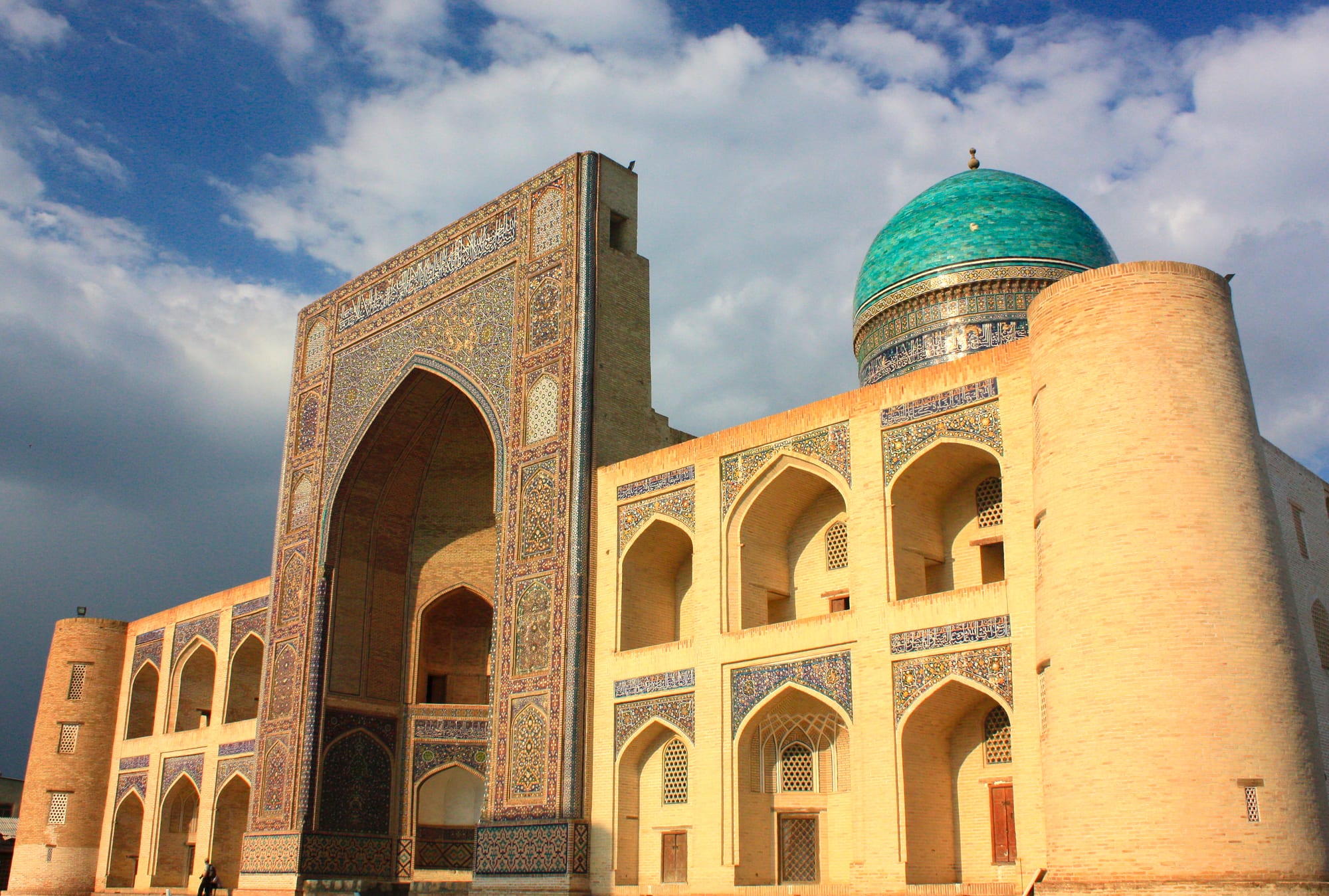
The defining figure is Timur (Tamerlane), who from the 1370s built a vast, brutal empire from his capital at Samarkand and adorned it with monumental architecture. His grandson Ulugh Beg was an astronomer of the first rank. This "Timurid Renaissance" left the tiled madrasas, mosques, and mausolea that still dominate the cities. Later the region fragmented into the Uzbek states — the Emirate of Bukhara and the khanates of Khiva and Kokand — which the Russian Empire conquered in the 1860s and 1870s.
The Soviet Union created the Uzbek Soviet Socialist Republic and turned it into a cotton monoculture, diverting the rivers that fed the Aral Sea for irrigation and causing one of the worst environmental disasters of the century: the sea shrank to a fraction of its size, and its eastern basin dried out completely in 2014 and is now the Aralkum Desert. Uzbekistan became independent in 1991 under Islam Karimov, the former Communist Party boss, who ruled repressively for 25 years — the 2005 Andijan killings were a low point — until his death in 2016. His successor, Shavkat Mirziyoyev, has liberalised the currency, eased travel, largely ended the forced-labour cotton harvest, and courted tourism and investment, while keeping firm political control.
- Uzbekistan: The Heart of the Silk Road — The land of Samarkand and Bukhara — Timur's imperial capital and a cradle of Islamic science, conquered by Russia, made a Soviet cotton republic that helped drain the Aral Sea, and independent since 1991 under two long-serving presidents