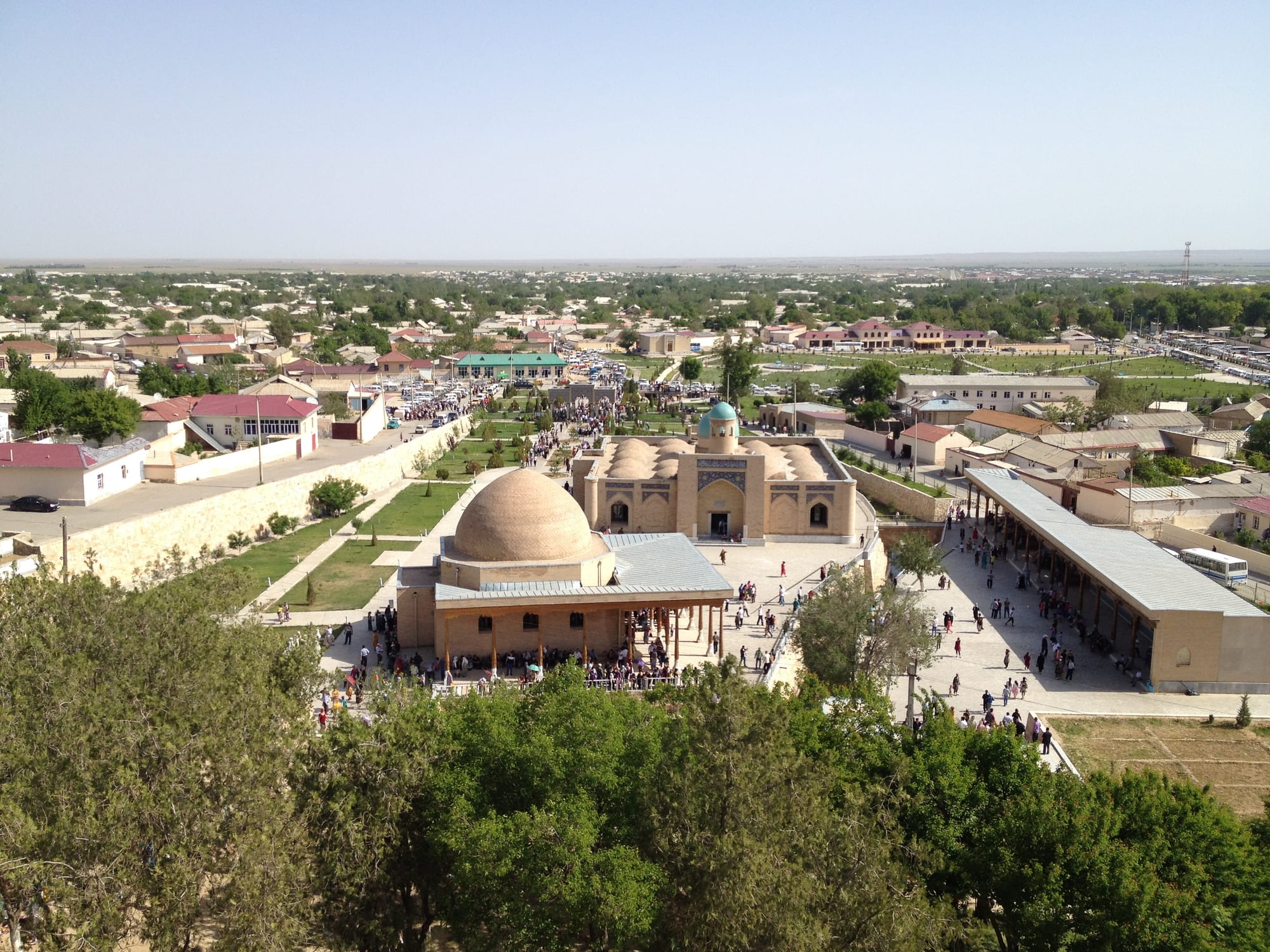
A low domed brick mosque and a blue-domed shrine in a paved square, with a small town of flat-roofed houses and green trees spreading to the plain beyond

Samarkand, Bukhara & the Silk Road, Uzbekistan

Nurata

The Chashma complex at the centre of Nurata, seen from the hill of the old fortress. (Carpodacus / Wikimedia Commons · CC BY-SA 4.0)

A small town in Navoiy province where the Nuratau mountains meet the Kyzylkum desert, roughly midway between Samarkand and Bukhara. It grew around a spring that feeds a pool of fish regarded as sacred, beside the earth ramparts of an ancient fortress, and is the usual staging point for yurt camps in the dunes and homestays in the mountain villages.

Neighbourhoods

  • The spring and the shrine quarter
    • First-time visitors
    • Historic district
    • Pilgrimage

    The centre of the town, where the spring rises into a walled pool below a mosque, a bath house and a shrine. Pilgrims, stalls selling bread and sweets, and the bus stand are all within a few minutes' walk of one another.

    Open in Maps
  • The fortress hill
    • Views
    • Walks

    The eroded earth ramparts on the rise directly above the spring, reached by a short climb from the square. The top gives the clearest view of how the town sits between the mountains and the open plain.

    Open in Maps
  • The bazaar and the main road
    • Local life
    • Close to public transport

    Shops, tea stalls, workshops and the market spread along the road that carries traffic between Navoiy and the desert. This is where shared taxis gather and where most of the town's daily business happens.

    Open in Maps
  • The mountain villages
    • Quiet and residential
    • Walks
    • Homestays

    Small settlements of stone and mud-brick houses in the valleys of the Nuratau range east of the town, living from orchards, walnuts and sheep. Several take guests in family homestays, and walking trails link one valley to the next.

    Open in Maps

Things to do

In the town

  • Chashma spring and its fishattraction

    A spring-fed pool beside the mosque whose fish are treated as sacred and never taken, the reason most Uzbek visitors come to the town.

    Open in Maps
  • Nurata fortresslandmark

    The weathered clay walls and ditches of an ancient hilltop stronghold, long associated in local tradition with Alexander the Great's campaign in Sogdiana.

    Open in Maps
  • Chashma mosque and bath houselandmark

    The round Friday mosque raised over the spring on forty columns, its dome among the largest in Central Asia, with the old bath house beside it.

    Open in Maps
  • Nurata bazaarmarket

    The town market, at its busiest in the morning, selling bread, melons, dried apricots, mutton and suzani embroidery from the surrounding villages.

    Open in Maps

The mountains and the desert

  • Nuratau Mountainstrail

    A dry range rising east of the town, with walnut and apple orchards in its valleys, village homestays and walking routes over the ridges.

    Open in Maps
  • Lake Aydarattraction

    A large lake created by floodwater in the 1960s, lying in the desert north-east of Nurata, with fishing camps and swimming from its sandy shore.

    Open in Maps
  • Kyzylkum yurt campsattraction

    Felt yurts pitched in the dunes east of the town, offering camel rides, night skies and meals cooked over fire, usually booked as an overnight stop.

    Open in Maps
  • Sentob and the Nuratau villagesattraction

    Tajik-speaking mountain villages east of Nurata where families run homestays, keep terraced orchards and weave the local embroidery.

    Open in Maps

Short trips from the town

  • Sarmishsay petroglyphsattraction

    A gorge in the Karatau hills towards Navoiy whose rock faces carry some 10,000 ancient carvings of animals and hunting scenes, the largest rock-art site in Uzbekistan.

    Open in Maps

Seasonal events

  • Navruzlate March

    The spring new year, marked with sumalak cooked overnight, wrestling and horse games, and crowds at the spring.

  • Pilgrimage seasonspring and autumn

    The months when Uzbek families travel to the shrine in the greatest numbers, filling the square around the pool at weekends.

Eat and drink

Long-standing places and food districts in Nurata. Hours, ratings and directions come from your maps app, always current.

Nurata classics

  • Tandoor bread and samsa at the springmarket

    Stalls around the shrine sell round tandoor bread, samsa baked with mutton and onion, and sweets bought as gifts by pilgrims.

    Open in Maps
  • Teahouses on the main roadcafe

    Simple roadside teahouses serve green tea, shurpa broth and grilled shashlik to drivers and market traders through the day.

    Open in Maps

The bazaar and the desert camps

  • Nurata bazaarmarket

    Melons, grapes, walnuts and dried apricots from the Nuratau valleys, alongside mutton, rice and spices for cooking at home.

    Open in Maps
  • Yurt camp mealsrestaurant

    Camps in the dunes cook plov, shurpa and shashlik over open fires and serve green tea and, sometimes, fermented camel's milk.

    Open in Maps

Experience Nurata

History

Nurata stands where underground water from the Nuratau reaches the surface at the edge of the Kyzylkum, and that spring is the reason for the town. The oasis lay on a branch of the caravan roads between Bukhara, Samarkand and the steppe to the north, and it marked the line where settled farming gave way to the grazing grounds of nomadic herders. Local tradition, repeated by guides and by many Uzbek visitors, holds that the earth fortress above the spring, called Nur, was built during Alexander the Great's campaign in Sogdiana in the 4th century BC; what survives are weathered clay ramparts and ditches on the hill, which have never been fully excavated.

With Islam the spring took on religious meaning. The pool below the mosque came to be regarded as holy, its fish protected by custom, and the complex of mosque, bath and shrine that grew around it made Nurata a pilgrimage stop for people from across the region. Under the Emirate of Bukhara it was a modest provincial town with a bazaar, orchards and a system of karez channels carrying water out to the fields.

Russian and then Soviet rule brought a road, a district administration and collective farms, and the town became a service centre for herding and cotton districts rather than a caravan halt. Its modern revival came with tourism after independence, when the road between Samarkand and Bukhara, the yurt camps in the dunes and the community homestays set up in the Nuratau valleys turned Nurata into a place travellers stop at on purpose. It is now part of Navoiy province, and the Nuratau-Kyzylkum Biosphere Reserve in the mountains behind it protects what is said to be the only surviving wild population of the Severtsov's wild sheep.

Culture & Customs

Nurata's identity is built around its spring. Uzbek families arrive in coaches and shared cars to pray at the mosque, drink the water, and look at the fish swimming in the pool, which no one takes or harms; the custom is old enough that the fish are part of how the town describes itself. Vendors around the square sell bread, sweets and small souvenirs to pilgrims, and the atmosphere on a spring weekend is closer to a family outing than to a solemn shrine.

The area is also a meeting point of two ways of life. The town and the irrigated fields belong to the settled world of the oasis; the desert beyond belongs to herders who still keep sheep, goats and camels in the Kyzylkum and who supply the yurt camps with their tents, milk and skills. In the Nuratau valleys to the north, Tajik-speaking villages have their own dialect, songs and long tradition of walnut and orchard farming, and homestay hosts there often speak of themselves as mountain people rather than as townsfolk.

Craft survives in embroidery above all. Nurata suzani, worked in fine silk stitches on cotton with characteristic curling floral motifs, is known well beyond the district and is still made at home by women who sell through the bazaar and guesthouses. Manners are those of rural Uzbekistan: greetings with a hand on the heart, elders served first, shoes left at the door, and a guest never allowed to leave without tea.

Daily Life

Something over 30,000 people live in Nurata, the administrative centre of a district of scattered villages in Navoiy province. Most housing is single-storey, built around courtyards with a vine and a raised wooden platform for sitting and eating, and the town spreads along the road rather than upwards. Uzbek is the language of the town; Tajik is spoken in many of the mountain villages.

Work is divided between farming, herding and, increasingly, tourism. Irrigated plots around the town grow wheat, vegetables, melons and fruit; flocks of sheep and goats graze the stony foothills and the desert margins; and families in the Nuratau make a living from walnuts, apples and honey. Guesthouses, homestays, drivers, cooks and camel handlers now form a season-long industry that runs from April to October, and a share of the district's young men work in Russia or in the mining towns of Navoiy province and send money home.

The day begins early, with the bazaar and the bread ovens busy soon after dawn and work in the fields done before the heat. Afternoons in summer are spent indoors or under shade, and the evening brings people out to the square around the spring. Water is the constant concern — the supply from the mountains is limited and irrigation draws heavily on it — along with the slow depopulation of the higher villages as young families move down to the towns.

Food

Cooking here is plain, mutton-based and generous. Plov, the rice pilaf with mutton and carrot, appears at every celebration and is cooked in enormous kazans for weddings. Shurpa, a broth of mutton with potato, carrot and onion, is the everyday soup; shashlik is grilled over charcoal at the bazaar and the roadside; and dimlama, a slow-cooked pot of meat and vegetables layered in a sealed pan, is common in homes. Samsa, pastry triangles filled with mutton and onion and baked against the wall of a tandoor, are sold hot around the shrine.

Bread comes from clay tandoors and is treated with respect, broken by hand and never laid upside down. Dairy is the mark of the desert and the mountains: fresh and soured milk, home-made butter, and qurt, hard salty balls of dried strained yoghurt carried by herders. Camel's milk from the Kyzylkum is drunk fresh or fermented as chal, and yurt camps often offer a bowl to guests.

The Nuratau valleys supply walnuts, apples, apricots, grapes and mulberries, dried in the sun for the winter, and honey from village hives is a prized gift. Melons ripen through late summer and are sold in piles at the roadside. Green tea, poured and returned to the pot before serving, accompanies everything, sweetened with lumps of navat sugar and drunk from wide bowls rather than cups.

Planning tools

Budget

Nurata is cheap, and there is little to spend money on in the town itself: a guesthouse room, meals at a teahouse and a small entry charge at some sites. The real costs are transport, since a car with a driver is the normal way to arrive and move on, and a night at a Kyzylkum yurt camp, which is usually priced with meals and a camel ride included.

Daily Budget Midrange
USD 70–150 (yurt camp or better guesthouse, meals included, a car and driver from Samarkand or Bukhara)
Daily Budget Shoestring
USD 25–45 (simple guesthouse or homestay, bazaar and teahouse food, shared taxis)

Let a yurt camp or homestay arrange the transfer, as public transport into the desert and the mountains is limited; carry cash, as cards are little use here.

Best Time to Visit

April to early June and September to October. Spring brings green hills, wildflowers and comfortable nights in a yurt; autumn is warm, dry and the season for walnuts and grapes in the mountain villages. Midsummer days in the Kyzylkum are punishing, and winter nights in the desert fall well below freezing, when many camps close.

Suggested Number of Days

The town itself takes only a few hours, and many people see it on the road between Samarkand and Bukhara. Two or three days allow a night in a desert yurt camp and a walk from a village homestay in the Nuratau, which is what most visitors come this way for.

First Visit
Half a day to 1 day
With Surroundings
2–3 days

Transportation

The centre of Nurata is small enough to cross on foot in a quarter of an hour. Everything beyond it needs a vehicle: shared taxis run to Navoiy, the nearest large town, and less often to Jizzakh and Samarkand, while yurt camps, Lake Aydar and the mountain villages are reached by private car, often on rough tracks that need a high-clearance vehicle.

Agree the fare and the route before setting off in a shared taxi, and arrange a return pick-up if heading into the mountains or the dunes.

Airport & Station Connections

Most visitors come by road from Samarkand or Bukhara, three to four hours away, usually with a hired driver as part of a desert trip. Navoiy, about an hour south, has the nearest railway station on the Tashkent–Samarkand– Bukhara line and an international airport; shared taxis link it with Nurata through the day.

Walkability

The shrine, the pool, the mosque, the bazaar and the fortress hill are all within a few minutes of each other on flat ground, and the climb to the ramparts is short but loose underfoot. Pavements are patchy along the main road, there is little shade in summer, and walking is not an option for reaching the desert camps or the mountain villages.

Safety

Nurata is a quiet town with very little crime, and pilgrims and travellers mix at the shrine without trouble. The real hazards are environmental: extreme summer heat, cold desert nights, long distances from medical help and rough mountain tracks. The fortress ruins are unfenced and uneven.

Carry water, a hat and warm layers for desert nights, tell someone the route before walking in the Nuratau, and keep a phone charged where signal is patchy. Check current official travel advice before travelling.

Climate

A dry continental climate at the desert's edge, with a wide gap between day and night temperatures all year. Rain falls mainly between December and April, spring is brief and green, and dust can blow off the Kyzylkum in summer.

Summer
very hot and dry, often 35–42°C by day, with the desert hotter still and nights cooling sharply
Winter
cold, around -3–8°C by day, with hard frosts at night and occasional snow on the Nuratau ridges

Local Customs

The spring is a religious site, and behaviour around it is expected to be respectful: modest clothing, hair covered by women at the mosque, shoes off at prayer halls, and no attempt to touch or feed the fish, which are never caught or eaten. Many of the mountain villages are Tajik-speaking, and hospitality is insistent — tea, bread and dried fruit are offered to every guest.

Ask before photographing pilgrims or families at the shrine, dress with shoulders and knees covered in the town, and accept at least a little of what a host offers.

Common Payment Methods

The currency is the Uzbek som (UZS), and Nurata runs on cash. There are banks and a few ATMs in the town, but they cannot be relied on, and yurt camps, homestays, taxis and market stalls all expect notes. Drawing enough som in Samarkand, Bukhara or Navoiy before arriving is the safe approach.