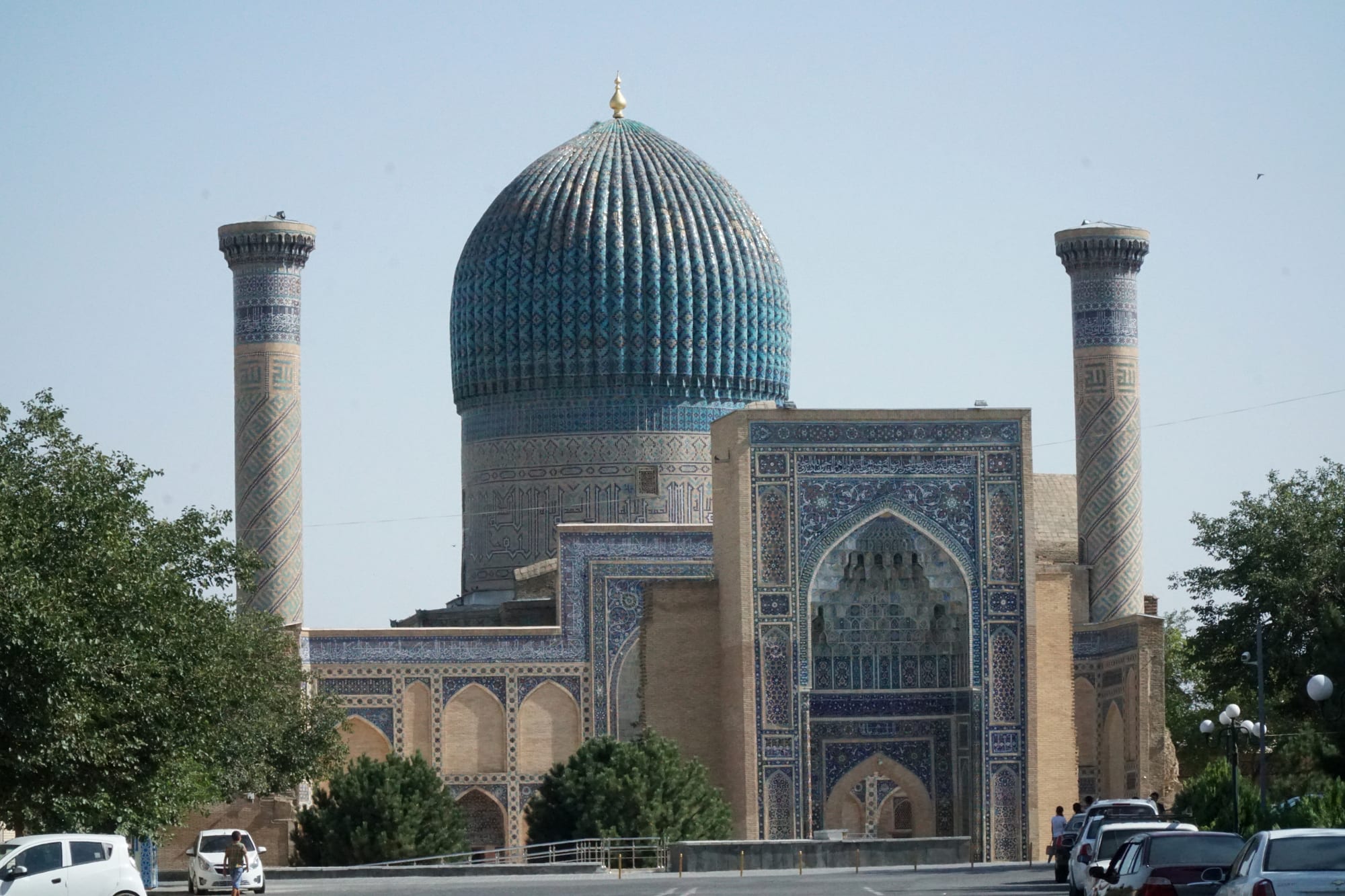
A ribbed turquoise dome on a tiled drum above a mosaic-covered portal, flanked by two patterned brick minarets

Samarkand, Bukhara & the Silk Road, Uzbekistan

Samarkand

The Gur-e-Amir, the mausoleum of Timur in Samarkand. (Adam Harangozó / Wikimedia Commons · CC BY-SA 4.0)

One of the oldest continuously inhabited cities in Central Asia, on the Zarafshan river, capital of Timur's empire in the late 14th century and the best known stop on the Silk Road. Its tiled madrasas, mosques and mausolea are a UNESCO World Heritage Site, set among a Russian-era grid of avenues and the busy Tajik-speaking mahallas of the old town.

Neighbourhoods

  • The monument quarter
    • First-time visitors
    • Historic district
    • Landmarks

    The strip of old Samarkand running from the Registan past Bibi-Khanym to Shah-i-Zinda, largely pedestrianised and rebuilt for visitors, with the Siab bazaar at its northern end. Most guesthouses, souvenir shops and monument entrances are within a twenty-minute walk of each other.

    Open in Maps
  • The old town mahallas
    • Local life
    • Quiet and residential
    • Historic district

    The lanes of courtyard houses east of the main monuments, where many families speak Tajik at home and life goes on behind high walls and carved gates. Small mosques, bakeries and family guesthouses are scattered through it, and traffic is light.

    Open in Maps
  • The Russian city
    • Cafés and bars
    • Parks
    • Close to public transport

    The grid of tree-lined avenues laid out west of the old town after 1868, centred on University Boulevard and the park. It holds the theatres, the university, restaurants, shops, most larger hotels and the everyday life of modern Samarkand.

    Open in Maps
  • Around the railway station
    • Close to public transport
    • Quiet and residential

    The district to the north-west where the Afrosiyob trains arrive, a practical area of apartment blocks, small hotels and cafés about four kilometres from the monuments, with taxis waiting outside the station.

    Open in Maps
  • Konigil and the northern edge
    • Crafts
    • Quiet and residential

    Villages along the Siab and the Zarafshan beyond the ruins of Afrasiyab, where mulberry groves supply workshops that make paper by hand in the medieval manner, and orchards and market gardens still work the riverside land.

    Open in Maps

Things to do

Timurid monuments

  • Registanlandmark

    The public square framed by three tiled madrasas — Ulugh Beg's of the 1410s and the 17th-century Sher-Dor and Tilya-Kori — the image most people carry of Uzbekistan.

    Open in Maps
  • Sher-Dor Madrasalandmark

    The 17th-century madrasa on the east side of the Registan, its portal decorated with lions and human-faced suns, unusual in Islamic architecture.

    Open in Maps
  • Tilya-Kori Madrasalandmark

    The madrasa and mosque closing the north side of the Registan, whose prayer hall is covered in gold leaf over blue.

    Open in Maps
  • Bibi-Khanym Mosquelandmark

    Timur's congregational mosque of the 1400s, built on a scale that strained the technology of its day and partly ruined for centuries before restoration.

    Open in Maps
  • Gur-e-Amirlandmark

    The mausoleum where Timur, his sons and Ulugh Beg are buried, under a ribbed turquoise dome, with a jade cenotaph over the founder's grave.

    Open in Maps
  • Shah-i-Zindalandmark

    A narrow lane of tiled mausolea climbing the hillside beside Afrasiyab, built over centuries around a shrine associated with a cousin of the Prophet.

    Open in Maps
  • Ulugh Beg Observatorylandmark

    The remains of the 1420s observatory whose huge stone sextant, cut into the hillside, produced a star catalogue used for centuries.

    Open in Maps

Ancient Samarkand and museums

  • Afrasiyabattraction

    The bare hills north of the old town, the site of the pre-Mongol city, abandoned after 1220 and excavated only in part.

    Open in Maps
  • Afrasiyab Museummuseum

    The site museum, built around 7th-century wall paintings of foreign envoys arriving at the Sogdian court.

    Open in Maps
  • Hazrat Khizr Mosquelandmark

    A mosque on a rise at the edge of Afrasiyab, rebuilt in the 19th century on an ancient site, with carved and painted interiors and a view over the old town.

    Open in Maps

Markets and streets

  • Siab Bazaarmarket

    The city's main market, beside Bibi-Khanym, piled with Samarkand bread, dried fruit, nuts, spices and produce from the Zarafshan valley.

    Open in Maps

Short trips from the city

  • Shahrisabzattraction

    Timur's birthplace beyond the mountains to the south, with the ruined portal of his Ak-Saray palace and a historic centre listed by UNESCO.

    Open in Maps
  • Urgutattraction

    A town in the foothills south-east of Samarkand, known for its large market and for ancient plane trees at a nearby shrine.

    Open in Maps

Seasonal events

  • NavruzMarch

    The spring new year, marked with fairs, music and neighbourhood cooking of sumalak from sprouted wheat.

  • Sharq Taronalarilate summer, in odd-numbered years

    An international festival of traditional music, with performances staged at the Registan.

  • Independence DaySeptember

    The national holiday of 1 September, marked with concerts and fireworks.

  • Grape and melon harvestAugust to October

    The season when the Zarafshan valley's fruit fills the Siab bazaar and dried fruit is prepared for winter.

Eat and drink

Long-standing places and food districts in Samarkand. Hours, ratings and directions come from your maps app, always current.

Samarkand classics

  • Samarkand plovrestaurant

    The local style layers the rice above the meat and carrots without stirring, and is served in layers on the plate rather than mixed, with yellow carrot and chickpeas.

    Open in Maps
  • Samarkand breadmarket

    Thick round loaves stamped in the centre, baked in tandoors and famous across the country for keeping for days; they are sold all over the Siab bazaar.

    Open in Maps
  • Choyxona lunchescafe

    Tea houses with raised platforms where green tea, bread, salads, shashlik and soup are eaten slowly, often under vines or plane trees.

    Open in Maps

Markets and food districts

  • Siab Bazaarmarket

    Bread, halva, dried apricots, raisins and nuts in heaps, spice sellers, melons in late summer and stalls cooking samsa and plov for market-goers.

    Open in Maps
  • Restaurants on University Boulevardneighborhood

    The pedestrian avenue in the Russian city and the streets around it hold most of Samarkand's sit-down restaurants, cafés and bakeries.

    Open in Maps

Drinks

  • Khovrenko wineryrestaurant

    Uzbekistan's oldest and best-known winery, which makes dessert wines from local grape varieties.

    Open in Maps

Experience Samarkand

History

Samarkand grew on the hill of Afrasiyab above the Siab stream, and the site has been settled since about the 7th century BC. As Maracanda it was the capital of Sogdiana when Alexander the Great took it in 329 BC, and for the next thousand years Sogdian merchants from the city ran the caravan trade between China, India and Persia. Arab armies conquered it in 712, and under the Samanids it became a centre of Persian letters and of the paper-making brought from China.

Genghis Khan's army destroyed the city in 1220; Afrasiyab was never rebuilt and settlement shifted south. In 1370 Timur made Samarkand the capital of an empire that reached from Anatolia to the Indus, and deported craftsmen from every conquered city to build it: Bibi-Khanym, the Gur-e-Amir, the mausolea of Shah-i-Zinda. His grandson Ulugh Beg ruled as a scholar-prince, building a madrasa on the Registan and an observatory whose measurements came remarkably close to modern values; he was murdered in 1449. Under the later Uzbek dynasties the governor Yalangtush Bahadur added the Sher-Dor and Tilya-Kori madrasas, but the capital had moved to Bukhara, and Samarkand declined, at one point standing almost empty.

Russian troops took the city in 1868, and a European town of avenues grew west of the ruins. Samarkand was capital of the Uzbek Soviet Socialist Republic from 1925 until 1930, when Tashkent replaced it. Soviet and later Uzbek restoration rebuilt much of what stands today, work that is admired and argued over in equal measure. The historic centre was inscribed by UNESCO in 2001, and since then tourism, a new airport and large-scale redevelopment have reshaped the city around the monuments.

Culture & Customs

Samarkand is a city of two languages and layered identities. Tajik, a form of Persian, is the mother tongue of a large part of the population, spoken beside Uzbek and Russian; the mix runs through the city's poetry, songs and humour, and is a subject handled with some care. The old town's mahallas, with their gated courtyards and neighbourhood committees, keep customs that the Russian city across the avenues observes more loosely.

Religion and scholarship shaped the place. The shrine of Shah-i-Zinda draws pilgrims as well as visitors, and the memorial complex of Imam al-Bukhari, outside the city, draws pilgrims from across the Muslim world. At the same time Samarkand is remembered as the city of Ulugh Beg the astronomer, and that double inheritance of faith and science is a point of local pride. The Sharq Taronalari music festival brings performers from many countries to the Registan in odd-numbered years.

Crafts continue: hand-made silk paper from mulberry bark at workshops on the Siab north of the city, suzani embroidery, ceramics and carpet weaving. Everyday manners follow national custom — elders greeted first, a hand on the heart, shoes removed indoors, bread torn by hand and never set face down, guests fed before anything else is discussed. Weddings are large and begin before dawn with plov, and whole streets are drawn in.

Daily Life

Around 880,000 people live in Samarkand, making it the second-largest city in Uzbekistan after Tashkent, and it is the centre of a densely farmed province along the Zarafshan. The old town's mahallas of courtyard houses, the Soviet apartment districts and new estates on the outskirts hold most residents, and families are large by European standards, often with several generations under one roof.

Tourism is the most visible employer, with guesthouses, restaurants, guides, drivers and craft workshops built around the monuments, but it is not the largest: farming and food processing in the valley, textiles, a long-standing vehicle and machinery plant, several universities and the trade that passes through the city matter more in ordinary households. Labour migration to Russia and Kazakhstan is common, as everywhere in the country.

The day begins early — the bazaar is at its best before nine — pauses through the hottest hours in summer, and revives in the evening, when families walk on University Boulevard and along the illuminated monument route. Recent years have brought heavy construction: new hotels, a tourism complex north of the centre and the clearance of older housing near the monuments, which is debated locally alongside water supply, traffic and the cost of housing.

Food

Samarkand's bread is its most famous product. Obi non here is a thick round loaf stamped in the middle and baked against the wall of a tandoor, denser than in other cities and said to keep for weeks when dried; it is bought at the Siab bazaar by the stack and given as a present when travelling. Local plov is made in the Samarkand manner, the rice steamed above the meat and carrots without stirring and served in layers on the plate, usually with yellow carrots and chickpeas.

The bazaar supplies the rest of the table. Halva in many forms, sugared nuts, dried apricots, raisins, figs and walnuts are sold in heaps, and the valley's grapes, pomegranates, peaches and melons arrive in quantity from late summer. Samsa baked in the tandoor, shashlik grilled over charcoal, lagman noodles, manti and chuchvara dumplings, and shurpa soup are eaten across the city, and nahor oshi, the dawn plov, marks weddings and commemorations.

Tea is constant and usually green, poured for guests before anything else and served with sweets. Samarkand is also one of the few Uzbek cities with a wine tradition, centred on the Khovrenko winery, the country's oldest, which makes dessert wines from local grapes, and small cafés serving coffee and European food have multiplied around the Russian city in recent years.

Planning tools

Budget

Samarkand is one of the two most expensive places to sleep in Uzbekistan, with boutique guesthouses and hotels around the monuments that fill in spring and autumn. Entry tickets to the main monuments add up over a few days. Food, taxis and trains stay cheap, so most of the difference between a shoestring and a mid-range visit is the room.

Daily Budget Midrange
USD 70–150 (boutique guesthouse, restaurants, monument tickets, a driver for Nurata and the desert)
Daily Budget Shoestring
USD 30–50 (guesthouse or hostel, bazaar and canteen food, buses, shared taxis and trains)

Book old-town rooms early for April, May, September and October, and buy a combined monument ticket where it is offered.

Best Time to Visit

April to May and September to October are the best months, with warm days for walking between the monuments and cool evenings. Midsummer brings temperatures around 35–40°C with little shade among the tiles and stone. Winter is cold, sometimes snowy, and the monuments are almost empty, which some visitors prefer.

Suggested Number of Days

Two to three days suit the monuments and the bazaar without rushing. Four or five allow the mountains, the desert and the towns beyond the city as well. Midsummer heat and the long walks between sites argue for adding a day.

First Visit
2–3 days
With Surroundings
4–5 days

Transportation

The monument quarter is walkable, and the rest of the city is covered by buses, trolleybuses and cheap taxis, with ride-hailing apps in use. The railway station lies several kilometres north-west of the centre and the airport a similar distance north. Drivers can be hired by the day for trips beyond the city, which is the usual way to reach Shahrisabz or the desert.

Use an app or agree the fare before getting into a taxi, and allow extra time for the drive to the station or airport in the evening rush.

Airport & Station Connections

High-speed Afrosiyob trains reach Samarkand from Tashkent in about two hours and continue to Bukhara in roughly another hour and a half; slower trains and buses take longer but run more often. Samarkand International Airport, on the northern outskirts and given a new terminal in 2022, is the country's second-busiest, with domestic and international flights. Cars with drivers cover the road from Tashkent in four to five hours.

Walkability

The monument quarter is largely pedestrianised and flat, and the walk from the Registan to Bibi-Khanym and the Siab bazaar takes about twenty minutes. Shah-i-Zinda and the observatory sit further north, at the edge of comfortable walking distance in summer. The Russian city is pleasant on foot along University Boulevard, but the four kilometres between it and the monuments are usually covered by taxi. Paving in the old mahallas is uneven.

Safety

Samarkand is among the safest cities in Central Asia for visitors, with tourist police around the monuments and very little violent crime. The practical risks are heat exhaustion in summer, uneven paving and steps in the old town, and overcharging by taxi drivers and some souvenir sellers. Traffic on the main avenues moves fast.

Carry water and a hat from June to September, agree fares in advance or use an app, and carry a passport for hotel registration. Check current official travel advice before travelling.

Climate

A continental climate, slightly milder than the desert cities to the west because the city sits higher on the Zarafshan. Summers are long, hot and dry; winters are short and cold, with most of the year's rain falling between December and April, when the surrounding hills turn green.

Summer
hot and dry, typically 33–38°C in July, with cooler nights
Winter
cold, around -3–8°C, with occasional snow and frosty nights

Local Customs

Samarkand is historically a Persian-speaking city, and many families speak Tajik at home alongside Uzbek and Russian; the subject is best treated lightly. Modest dress is expected at the monuments, most of which are former or working religious buildings: shoulders and knees covered, shoes off and hair covered for women in working mosques and shrines. Greetings are unhurried and elders greeted first.

Ask before photographing people, especially at prayer or at the shrines; bargaining is normal in the bazaar but done politely; tipping is not expected, though rounding up is welcome.

Common Payment Methods

The currency is the Uzbek som (UZS). Hotels, larger restaurants and monument ticket offices generally take cards, more widely than in smaller towns, but the bazaar, taxis and craft workshops want cash. ATMs are found in the Russian city and near the main hotels; money should be changed at banks or licensed exchange desks only.