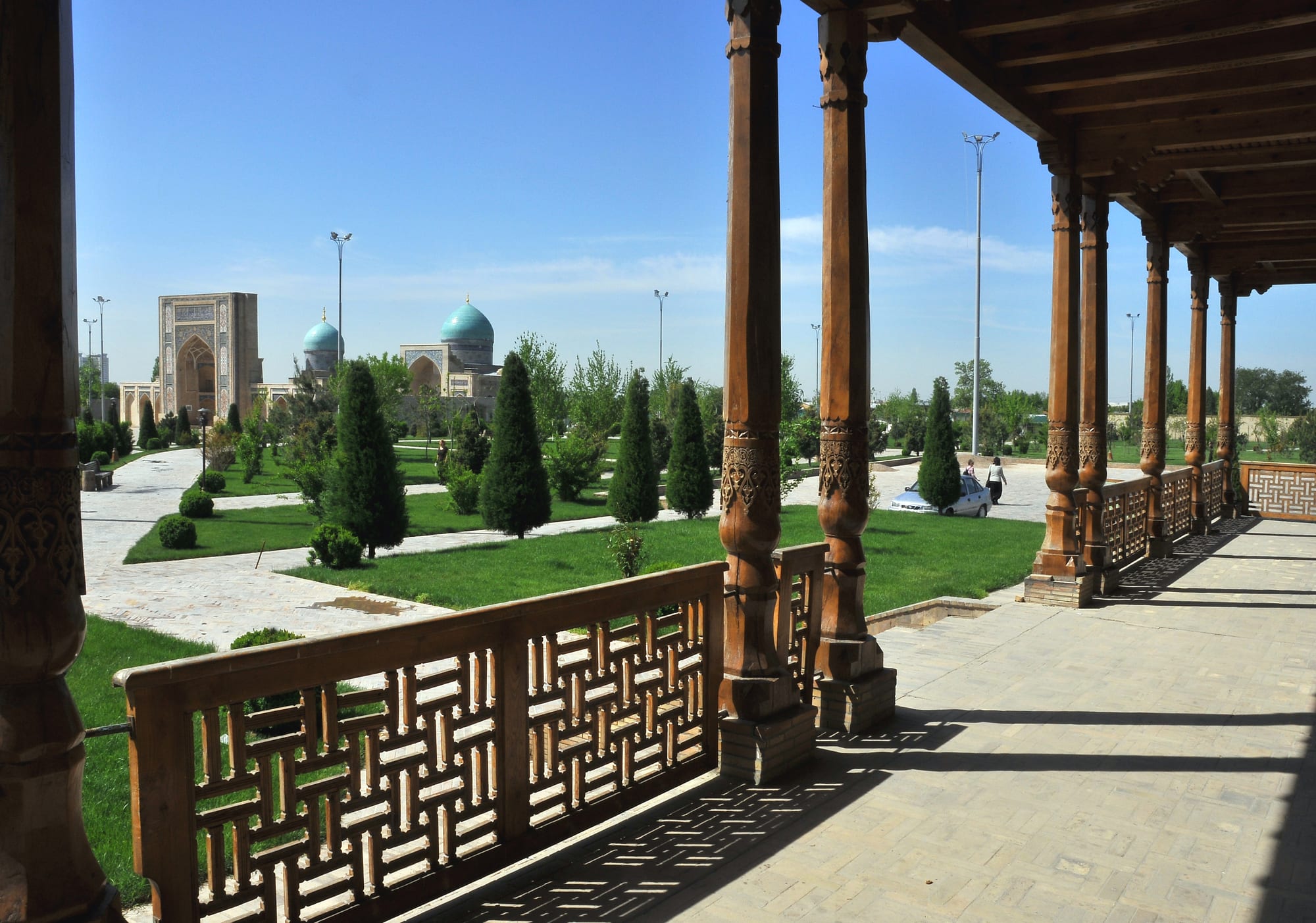
A carved wooden veranda looking across clipped lawns and conifers to a tiled portal and two turquoise domes under a clear sky

Tashkent & the Fergana Valley, Uzbekistan

Tashkent

The Hazrati Imam complex in the old quarter of Tashkent, seen from a columned veranda. (LBM1948 / Wikimedia Commons · CC BY-SA 4.0)

Uzbekistan's capital and the largest city in Central Asia, on the Chirchiq oasis at the foot of the western Tian Shan. An ancient caravan town that became the capital of Russian Turkestan, it was largely rebuilt after the earthquake of 1966 as a planned Soviet city of wide avenues, parks and a decorated metro, with the old quarter around Chorsu bazaar and Hazrati Imam surviving beside new glass towers.

Neighbourhoods

  • The old city and Chorsu
    • First-time visitors
    • Markets
    • Historic district

    The surviving old quarter north-west of the centre, where low mahalla streets run between the blue-domed Chorsu market hall, the Kukeldash madrasa and the Hazrati Imam complex. It is the densest, most traditional part of the city, busy from early morning and close to a metro station.

    Open in Maps
  • The city centre and Amir Timur Square
    • First-time visitors
    • Museums
    • Close to public transport

    The heart of the Russian and Soviet city, laid out around a park-ringed square where the main avenues meet. Museums, theatres, hotels, the main metro interchanges and long shaded pavements are all here, and Independence Square lies a short walk west.

    Open in Maps
  • Yakkasaray and Mirobod
    • Best for food
    • Cafés and bars
    • Quiet and residential

    Leafy inner districts south and east of the centre, mixing low pre-Soviet houses with apartment blocks. Restaurants, coffee houses and small shops cluster along the main streets, and the main railway station stands in Mirobod.

    Open in Maps
  • Chilanzar
    • Local life
    • Close to public transport

    The large residential district south-west of the centre, a major Soviet-era housing development served by the metro line that carries its name. Markets, parks and canteens give a good sense of everyday Tashkent away from the monuments.

    Open in Maps
  • Yunusobod
    • Quiet and residential
    • Views

    A spread-out northern district of apartment blocks, embassies and sports grounds, with the television tower rising above it. It is greener and calmer than the centre and linked to it by its own metro line.

    Open in Maps
  • Tashkent City and the new centre
    • Modern architecture
    • Nightlife

    A district of high-rise offices, hotels and a large park built in the 2010s and 2020s just west of the centre, on land cleared of older housing. It is where the city's newest restaurants, bars and shopping are concentrated.

    Open in Maps

Things to do

The old city

  • Chorsu Bazaarmarket

    The city's great market, sprawling around a ribbed blue dome where butchers, spice sellers, dairy stalls and bread bakers trade under one roof.

    Open in Maps
  • Kukeldash Madrasalandmark

    A brick madrasa on a rise above Chorsu, built around 1570 under the Shaybanid ruler Dervish Sultan and a working madrasa again since the 1990s.

    Open in Maps
  • Hazrati Imam Complexlandmark

    The religious centre of the old city, a square of madrasas, a mausoleum and the modern Hazrati Imam mosque; it held the Samarkand Kufic Quran, one of the oldest surviving Qur'an manuscripts, from 1989 until the manuscript moved to the new Centre of Islamic Civilisation in 2025.

    Open in Maps

Museums

  • State Museum of History of Uzbekistanmuseum

    The national history collection, running from Bactrian and Sogdian antiquity through the Islamic centuries to the Russian and Soviet periods.

    Open in Maps
  • State Museum of Applied Arts of Uzbekistanmuseum

    Suzani embroidery, ceramics, carved wood and jewellery from a national collection founded in 1937, shown in rooms with carved and painted decoration.

    Open in Maps
  • Museum of Olympic Glorymuseum

    A museum of Uzbekistan's Olympic sportspeople, in a modern building near the centre.

    Open in Maps

Squares, parks and the modern city

  • Amir Timur Squarelandmark

    The central square laid out in 1882, planted with old plane trees and centred on an equestrian statue of Timur.

    Open in Maps
  • Independence Squarelandmark

    A large ceremonial square of fountains and arches west of the centre, with a monument to those who died in the Second World War alongside.

    Open in Maps
  • Tashkent TV Towerviewpoint

    A 375-metre lattice tower in Yunusobod, opened in 1985, with an observation deck looking over the city towards the mountains.

    Open in Maps
  • Alisher Navoi Theatrelandmark

    The opera and ballet theatre designed by Alexey Shchusev and completed in 1947, with foyers decorated in regional plasterwork styles.

    Open in Maps

The metro and getting about

  • Tashkent Metrotransit hub

    Central Asia's first underground railway, opened in 1977 and now four lines, whose older stations are decorated with marble, mosaic, carved ganch and chandeliers.

    Open in Maps
  • Tashkent International Airporttransit hub

    The country's main airport, a short drive south of the centre, with flights across Central Asia, Russia, Turkey, the Gulf and Europe.

    Open in Maps

Short trips from the city

  • Chimganattraction

    A mountain resort area in the western Tian Shan about 70 km north-east of the city, used for walking in summer and skiing in winter.

    Open in Maps
  • Charvak Reservoirattraction

    A large blue reservoir in the mountains east of Tashkent, ringed by beaches and holiday bases and busy through the summer.

    Open in Maps
  • Ugam-Chatkal National Parkpark

    A protected area of forested slopes, gorges and high pastures in the mountains north-east of the capital.

    Open in Maps

Seasonal events

  • NavruzMarch

    The spring new year, marked with public concerts, fairs and family meals, and with sumalak simmered overnight in the mahallas.

  • Independence DaySeptember

    The national holiday of 1 September, with an evening show and fireworks in the centre of the capital.

  • Tashkent International Film Festivalautumn

    A film festival with roots in the Soviet-era festival of Asian, African and Latin American cinema, revived in 2021 and held in the second half of the year.

Eat and drink

Long-standing places and food districts in Tashkent. Hours, ratings and directions come from your maps app, always current.

Tashkent classics

  • Plov centresrestaurant

    Large open-sided halls where cooks make wedding-style plov in cauldrons from early morning and sell it by the plate until it runs out, usually by mid-afternoon.

    Open in Maps
  • Norin and noodle housesrestaurant

    A Central Asian dish long associated with Tashkent — finely hand-cut boiled noodles tossed with thin slices of horse meat and onion, served cold or as a hot noodle soup.

    Open in Maps
  • Choyxona tea housescafe

    Shaded tea houses with raised platforms for sitting, where green tea, bread, shashlik and salad are eaten slowly over a long lunch.

    Open in Maps

Markets and food districts

  • Chorsu Bazaarmarket

    The city's biggest food market: the meat and dairy floors under the dome, tandoor bread and samsa at the edges, and heaps of dried fruit, nuts and spices in the surrounding rows.

    Open in Maps
  • Restaurants around Yakkasaray and Mirobodneighborhood

    The inner southern streets hold most of the city's modern restaurants, coffee houses and bakeries, alongside Russian, Korean, Turkish and Georgian kitchens.

    Open in Maps

Experience Tashkent

History

Tashkent began as Chach, an oasis settlement on the Chirchiq river watered by canals, trading with the steppe nomads to the north and with the Sogdian cities to the south-west. Arab armies took it in the 8th century, when the name shifted towards Shash and then Tashkent, the "stone city" in Turkic. It was ruled in turn by the Samanids, the Karakhanids, the Khwarazmshahs, the Mongols and the Timurids, and under the Shaybanid Uzbeks in the 16th century it gained the Kukeldash madrasa that still stands above Chorsu. It was never a capital of empire like Samarkand or Bukhara, but it sat where the caravan roads met, and it grew rich on trade and craft.

In the early 19th century the Khanate of Kokand took the city and walled it. Russian troops under General Chernyayev stormed it in May 1865, and Tashkent became the seat of the Governor-General of Russian Turkestan. The Russians built a new town of avenues, churches and villas east of the old walls, leaving the mahalla quarters largely intact, and the railway arrived in 1889. In April 1918 the city became the capital of the Turkestan Autonomous Soviet Socialist Republic, and later of the Uzbek Soviet Socialist Republic. Evacuation during the Second World War pushed the population past a million and brought Russian and Ukrainian industry, Polish refugees and much of the Soviet film industry.

On 26 April 1966 a shallow earthquake destroyed much of the centre, leaving hundreds of thousands homeless though killing comparatively few. Brigades from across the Soviet Union rebuilt the city to a new plan of broad avenues, squares and standard apartment districts, and the metro followed in 1977. Independence in 1991 brought new ministries, monuments and names; since the late 2010s glass towers, new parks and large-scale clearance of old housing have again changed the centre.

Culture & Customs

Tashkent is the most cosmopolitan city in Central Asia. Uzbek and Russian are both heard constantly, and the city is home to Tatars, Kazakhs, Armenians, Ukrainians and the Koryo-saram, Koreans deported from the Soviet Far East in 1937, whose salads and pickles are now a fixture of every bazaar. Russian remains a language of business and higher education, while Uzbek in the Latin alphabet dominates signage and official life.

The city sets national fashion in music, clothes and weddings. Uzbek pop and estrada fill the taxis, classical maqom and Alisher Navoi's poetry are taught in the conservatoires, and the opera and ballet theatre has been at work since it opened in 1947. Football is followed closely, with the national team playing at the Milliy Stadium, and kurash, the local jacket wrestling, is a point of pride.

Everyday manners follow the mahalla, the neighbourhood community that organises weddings, funerals and disputes and still carries real authority. Elders are greeted first and served first; a hand on the heart accompanies a greeting; bread is broken by hand, never cut, and never left face down. Weddings are large, early and public, often beginning with a dawn plov for hundreds of guests; the government has at times legislated to limit their size and cost. Tea is offered to every visitor, and the first cup is poured back into the pot several times before being served.

Daily Life

About three million people live in the city, making it the largest in Central Asia, and the metropolitan area is larger still. Most live in apartment districts built after 1966 — Chilanzar, Yunusobod, Sergeli and others — in blocks around courtyards, shops and schools, while the older mahallas of low courtyard houses survive in patches near the old city. Rents and property prices have risen sharply, and the demolition of older housing for new towers is among the most contested issues in the city.

Tashkent holds the ministries, the universities, the banks and most large businesses, and draws workers from the whole country, especially the crowded Fergana Valley. Government service, trade, construction, transport and a growing technology and service sector provide the work; remittances from Uzbeks working in Russia and Kazakhstan matter here less than in the provinces but still matter. Wages are low by international standards and many households run a second job.

The day starts early, with bread bought fresh in the morning and offices open by nine, and the streets stay busy well into the evening in summer, when families sit out in the parks after dark. Winter brings smog trapped over the city, and air quality, water supply and the loss of old trees to road widening are regular complaints. At weekends those who can drive north-east to the mountains and the Charvak reservoir.

Food

Plov, called palov or osh, is the centre of the city's food. Tashkent's own style is a wedding plov, to'y oshi, cooked at dawn in cauldrons over wood, with rice coloured by carrots and onion and topped with mutton, chickpeas, quail eggs and slices of sausage; the plov centres serve it by the plate until the cauldrons are empty, usually in the early afternoon. The city's other signature is norin, cold hand-cut noodles tossed with thin slices of boiled horse meat and onion, a Central Asian dish long associated with Tashkent.

Bread is central: obi non, round loaves stamped in the middle and baked on the walls of a tandoor, are sold hot everywhere and differ from town to town. Samsa, flaky or tandoor-baked pastries filled with lamb and onion or pumpkin, are eaten at any time of day. Lagman, hand-pulled noodles in broth or fried with vegetables, came with Uyghur and Dungan settlers; manti, large steamed dumplings, and chuchvara, small ones in soup, are everyday food; shashlik is grilled to order over charcoal. Shurpa, a fatty mutton and vegetable soup, and mastava, a rice soup with sour milk, fill the winter table.

Green tea is drunk through the day, often with sugared nuts or halva. Korean salads and kimchi sold in the bazaars have become part of the local diet, and Russian, Georgian, Turkish and Korean restaurants are common. Melons, grapes, apricots and pomegranates arrive in season in great quantity, and are dried for the winter. Local beer and brandy are produced, and coffee houses have spread quickly among younger people in the past decade.

Planning tools

Budget

Tashkent is the most expensive city in Uzbekistan, with international hotels, a wide choice of restaurants and taxi fares that rise in the evening rush. Everyday costs stay low: the metro is cheap, bazaar food and canteen meals are cheap, and most museums charge little. Hotel prices are the main variable, and rise during conferences and holidays.

Daily Budget Midrange
USD 60–130 (mid-range hotel, restaurants, museum tickets, ride-hailing and a day trip to the mountains)
Daily Budget Shoestring
USD 25–45 (hostel bed or simple guesthouse, bazaar and canteen food, metro and buses)

Use the metro and ride-hailing apps rather than street taxis, and keep som in cash for bazaars and small cafés.

Best Time to Visit

April to early June and September to October are the comfortable seasons, with warm days, blossom in spring and bazaars full of fruit in autumn. July and August are very hot and the city empties towards the mountains at weekends. Winter is cold and grey but quiet, and the ski slopes north-east of the city are open from January.

Suggested Number of Days

Two to three days covers the old quarter, the museums and a ride round the metro. Four or five allow the mountains and reservoir to the north-east, or a first leg onward to the Fergana Valley. Heat in midsummer slows everything down and argues for longer.

First Visit
2–3 days
With Surroundings
4–5 days

Transportation

The four-line metro is the quickest way across the city, cheap, frequent and signed in Latin script as well as Cyrillic. Buses fill the gaps, and ride-hailing apps are widely used and inexpensive. Traffic on the main avenues is heavy at either end of the day, and the ring roads are fast but confusing. Shared taxis for other cities leave from fixed stands on the outskirts.

The metro and buses are cheap and simple to use; ride-hailing apps avoid the haggling that comes with flagging down a private car.

Airport & Station Connections

Tashkent International Airport lies a short drive south of the centre and is the country's main gateway, with flights across Central Asia, Russia, Turkey, the Gulf and Europe. The railway station in Mirobod is the hub of the network: fast Afrosiyob trains reach Samarkand in roughly two hours and continue to Bukhara, and slower trains and buses run to the Fergana Valley over the Kamchik Pass. Road and rail links reach Kazakhstan to the north.

Walkability

The centre is walkable in patches rather than as a whole: the blocks around Amir Timur Square and the museum streets are pleasant, shaded by plane trees and lined with pavements, but the avenues laid out after 1966 are very wide and the distances between districts are long. The old city around Chorsu is best explored on foot. Underpasses and footbridges are needed to cross the main roads, and summer heat makes midday walking hard.

Safety

Tashkent is a safe city by international standards, with low levels of violent crime and a visible police presence. The usual problems are pickpocketing in crowded bazaars and on the metro, overcharging by unlicensed taxis, and traffic: drivers are assertive and pedestrian crossings are not always respected. Summer heat is a genuine risk.

Carry a passport or a copy for identity checks, agree fares in advance or use an app, and drink plenty of water in summer. Check current official travel advice before travelling.

Climate

A continental climate with hot, very dry summers and cool, damp winters, moderated slightly by the mountains to the east. Most of the year's modest rainfall comes between November and April, and spring is the greenest season.

Summer
hot and dry, typically 33–40°C in July, with cooler nights and strong sun
Winter
cool to cold, around -3–8°C, with occasional snow and frequent grey days

Local Customs

Greetings matter: a handshake between men, a hand on the heart for elders and for women who do not offer a hand. Dress is modest but relaxed in the capital, and shoulders and knees should be covered at mosques and shrines, where women cover their hair and everyone removes their shoes. Bread is treated with respect and never placed upside down. Guests are pressed to eat and refusal is taken lightly.

Tipping is not expected but small change is appreciated; ask before photographing people, especially at prayer, and accept tea when it is offered.

Common Payment Methods

The currency is the Uzbek som (UZS). Cards, including contactless, are accepted in Tashkent's hotels, supermarkets, chain cafés and on the metro, far more widely than in the rest of the country. Bazaars, small cafés and taxis want cash, and ATMs are common in the centre, though some dispense US dollars rather than som. Changing money outside banks and licensed exchange points is illegal.