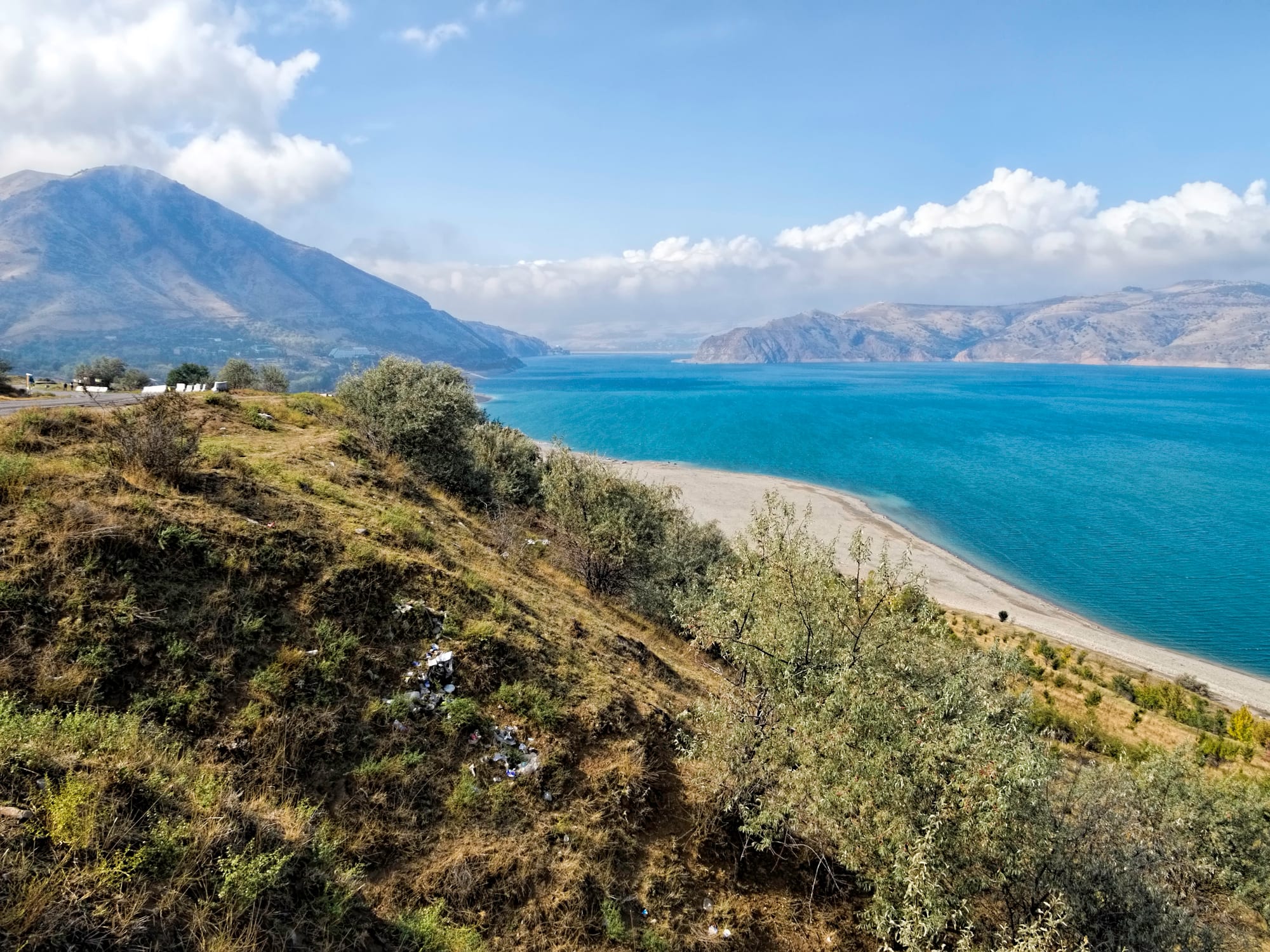
Blue reservoir water and a pale beach below green scrubby slopes, with bare mountains and clouds on the far shore

Uzbekistan

Tashkent & the Fergana Valley

The Charvak reservoir among the Chimgan mountains in Tashkent Region. (Dan Lundberg / Wikimedia Commons · CC BY-SA 2.0)

Uzbekistan's populous north-east, joining the capital Tashkent and its mountain hinterland in the western Tian Shan to the Fergana Valley beyond the Kamchik Pass — a fertile, densely farmed basin shared with Kyrgyzstan and Tajikistan, and the country's heartland of silk, ceramics and traditional crafts.

Explore Tashkent & the Fergana Valley

History

Tashkent grew from the oasis of Chach, or Shash, on the Chirchiq river, a Sogdian and Turkic trading town on the road north to the steppe. It was taken by the Arabs, the Samanids, the Mongols and the Timurids, and in the 16th century it was a notable centre of the Shaybanid Uzbeks, who built the Kukeldash madrasa. The Fergana Valley to the east was ancient Dayuan, whose "heavenly horses" drew Han Chinese armies across the mountains in the 2nd century BC, and later the homeland of Babur, born in Andijan in 1483, who lost Fergana, took Kabul and founded the Mughal Empire in India.

In the 18th century Kokand became the seat of a new khanate that came to rule the whole valley and, from the early 19th century, Tashkent. Russian forces stormed Tashkent in 1865, made it the capital of Russian Turkestan, and annexed the Kokand Khanate in 1876, building a European new town beside each old one, including Fergana city, first called New Margilan.

Under Soviet rule Tashkent became the capital of the Uzbek republic and the largest city in Soviet Central Asia. The earthquake of 1966 destroyed much of the old centre, and it was rebuilt as a planned city with a metro. After independence the Fergana Valley saw ethnic violence and Islamist activity in the 1990s, and in 2005 security forces killed many protesters in Andijan.

Culture & Customs

Tashkent is the most cosmopolitan and Russian-speaking city in the country, home to Uzbeks, Russians, Tatars, Koreans deported by Stalin in the 1930s and many others. It sets national fashions in music, dress and weddings, and its cafés and theatres give it a more secular, urban feel than anywhere else.

The Fergana Valley has a different reputation: more conservative, more devout and fiercely proud of its crafts and hospitality. Valley Uzbek has its own accents, and Tajik and Kyrgyz communities live near the borders. The valley is the heart of the country's craft traditions: khan-atlas and adras ikat silk and half-silk in Margilan, glazed ceramics with a local plant-ash glaze in Rishtan, and knives with decorated handles from Chust in Namangan region.

Classical music, maqom, and folk singing are strong in the valley, and Kokand, the old khanate capital, carries a scholarly and literary tradition. Weddings are large everywhere, and guests are welcomed with bread, tea and sweets on a laid dastarkhan.

Daily Life

Tashkent, with about 3 million people, is the largest city in Central Asia and the centre of government, business and education. Its tree-lined avenues, metro stations and Soviet blocks now stand beside new business districts, and the city is growing fast, with traffic and rising rents the everyday complaints.

The Fergana Valley holds a large share of the country's people on a small area of irrigated land, with Namangan, Andijan, Fergana, Kokand and Margilan the main cities, each of a few hundred thousand people or fewer. Cotton, silk, fruit and vegetables dominate farming, and Asaka in Andijan region has the country's main car plant. Land is scarce, families are large, and many young men work in Russia or Tashkent.

Life in the valley revolves around the mahalla, the bazaar and the mosque, with Friday prayers well attended. Shared water from rivers that cross three countries is a long-running regional issue.

Food

Tashkent has its own versions of the national dishes: wedding plov, to'y oshi, cooked in huge cauldrons at dawn and served at plov centres by lunchtime, and norin, cold hand-cut noodles with thin slices of horse meat. Its bazaars sell samsa from tandoors, chuchvara dumplings and grilled shashlik by the skewer.

The Fergana Valley cooks its own versions of plov, and lagman, hand-pulled noodles, is especially popular here, and the valley's orchards supply apricots, pomegranates, grapes, cherries and melons in huge quantities.

Green tea is drunk throughout the day, often in a choyxona over a long lunch, and in Tashkent beer and coffee culture have spread among the young.

Attractions & Natural Wonders

Tashkent's old city centres on Chorsu bazaar, under its blue dome, and the 16th-century Kukeldash madrasa, with the Khast Imam complex nearby, whose library housed an early copy of the Qur'an linked to the Caliph Uthman until 2025. The Soviet city offers Amir Timur Square, the Museum of Applied Arts, the State Museum of Arts and the metro, whose decorated stations are sights in themselves.

North-east of the capital, the Chimgan mountains rise above the Charvak reservoir. Greater Chimgan is a popular climb, the Beldersay and Amirsoy resorts offer skiing in winter, and the Ugam-Chatkal National Park protects forested slopes and high mountain valleys beyond.

Across the Kamchik Pass, Kokand has the tiled palace of Khudayar Khan, built in the 1870s, the wooden-columned Jami mosque and the Narbutabey madrasa. Rishtan, to the south, is a town of potters' workshops where masters throw and paint bowls in blue and turquoise. Margilan's Yodgorlik factory shows each stage of ikat silk-making, from cocoons to looms, and the Kumtepa bazaar nearby is one of the valley's great markets. Andijan is Babur's birthplace, and Namangan the Mullah Kyrgyz madrasa.

Cities in Tashkent & the Fergana Valley

Planning basics

Budget

Tashkent is the most expensive city in the country, with international hotels and restaurants, but its metro, markets and canteens remain cheap. The Fergana Valley is noticeably cheaper than the Silk Road cities, with simple hotels and guesthouses, and far fewer tourists. Prices are paid in UZS; cards work widely in Tashkent but much less in the valley towns.

Daily Budget Midrange
USD 60–130 (mid-range hotel, restaurants, a driver for the valley circuit or the mountains)
Daily Budget Shoestring
USD 25–40 (hostel or guesthouse, bazaar food, metro, shared taxis and trains)

Carry som in cash for the Fergana Valley and use the metro and ride-hailing apps in Tashkent.

Safety

Tashkent and the Fergana Valley are generally safe, with low crime and a visible police presence. The valley was once a focus of security concern, and Uzbekistan's borders with Kyrgyzstan and Tajikistan here have seen occasional tension, so border areas can have checkpoints and restrictions. Traffic, summer heat and petty overcharging are the usual nuisances.

Carry a passport at all times for checkpoints, use licensed taxis or ride-hailing apps, and take mountain weather seriously in Chimgan. Check current official travel advice before travelling.

Climate

Tashkent and the Fergana Valley share hot, dry summers and cool winters, though the valley, enclosed by mountains, is a little more sheltered and has frequent summer haze. The Chimgan mountains are the exception: cooler in summer and snowy in winter, when they become the country's main ski area.

Summer
hot and dry, 33–40°C in Tashkent and the valley; much milder in the mountains
Winter
cool, around -3–8°C, with occasional snow in the cities and reliable snow in Chimgan

Transportation

Tashkent is the country's main air and rail hub, with a four-line metro. Trains and roads cross the Kamchik Pass into the Fergana Valley, taking several hours to Kokand or beyond, and shared taxis link the valley towns quickly. Chimgan and Charvak are about two hours by car from Tashkent. Border crossings into Kyrgyzstan and Tajikistan ring the valley.

Kokand, Rishtan and Margilan make an easy one-day chain by car; base overnight in Fergana city or Margilan.

Best Time to Visit

April to May and September to October for the cities and the valley, when the orchards blossom in spring and the bazaars overflow with fruit in autumn. June to September suits walking around Chimgan and Charvak, and January to February is the ski season. Navruz in March is widely celebrated in Tashkent's parks.