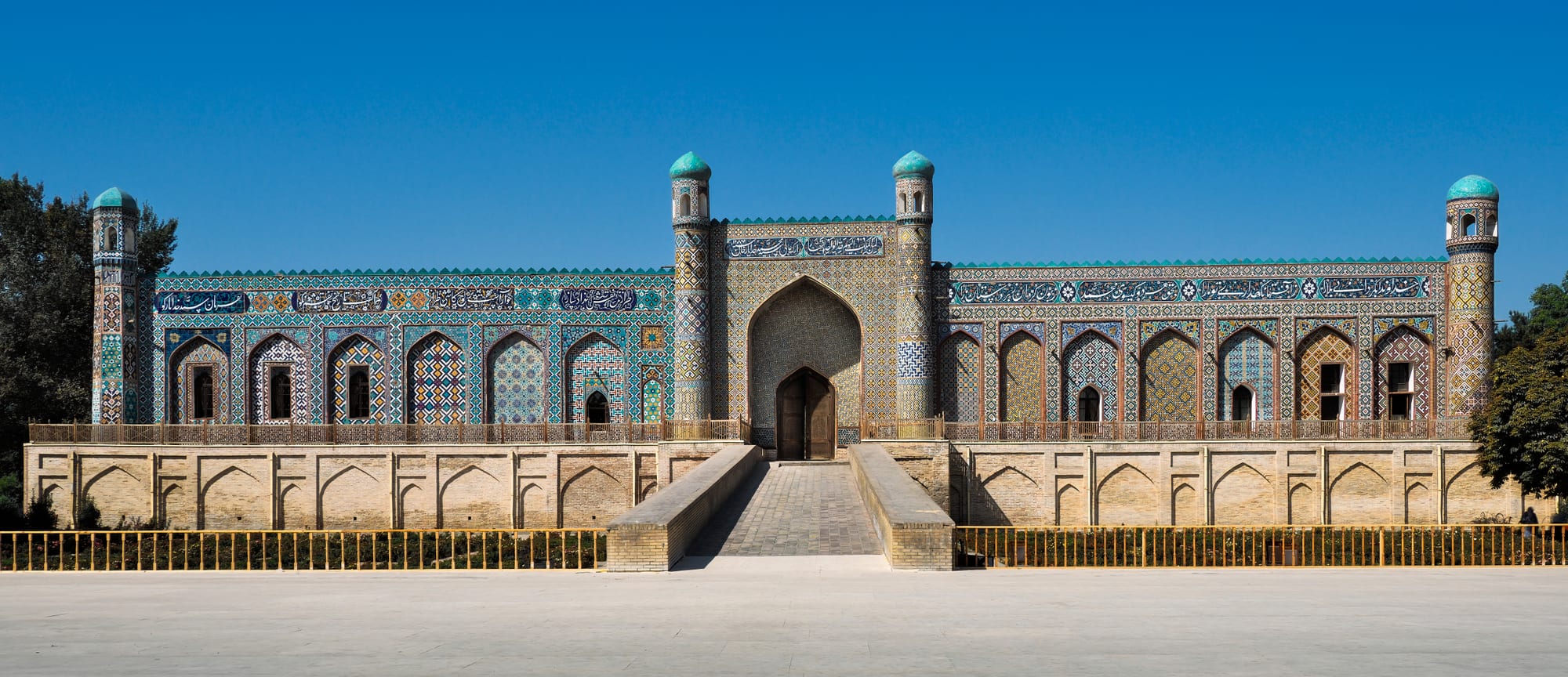
A long low palace facade covered in blue and ochre tilework, with four minaret-like turrets and a tall arched gateway above a ramp

Tashkent & the Fergana Valley, Uzbekistan

Kokand

The tiled facade of the Khudayar Khan Palace in Kokand. (Petar Milošević / Wikimedia Commons · CC BY-SA 4.0)

A city at the western end of the Fergana Valley that was the capital of the Khanate of Kokand, the power that ruled the valley and much of Central Asia until Russia annexed it in 1876. Its tiled palace, Friday mosque with a wooden-columned gallery and royal tombs survive among ordinary streets, and it remains a market town and craft centre.

Neighbourhoods

  • The palace quarter
    • First-time visitors
    • Historic district
    • Parks

    The open ground around the Khudayar Khan Palace, laid out as a park with flowerbeds and fountains on the site of the old royal citadel. Most of the city's monuments and its regional museum are within a short walk, and cafés and hotels stand on the surrounding avenues.

    Open in Maps
  • The old town and the bazaar
    • Markets
    • Local life
    • Best for food

    The dense lanes of mahalla housing north and west of the centre, built around the main bazaar and the Friday mosque. Bread ovens, teahouses and workshops sit among single-storey courtyard houses, and the market is at its busiest in the early morning.

    Open in Maps
  • The Russian-era centre
    • Quiet and residential
    • Close to public transport

    The grid of tree-lined streets laid out after the Russian annexation, east of the old town, with low 19th- and early 20th-century buildings, Soviet apartment blocks, the theatre and the railway station. It is the quieter, greener half of the city.

    Open in Maps

Things to do

The khanate's monuments

  • Khudayar Khan Palacelandmark

    The palace built in the early 1870s for Khudayar Khan, the last ruler of the khanate, its long facade covered in tilework, with courtyards, carved and painted ceilings and a museum that has occupied it since 1925.

    Open in Maps

Craft towns nearby

  • Rishtanattraction

    A small town of potters' workshops east of Kokand, known across Central Asia for bowls and plates glazed in blue and turquoise.

    Open in Maps

Short trips from the city

  • Margilanattraction

    The valley's silk town, where ikat khan-atlas cloth is dyed and woven by hand and a large bazaar trades on the edge of town.

    Open in Maps
  • Chustattraction

    A town in the northern corner of the valley known for its embroidered skullcaps and for its knives, many with the curved tip that is the local trademark.

    Open in Maps
  • Ferganaattraction

    The green Russian-planned provincial capital, the usual base for travel around the eastern half of the valley.

    Open in Maps
  • Namanganattraction

    One of the largest cities of the valley, on the northern side of the Syr Darya, with old madrasas and a large bazaar.

    Open in Maps
  • Kamchik Passviewpoint

    The high road pass through the Qurama range that carries the route between Tashkent and the valley, with long mountain views.

    Open in Maps

Seasonal events

  • NavruzMarch

    The spring new year, marked with neighbourhood gatherings, fairs and sumalak cooked overnight in large pots.

  • Independence DaySeptember

    The national holiday of 1 September, with concerts and fireworks in the parks and squares.

Eat and drink

Long-standing places and food districts in Kokand. Hours, ratings and directions come from your maps app, always current.

Valley classics

  • Kokand plov and choyxona lunchesrestaurant

    Fergana-style plov, with the rice cooked in the stock and served with mutton, carrots and onion, eaten at midday in teahouses with bread and green tea.

    Open in Maps
  • Lagman and shashlik housesrestaurant

    Hand-pulled noodles in broth or fried with meat and peppers, alongside skewers grilled over charcoal, are the staple of the city's small restaurants.

    Open in Maps

Markets

  • Kokand bazaarmarket

    The city's main market: bread from tandoors, samsa, dried apricots and raisins, melons and grapes in season, and stalls of spices, pickles and Korean-style salads.

    Open in Maps

Experience Kokand

History

Kokand takes its name from the Khokand or Khuqand of the medieval sources, a settlement on the caravan road between the Fergana Valley and the west that was destroyed by the Mongols and lay largely abandoned for centuries. It was refounded as a fortress in 1709 by Shahrukh Biy of the Ming tribe of Uzbeks, who had made themselves masters of the western valley, and from that fort grew the Khanate of Kokand.

Under Alim Khan, Umar Khan and Madali Khan in the first half of the 19th century the khanate expanded far beyond the valley, taking Tashkent, pushing north across the steppe to Turkestan and Hazrat-i Turkestan and south into the Pamirs, and controlling the caravan trade towards Kashgar and Russia. Umar Khan's court was a centre of Chagatai poetry, presided over in part by his wife Nodira, herself a celebrated poet, and the city filled with mosques, madrasas and the tombs of the ruling family. By the mid-century it was said to hold more than three hundred mosques, along with many madrasas.

Rivalry with the Emirate of Bukhara, revolts and dynastic murders weakened the khanate, and Russian expansion did the rest: Tashkent fell in 1865, and after an uprising the generals Kaufman and Skobelev annexed the khanate, which was abolished in 1876, its lands becoming the Fergana Oblast of Russian Turkestan. Khudayar Khan's palace, finished only a few years earlier, survived. Soviet rule brought cotton, a railway and light industry; many older religious buildings were demolished or converted. The late Soviet years and the decades since brought periods of unrest to the valley, and Kokand is now a provincial industrial and market town whose monuments have been restored for visitors.

Culture & Customs

Kokand carries the memory of a court city. Its 19th-century poets, above all Nodira, are part of the national literary canon, and the palace, the tombs and the madrasas are treated as monuments of Uzbek statehood rather than only as tourist sights. The city has long had a reputation for scholarship and for religious learning, and several of the old madrasas still stand.

Craft traditions run through everyday life in the western valley: pottery from Rishtan a short way east, woodcarving and ganch plasterwork of the kind that decorates the palace ceilings, knife-making, and embroidery. Kokand has hosted an international handicrafts festival since 2019, bringing artisans from many countries to the city. Music at weddings and holidays draws on the maqom tradition and on valley folk singing, with the surnay and doira leading processions.

Social life is organised by the mahalla, the neighbourhood association that runs weddings, funerals, and mutual help, and its committees carry real weight. The valley is more conservative than Tashkent: dress is modest, Friday prayers are well attended, alcohol is drunk more discreetly, and hospitality is emphatic — a visitor who stops to look at a courtyard gate is likely to be asked in for tea. Elders are greeted first, and the right hand, or both hands, is used to give and receive.

Daily Life

About 250,000 people live in Kokand, making it one of the larger cities of the Fergana Valley, in a district where villages and fields begin immediately beyond the last streets. Most families live in single-storey courtyard houses in the mahallas, with Soviet apartment blocks in the newer districts, and households are large by national standards; land and housing are scarce in the most densely settled part of the country.

The economy mixes industry, farming and trade. Chemical and fertiliser plants, a cotton mill and food processing date from Soviet planning; the surrounding district grows cotton, wheat, fruit and vegetables under irrigation; and the bazaar is the city's commercial heart. Many households depend on a member working in Tashkent, Russia or Kazakhstan, and remittances show in the newly built houses and wedding halls.

The day starts early, with bread bought hot and the market busiest before the sun gains strength, and slows in the middle of hot afternoons before reviving in the evening, when families walk in the park around the palace. Water for irrigation, gas and electricity supply in winter, and work for young people are the everyday concerns, and the city empties a little in summer as families visit relatives in the hills.

Food

Kokand eats the food of the Fergana Valley. Plov here is made in the valley style, with the rice cooked together with the stock, meat, carrot and onion so that it takes on a deep colour, and it is eaten at midday rather than in the evening. Lagman, hand-pulled wheat noodles served in a spiced broth with mutton and peppers or fried as quruq lagman, is a valley staple, brought by Uyghur and Dungan settlers and now thoroughly local.

Bread is the fixed point of every meal: obi non baked on the wall of a tandoor, round and stamped in the centre, with the valley's own patterned versions sold at the bazaar. Samsa, pastries of lamb and onion or pumpkin baked in the same tandoors, are eaten standing up through the morning. Other everyday dishes include shurpa, a fatty mutton and vegetable soup; manti, large steamed dumplings served with sour cream; chuchvara, small dumplings in broth; and shashlik grilled to order.

The valley's orchards supply the rest: apricots fresh and dried, cherries, grapes, pomegranates and the melons that are piled in the markets from late summer. Kokand has a particular name for its halva and its sweets, sold in slabs at the bazaar alongside sugared nuts and dried mulberries. Green tea is drunk through the day, poured for guests before anything else arrives, and the teahouse is as much a meeting place as somewhere to eat.

Planning tools

Budget

Kokand is inexpensive even by Uzbek standards. Hotels are simple and few, meals in teahouses and canteens cost very little, and the monuments charge small entry fees. The main costs are transport — a shared taxi or a hired car for the day to link Kokand with Rishtan and Margilan — and there is little on which to spend more.

Daily Budget Midrange
USD 60–130 (mid-range hotel, restaurants, a driver for the valley circuit or the mountains)
Daily Budget Shoestring
USD 20–35 (guesthouse or simple hotel, bazaar and canteen food, shared taxis)

Carry som in cash: card payment is far less common here than in Tashkent, and ATMs are limited to the centre.

Best Time to Visit

April to early June and September to October, when the valley is warm rather than hot and the orchards are in blossom or the bazaars full of fruit. July and August bring heat above 35°C and a haze over the valley. Winter is cold and damp, with little snow, and the monuments are almost empty.

Suggested Number of Days

The monuments are compact and a day is enough for the city itself. Two or three allow the rest of the western valley as well. Travelling by shared taxi rather than a hired car adds time, and midsummer heat slows everything down.

First Visit
1 day
With Surroundings
2–3 days

Transportation

The city is small enough to cross by taxi for a fixed low fare, and minibuses and shared cars run along the main avenues. Shared taxis leaving from the stands near the bazaar are the usual way to reach Margilan, Rishtan, Fergana and the Tashkent road, and they depart when full rather than to a timetable.

Agree the fare before getting into a taxi, and expect to share a car with other passengers on intercity routes.

Airport & Station Connections

Kokand is the first major town beyond the Kamchik Pass from Tashkent, about 230 km away by road; shared taxis and buses take four to five hours, and trains run through the tunnel under the pass. The station is on the edge of the city. Fergana and Margilan lie an hour or so east by road, and the nearest airport is at Fergana.

Walkability

The centre is flat and easy to walk, and the palace, the park and the nearest monuments sit within a few hundred metres of each other. The mosques and mausolea in the old town are spread over a wider area of narrow lanes without much shade, so a short taxi ride between them helps in summer. Pavements are uneven in places and traffic is unhurried.

Safety

Kokand is a quiet, low-crime city where visitors attract friendly curiosity rather than trouble. The practical risks are traffic on the main avenues, summer heat and the occasional overcharging of foreigners by taxi drivers. Police checkpoints are normal on the roads in and out of the valley.

Carry a passport for checkpoints and hotel registration, dress modestly at mosques and shrines, and drink plenty of water in summer. Check current official travel advice before travelling.

Climate

A continental climate sheltered by the mountains that ring the Fergana Valley: hot, dry summers, cool winters, and most of the light rainfall between late autumn and spring. Summer haze and dust are common in the enclosed valley.

Summer
hot and dry, typically 33–38°C in July, with warm evenings
Winter
cool to cold, around -3–8°C, with occasional snow that rarely lies long

Local Customs

The Fergana Valley is more traditional and more devout than the capital. Modest dress is usual, and shoulders and knees should be covered at mosques and shrines, where shoes come off and women cover their hair. Greetings are unhurried, elders are addressed first, and bread is broken by hand and never placed upside down. Invitations to tea are frequent and sincere.

Ask before photographing people, especially women and worshippers; tipping is not expected, and refusing food outright is best softened with an excuse.

Common Payment Methods

The currency is the Uzbek som (UZS). Cash is used for almost everything — bazaars, taxis, teahouses and small hotels — and notes should be carried in useful denominations. Cards are accepted in a handful of larger hotels and supermarkets, and ATMs cluster around the centre; money should only be changed at banks or licensed exchange desks.