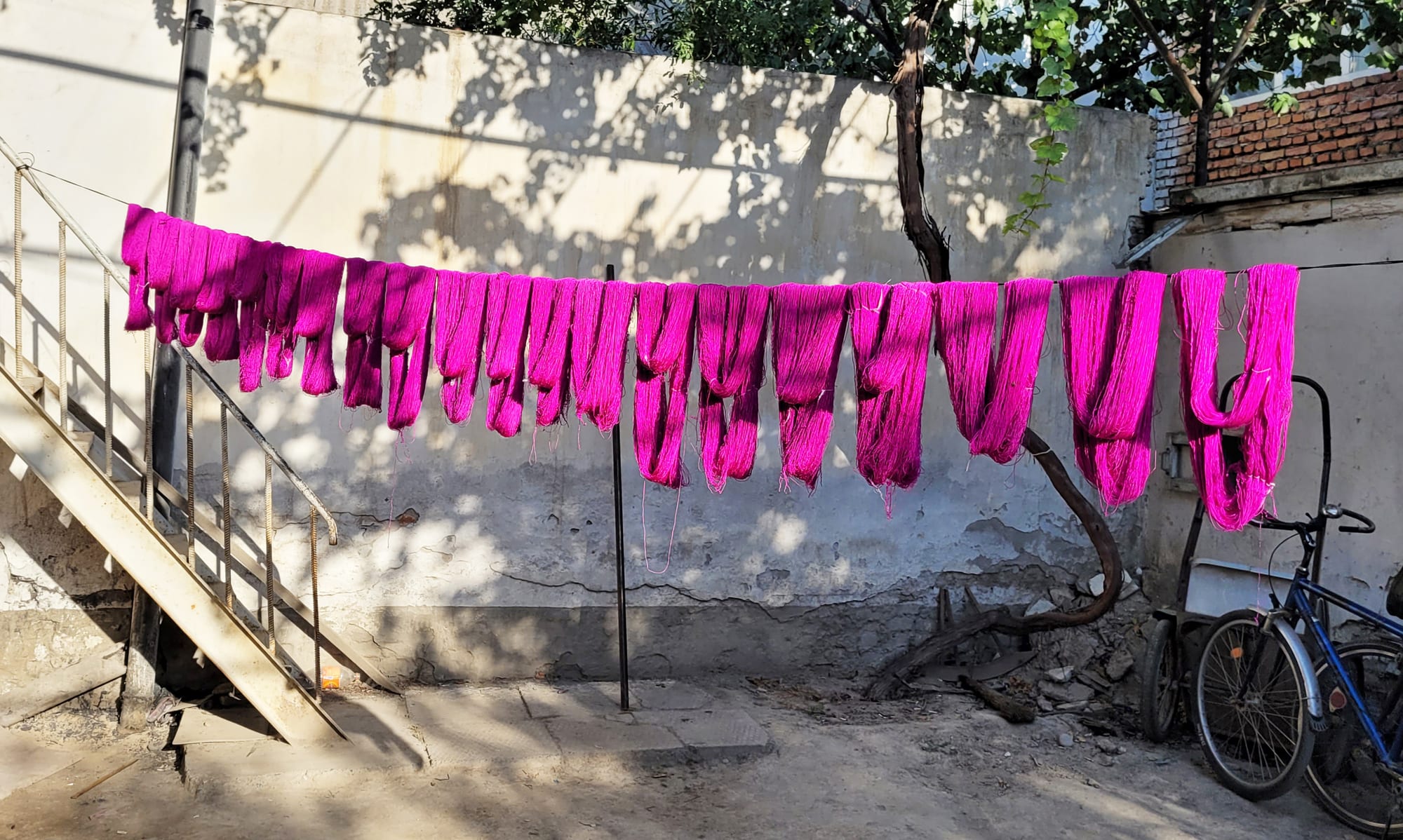
Skeins of freshly dyed magenta silk hung to dry on a line in a sunlit yard beside a plastered wall

Tashkent & the Fergana Valley, Uzbekistan

Margilan

Dyed silk thread drying at a silk works in Margilan. (Bgag / Wikimedia Commons · CC0)

An old town in the centre of the Fergana Valley that has made silk for more than a thousand years and still does, weaving the rippling ikat cloth known as khan-atlas on hand looms as well as in factories. Conservative, low-built and organised around its mahallas and its bazaar, it lies a short drive from the provincial capital, Fergana.

Neighbourhoods

  • The old mahallas
    • Historic district
    • Local life
    • Crafts

    Low streets of courtyard houses behind mud-brick and plastered walls, where family weaving and dyeing workshops work in back yards and the sound of looms carries into the lane. Mosques and shrines stand at the corners of several quarters, and life is quiet and domestic.

    Open in Maps
  • The centre and the bazaar
    • Markets
    • Best for food
    • Close to public transport

    The commercial core around the main market and the avenues laid out in Soviet times, with shops selling bolts of atlas and adras, canteens, teahouses and the stands where shared taxis leave for Fergana and Kokand.

    Open in Maps
  • Yangi Margilan
    • Quiet and residential

    The newer districts on the edge of town towards the Fergana road, a mix of apartment blocks, new houses and wide streets. It is where most of the town's recent building has gone, and it is calmer than the centre.

    Open in Maps

Things to do

Nearby valley towns

  • Ferganaattraction

    The provincial capital a short drive south, a green Russian-planned city of wide avenues, parks and the valley's main hotels.

    Open in Maps
  • Quvaattraction

    A small town east of Margilan built on the site of Qubo, an ancient Buddhist and Muslim centre ruined by the Mongol invasion.

    Open in Maps

Craft workshops nearby

  • Rishtanattraction

    A town of potters west of Margilan whose workshops glaze bowls and plates in the blue and turquoise that made its name.

    Open in Maps

Short trips from the town

  • Kokandattraction

    The old capital of the Khanate of Kokand at the western end of the valley, with the tiled palace of Khudayar Khan.

    Open in Maps
  • Andijanattraction

    The valley's eastern city, the birthplace of Babur, founder of the Mughal Empire, with a large bazaar and a memorial park in his name.

    Open in Maps
  • Namanganattraction

    One of Uzbekistan's largest cities, on the northern side of the Syr Darya, with old madrasas and extensive parks.

    Open in Maps

Seasonal events

  • NavruzMarch

    The spring new year, celebrated in the mahallas with communal cooking of sumalak, music and fairs.

  • Independence DaySeptember

    The national holiday of 1 September, with concerts and fireworks in the town's parks.

Eat and drink

Long-standing places and food districts in Margilan. Hours, ratings and directions come from your maps app, always current.

Valley classics

  • Choyxona lunchesrestaurant

    Teahouses with raised platforms where Fergana-style plov, salads, bread and green tea are served at midday to long tables of men and families.

    Open in Maps
  • Lagman and samsarestaurant

    Hand-pulled noodles in a spiced mutton broth, and tandoor-baked pastries of lamb and onion eaten through the morning, are the town's everyday food.

    Open in Maps

Markets

  • Kumtepa Bazaarmarket

    Food stalls sit alongside the cloth rows: bread from tandoors, dried apricots, raisins and nuts, and melons and grapes in late summer.

    Open in Maps
  • The central marketmarket

    The everyday market in the middle of town, with fruit and vegetables, butchers, dairy stalls, pickles and Korean-style salads.

    Open in Maps

Experience Margilan

History

Margilan is one of the oldest towns of the Fergana Valley, and local tradition dates it to antiquity, linking its foundation to the campaigns of Alexander the Great; the valley it stands in was the country the Han Chinese called Dayuan, whose horses drew their armies west in the 2nd century BC. Its documented importance begins with the Silk Road: caravans crossing between Kashgar and the cities of the Zarafshan passed this way, and Arab geographers of the 10th century already name it as a town of the valley.

Silk is the thread running through its history. Mulberry trees grew along the irrigation canals, silkworms were raised in village houses, and the town's weavers developed the resist-dyed warp technique known as ikat, whose blurred patterns give khan-atlas and the heavier half-silk adras their rippling edges. Under the Khanate of Kokand, Margilan was a wealthy trading town of merchants and craft guilds, and it was annexed with the rest of the khanate by Russia in 1876. The Russians built their administrative centre not here but a few kilometres away, calling it New Margilan; that town is now Fergana.

Soviet rule industrialised the craft, building a large silk combine and collectivising the mulberry groves, while private weaving continued quietly in the mahallas. The town gained a reputation both for religious conservatism and for trade, and its markets did well from the informal economy of the late Soviet years. Since independence the hand workshops have revived, partly through international interest in natural dyes and ikat, and silk-making has been recognised as living heritage.

Culture & Customs

The town's identity is bound up with cloth. Khan-atlas, the bright silk whose pattern is dyed into the warp threads before weaving, is worn across Uzbekistan in dresses and coats, and Margilan is where much of it is made; adras, the sturdier mix of silk and cotton, is used for coats and cushions. Hand workshops pass the skills through families, and the dyer, the warp-tier and the weaver are separate trades. Suzani embroidery and skullcap making are practised here too.

Margilan has long been considered one of the more devout towns of a devout valley. Mosques anchor the mahallas, Friday prayers are well attended, and dress in the street is modest; women more often wear the atlas dress and headscarf than in Tashkent. The mahalla committee organises weddings, funerals and mutual support, and its approval matters in family affairs.

Hospitality follows valley custom. Guests are seated at a dastarkhan spread with bread, sweets, nuts and fruit before anything cooked appears; tea is poured by the youngest present, the first cups returned to the pot; bread is torn by hand and never set upside down. Weddings are large and start early, often with a plov served to hundreds before noon, and the whole street takes part. Visitors who show interest in the looms are usually invited in.

Daily Life

About 250,000 people live in Margilan, in a town that runs almost without a break into the surrounding villages and into the city of Fergana to the south. Most families live in courtyard houses in the mahallas, several generations together, with newer apartment blocks in the districts at the edge. The Fergana Valley is the most densely populated part of Uzbekistan, and land, water and housing are under constant pressure.

Work is in textiles above all — the silk combine and smaller factories, the hand workshops, and the trade in cloth through the markets — alongside farming in the irrigated fields around the town, small-scale commerce and public employment. Wages are low, and a great many households have a son or husband working in Russia, Kazakhstan or Tashkent; the money sent home pays for building and for weddings.

Days begin before dawn in summer, with bread and the market early, work through the morning, a long pause at the hottest hours and a second round of activity in the evening, when the streets fill again and families visit. The market days at Kumtepa set the rhythm of the week. Water for irrigation, winter gas and power supply, and the future of hand weaving against cheap machine-printed cloth are the recurring local concerns.

Food

Margilan eats the food of the Fergana Valley, and its cooking is plainer and less elaborate than Samarkand's. Plov is made in the valley manner, the rice cooked together with the meat, carrot and onion in one cauldron so that it absorbs the stock and darkens, and served at midday. Wedding plov is made in enormous quantities and served early in the morning to guests who then go to work.

Lagman is the town's other staple: wheat noodles pulled by hand and served in a broth with mutton, peppers and tomato, or fried with the same ingredients. Samsa baked on the wall of a tandoor, filled with lamb and onion or with pumpkin in autumn, are sold hot through the morning; manti, large steamed dumplings, and chuchvara, small ones in soup, appear on most tables. Shurpa, a rich mutton and vegetable soup, is winter food, and shashlik is grilled over charcoal at every market.

Bread is baked in the tandoor as obi non, round loaves stamped in the middle, with patterned versions for holidays. The valley's orchards supply apricots, cherries, grapes, pomegranates and melons, eaten fresh in season and dried for the winter, and heaps of dried fruit and nuts fill the bazaar rows. Green tea is drunk all day, sweets and halva are served with it, and the teahouse remains the main place to sit and talk.

Planning tools

Budget

Margilan is cheap. Accommodation is limited to guesthouses and a few small hotels, many of them in weaving families' houses, and meals in teahouses and canteens cost very little. Silk is the main expense: a length of hand-woven khan-atlas costs far more than the factory-printed cloth sold beside it. Many visitors stay in Fergana and come for the day.

Daily Budget Midrange
USD 60–130 (mid-range hotel, restaurants, a driver for the valley circuit or the mountains)
Daily Budget Shoestring
USD 20–35 (guesthouse, bazaar and canteen food, shared taxis)

Bring som in cash — cards are rarely accepted outside a few hotels — and expect to bargain politely for cloth.

Best Time to Visit

April to early June and September to October are the pleasant months, warm rather than hot, with blossom in spring and the bazaars piled with fruit in autumn. Midsummer is above 35°C with a dusty haze over the valley. Winter is cold and grey, though workshops work all year and the market never stops.

Suggested Number of Days

A day is enough for the workshops, the mosques and the market. Two or three allow the wider valley as well. Anyone interested in weaving or buying cloth will want longer, and the weekend market days are the busiest time to be in town.

First Visit
1 day
With Surroundings
2–3 days

Transportation

The town is small and taxis cross it for a low fixed fare; minibuses run along the main roads and to the bazaar on the outskirts. Shared cars leave from stands near the market for Fergana, a short drive away, and for Kokand and Rishtan, departing when they fill rather than to a timetable.

Agree a fare before getting in, and ask for the Kumtepa market by name on market days, when extra minibuses run.

Airport & Station Connections

Margilan has a railway station on the Andijan–Kokand line, with trains from Tashkent across the Kamchik Pass. Fergana's airport is a short drive away, and the road from Tashkent over the pass takes five hours or so by shared taxi or bus. Most visitors arrive by car or shared taxi from elsewhere in the valley.

Walkability

The centre is flat and small enough to walk, and the old mahallas are best seen on foot, though their lanes are unsigned and easy to lose track of. Distances to the Kumtepa market and to the outer districts are longer than they look and usually covered by taxi. There is little shade on the main avenues, which makes midday walking hard in summer.

Safety

Margilan is a quiet town with very little crime, and visitors are a curiosity rather than a target. The risks are traffic on the main roads, summer heat, and being overcharged for cloth or a taxi. Police checkpoints on the valley roads are routine and polite.

Carry a passport for checkpoints and hotel registration, dress modestly in this conservative town and cover shoulders and knees at mosques and shrines. Check current official travel advice before travelling.

Climate

A continental valley climate: hot, dry summers, cool winters and light rainfall concentrated between late autumn and spring. The mountains enclosing the Fergana Valley keep the wind down, which leaves summer haze and dust hanging over the towns.

Summer
hot and dry, typically 33–38°C in July, with warm nights
Winter
cool to cold, around -3–8°C, with occasional snow and damp grey spells

Local Customs

Margilan is among the more traditional towns in Uzbekistan, and modest dress is normal for both men and women; shoulders and knees should be covered at mosques and shrines, where shoes are removed and women cover their hair. Greetings are unhurried and elders greeted first. Workshops welcome visitors, but it is courteous to ask before entering a courtyard or photographing a loom.

Ask before photographing people, especially women; accept tea when it is offered; tipping is not expected, though a small sum for a workshop demonstration is appreciated.

Common Payment Methods

The currency is the Uzbek som (UZS), and cash is the rule for cloth, taxis, teahouses and market stalls. A few hotels and larger shops take cards, and ATMs are found in the centre but should not be relied on. Change money at banks or licensed exchange desks only, and carry smaller notes for everyday purchases.