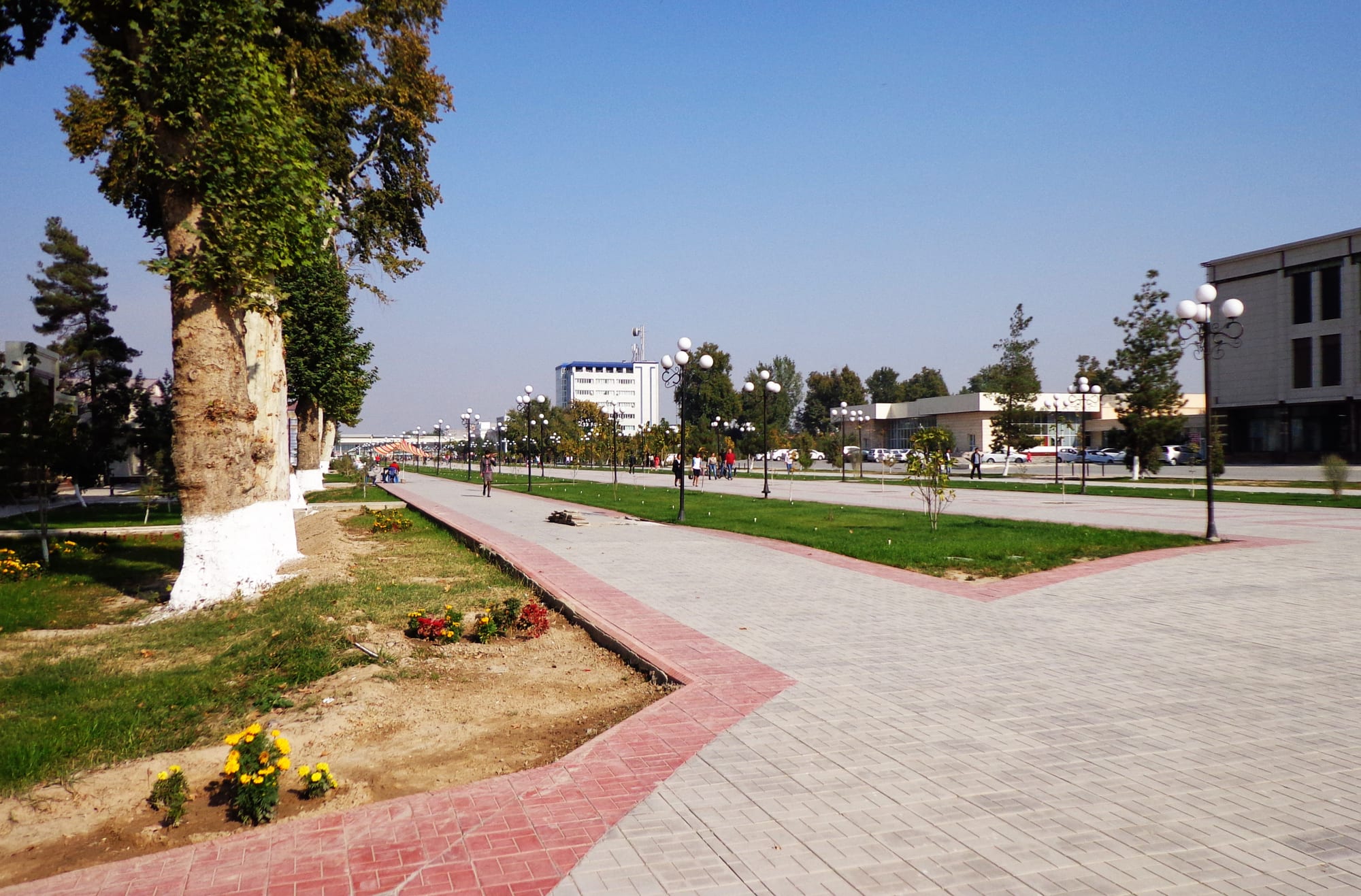
A wide paved promenade with flowerbeds, young trees and old plane trees leading towards low civic buildings under a clear sky

Tashkent & the Fergana Valley, Uzbekistan

Fergana

A tree-lined promenade in the centre of Fergana. (Multik2014 / Wikimedia Commons · CC BY-SA 3.0)

The provincial capital of the Fergana Valley, founded by the Russian army in 1876 as New Margilan and laid out with wide avenues radiating from a central park. It has few old monuments but plenty of shade, hotels and restaurants, which makes it the usual base for visiting the valley's silk, ceramic and khanate towns nearby.

Neighbourhoods

  • The central avenues
    • First-time visitors
    • Parks
    • Close to public transport

    The core of the Russian-planned town, where broad streets lined with plane trees meet at the central park. The regional administration, the theatre, the museum, most hotels and the main restaurants are within a few blocks of each other, and the pavements are shaded almost everywhere.

    Open in Maps
  • The bazaar quarter
    • Markets
    • Best for food
    • Local life

    The busier commercial district around the central market, north of the avenues, with food stalls, teahouses, shops and the stands where shared cars leave for Margilan, Kokand and the mountain roads. It is loud, practical and at its best early in the day.

    Open in Maps
  • The outer mahallas
    • Quiet and residential
    • Local life

    Beyond the planned grid the city turns into low streets of courtyard houses and orchards that merge with the surrounding villages and with Margilan to the north. There is little for visitors, but it shows how most of the valley actually lives.

    Open in Maps

Things to do

Nearby valley towns

  • Margilanattraction

    The valley's silk town a few kilometres north, where ikat khan-atlas cloth is dyed and woven by hand in family workshops.

    Open in Maps
  • Quvaattraction

    A small town east of the city built on the site of Qubo, an ancient Buddhist and Muslim centre ruined by the Mongol invasion.

    Open in Maps

Craft towns nearby

  • Rishtanattraction

    A town of potters west of Fergana whose studios have glazed bowls and plates in blue and turquoise for generations.

    Open in Maps

Short trips from the city

  • Kokandattraction

    The capital of the Khanate of Kokand at the western end of the valley, with the tiled palace of Khudayar Khan and old madrasas.

    Open in Maps
  • Andijanattraction

    The valley's eastern city, birthplace of Babur, founder of the Mughal Empire, with a large bazaar and a memorial park in his name.

    Open in Maps
  • Namanganattraction

    A large city on the northern side of the Syr Darya, known for its madrasas, its parks and a strong craft tradition.

    Open in Maps

Seasonal events

  • NavruzMarch

    The spring new year, marked with concerts and fairs in the central park and with sumalak cooked overnight in the mahallas.

  • Independence DaySeptember

    The national holiday of 1 September, with an evening concert and fireworks in the city centre.

Eat and drink

Long-standing places and food districts in Fergana. Hours, ratings and directions come from your maps app, always current.

Valley classics

  • Plov and choyxona lunchesrestaurant

    Fergana-style plov, the rice cooked with the meat and carrots in one cauldron, is eaten at midday in teahouses with salad, bread and green tea.

    Open in Maps
  • Lagman and shashlik housesrestaurant

    Hand-pulled noodles in a spiced mutton broth or fried with peppers and tomato, alongside skewers grilled over charcoal, fill the small restaurants near the market.

    Open in Maps

Markets and food streets

  • Fergana central bazaarmarket

    The city's main market: tandoor bread and samsa, butchers and dairy stalls, pickles and Korean-style salads, and heaps of apricots, grapes and melons in season.

    Open in Maps
  • Restaurants on the central avenuesneighborhood

    The shaded streets around the park hold most of the city's sit-down restaurants and cafés, including Russian, Turkish and Korean kitchens alongside Uzbek ones.

    Open in Maps

Experience Fergana

History

Fergana is the youngest of the valley's cities. After Russian forces abolished the Khanate of Kokand in 1876 and created the Fergana Oblast, the military governor Mikhail Skobelev chose a site on empty land a few kilometres south of the old silk town of Margilan for a garrison and administrative centre, rather than build inside an existing Muslim city. The new town, laid out from 1877 on a fan of straight avenues radiating from the military and administrative quarter and planted with plane trees, was named New Margilan, then Skobelev in 1907 after the valley's first Russian military governor.

The town grew as the administrative and commercial capital of a cotton-growing province, with Russian officials, merchants, a garrison and, after the railway reached the valley, warehouses and cotton-cleaning plants. In 1924 it was renamed Fergana, after the valley itself, and under Soviet planning it acquired textile mills, a fertiliser works fed by gas piped from western Uzbekistan and an expanded oil refinery, the valley's first having been built near the city in 1908, which drew workers from across the Soviet Union.

Independence in 1991 left Fergana the capital of a densely populated and economically strained province. Many Russian and other Slavic residents left in the following decades, the valley saw unrest and, in 1989, ethnic violence against Meskhetian Turks that led to their mass departure, and the industrial plants shed jobs. In recent years the city has been repaved and replanted and tourism to the surrounding craft towns has grown, with Fergana serving as the base.

Culture & Customs

Fergana has a double character: a planned Russian town at its centre and a thoroughly Uzbek valley city around it. Russian is still widely spoken in the centre, where Soviet-era apartment blocks, a theatre and a regional museum stand among the avenues, while the outer mahallas keep the customs of the valley — the mahalla committee, the dawn wedding plov, Friday prayers and the dastarkhan spread for guests.

The city has no great monuments of its own, and its cultural life is that of a provincial capital: the regional drama theatre, concerts in the park, sports grounds and the celebrations at Navruz in March, when the parks fill and sumalak is cooked overnight. Its real cultural weight comes from the towns around it, whose weaving, pottery and knife-making are treated as national heritage, and whose masters are well known in the city.

Manners follow valley custom. Elders are greeted first, often with a hand placed on the heart; guests are pressed to eat and served tea before anything else; bread is broken by hand and never placed face down. Dress in the street is modest and rather formal, and alcohol, though sold openly, is drunk discreetly. The Fergana Valley is proud, hospitable and slightly wary of outsiders' assumptions about it, and interest in local crafts is the surest way into a conversation.

Daily Life

About 320,000 people live in the city, in a province of several million packed into irrigated land between the mountains. The centre is a mixture of Soviet apartment blocks and low pre-revolutionary houses; most families live further out in courtyard houses in mahallas that run without a clear break into villages and into Margilan a few kilometres north. Housing and land are in short supply and households are large.

The economy rests on administration, trade and industry. The oil refinery and chemical works, textile mills and food processing remain significant employers, the bazaar and small businesses absorb many more, and farming — cotton, wheat, fruit and vegetables under irrigation — surrounds the city. Wages are low, and labour migration to Russia, Kazakhstan and Tashkent is a fact of life in almost every extended family, with remittances paying for houses and weddings.

The day begins early, with the bazaar busiest before mid-morning and offices open by nine; the hottest hours empty the streets, and the avenues and parks fill again in the evening, when families walk, eat ice cream and sit under the trees. Water for irrigation, winter gas and electricity supply, air quality near the industrial zone and work for young people are the persistent local concerns.

Food

Fergana eats valley food. Plov is cooked in the valley manner, with rice, mutton, carrot and onion simmered together in one cauldron so the grains absorb the stock and darken, and it is a midday dish; wedding plov is served in vast quantities early in the morning. Every teahouse has its own version, and cooks in the valley argue about the right rice, fat and proportion of carrot.

Lagman is the other staple: wheat noodles pulled by hand and served in a broth with mutton, peppers, tomato and herbs, or fried dry. Samsa, lamb or pumpkin pastries baked on the wall of a tandoor, are eaten through the morning; manti, large steamed dumplings, come with sour cream; chuchvara are small dumplings in soup; shurpa, a rich mutton and vegetable soup, is winter food; and shashlik is grilled over charcoal at the markets and in the evenings. Korean-style salads and pickles, sold by the weight at the bazaar, have been part of the local table since Korean deportees settled in Central Asia in the 1930s.

Bread is baked in the tandoor as obi non, round loaves stamped in the middle, different in each town of the valley. The orchards around the city supply apricots, cherries, peaches, grapes, pomegranates and melons in great quantity, eaten fresh in season and dried for winter, and piled in the market rows with nuts and halva. Green tea is drunk through the day, black tea in winter, and coffee shops have appeared along the central avenues in recent years.

Planning tools

Budget

Fergana has the best choice of hotels in the valley and is still inexpensive: mid-range rooms cost a fraction of Samarkand's, and meals in teahouses and canteens are very cheap. The main variable cost is transport, since most of what visitors come for lies in other towns and a car with a driver for the day is the efficient way to reach them.

Daily Budget Midrange
USD 60–130 (mid-range hotel, restaurants, a driver for the valley circuit or the mountains)
Daily Budget Shoestring
USD 20–40 (guesthouse or simple hotel, bazaar and canteen food, shared taxis)

Keep som in cash for taxis, markets and small towns; cards work in a few hotels and supermarkets only.

Best Time to Visit

April to early June and September to October bring warm days, blossom in the orchards in spring and markets full of fruit in autumn. July and August are hot, above 35°C, with a dusty haze across the valley. Winter is cold and grey, but the city's hotels stay open and the craft workshops work all year.

Suggested Number of Days

The city itself takes half a day at most. Three or four days make sense for the valley as a whole, using Fergana as a base. Travelling by shared taxi rather than a hired car adds time, and summer heat shortens what can be done between late morning and mid-afternoon.

First Visit
1 day
With Surroundings
3–4 days

Transportation

Taxis cross the city for a low fixed fare and minibuses run along the main avenues. Shared cars for Margilan, Kokand, Rishtan, Andijan and Namangan leave from stands near the bazaar when they are full. Hiring a car with a driver for the day is common and not expensive, and is the usual way to link several valley towns.

Agree fares before setting off, and expect the driver to pick up other passengers on intercity routes unless the car is hired outright.

Airport & Station Connections

Fergana International Airport, on the edge of the city, is one of Uzbekistan's busier airports after those at Tashkent, Samarkand and Namangan. Margilan, a short drive north, has the railway station on the Andijan–Kokand line, with trains from Tashkent across the Kamchik Pass. By road from Tashkent the journey over the pass takes around five hours by bus or shared taxi. The city lies about 320 km east of Tashkent.

Walkability

The centre is one of the easiest places to walk in Uzbekistan: flat, laid out on a regular plan, and shaded by mature plane trees along most avenues, with the park in the middle. Distances between the centre, the bazaar and the outer districts are longer and usually covered by taxi. Crossings on the wide avenues need care, and midsummer afternoons are draining even in shade.

Safety

Fergana is calm and safe, with low crime and a steady police presence, and foreign visitors draw friendly interest. The practical risks are traffic, summer heat and occasional overcharging by taxi drivers. Roads towards the Kyrgyz and Tajik borders that ring the valley have checkpoints, and border areas can be subject to restrictions.

Carry a passport for checkpoints and hotel registration, avoid wandering into unmarked border zones, and use agreed fares or ride-hailing apps. Check current official travel advice before travelling.

Climate

A continental climate sheltered by the mountains that enclose the Fergana Valley, with hot dry summers, cool winters and light rain concentrated from late autumn to spring. Still air leaves haze and dust over the valley in the hottest months.

Summer
hot and dry, typically 33–38°C in July, with warm evenings
Winter
cool to cold, around -3–8°C, with occasional snow and damp grey spells

Local Customs

The valley is more conservative than Tashkent, though the provincial capital is the most relaxed place in it. Modest dress is normal, and shoulders and knees should be covered at mosques and shrines, where shoes are removed and women cover their hair. Greetings are unhurried, elders greeted first, and bread is torn by hand rather than cut.

Ask before photographing people, especially women and worshippers; accept tea when offered; tipping is not expected but small change is welcome.

Common Payment Methods

The currency is the Uzbek som (UZS). Cash is used for taxis, markets, teahouses and small hotels, and is essential outside the city. Cards are accepted in the larger hotels and supermarkets, and ATMs are found in the centre, though they can be out of cash; change money only at banks or licensed exchange desks.