💰 Budget
Moynaq itself costs very little: rooms are simple, meals are basic and there is almost nothing to spend money on. The expense is getting here and getting about, since nearly everyone hires a car and driver from Nukus, and a night in one of the yurt camps set up for visitors adds to that.
- Daily Budget Midrange
- USD 60–140 (a car and driver from Nukus for the day, a night in a yurt camp, meals included)
- Daily Budget Shoestring
- USD 25–40 (guesthouse room, meals with the family, shared taxi from Nukus)
Share the cost of the car from Nukus with other travellers, bring cash for the whole trip, and arrange a room before arriving, as there are only a few.
📅 Best Time to Visit
April to early June and September to October. The desert is bearable then, the light on the seabed is good early and late in the day, and dust is less of a problem than in high spring. Summer is very hot with no shade at all, and winter brings hard frosts and a bitter wind off the open plain.
⏳ Suggested Number of Days
Many people come for only a few hours, as a long day trip from the regional capital. Staying overnight adds early morning light and a quieter sense of the place; two or three days are needed for the deeper desert journeys, which depend on hiring a suitable vehicle.
- First Visit
- half a day to a day
- With Surroundings
- 2–3 days
🚆 Transportation
There is no local public transport worth the name. The town is small enough to walk, and the ship graveyard is on its northern edge. Shared taxis and occasional minibuses run to Kungrad and Nukus, mostly in the morning, and everything further — the current shoreline, the gas fields, the plateau — needs a four-wheel drive with a driver who knows the tracks.
Treat any trip beyond the town as an expedition with fuel, water and a driver who has done the route before, and do not attempt the seabed tracks in an ordinary car.
🛬 Airport & Station Connections
Nukus is the gateway: roughly 200 kilometres and about three hours by road, on a route through Kungrad that is paved most of the way. Shared taxis leave Nukus in the morning, and hired cars with drivers are the usual choice. The nearest airport and railway station are at Nukus, though trains also stop at Kungrad.
🚶 Walkability
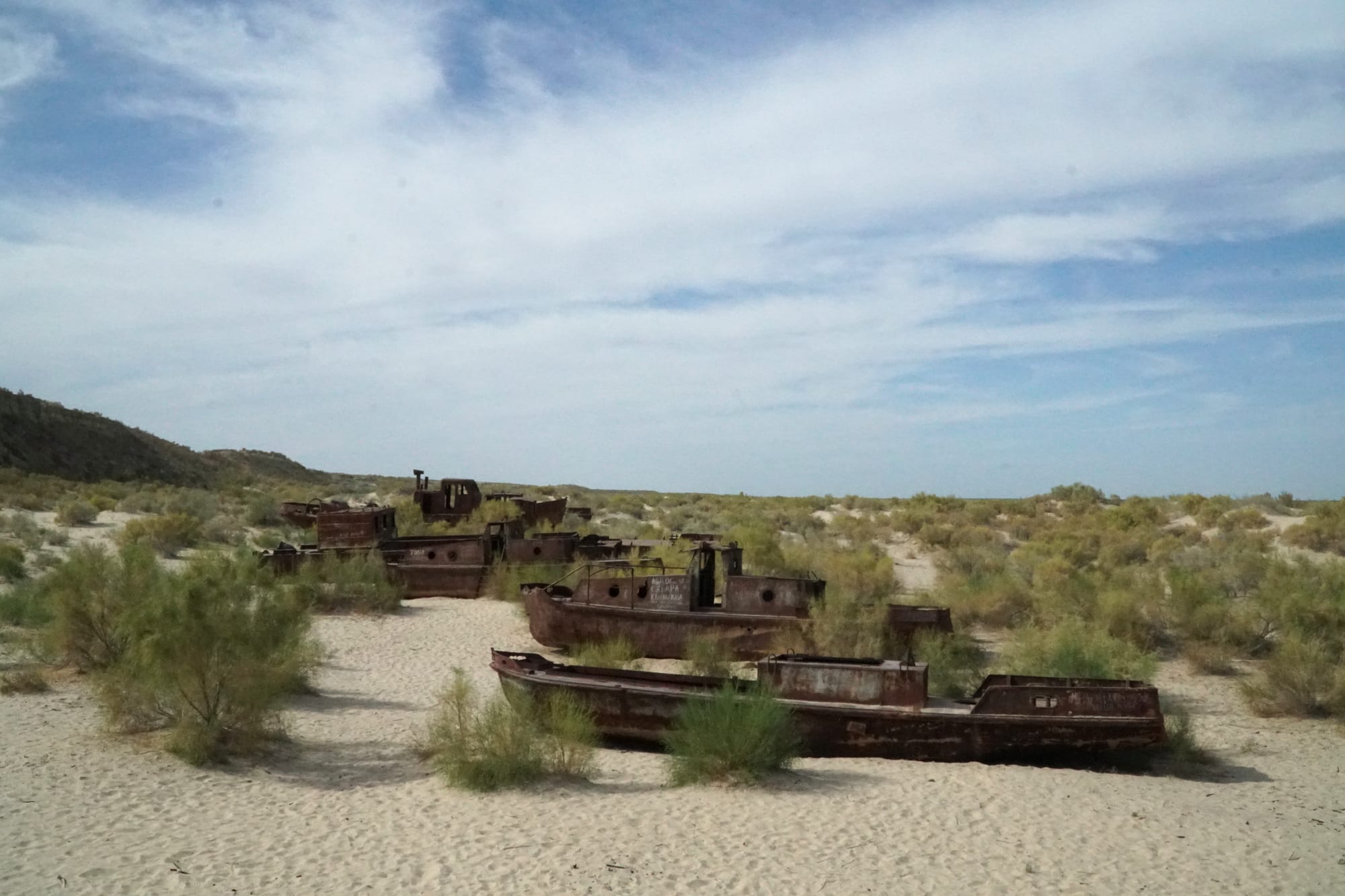
The town is flat, quiet and easily walked, with the memorial and the ship graveyard about twenty minutes from the centre. Roads are wide, sandy and largely unpaved away from the main street, distances between houses are long, and there is very little shade or street lighting. Walking out onto the seabed is easy going but exposed, and the sand and salt are hard on shoes.
🛡️ Safety
Crime is not a concern in a town this small, and visitors are welcomed. The risks are environmental and logistical: extreme heat in summer and hard cold in winter, dust and salt storms off the dried seabed, no shelter or water beyond the town, sharp rusted metal among the wrecks, and medical facilities that amount to a small clinic, with the nearest hospital hours away in Nukus.
Carry more water than seems necessary, cover the face in dusty wind, take care climbing on the wrecks, and never head onto the seabed without a driver and a working vehicle. Check current official travel advice before travelling.
🌦️ Climate
A harsh continental desert climate, made harsher by the loss of the sea that once moderated it: summers are hotter and winters colder than they were before the 1960s, rainfall is minimal, and the wind blows dust and salt off the exposed bed, worst in spring.
- Summer
- very hot and dry, often 35–40°C by day, with strong sun and no shade on the seabed
- Winter
- cold, with January days commonly around -5 to 0°C, night frosts well below that and a biting wind
🤝 Local Customs
This is a Karakalpak town, with its own language close to Kazakh alongside Uzbek and Russian, and hospitality is taken seriously: tea, bread and sweets appear for any guest. Dress modestly, remove shoes when entering a house, and ask before photographing people or their yards. The loss of the sea is a painful family history rather than a curiosity, and is best approached with care.
Tipping is not expected, though paying a fair price to drivers and hosts matters in a place with little work; gifts of food or tea for a host household are appreciated.
💳 Common Payment Methods
The currency is the Uzbek som, and Moynaq runs on cash. Cards are of almost no use, and ATMs cannot be relied on, so enough money for the whole visit — including the driver, the room and meals — should be drawn in Nukus beforehand, in small notes where possible.