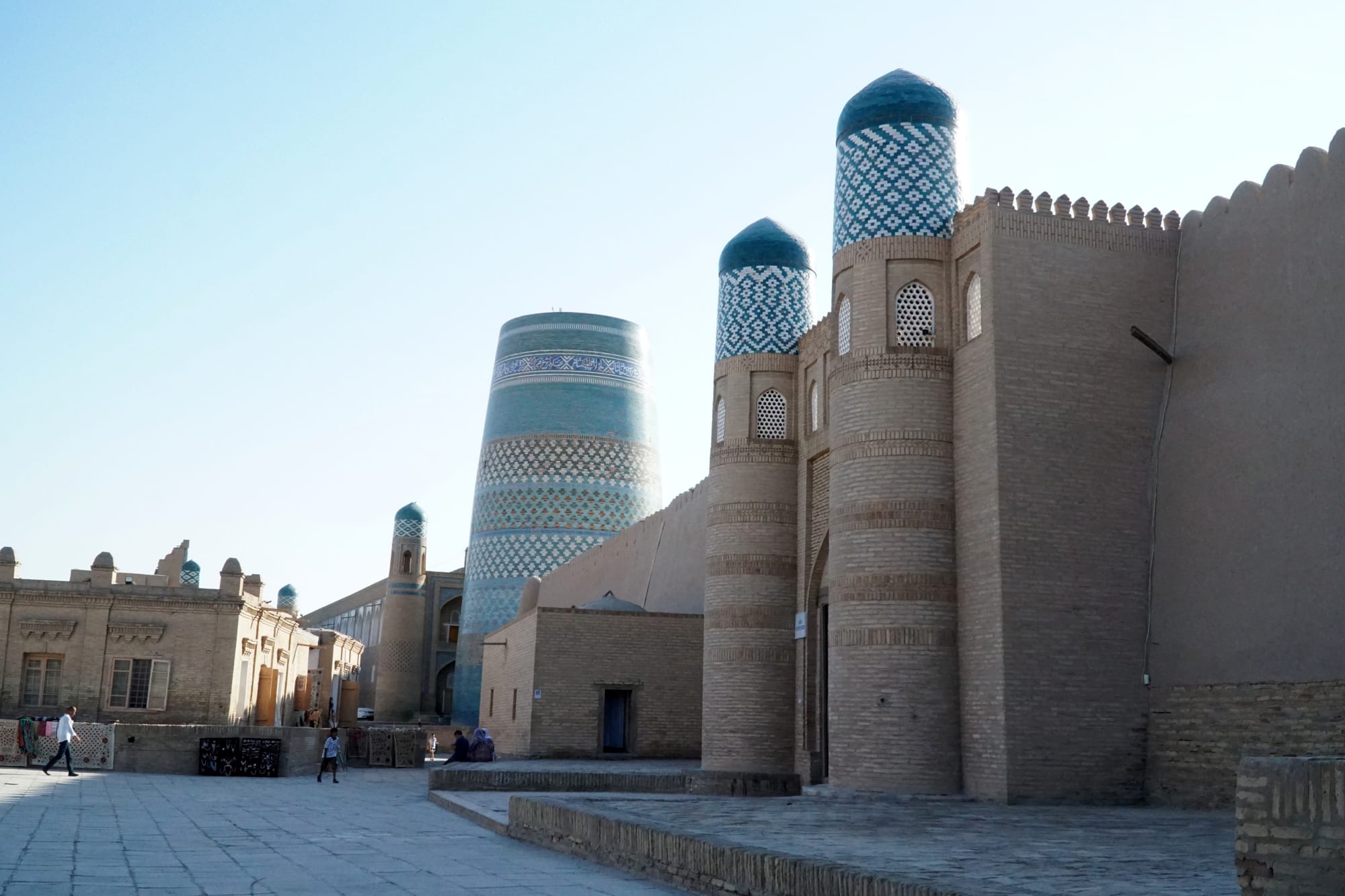
A squat turquoise-tiled minaret behind the brick walls and round bastions of a fortress gateway, under a clear sky

Khiva & Karakalpakstan, Uzbekistan

Khiva

The Kalta Minor minaret rising behind the gate towers of the Kuhna Ark in Khiva's walled inner town. (Adam Harangozó / Wikimedia Commons · CC BY-SA 4.0)

An oasis town on the edge of the Kyzylkum desert in western Uzbekistan, and from the early 17th century the capital of the Khanate of Khiva. Its walled inner town, Itchan Kala, keeps mosques, madrasas, minarets and palaces inside a ring of mud-brick ramparts and became Uzbekistan's first UNESCO World Heritage Site in 1990.

Neighbourhoods

  • Itchan Kala
    • First-time visitors
    • Historic district
    • Museums

    The walled inner town, a compact rectangle inside ramparts eight to ten metres high, holding almost every monument the khans built, along with guesthouses, craft workshops and families who still live inside the ramparts. Traffic is largely kept out, so it is covered on foot, and the tiled facades look very different at dawn and after dark.

    Open in Maps
  • Dishan Kala
    • Local life
    • Quiet and residential
    • Architecture

    The outer town within its own, longer wall, built in the 19th century around the inner city. It mixes courtyard houses, gardens, the Nurullabay palace and ordinary shops, and is where much of Khiva's population actually lives.

    Open in Maps
  • Around the east gate and the bazaar
    • Best for food
    • Markets
    • Close to transport

    The busiest edge of the old town, where the Palvon gate opens onto the market, food stalls and the stands for shared taxis and buses to Urgench. Hotels and eating places cluster along the approach streets.

    Open in Maps
  • The modern town
    • Quiet and residential
    • Budget stays

    Soviet-era apartment blocks, schools and offices spreading north and east towards the Urgench road, with little for visitors beyond cheaper rooms, banks and the everyday shops the old town lacks.

    Open in Maps

Things to do

Inside Itchan Kala

  • Itchan Kalalandmark

    The walled inner town itself, listed by UNESCO in 1990, entered through four gates and walkable along sections of its mud-brick ramparts.

    Open in Maps
  • Konya Arklandmark

    The khans' citadel against the western wall, with a tiled throne courtyard, a mint, a summer mosque and a bastion that is the classic sunset viewpoint.

    Open in Maps
  • Juma Mosquelandmark

    The Friday mosque, rebuilt in 1788 as a flat-roofed hall carried on 212 wooden columns, some of them carved centuries before the present building.

    Open in Maps
  • Tash Haulilandmark

    The 19th-century 'stone house' palace of Allakuli Khan, with harem, reception and court courtyards lined in blue and white tile and carved wood.

    Open in Maps
  • Islamkhodja Madrasah and minaretlandmark

    A madrasa of 1908–1910 beside the tallest tower in Khiva, a minaret of 56.6 metres banded in brick and glazed tile, built by the khanate's prime minister Islam Khodja.

    Open in Maps
  • Kalta Minorlandmark

    The wide, unfinished minaret sheathed in glazed turquoise and green tile, begun by Muhammad Amin Khan and left as a stump when he died.

    Open in Maps
  • Muhammad Aminkhan Madrasahlandmark

    The largest madrasa of the old town, built beside the Kalta Minor in the mid-19th century and later converted to accommodation.

    Open in Maps
  • Pahlavon Mahmud Mausoleumlandmark

    The domed shrine of a 13th-century poet, wrestler and healer who became Khiva's patron saint, its interior covered in blue and white tilework and visited by pilgrims.

    Open in Maps

Museums and workshops

  • Nurullaboy Palacelandmark

    A palace in Dishan Kala built by Muhammad Rahim Khan II for his son Asfandiyar Khan and finished in 1912, combining Khorezm courtyards with a European-style wing for receiving foreign guests.

    Open in Maps
  • Woodcarving and silk workshops of Itchan Kalaattraction

    Several madrasas inside the walls house workshops and small museums where carvers, silk weavers and carpet makers work in view of visitors.

    Open in Maps

Walls, gates and views

  • Ota Darvozalandmark

    The rebuilt west gate, the main entrance to the inner town and the start of the axis that runs past the Kalta Minor to the eastern gate.

    Open in Maps
  • The city wallsviewpoint

    The mud-brick ramparts with their rounded bastions can be climbed in places, giving a view over flat roofs, domes and minarets towards the desert.

    Open in Maps

Short trips from the town

  • Urgenchattraction

    The provincial capital about 35 kilometres east, with the region's airport, the main railway station and long-distance bus links.

    Open in Maps
  • Ayaz Kalalandmark

    A group of ancient Khwarazmian fortresses on a bluff above the desert north-east of Khiva, with a yurt camp below the ruins.

    Open in Maps
  • Toprak-Kalalandmark

    The eroded mud-brick walls and high palace platform of a Khwarazmian royal city, excavated for its wall paintings and archives.

    Open in Maps
  • Kyzyl-Kalalandmark

    A compact square fortress of the Khwarazm desert, partly restored, standing within sight of Toprak-Kala.

    Open in Maps

Seasonal events

  • Navruzaround 21 March

    The spring new year, marked in Khiva with music and dancing in the squares of the old town and sumalak cooked overnight from sprouted wheat.

  • Independence Day1 September

    Concerts, fireworks and folk performances mark the national holiday, with events staged inside the walls.

  • Lazgi dance performancesspring and autumn

    Khorezm's fast, expressive dance, recognised by UNESCO in 2019, is performed regularly for visitors and at local celebrations.

Eat and drink

Long-standing places and food districts in Khiva. Hours, ratings and directions come from your maps app, always current.

Khiva classics

  • Shivit oshi restaurants in Itchan Kalarestaurant

    Courtyard and rooftop places inside the walls serve Khiva's signature dish, shivit oshi — dill-green noodles under a stew of meat, potato and vegetables, with sour cream.

    Open in Maps
  • Tea houses by the east gatecafe

    Simple chaikhanas around the eastern gate where green tea, somsa baked in a tandir and grilled shashlik are served through the day.

    Open in Maps

Markets and food streets

  • Khiva bazaarmarket

    The town market outside the eastern wall, with melons, apricots, rice, spices, dried fruit and bread stacked in rounds.

    Open in Maps
  • Tim of Allakuli Khanmarket

    A domed 19th-century trading arcade inside the walls, built for caravan commerce and now full of craft and souvenir stalls.

    Open in Maps

Experience Khiva

History

Local tradition says Khiva grew around a well called Kheivak, dug on the order of Shem, son of Noah, and that the water still tastes of it. Firmer history begins with the oasis of Khwarazm on the lower Amu Darya, a chain of irrigated settlements and fortified towns that had been farming the delta for thousands of years. Khiva was a modest stop on the caravan route to the Caspian until the Amu Darya changed course and the ruling Uzbek khans moved their capital here from Kunya-Urgench around the turn of the 17th century.

As capital of the Khanate of Khiva it grew rich in ways travellers found appalling: alongside cotton, silk and caravan trade, the town ran one of Central Asia's largest slave markets, supplied by Turkmen raiders who seized Persians and Russians from the steppe. Khans of the 19th century — above all Allakuli Khan and Muhammad Amin Khan — rebuilt the inner town, raising the madrasas, the Tash Hauli palace and the never-finished Kalta Minor.

In 1873 a Russian force under General Kaufman took the town, and the khanate continued as a Russian protectorate with its territory much reduced. The last khan was deposed in 1920 and the Khorezm People's Soviet Republic declared; within a few years the area was divided between the Uzbek and Turkmen republics. The Soviet authorities eventually treated Itchan Kala as a museum, resettling some residents and restoring monuments, and in 1990 it became the first site in Uzbekistan inscribed on the UNESCO World Heritage List.

Culture & Customs

Khiva belongs to Khorezm, a region with a strong identity of its own inside Uzbekistan. The local dialect sits closer to Oghuz Turkic — the branch that includes Turkmen and Turkish — than to the Uzbek of Tashkent, and Khorezmians are quick to point out the difference. The region's emblem is the lazgi, a fast dance built on shoulder shakes and rapid hand movements, said to have ancient roots and added to the UNESCO list of intangible heritage in 2019; it is danced at weddings and performed for visitors in the old town's courtyards.

Craft is the other pillar. Khiva's woodcarvers are known across Central Asia for the deep floral carving on the columns and doors of the old town, work that a few families have passed down for generations, and madrasas inside the walls now house carving, silk weaving, carpet and ceramic workshops. The sheepskin hats worn by older men, tall and shaggy, are a Khorezm signature.

Religious life centres on the mausoleum of Pahlavan Mahmud, a 13th-century poet, wrestler and healer adopted as the town's patron saint; pilgrims come from across the region, and the courtyard is treated as a place of quiet. Khivans live daily among monuments and have grown used to visitors, though families inside Itchan Kala guard their privacy: the lanes behind the main axis are homes, not exhibits.

Daily Life

About 90,000 people live in Khiva, a small town by Uzbek standards, and only a few thousand of them inside the walls. Tourism shapes far more of the economy than anywhere else in the region — guesthouses, restaurants, guides, drivers and craft workshops — but the surrounding Khorezm oasis is still farmland, irrigated by canals from the Amu Darya and planted with cotton, rice, wheat, melons and fruit trees.

The working day starts early, particularly in summer, when outdoor work stops in the worst of the afternoon heat and life resumes in the cool of the evening. The bazaar outside the eastern gate is the town's practical centre, and households buy bread, fruit and meat daily. Most families live in Dishan Kala or the newer blocks beyond it, in single-storey courtyard houses with a garden and a grapevine, and the mahalla committee organises weddings, funerals and neighbourhood upkeep.

Water is the constant issue: the Amu Darya's flow is heavily drawn on upstream, soils have grown saltier across the delta, and the shrinking of the Aral Sea to the north has made the whole region's climate harsher. Young people leave for Tashkent, Kazakhstan or Russia for work, and money sent home pays for the new houses on the edge of town. Restoration inside Itchan Kala is continuous, and how heavily it is done is a matter of local argument.

Food

Khorezm cooks differently from the rest of Uzbekistan, and Khiva's calling card is shivit oshi — noodles coloured bright green with dill, cut fine, steamed and served under a stew of mutton or beef with potato, carrot and tomato, and a spoonful of sour cream. It appears on nearly every menu in the old town and is made at home for guests. Tukhum barak, a pale parcel of pastry filled with beaten egg and milk and boiled, is the other local speciality, eaten with sour cream.

Bread is obi non baked against the wall of a clay tandir, stamped in the middle and bought fresh each morning; somsa, flaky pastries of lamb and onion, come out of the same ovens. Plov, cooked in a kazan over a wood fire, is the dish for weddings and guests, and the Khorezm version is usually simpler and less sweet than Samarkand's. Shurpa broth, grilled shashlik and manti, large steamed dumplings of minced meat and onion, fill out the everyday table.

The oasis is famous for its melons and watermelons, stacked by the road in late summer, along with apricots, grapes, pomegranates and mulberries. Green tea is drunk constantly and offered to every guest before anything else, usually with bread, dried fruit and sweets set out on the table.

Planning tools

Budget

Khiva is cheaper than Samarkand or Bukhara and easy to do on a small budget, with family guesthouses inside the walls, plenty of mid-range hotels and inexpensive restaurants. A single combined ticket covers most of the museums and monuments of Itchan Kala. The main extra cost is a car with driver for the desert fortresses or a night in a yurt camp.

Daily Budget Midrange
USD 60–140 (hotel inside or beside the walls, restaurant meals, a driver to the fortresses, a night in a yurt camp)
Daily Budget Shoestring
USD 25–40 (guesthouse room, bazaar and canteen food, shared taxis to Urgench)

Buy the combined Itchan Kala ticket rather than paying at each monument, and share the cost of a car to the desert fortresses with other travellers.

Best Time to Visit

April and May, then September and October, when days are warm rather than punishing and the evenings inside the walls are pleasant. Melons and grapes arrive from late summer. July and August are ferociously hot in open sun, and winter is cold and sometimes snowy, but the old town is almost empty and the light is good.

Suggested Number of Days

The walled town is small and most visitors give it a day and a half, including an evening and an early morning when the streets are quiet. Three or four days allow the desert fortresses, a yurt camp and slower time in the outer town.

First Visit
1–2 days
With Surroundings
3–4 days

Transportation

Itchan Kala is closed to most traffic and covered on foot. Shared taxis and marshrutka minibuses run constantly to Urgench, about 35 kilometres away; taxis are cheap and easy to find at the gates. Trips into the desert, to the fortresses or to Nukus are made by hired car with a driver.

Agree the fare with a taxi driver before setting off, and book a car for the fortresses through a guesthouse, since there is no public transport to them.

Airport & Station Connections

Urgench airport, about 35 kilometres away, has several flights a day from Tashkent and a few international services, and a taxi covers the distance in around 40 minutes. Trains from Tashkent, Samarkand and Bukhara run to Urgench, taking many hours; the road from Bukhara crosses a long empty stretch of the Kyzylkum desert in six to eight hours.

Walkability

One of the most walkable towns in Uzbekistan. Itchan Kala can be crossed end to end in about fifteen minutes, the lanes are paved and free of cars, and every monument is within a few minutes of another. Surfaces are uneven stone and brick, with steps and narrow stairs in the towers and minarets, and there is very little shade at midday. Dishan Kala and the bazaar are a short walk beyond the gates.

Safety

Khiva is a very safe town, well policed and used to visitors, and serious crime against travellers is rare. The real hazards are heat and sun in summer, uneven paving and unlit lanes after dark, and steep, dark stairs inside the minarets. Persistent souvenir selling and occasional overcharging are nuisances rather than dangers, and medical facilities are limited, with the nearest larger hospitals in Urgench.

Carry water and cover up against the sun in summer, use a torch in the old town after dark, and keep hotel registration slips as a precaution. Check current official travel advice before travelling.

Climate

Sharply continental and very dry, on the edge of the desert, with fierce summers, cold winters and short, changeable springs and autumns. Rain is scarce and falls mostly between late autumn and spring, and dust can blow off the desert in windy weather.

Summer
very hot and dry, commonly 35–42°C by day with strong sun and little shade
Winter
cold, with January days around 0–5°C, nights well below freezing and occasional snow on the domes

Local Customs

Khorezm is proud of its own dialect, music and dance, and visitors who show interest are treated warmly. Modest dress is expected at mosques, madrasas and the Pahlavan Mahmud shrine, where shoes are removed and women cover their heads; the shrine is a working pilgrimage site, so photographing worshippers is inappropriate. Bargaining at craft stalls is normal and good-humoured. Tea is offered before any transaction or conversation of substance.

Tipping is not obligatory but rounding up a restaurant bill is appreciated, and permission should be asked before photographing craftspeople at work or families in the lanes.

Common Payment Methods

The currency is the Uzbek som. Larger hotels, some restaurants and the museum ticket office take cards, but Khiva remains largely a cash economy, and guesthouses, taxis, stalls and the bazaar expect notes. ATMs exist in the town and more in Urgench, though they sometimes run out; US dollars in good condition are exchanged at banks.