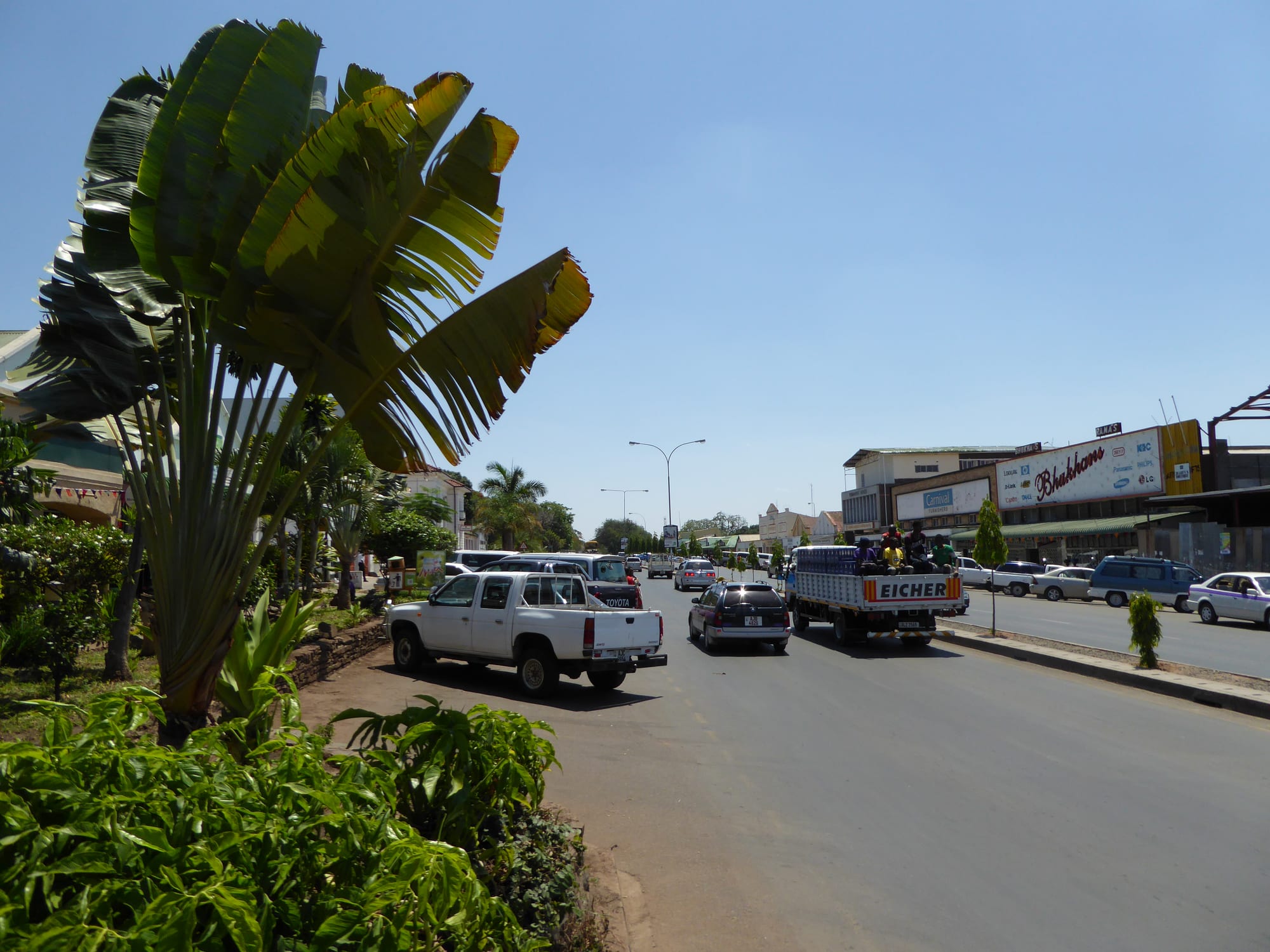
A wide main street with shopfronts and signs on the right, pickups and a lorry in the traffic, and a large-leaved palm in the foreground

Livingstone, Victoria Falls & the West, Zambia

Livingstone

The main street through the centre of Livingstone, Zambia. (cowbridgeguide.co.uk / Wikimedia Commons · CC BY 3.0)

The Zambian town beside Victoria Falls, laid out in 1905 when the railway bridge crossed the Zambezi gorge and the capital of Northern Rhodesia until 1935. Its long main street of early twentieth-century buildings, its museums and its lodges along the river make it the base for the Zambian side of the Falls, for rafting in the gorges and for the game park on the town's doorstep.

Neighbourhoods

  • The town centre and Mosi-oa-Tunya Road
    • First-time visitors
    • Historic district
    • Close to transport

    The long main street carries most of the town's life — banks, supermarkets, craft stalls, bus stops and a row of verandahed buildings from the first decades of the twentieth century. The Livingstone Museum and the railway museum are both a short walk away, and budget guesthouses and backpacker places cluster around here.

    Open in Maps
  • The riverfront road towards the Falls
    • Views
    • Lodges and river trips
    • Wildlife

    The road running the ten or so kilometres south to the Falls passes the river frontage, the entrance to Mosi-oa-Tunya National Park and a line of lodges and camps set above the Zambezi. It is quiet, green and full of birds, with elephants and giraffes sometimes crossing the road.

    Open in Maps
  • Maramba and the eastern townships
    • Local life
    • Markets
    • Best for food

    The residential districts east and north of the centre, where most of Livingstone's people live, are built around markets, churches, schools and small bars. Maramba's market is the busiest, selling produce, dried fish, secondhand clothes and household goods.

    Open in Maps
  • Dambwa and the northern suburbs
    • Quiet and residential
    • Local life

    Low-rise housing areas spread north of the railway from the older civil-service quarters into newer, denser compounds. There is little for visitors beyond neighbourhood shops and bars, but this is where much of the town's workforce lives, a short minibus ride from the centre.

    Open in Maps

Things to do

Victoria Falls and the gorge

  • Victoria Fallslandmark

    Mosi-oa-Tunya, the smoke that thunders — a curtain of the Zambezi falling into a narrow gorge on the Zambia–Zimbabwe border, a UNESCO World Heritage Site, about ten kilometres from the town centre.

    Open in Maps
  • Knife-Edge Bridgeviewpoint

    A footbridge built in the 1960s out to the cliffs facing the Rainbow Falls, looking down where the first gorge drains into the Boiling Pot.

    Open in Maps
  • Boiling Potviewpoint

    A steep path from the Falls drops to the churning pool at the foot of the first gorge, where the Zambezi turns back on itself beneath the bridge.

    Open in Maps
  • Livingstone Islandattraction

    The island on the lip of the Falls from which David Livingstone first saw them, reached on guided boat trips when the river is low, alongside the Devil's Pool at the very edge.

    Open in Maps
  • Victoria Falls Bridgelandmark

    The steel arch of 1905 across the gorge below the Falls, carrying road, rail and foot traffic to Zimbabwe and a well-known bungee jump.

    Open in Maps
  • Batoka Gorgeattraction

    The zigzag basalt gorges downstream of the Falls, whose rapids make some of the best-known white-water rafting in Africa.

    Open in Maps

Parks and the river

  • Mosi-oa-Tunya National Parkpark

    A small park along the Zambezi above the Falls, holding zebra, giraffe, buffalo and a protected population of white rhino that is followed on guided walks.

    Open in Maps
  • Zambezi sunset cruisesattraction

    Boats run on the calm stretch of river above the Falls in the late afternoon, passing hippos and elephants on the islands and banks.

    Open in Maps

Museums and heritage

  • Livingstone Museummuseum

    The oldest and largest museum in Zambia, established in 1934, with archaeology, ethnography and history collections and the letters, journals and possessions of David Livingstone.

    Open in Maps
  • Railway Museum, Livingstonemuseum

    Locomotives, rolling stock and displays on Zambia's railway heritage in the old railway yards, along with an exhibition on the history of Jews in Zambia.

    Open in Maps
  • The old main streetneighborhood

    A stretch of single-storey shops and offices with iron roofs and deep verandahs, put up in the decades after the town was laid out and still in daily use.

    Open in Maps

Short trips from the town

  • Mukuniattraction

    The largest village in the area before Livingstone was founded, seat of the chieftaincy that the Baleya have lived under since the sixteenth century, and a regular stop on tours from the town.

    Open in Maps
  • Victoria Falls, Zimbabweattraction

    The town on the opposite bank, reached over the bridge; the KAZA UniVisa, valid for both countries, suits a trip that crosses the border.

    Open in Maps
  • Kazungula Bridgelandmark

    The road and rail bridge opened in 2021 between Zambia and Botswana, replacing the old ferry near the point where four countries meet.

    Open in Maps

Eat and drink

Long-standing places and food districts in Livingstone. Hours, ratings and directions come from your maps app, always current.

Livingstone classics

  • Nshima with bream and kapentarestaurant

    The everyday plate is nshima, stiff maize porridge, with river bream, dried kapenta fried with tomato and onion, or beef and chicken stews with greens.

    Open in Maps
  • Mosi lagerrestaurant

    Zambia's national lager is named after Mosi-oa-Tunya and brewed under that name, and it is what most bars in town pour alongside Chibuku sorghum beer.

    Open in Maps

Markets and food streets

  • Maramba Marketmarket

    The town's main produce market, with vegetables, maize meal, dried fish, groundnuts and cheap cooked food sold from stalls.

    Open in Maps
  • Mosi-oa-Tunya Roadneighborhood

    Cafés, takeaways, bakeries and tourist-facing restaurants line the main street between the museum and the southern end of town.

    Open in Maps
  • Riverside lodge restaurantsneighborhood

    The lodges along the Zambezi south of town serve game meat, river fish and grilled dishes on terraces above the water.

    Open in Maps

Experience Livingstone

History

The Falls have been known to the peoples of the middle Zambezi for far longer than the town: the Leya and Toka villages of the north bank, under the Mukuni and Sekute chieftaincies, lived by farming, fishing and the river crossing. The Scottish missionary and explorer David Livingstone reached the Falls in 1855, travelling downriver with Kololo companions, and named them for Queen Victoria; the Kololo name Mosi-oa-Tunya has remained in local use throughout.

A settlement grew at the Old Drift, a crossing point on the river above the Falls, in the 1890s, but the site was malarial and deadly. When the Cape-to-Cairo railway reached the gorge and the Victoria Falls Bridge opened in 1905, the town was moved to higher, healthier ground and laid out on its present grid, taking the explorer's name. Livingstone became the seat of colonial administration for Northern Rhodesia and remained the territory's capital until it was moved to Lusaka in 1935, leaving behind government buildings, a main street of shops with deep verandahs and a museum established in 1934.

Losing the capital left the town dependent on the railway, on light industry and on tourism. Since the beginning of the twenty-first century it has seen a resurgence in tourism and has become the usual base for visiting the Falls: lodges, activity operators and a rebuilt airport terminal turned it into Zambia's main tourist town. Growth since has been steady, though it tracks the fortunes of the river and of regional travel, and recent droughts, which have dropped the Zambezi to unusually low flows, are felt in the town as well as on the Falls.

Culture & Customs

Livingstone is a border town and a tourist town, and both show. Its permanent population is Tonga and Leya in origin, with Lozi, Nyanja and Bemba speakers who came with the railway and the civil service, and traders and workers from Zimbabwe, Botswana and further afield passing through. English is the working language, and a visitor will hear several Zambian languages within a single market.

The chieftaincies around the Falls remain important. Mukuni village, south-east of the town, is the seat of the Leya chief, and traditional authority governs land, ceremonies and much of the craft trade; the Falls themselves are regarded as a place of spiritual significance, and offerings and ceremonies are still made at the river. Carving, basketry and copper and stone work fill the craft markets along the road to the Falls, much of it made in the surrounding villages.

The town's social life runs on churches, football, bars along the main street and music at weekends, with Zambian rumba, gospel and contemporary pop on the speakers. Livingstone is more used to foreign visitors than anywhere else in the country, which makes it relaxed and also brisk: touts and guides work the Falls entrance, and prices for craft and services are negotiated as a matter of course, politely and without pressure.

Daily Life

About 180,000 people live in Livingstone, making it one of Zambia's larger towns and the main urban centre of the Southern Province's south-western corner. Most live in the townships and compounds north and east of the centre — Maramba, Dambwa, Linda and their neighbours — in low-rise housing served by markets, churches, schools and clinics, and travel into town by minibus.

Tourism is the town's distinguishing industry: lodges, hotels, tour and activity operators, guides, drivers, craft traders and the airport employ a large share of households, directly or indirectly. Beyond that, Livingstone lives from trade and transport on the routes into Zimbabwe and Botswana, from government offices, the hospital and colleges, from a little manufacturing, and from farming and cattle in the surrounding district.

The rhythm of the day starts early, before the heat: markets and the minibus ranks are busy by seven, offices close in the late afternoon and the streets empty soon after dark. National electricity load-shedding is felt here as elsewhere, with generators running at lodges and shops, and the drought years have hit farming and household water supplies in the district. Work in tourism is seasonal and often insecure, and the gap between the riverside lodges and the compounds is plain.

Food

Everyday eating in Livingstone is Zambian and unfussy: nshima, the stiff white maize porridge, eaten by hand with a relish of beans, pumpkin or rape leaves cooked with groundnuts, okra, or a stew of beef, goat or village chicken. Bream and tigerfish come from the Zambezi, and dried kapenta from Lake Kariba is fried with tomato and onion into one of the commonest relishes in town.

Market food and street stalls make up much of the rest: roasted or boiled maize cobs, fritters, chips with fried fish, groundnuts sold in twists of paper, and sweet potatoes and cassava in season. Mangoes, bananas, guavas and papaya are sold from stands along the main street. Chikanda, the savoury loaf made from ground wild orchid tubers and peanuts, travels down from the north and turns up in markets here too.

Because the town lives on visitors, its restaurants range much wider than the national norm — grills, pizzas, Indian and South African dishes, and lodge kitchens along the river serving game meats such as kudu and warthog alongside river fish. To drink there is Mosi lager, named after the Falls, Chibuku sorghum beer in cartons, munkoyo, and strong sweet tea with bread at breakfast.

Planning tools

Budget

Livingstone has the widest range of prices in Zambia, from backpacker dormitories to riverside luxury lodges. Rooms and food are cheap by regional standards; the Falls activities are not, and rafting, helicopter or microlight flights, Livingstone Island trips and park entry are priced in US dollars and add up quickly.

Daily Budget Midrange
USD 130–330 (lodge or hotel room, one paid Falls activity, guided drives, restaurant meals)
Daily Budget Shoestring
USD 45–85 (hostel bed, nshima and market food, minibuses, park entry to the Falls)

Buy activities separately rather than as bundles, and consider the KAZA UniVisa if a trip to the Zimbabwean side is planned.

Best Time to Visit

The Falls are fullest from about March to May, when spray hides much of the gorge and soaks anyone on the paths. Water is lowest from about September to December, when the rock face shows, guided trips to Livingstone Island and Devil's Pool run and rafting is at its best. June to August is dry, mild and busy; October is very hot.

Suggested Number of Days

Two or three days suit a first visit, and four or five allow for the river, the game park and a crossing of the border. Anyone planning several paid activities should allow more time, since each takes half a day and weather can move bookings.

First Visit
2–3 days
With Surroundings
4–5 days

Transportation

Minibuses run along the main street and out to the townships, and shared and private taxis cover the rest; most lodges run their own shuttles to the Falls and the airport. Hire cars and guided transfers are available, and bicycles suit the flat road towards the Falls for the confident.

Agree taxi fares before setting off, and ignore touts offering activities or currency at the Falls entrance and the bus station.

Airport & Station Connections

Harry Mwaanga Nkumbula International Airport lies on the edge of the town, a few kilometres from the centre, with domestic flights from Lusaka and international services to cities such as Johannesburg and Nairobi. Buses run from Lusaka, roughly 470 kilometres north-east on the main highway, taking the best part of a day. The Victoria Falls Bridge crosses to Zimbabwe, and the Kazungula Bridge leads west into Botswana.

Walkability

The centre is flat, laid out along one long street, and easy to cover on foot between the museums, banks, markets and guesthouses. The Falls are about ten kilometres south — too far to walk comfortably in the heat, and the last stretch passes through a wildlife area — so most people take a taxi, shuttle or bicycle. Walking after dark in outlying areas is best avoided.

Safety

Livingstone is a relaxed town used to visitors, and serious crime against them is uncommon, though touts, street money-changers and opportunist theft occur around the Falls entrance, the markets and the bus station. The Zambezi is the real hazard, with strong currents, crocodiles and hippos, and wild animals move along the river road at night. Malaria is present year-round.

Change money at banks or bureaux, swim only at guided sites, carry water and fuel on western roads, and take malaria precautions. Check current official travel advice before travelling.

Climate

Livingstone sits in the hot Zambezi valley. The year runs from a warm wet season between November and April, through cooler dry months from May to August, into a fierce build-up of heat in September and October before the rains return. Being in the southern hemisphere, summer here falls in December to February.

Summer
December to February is hot and wet, often 30–33°C by day with afternoon storms and high humidity
Winter
June to August is dry and sunny, around 25–27°C by day and cold enough at dawn for a jacket

Local Customs

Tonga and Leya people are long settled around the Falls, with Tonga, Lozi, Nyanja and Bemba all heard in town and English used in business. Greetings are unhurried and handshakes common. Churches are central to social life, and the Falls and the river carry spiritual meaning for local communities.

Dress modestly in town away from the lodges, ask before photographing people or homes, tip guides and restaurant staff around ten per cent, and treat the Falls area and village visits as places where the local chieftaincy sets the rules.

Common Payment Methods

The Zambian kwacha is the currency, but lodges, park fees and activities are often priced in US dollars and dollars are widely accepted. Banks, bureaux de change and cash machines are in the centre, cards work at hotels and larger shops, and mobile money is used for small payments. Cash in kwacha is needed at markets and for minibuses.