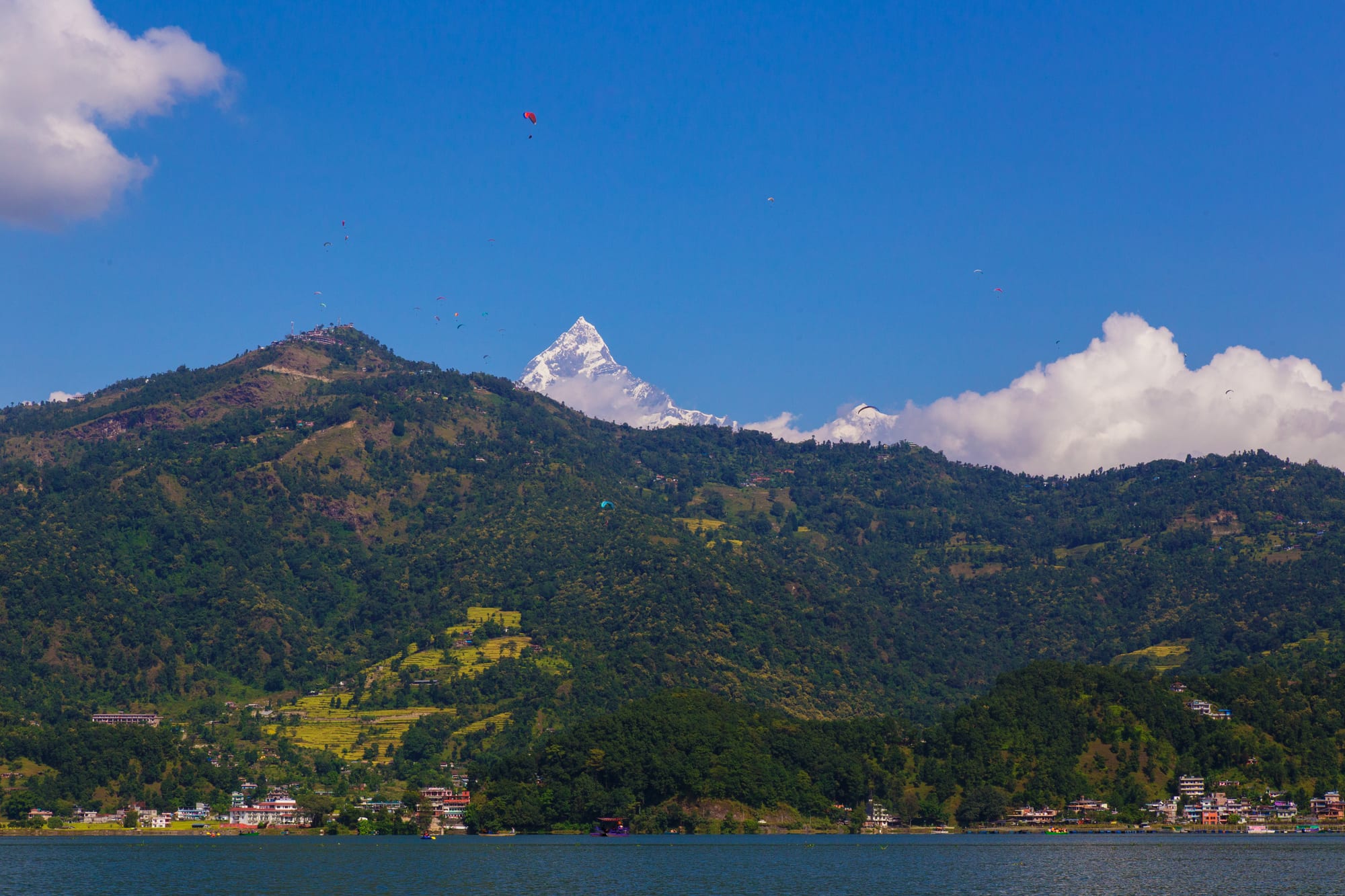
The snowy pyramid of Machapuchare above a forested ridge dotted with paragliders, with Phewa lake in the foreground

Nepal

Pokhara & the Annapurna Region

Machapuchare, the "Fishtail", rising behind the Sarangkot ridge across Phewa lake in Pokhara. (Jean-Marie Hullot / Wikimedia Commons · CC BY 2.0)

Gandaki Province in central-western Nepal, running from the lakeside city of Pokhara and the Gurung and Magar hill country up to the Annapurna and Manaslu ranges and over them into the dry, Tibetan-Buddhist valleys of Manang and Mustang — Nepal's most popular trekking country and the cradle of the Shah dynasty at Gorkha.

Explore Pokhara & the Annapurna Region

History

The hills of Gandaki were once divided among small principalities, the Chaubisi or "twenty-four kingdoms", ruled by Thakuri, Khas and Magar dynasties over Gurung and Magar farming communities. The most ambitious of them was Gorkha. Prithvi Narayan Shah, born there in 1723, set out from its hilltop palace to conquer the Kathmandu Valley, and his dynasty ruled Nepal until 2008. Gorkha's name passed into English as "Gurkha", the soldiers recruited by Britain since the 19th century, many of them Gurung and Magar men from these hills.

North of the Himalaya the story was Tibetan. The kingdom of Lo, in Upper Mustang, was founded in the 14th century by Ame Pal and grew rich on the salt and grain trade along the Kali Gandaki, a major route through the range. Its rulers kept the title of king under Nepal until the monarchy was abolished in 2008. Further down the valley, the Thakali of Tukuche and Marpha were a people of traders.

Pokhara was a small bazaar on a trade route until the 1960s, when its first road, completed in 1968, turned it into a growing city and, from the 1970s, the base for trekking in the Annapurnas. The Annapurna Conservation Area, Nepal's largest protected area, covers the high country. Road building has since pushed jeep tracks up the Kali Gandaki and Marsyangdi valleys and, in 2023, Pokhara's international airport opened.

Culture & Customs

The middle hills are Gurung and Magar country. The Gurung, who call themselves Tamu, keep their own language, a blend of Buddhist and shamanic religion and a strong military tradition; their Tamu Lhosar new year in December or January is a public holiday, and the rodhi, a village gathering house where young people sang and worked together, is remembered as their social institution. Ghandruk and Sikles are Gurung villages of slate-roofed stone houses. Magar villages dominate further west, and the Brahmin and Chhetri communities and Newar traders of towns such as Bandipur complete the mix.

Beyond the range the culture is Tibetan Buddhist. Manang and Mustang have monasteries, prayer walls and chorten gateways, and in Upper Mustang the Tiji festival brings three days of masked dancing by costumed lamas. The Thakali of the Kali Gandaki mix Buddhist and Hindu practice and run many of the region's lodges and restaurants.

Muktinath is shared ground, visited by Hindu pilgrims as one of the holiest Vishnu shrines and by Buddhists as a place blessed by Guru Rinpoche. Pokhara itself is a modern city of migrants from all these communities and a centre for Tibetan refugee settlements.

Daily Life

Pokhara, the provincial capital, has about 600,000 people within its metropolitan boundaries, making it Nepal's second-largest city after Kathmandu. Its lakeside quarter lives on tourism — hotels, trekking agencies, paragliding over Sarangkot, rafting on the Seti and Kali Gandaki — while the older town to the east runs on trade, government and education. Many families in the Pokhara area are supported by pensions from the British and Indian armies and by work in the Gulf.

In the hill districts of Syangja, Parbat, Baglung and Lamjung, most people farm terraces of rice, maize and millet, and villages have emptied as young people leave for towns or abroad. Damauli, Besisahar and Beni are market towns at the ends of trekking roads.

In Mustang and Manang, life follows a short farming season of barley, buckwheat and apples, and many residents spend the winter in Pokhara or Kathmandu. The jeep roads have brought cheaper goods and quicker rescue, but also changed the character of the Circuit, and villages now debate how to keep trekkers coming.

Food

The region's best-known cooking is Thakali. The Thakali set is a refined daal bhaat: rice or buckwheat dhido, a lentil daal, spiced greens, pickles, potatoes and often mutton or dried meat, served on brass plates with generous refills. Thakali restaurants are now found across Nepal, but the originals are in Tukuche, Marpha and Jomsom.

Mustang and Manang grow apples, apricots and buckwheat, and Marpha is famous for its apple orchards, apple brandy and jams. Buckwheat pancakes, tsampa and yak meat appear on the upper trail, along with salty butter tea. Dried mountain meat, sukuti, is fried with chilli and onion as a snack.

In the Gurung hills, meals feature millet bread, gundruk, stinging-nettle soup (sisnu), and chicken or pork, with raksi and millet beer poured at gatherings. Pokhara's lakeside restaurants serve a traveller's menu from momos to wood-fired pizza, and fish from Phewa and Begnas lakes is fried in lakeside stalls.

Attractions & Natural Wonders

Pokhara's Phewa lake is the centre of the region: boats cross to the Tal Barahi temple on its island, the World Peace Pagoda looks down from the southern ridge, and Sarangkot is the sunrise viewpoint and paragliding launch facing Machapuchare and the Annapurnas. Davis Falls, the Gupteshwor Mahadev cave, the International Mountain Museum and the quieter Begnas and Rupa lakes complete the city.

The Annapurna Base Camp trek climbs through Gurung villages such as Ghandruk and Chhomrong into the Annapurna Sanctuary, often combined with the Poon Hill sunrise above Ghorepani. The Annapurna Circuit follows the Marsyangdi to Manang, with side trips to Gangapurna and Tilicho lakes, crosses the Thorong La at about 5,400 metres and descends to Muktinath, Jomsom and Marpha in the Kali Gandaki gorge between Dhaulagiri and Annapurna. Upper Mustang, north of Kagbeni, holds the walled town of Lo Manthang, cave monasteries and red and ochre cliffs. The Manaslu Circuit, in the east of Gorkha district, is a restricted-area trek around the world's eighth-highest mountain.

Closer to the highway, Bandipur has a pedestrian bazaar of old Newar houses and short walks to the Siddha cave. Gorkha has the Gorkha Durbar palace-temple on the ridge above the town, where Prithvi Narayan Shah began his conquest, and the Manakamana temple, reached by cable car from the Trishuli valley.

Cities in Pokhara & the Annapurna Region

Planning basics

Budget

Pokhara has budget guesthouses and lakeside hotels at every level and is cheaper than Kathmandu for comparable comfort. On the Annapurna treks, teahouse rooms are cheap but meals rise in price as the trail climbs, and the Annapurna Conservation Area permit is required. Upper Mustang is the costly exception, with a high restricted-area permit fee per person and a compulsory licensed guide.

Daily Budget Midrange
USD 45–100 (lake-view hotel, restaurant meals, a guided trek with porter, a paragliding flight)
Daily Budget Shoestring
USD 15–25 (lakeside guesthouse or teahouse, daal bhaat, tourist buses)

Get trekking permits in Pokhara before setting off, and carry cash for the upper trail, where ATMs are few and unreliable.

Safety

Pokhara is relaxed and safe. The risks are in the mountains: altitude sickness on the Thorong La and at Annapurna Base Camp, avalanche danger in the Modi Khola gorge after heavy snow, sudden storms on the pass, and landslides on the jeep roads in the monsoon. Paragliding and rafting should be booked with established operators.

Cross the Thorong La early in the morning after acclimatising in Manang, and ask about avalanche conditions before entering the Annapurna Sanctuary. Check current official travel advice before travelling.

Climate

Pokhara, at about 800 metres, is warmer than Kathmandu and one of the wettest cities in Nepal in the monsoon, when the Annapurna wall catches the rain. North of the main range, Manang and Mustang lie in a rain shadow — dry, windy and cold, and trekkable during the monsoon. The Thorong La can be closed by snow.

Summer
hot and very wet in Pokhara, 25–32°C with heavy afternoon downpours; dry and windy in Mustang
Winter
mild days in Pokhara, 7–20°C; freezing nights and snow on the high passes and in Manang

Transportation

Pokhara is about six to eight hours by tourist bus from Kathmandu on the Prithvi Highway, or a short flight; its newer international airport opened in 2023. Jeeps and buses now run up the Kali Gandaki to Jomsom and Muktinath and up the Marsyangdi towards Manang, so many trekkers walk only parts of the Circuit. Jomsom also has a short flight from Pokhara, often disrupted by wind after mid-morning.

Take morning flights to Jomsom, as winds in the Kali Gandaki valley close the airstrip later in the day.

Best Time to Visit

October and November bring the clearest mountain views over Phewa lake and the most reliable conditions on the Thorong La. March to May is also popular, with rhododendron forests in bloom around Ghorepani, though haze can hide the peaks. The monsoon is the season for Upper Mustang, and Lo Manthang's masked Tiji festival usually falls in April or May.