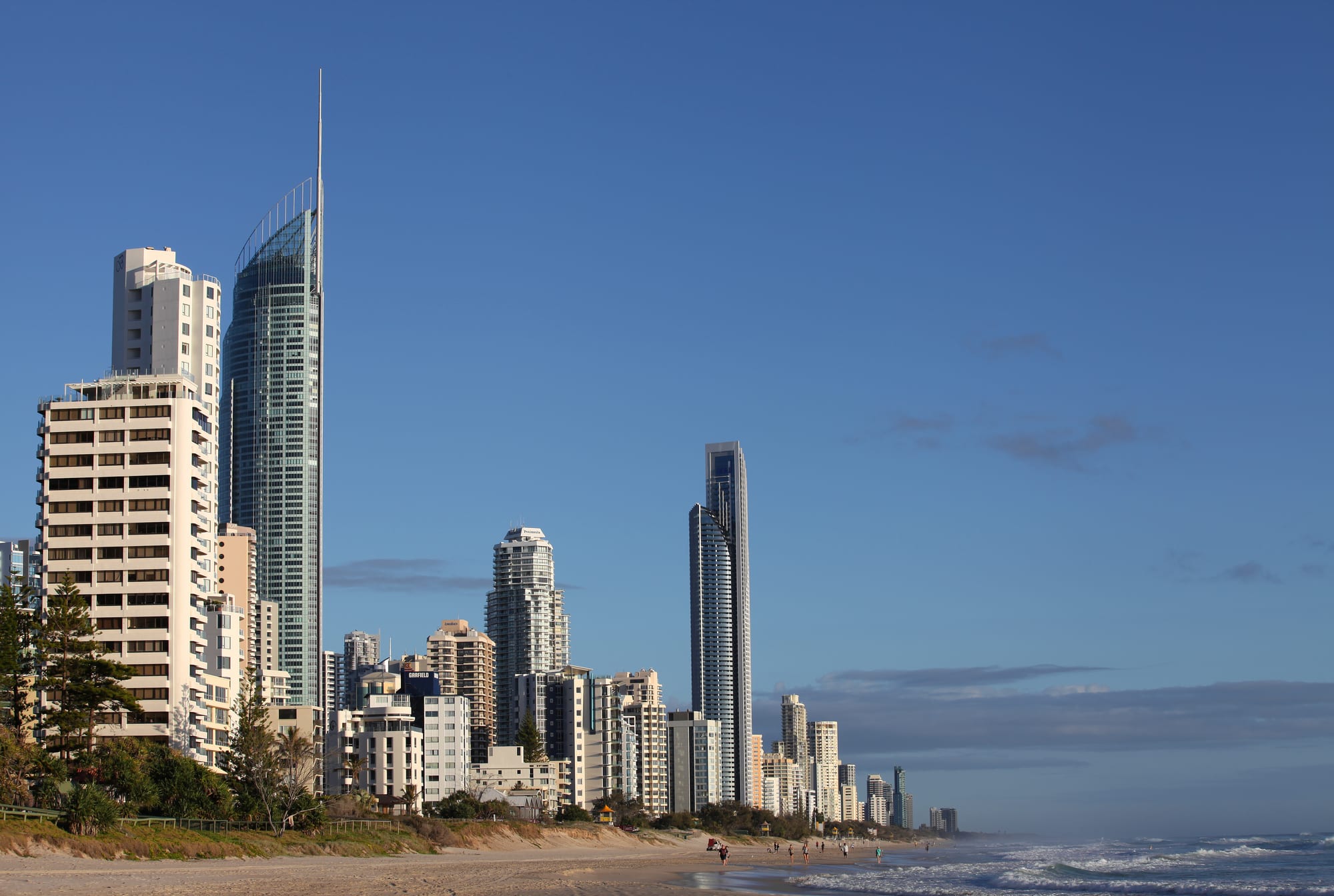
High-rise towers standing along a wide surf beach that curves away into haze under a clear blue sky

Queensland, Australia

Gold Coast

The high-rise strip at Surfers Paradise above the beach on the Gold Coast. (Donaldytong / Wikimedia Commons · CC BY-SA 3.0)

The Gold Coast is a city of more than half a million people on the southern Queensland coast, built along a line of surf beaches between the New South Wales border and Brisbane. A cedar-cutting and farming district that became a holiday strip in the 1950s, it now mixes high-rise Surfers Paradise, quieter beach suburbs, theme parks and rainforest in the hills behind.

Neighbourhoods

  • Surfers Paradise
    • First-time visitors
    • Nightlife
    • Beaches

    The high-rise core, where towers stand almost on the sand and Cavill Avenue runs down to the beach through shops, bars and clubs. It is the loudest and most crowded part of the coast, with the tallest tower on the coast and the best public transport.

    Open in Maps
  • Broadbeach
    • Best for food
    • Families
    • Close to public transport

    Two kilometres south of Surfers and calmer, with a grassy park behind a wide beach, a large casino and convention centre, and the coast's densest run of restaurants and cafés. The light rail stops here.

    Open in Maps
  • Main Beach and The Spit
    • Quiet beaches
    • Boating
    • Families

    North of Surfers, where the beach runs out to a long sand spit between the ocean and the sheltered Broadwater. Marinas, a marine park and the entrance to the Gold Coast Seaway are here, with Tedder Avenue's cafés behind.

    Open in Maps
  • Southport
    • Business district
    • Close to public transport
    • Better value

    The administrative and business centre of the city, on the Broadwater rather than the surf. It has the hospital, the courts, the university's health campus, a small Chinatown and a long stretch of parkland along the water, and rooms cost less than on the beach.

    Open in Maps
  • Burleigh Heads
    • Surfing
    • Cafés
    • Headland walks

    A rocky headland with a famous right-hand point break, a national park on top and a sweep of beach to the north. James Street behind it has become the coast's fashionable eating and drinking street, and the suburb is low-rise by Gold Coast standards.

    Open in Maps
  • Currumbin and Palm Beach
    • Families
    • Local life
    • Estuary swimming

    Quieter southern suburbs around the mouth of Currumbin Creek, where the calm estuary water suits children and the waves at Currumbin Alley draw surfers. A wildlife sanctuary, low-rise flats and a strong neighbourhood feel set it apart from the towers to the north.

    Open in Maps
  • Coolangatta and Kirra
    • Surfing
    • Quiet and residential
    • Close to the airport

    The southern end of the city, on the New South Wales border and beside the airport, with a row of sheltered beaches and the long sand-bank waves that run from Snapper Rocks. The town centre is modest, and Tweed Heads is a street away across the state line.

    Open in Maps

Things to do

Beaches, surf and views

  • Snapper Rocksviewpoint

    The rocky point at the southern end of the city where sand pumped from the Tweed River has built one of the longest rideable waves in the world, known as the Superbank.

    Open in Maps
  • Kirra Beachbeach

    A sheltered beach and celebrated surf break just north of Coolangatta, with a grassy foreshore, a surf club and a long history in Australian board riding.

    Open in Maps
  • Burleigh Head National Parkpark

    A small national park on a basalt headland, with a short walking circuit through rainforest and pandanus to lookouts over the point break and the coastline north.

    Open in Maps
  • Gold Coast Broadwaterattraction

    The sheltered estuary behind the sand spit, used for swimming, sailing, paddling and fishing, with parkland and a swimming lagoon along its Southport shore.

    Open in Maps
  • Q1landmark

    The tower that dominates Surfers Paradise, for some years the tallest residential building in the world, with a public observation deck near the top and a climb up its spire.

    Open in Maps

Theme parks and wildlife

  • Warner Bros. Movie Worldattraction

    A film-themed park on the highway north of the city, with roller coasters, stunt shows and character parades, beside Village Roadshow Studios at Oxenford, the main film production base in Queensland.

    Open in Maps
  • Dreamworldattraction

    The largest of the Gold Coast theme parks, opened in 1981 at Coomera, with thrill rides, a water park and an Australian wildlife section holding tigers and native animals.

    Open in Maps
  • Sea Worldattraction

    A marine park on The Spit with dolphin and seal presentations, rides and a rescue programme for turtles, dugongs and whales.

    Open in Maps
  • Currumbin Wildlife Sanctuaryattraction

    A large sanctuary in bushland begun in the 1940s around the feeding of wild rainbow lorikeets, now holding koalas, crocodiles, cassowaries and a wildlife hospital.

    Open in Maps
  • David Fleay Wildlife Parkattraction

    A quiet state-run park in mangrove and forest at Burleigh, named after the naturalist who first bred a platypus in captivity, with boardwalks and nocturnal animals.

    Open in Maps

Short trips from the city

  • Springbrook National Parkpark

    A rainforest plateau on the rim of an ancient volcano, with waterfalls, a cave of glow-worms at the Natural Bridge and lookouts over the coast, part of the Gondwana Rainforests World Heritage Area.

    Open in Maps
  • Lamington National Parkpark

    Subtropical rainforest and Antarctic beech on the McPherson Range, with long walking tracks and two mountain lodges, also part of the Gondwana Rainforests.

    Open in Maps
  • Tamborine Mountainattraction

    A plateau of remnant rainforest in the hinterland, much of it protected in the scattered sections of Tamborine National Park, with walking tracks, waterfalls and three small townships, an easy drive inland from the coast.

    Open in Maps
  • Tweed Headsneighborhood

    The New South Wales town that runs straight into Coolangatta across the border, with the Tweed River mouth, a headland lookout and a different time zone in summer.

    Open in Maps
  • Byron Bayattraction

    A beach town about an hour and a half south with a lighthouse on the most easterly point of mainland Australia, long beaches and a well-known surf and music scene.

    Open in Maps

Seasonal events

  • Supercars street race at Surfers ParadiseOctober

    A touring-car race on a temporary street circuit through Surfers Paradise, run in one form or another since the early 1990s and watched from grandstands along the beachfront.

  • Blues on BroadbeachMay

    A free blues and roots music festival on outdoor stages, in parks and in pubs across Broadbeach over several days.

  • Gold Coast MarathonJuly

    A flat road race along the coast in the middle of the dry winter, with shorter distances alongside it, drawing runners from across Asia and Australia.

  • Schoolies weeklate November

    School leavers from across Queensland and beyond fill Surfers Paradise for week-long celebrations after final exams, with organised events and heavy policing.

  • Humpback whale seasonroughly June to November

    Humpback whales pass close to the coast on their migration, visible from the headlands as well as from boats.

Eat and drink

Long-standing places and food districts in Gold Coast. Hours, ratings and directions come from your maps app, always current.

Food districts

  • Broadbeachneighborhood

    The coast's main restaurant precinct, several blocks of Italian, Japanese, Greek and modern Australian kitchens with tables on the footpath, a short walk from the beach.

    Open in Maps
  • Burleigh Headsneighborhood

    James Street and the streets around it hold the coast's most talked-about cafés, bakeries, wine bars and small restaurants, with a health-food and breakfast culture built around surfing.

    Open in Maps
  • Surfers Paradiseneighborhood

    Japanese, Korean and Chinese restaurants sit alongside steakhouses, pizza and late-night takeaways, reflecting decades of Asian visitors to the strip.

    Open in Maps
  • Southport Chinatownneighborhood

    A small designated Chinatown around Young and Davenport streets, with Chinese, Vietnamese, Korean and Malaysian restaurants, grocers and dumpling shops.

    Open in Maps

Markets

  • Carrara Marketsmarket

    A large weekend market inland at Carrara that has run for decades, with produce, cooked food from many countries, plants and second-hand stalls.

    Open in Maps

Experience Gold Coast

History

The coast, its creeks and the forested ranges behind are the country of the Yugambeh people, whose clans, among them the Kombumerri around the Nerang River and the Broadwater, left middens, fish traps and ceremonial grounds along the waterways. European interest began with timber: from the 1840s cutters worked up the rivers for red cedar, and farms of sugar cane, bananas and dairy cattle followed on the cleared flats.

Holidays came next. Southport grew from the 1870s as a seaside resort for Brisbane's well-off, reached first by coach and then by rail. In the 1920s a hotel opened behind the dunes further south and gave its name to the district around it, Surfers Paradise. After the Second World War the South Coast became a mass holiday destination, the first high-rise went up in Surfers Paradise in 1960, and in 1958 the local authority took the nickname that had grown out of the area's soaring land prices and called itself the Gold Coast, which was declared a city the following year.

From then on growth was almost continuous. High-rise towers replaced beach houses along the strip, canal estates were dredged out of the swamps behind it, and the theme parks arrived between the 1970s and the 1990s. A street motor race began in the early 1990s, a private university opened at Robina in 1989, the light rail opened in 2014, and the city hosted the Commonwealth Games in 2018. What was a string of villages is now Australia's sixth-largest city and one of its fastest-growing.

Culture & Customs

Everything here begins with the beach. Surf life saving clubs, board-riding clubs and nippers programmes run through family life, the surf report is local news, and the point breaks at the southern end of the city are treated as serious cultural property. The coast has produced a long line of world surfing champions, and the sand-bank wave at Snapper Rocks draws crowds from around the world.

The city's reputation elsewhere in Australia is for glitter, high-rise and holiday excess, and Surfers Paradise does little to dispel it, with its towers, nightlife and the meter maids in gold bikinis who have topped up expired parking bays along the beachfront since the 1960s. Away from that strip the culture is suburban and outdoorsy: barbecues, junior sport, fishing, and the quieter cafés of Burleigh and Palm Beach, where the surfing and health-food culture of the southern beaches has become a style of its own.

There is a working film industry at the studios north of the city, an arts precinct with a gallery and open-air stage beside the Nerang River, and two universities that have given the coast a large student population. Rugby league and Australian football both have professional teams here. Two national habits are worth knowing: dress is extremely casual, and Queensland's refusal of daylight saving means the clocks differ from New South Wales, a street away, for half the year.

Daily Life

More than half a million people live in the City of Gold Coast, and the number grows every year with arrivals from Sydney, Melbourne and overseas. Unusually for an Australian city there is no single centre: Southport holds the offices, courts and hospital, Surfers Paradise the visitors, Robina and Helensvale the big shopping centres, and the rest is a chain of beach suburbs, canal estates and new housing on the western flats towards the motorway.

Tourism and construction drive the economy, with retail, health, education, marine services and film work behind them, and a growing number of residents commute to Brisbane by train. Work in hospitality is seasonal and often casual, and the city has a large population of young people, backpackers and retirees at the same time.

Daily life follows the water. Mornings begin early on the sand, with swimmers, runners and surfers out before work; afternoons in summer are broken by thunderstorms; weekends mean the beach, the Broadwater or sport. The standing local arguments are about the pace of high-rise approval, the cost of housing, traffic on a coast with one motorway, and beach erosion, which is fought with sand pumping and seawalls after every big storm.

Food

Seafood is the foundation. Prawns, spanner crab, Moreton Bay bugs, snapper and mackerel come from local waters, and oysters are grown in the Tweed River just across the border. Surf life saving clubs run public dining rooms with ocean views, an institution particular to this coast and still among the better value meals in it.

The eating map splits between the towers and the southern beaches. Surfers Paradise reflects decades of Japanese, Korean and Chinese visitors in its restaurants and late-night noodle shops, Broadbeach has the largest concentration of restaurants on the coast, and Southport keeps a small Chinatown. Burleigh Heads and Nobby Beach lead the other style: bakeries, smoothie and bowl cafés, wine bars and small kitchens built around surfing hours and early mornings.

The hinterland supplies avocados, macadamias, custard apples, bananas and coffee, sold at the weekend markets at Carrara and in the smaller farmers' markets along the coast. Burleigh and Currumbin have produced some of Queensland's best-known craft breweries, several of them started by surfers.

Planning tools

Budget

Beds are plentiful, from hostels in Surfers Paradise to holiday apartments and resorts, so accommodation is competitive outside the peak weeks. The real costs are the theme parks, which are expensive per person and add up quickly for a family, and a hire car if the hinterland is on the list. Prices rise steeply over Christmas, Easter and the school holidays.

Daily Budget Midrange
USD 170–300 (a holiday apartment or hotel, restaurant meals, one theme park or wildlife sanctuary, some car use)
Daily Budget Shoestring
USD 70–120 (a hostel bed or a room out of season, self-catering, the light rail and buses, free beaches and headland walks)

Multi-park passes are cheaper than separate tickets if more than one theme park is planned; the beaches, the oceanway path, the national parks on the headland and the Broadwater parkland cost nothing.

Best Time to Visit

The shoulder months of March to May and September to November are the best balance: warm, mostly dry, with the water still comfortable and fewer crowds. Winter is mild, sunny and quiet, and whales pass offshore. Summer is hot, humid and stormy and coincides with the Australian school holidays, when the coast is at its fullest.

Suggested Number of Days

Two to four days cover a stretch of beach and one or two of the big attractions. Five to seven suit a family holiday with the theme parks and a couple of days in the hinterland. The city is long, so more time is needed without a car.

First Visit
2–4 days
With Surroundings
5–7 days

Transportation

A light rail line runs along the coastal strip from the northern suburbs through Southport, Surfers Paradise and Broadbeach to Burleigh Heads, and connects with the Brisbane suburban trains at Helensvale. Buses cover the rest of the city, including the airport and the southern beaches. A hire car is the usual way to reach the theme parks and the hinterland, and the Pacific Motorway runs the length of the city inland.

The city is more than fifty kilometres long, so choose a base near the beach and the tram line rather than trying to see all of it from one end.

Airport & Station Connections

Gold Coast Airport sits on the state border at Coolangatta, about twenty kilometres south of Surfers Paradise, with domestic flights and services from New Zealand and parts of Asia; buses and taxis run up the coast from it. Brisbane Airport is roughly ninety kilometres north. Trains from Brisbane take about an hour and a half to the southern end of the suburban line, where buses and the tram continue to the beaches.

Walkability

Each beach suburb is easily walked, and a continuous shared path, the oceanway, runs for many kilometres behind the sand. The city as a whole is not walkable: it is a chain of centres strung along the coast, separated by canal estates and a motorway, so getting between them means the tram, a bus or a car. Summer humidity slows walking considerably.

Safety

The Gold Coast is safe by day, and the ordinary risks are the surf and the nightlife. Rip currents are the main danger on open beaches, and several people drown on this coast most years, almost always outside patrolled areas. Surfers Paradise has alcohol-related trouble late at night, especially during Schoolies in November. Summer brings severe storms, and saltwater crocodiles do not live this far south.

Swim between the red and yellow flags at a patrolled beach, ask a lifesaver about conditions if unsure, and watch drinks and belongings in the night district. Check current official travel advice before travelling.

Climate

Subtropical and mild, with warm humid summers and the dry sunny winters for which the coast is internationally known. Most rain falls between December and March, often in short heavy storms, and the ocean is warm enough for swimming all year for most people.

Summer
hot and humid, generally about 21–29°C, with afternoon thunderstorms and sea temperatures near 26°C — summer in the southern hemisphere runs from December to February
Winter
mild and dry, generally about 11–21°C, sunny by day with cool evenings and sea temperatures near 20°C

Local Customs

Beach dress is normal in the street near the sand, though shops and restaurants expect a shirt and footwear. Tipping is not customary in Australia and prices include tax and service. Queensland does not use daylight saving while New South Wales does, so in summer the towns either side of the border at Coolangatta run an hour apart. Surf etiquette matters at the crowded southern breaks: beginners are expected to stay clear of the point.

Glass and alcohol are banned on many beaches and in parks, the drinking age is 18 and identification is checked, and strong sun means sunscreen, a hat and a shirt even in winter.

Common Payment Methods

The currency is the Australian dollar. Cards and phones are accepted everywhere, including on the tram and buses, and some venues are cashless. ATMs are common along the beachfront and in shopping centres. Card surcharges are normal and must be displayed.