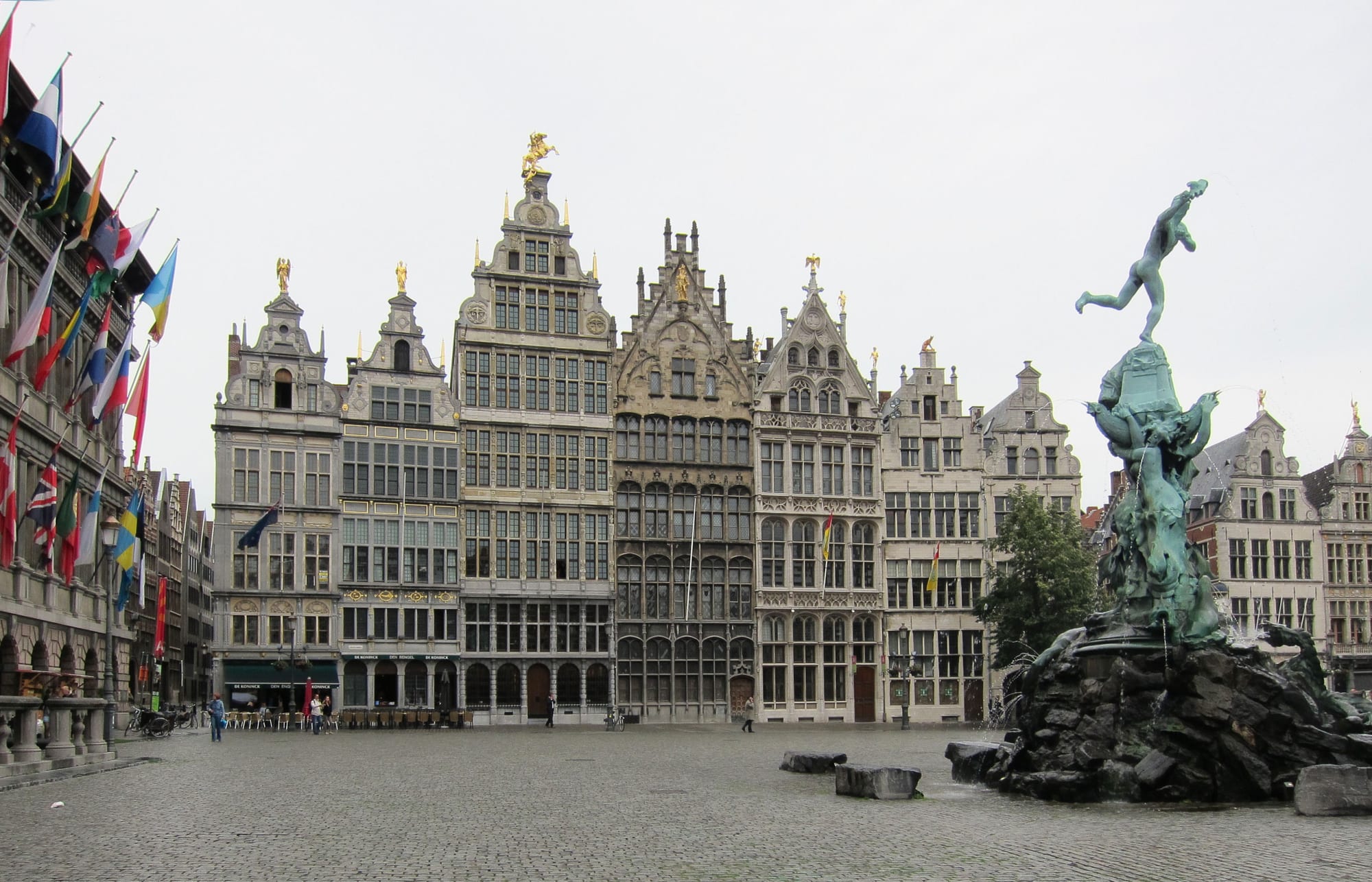
Tall gabled guildhouses with gilded statues on Antwerp's main square, with the bronze Brabo statue on a rocky fountain

Brussels & Flanders, Belgium

Antwerp

Guildhouses and the Brabo Fountain on the Grote Markt in the historic centre of Antwerp. (Alan Stanton / Wikimedia Commons · CC BY-SA 2.0)

Belgium's most populous municipality, on the river Scheldt about 40 km north of Brussels, with a port second in Europe only to Rotterdam. In the 16th century it was the richest trading city of northern Europe and later the home of Rubens; today it is the hub of the world's diamond trade, a fashion centre and a very diverse city of about 180 nationalities.

Neighbourhoods

  • The old town
    • First-time visitors
    • Historic district
    • Bars and cafés

    The historic centre by the Scheldt, around the Grote Markt, the cathedral and Het Steen. Guildhouses, Baroque churches and small lanes such as the hidden Vlaeykensgang lie within a few minutes of each other, with restaurants along the Oude Koornmarkt.

    Open in Maps
  • Meir and the station quarter
    • Shopping
    • Close to public transport

    The Meir, Belgium's busiest and most expensive shopping street, runs from the old town to Antwerpen-Centraal station. Around the station are the zoo, the diamond district and a small Chinatown.

    Open in Maps
  • The diamond district
    • Diamonds
    • Jewish heritage

    A few blocks beside Central Station, known as the Square Mile, holding four diamond exchanges and hundreds of workshops and companies. Jewish, Indian Jain, Lebanese and Armenian dealers dominate the trade, and no business is done on Saturdays.

    Open in Maps
  • Zuid
    • Museums
    • Galleries
    • Best for food

    The southern part of the city centre by the river, revived since the mid-1980s, with Art Nouveau and modern buildings, the Royal Museum of Fine Arts, art centres, commercial galleries and many cafés and restaurants.

    Open in Maps
  • Eilandje
    • Waterfront
    • Modern architecture

    The waterfront district on the Scheldt where the red sandstone MAS museum rises beside the docks and Zaha Hadid's Port House adds a glass extension to a restored former fire station.

    Open in Maps
  • Zurenborg
    • Art Nouveau
    • Quiet and residential

    A south-eastern quarter built mostly between 1894 and 1906, with a high concentration of Art Nouveau and other fin-de-siècle town houses.

    Open in Maps
  • Borgerhout
    • Multicultural
    • Local life

    The smallest of the city's districts, a separate municipality until 1983, with about 47,000 residents; Time Out named it the world's second coolest neighbourhood in 2025.

    Open in Maps

Things to do

Famous landmarks

  • Cathedral of Our Ladylandmark

    The Gothic cathedral begun in 1352 and never fully completed, whose tower is part of the UNESCO listing of the belfries of Belgium and France.

    Open in Maps
  • Grote Marktlandmark

    The main square of the old town, framed by the Renaissance City Hall and ornate guildhouses, with a Christmas market and ice rink every winter.

    Open in Maps
  • Antwerp City Halllandmark

    A Renaissance building of 1561–1565 designed by Cornelis Floris de Vriendt and others, mixing Flemish and Italian influences.

    Open in Maps
  • Brabo Fountainlandmark

    Jef Lambeaux's fountain of 1887 in front of the City Hall, showing the legendary Silvius Brabo throwing the giant Antigoon's severed hand into the Scheldt.

    Open in Maps
  • Het Steenlandmark

    The riverside fortress built in 1200–1225 as the gateway of a larger castle of the dukes of Brabant, the oldest stone fortification of the city.

    Open in Maps
  • Antwerpen-Centraaltransit hub

    The city's main railway station, a monumental building and one of the country's four stations on the high-speed network; a terminus until 2007.

    Open in Maps
  • Port Houselandmark

    Zaha Hadid's headquarters for the port authority on the Eilandje, built between 2009 and 2016, a glass extension resting on a restored older building.

    Open in Maps
  • Boerentorenlandmark

    An Art Deco tower of 1929–1932, one of Europe's very first tall buildings and the tallest in Belgium until 1960.

    Open in Maps
  • St. Charles Borromeo Churchlandmark

    The Jesuit church of 1615–1621 on the Hendrik Conscienceplein, rededicated in 1779.

    Open in Maps
  • St. Paul's Churchlandmark

    A Gothic church with a Baroque tower and rich Baroque interior, holding paintings by Rubens, Van Dyck and Jordaens.

    Open in Maps

Museums

  • MASmuseum

    The largest museum in Antwerp, opened in 2011 on the Eilandje beside the Scheldt.

    Open in Maps
  • Plantin-Moretus Museummuseum

    The house and works of the printing dynasty founded by Christophe Plantin and Jan Moretus in the 16th century.

    Open in Maps
  • Royal Museum of Fine Arts Antwerpmuseum

    Founded in 1810, with paintings, sculpture and drawings from the 14th to the 20th century in a grand building of 1884–1894 in the Zuid.

    Open in Maps
  • MoMumuseum

    The fashion museum, holding the largest collection of Belgian fashion, in the ModeNatie building on Nationalestraat alongside the Royal Academy's fashion department.

    Open in Maps
  • Museum Mayer van den Berghmuseum

    A collector's museum of mostly Gothic and Renaissance art from the Low Countries, including paintings by Pieter Bruegel.

    Open in Maps
  • Snijders&Rockox Housemuseum

    Two neighbouring town houses of the painter Frans Snyders and the mayor Nicolaas Rockox, with 16th- and 17th-century Flemish art.

    Open in Maps

Parks and gardens

  • Antwerp Zooattraction

    The oldest animal park in Belgium and one of the oldest in the world, established in 1843 right beside Central Station.

    Open in Maps
  • Middelheim Open Air Sculpture Museumpark

    A 24-hectare sculpture park in the south of the city with about 215 sculptures among some 400 works on display.

    Open in Maps

Short trips from the city

  • Mechelenattraction

    A historic city about 22 km south, one of Flanders' cities of historical art and a centre of artistic production in the Northern Renaissance.

    Open in Maps
  • Lierattraction

    A small city whose centre is ringed by the river Nete, around which it grew.

    Open in Maps

Seasonal events

  • Zomer van Antwerpensummer

    Two summer months of theatre, music, dance, circus and film around the city.

  • Jazz Middelheimsummer

    An annual jazz festival in Middelheim Park.

  • Christmas market and ice rinkDecember

    A Christmas market and skating rink set up on the Grote Markt every winter.

Eat and drink

Long-standing places and food districts in Antwerp. Hours, ratings and directions come from your maps app, always current.

Antwerp classics

  • Antwerpse handjesrestaurant

    Biscuits or chocolates in the shape of a hand; the almond biscuit version dates from 1934.

    Open in Maps
  • Bolleke at a city cafécafe

    Bolleke, formerly sold as De Koninck, the city's own Spéciale belge, on the market since 1913; Elixir d'Anvers, a herbal liqueur made since 1863, is the local digestif.

    Open in Maps

Food districts and markets

  • Chinatownneighborhood

    A couple of streets north of Central Station, entered between two stone lions on Van Wesenbekestraat, with Chinese and other Asian restaurants and grocers.

    Open in Maps
  • Vogelenmarktmarket

    The Sunday-morning market on the Oudevaartplaats, with the weekend markets on the neighbouring Theaterplein.

    Open in Maps
  • Oude Koornmarktneighborhood

    A street of restaurants and cafés in the old town between the Grote Markt and the cathedral.

    Open in Maps

Experience Antwerp

History

A folk tale derives the city's name from handwerpen, "hand-throwing": the hero Silvius Brabo is said to have cut off the hand of the giant Antigoon, who maimed boatmen who would not pay his toll, and flung it into the Scheldt. Het Steen, the riverside fortress, has its origins in the ninth century. When the Zwin silted up and Bruges declined, trade moved to Antwerp.

Between 1500 and 1569 the population doubled. The Portuguese made Antwerp one of their main bases for Asian spices by 1504, sugar from Atlantic plantations, increasingly worked by enslaved Africans, made it Europe's sugar capital, and its exchange of 1531 was the world's first purpose-built commodity bourse. At the beginning of the century the city handled about 40 per cent of world trade, and by 1560 it had around 360 painters, Pieter Bruegel among them. Then the Dutch Revolt broke this world apart. On 4 November 1576 Spanish troops sacked the city in the Spanish Fury, killing about 8,000 people; in 1585 the Duke of Parma took it after a long siege and Protestants were given two years to leave; and in 1648 the Treaty of Münster closed the Scheldt to shipping.

By 1800 the population had fallen below 40,000, when Napoleon funded new docks to rival London. Antwerp hosted the 1920 Summer Olympics. Occupied in 1940 and liberated on 4 September 1944, it was then hit by more V-2 rockets than all other targets combined. A ten-year plan from 1956 expanded the port, the surrounding municipalities were merged into the city in 1983, and from the 1990s Antwerp rebranded itself as a fashion centre.

Culture & Customs

Antwerp's golden age left an outstanding artistic legacy. In the 17th century its school of painting included Rubens, Van Dyck and Jordaens; Rubens bought his town house in 1610 and rebuilt it to his own designs like an Italian palazzo, and his paintings hang in the city's churches. The Plantin-Moretus house preserves the workshop of a 16th-century printing dynasty. Fashion is the modern equivalent: the Antwerp Six, who trained at the Royal Academy of Fine Arts in 1980–81, made the city's name when they took their designs to London in 1986, and MoMu, the fashion museum, shares a building with the academy's fashion department.

The city is very diverse, with about 180 nationalities; in 2019 more than half the population had a parent who was not born a Belgian citizen. About 15,000 Haredi Jews, many of them Hasidic, live here, making Antwerp one of only two European cities, with London, to have a large Haredi community, and Jain families from India are prominent in the diamond trade alongside Jewish, Lebanese and Armenian dealers.

People from Antwerp are nicknamed Sinjoren, from the Spanish señor, after the Spanish nobles who ruled in the 17th century, and some of them call the city simply 't Stad. Music runs from the Antwerp Jazz Club, founded in 1938 and on the Grote Markt since 1994, to the opera and the symphony orchestra, with big concerts at the Sportpaleis. Tomorrowland, the dance music festival, is held at Boom, about 15 km south of the city.

Daily Life

More than 556,000 people lived in the municipality in 2025, making it the most populous in Belgium, and the metropolitan area holds over 1.2 million. The city is divided into districts, among them Berchem, Borgerhout, Deurne, Hoboken, Merksem and Wilrijk, merged into Antwerp in 1983, and Borsbeek, which joined in January 2025. Since February 2025 the acting mayor has been Els van Doesburg of the N-VA, leading a coalition with Vooruit.

The port, second in Europe after Rotterdam and within the world's top 20, is the base of the economy. The diamond district beside Central Station is the other mainstay: about 85 per cent of the world's rough diamonds pass through it each year, though much of the cutting and polishing has moved to cheaper places such as India and Dubai. The Meir is the country's busiest shopping street, with the highest rents in Belgium.

Neighbourhoods vary widely, from the Art Nouveau streets of Zurenborg and the galleries of the Zuid to the busy multicultural streets of Borgerhout and the Orthodox Jewish quarter near the station. A large new green neighbourhood, Nieuw Zuid, is being built on old railway land beside the river.

Food

Antwerp's best-known local treat is the Antwerpse handje, a biscuit or chocolate in the shape of a hand; the almond biscuit version was created in 1934. The city's drink is the bolleke, formerly called De Koninck, an amber Spéciale belge of 5.2 per cent on the market since 1913. Elixir d'Anvers, a herbal liqueur made by the De Beukelaer distillery since 1863, is the local digestif.

Belgian frites are sold all over the centre, and the Flemish classics — carbonade flamande, beef stewed in beer and mustard and often served with fries, and moules-frites, mussels cooked with onions and celery — fill the menus of the old town. The variety comes from the city's communities: a small Chinatown north of Central Station, entered between two stone lions on Van Wesenbekestraat, and the many communities that make Antwerp home to about 180 nationalities.

Markets are part of the weekend. The Vogelenmarkt fills the Oudevaartplaats on Sunday mornings, with stalls spreading onto the Theaterplein on Saturdays and Sundays, and an antiques market is held every Sunday on the Sint-Jansvliet.

Planning tools

Budget

Antwerp's cafés, frites stands and Chinatown restaurants keep eating out affordable. Fashion boutiques and diamond shops are the obvious ways to spend more.

Daily Budget Midrange
USD 180–320 (mid-range hotel, restaurant dinners, museum tickets, day trips by train)
Daily Budget Shoestring
USD 90–150 (hostel or budget hotel, frites and café meals, trams)

Walking the old town, the Meir and the Eilandje costs nothing, and the pedestrian tunnel under the Scheldt is free.

Best Time to Visit

April to June and September have the brightest weather. Summer brings the Zomer van Antwerpen, Jazz Middelheim and other festivals, with Tomorrowland at nearby Boom. December has the Christmas market and ice rink on the Grote Markt. The diamond district is quiet on Saturdays.

Suggested Number of Days

Two to three days cover the old town, the main museums and the cathedral at a steady pace. Four or five allow time for the outer districts, the parks and short train trips to nearby Flemish cities.

First Visit
2–3 days
With Surroundings
4–5 days

Transportation

De Lijn runs 14 tram lines and many bus routes; the underground part of the tram network, the premetro, includes a tunnel under the Scheldt to the Left Bank. Antwerpen-Centraal and Antwerpen-Berchem are the main railway hubs. The city has a low-emission zone and scarce parking, so a car is more trouble than it is worth.

Look for trams and bicycles before crossing, and take the old pedestrian tunnel, with its wooden escalators, to the Left Bank for the view back over the city.

Airport & Station Connections

Brussels Airport is about 45 km away and linked to Antwerpen-Centraal by direct fast trains. Trains reach Brussels in 40 minutes to an hour and a quarter, and Central Station is on the high-speed network. Antwerp's own small airport at Deurne is mainly used for business flights and linked to the centre by bus.

Walkability

The centre is easy to walk: the Meir runs from Central Station to the old town, and the Grote Markt, the cathedral and the river are close together. The Zuid and the Eilandje are a longer walk or a short tram ride away, and a pedestrian tunnel under the Scheldt leads to the Left Bank.

Safety

Belgium is generally safe, with low levels of violent crime against visitors. Some areas, such as the streets around De Coninckplein, can feel rough in the evening.

Keep valuables out of sight around the station and look for trams and bicycles before crossing. Check current official travel advice before travelling.

Climate

An oceanic climate with cool winters, warm summers and frequent, though light, rain throughout the year.

Summer
warm; Belgium's July average is about 18°C, with occasional days of 30°C
Winter
cool and damp; Belgium's January average is about 3°C

Local Customs

Dutch is the language of Antwerp, and some residents call their home 't Stad, "the city". Service is included in restaurant bills, so tipping is modest. No business is done in the diamond district on Saturdays.

Rounding up the bill is plenty; a tip is a sign of appreciation rather than an expectation. Ask before photographing people in the Orthodox Jewish quarter, and dress modestly in churches.

Common Payment Methods

Belgium uses the euro. Card and phone payment are widely accepted, but a little cash is useful for markets, frites stands and small cafés.