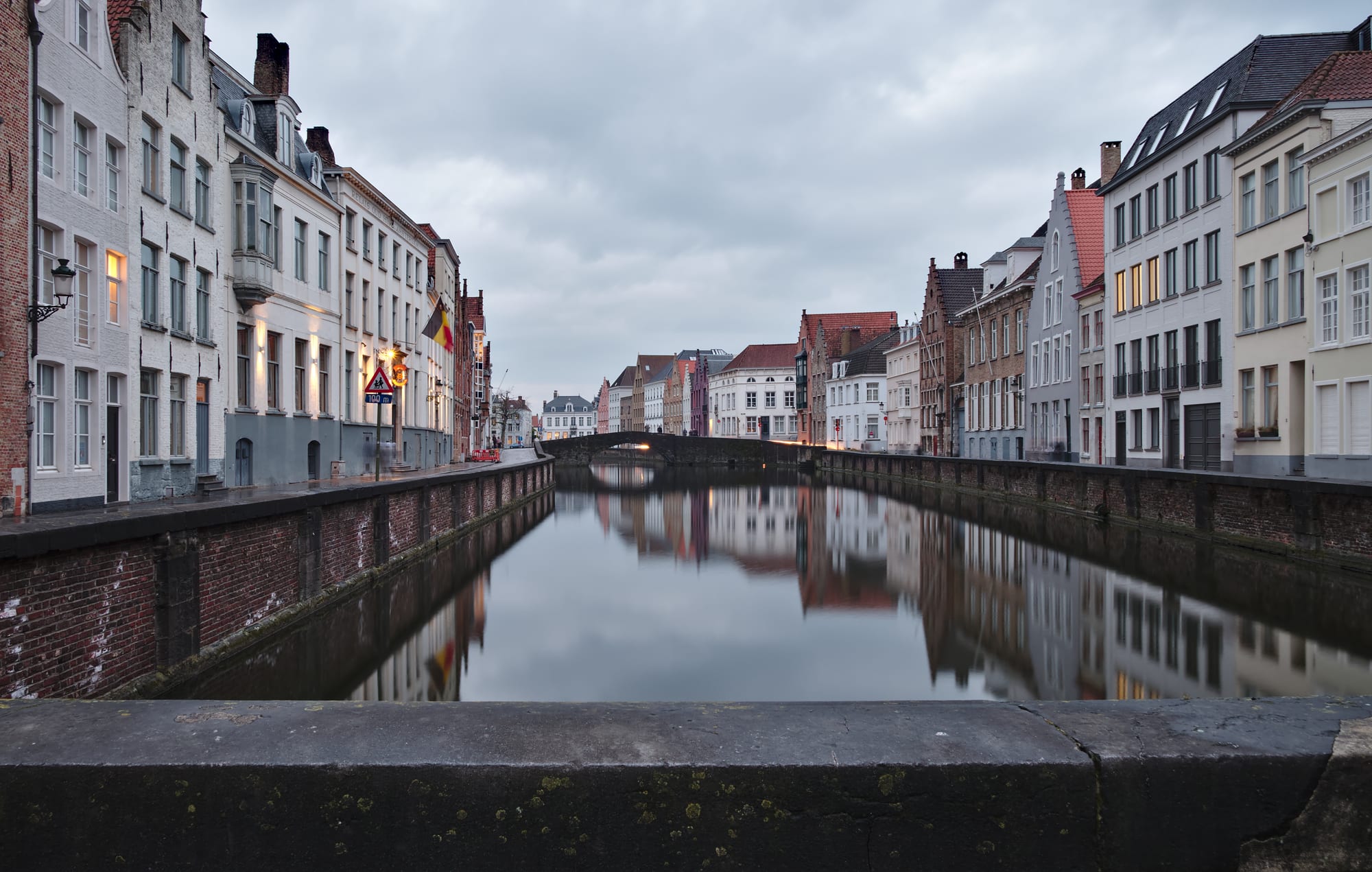
A still canal reflecting rows of white and brick gabled houses under a grey evening sky, with a stone bridge in the distance

Brussels & Flanders, Belgium

Bruges

The Spiegelrei and Spinolarei canals seen from the Jan van Eyckplein in Bruges at dusk. (Trougnouf / Wikimedia Commons · CC BY 4.0)

The capital of West Flanders, a canal city whose Golden Inlet to the sea made it one of medieval Europe's chief trading centres until the channel silted up around 1500. Its oval historic centre of brick gables, belfry and Flemish Primitive paintings is a UNESCO World Heritage Site, drawing millions of visitors a year, while the modern port of Zeebrugge lies on the coast.

Neighbourhoods

  • The Markt and the Burg
    • First-time visitors
    • Historic district
    • Landmarks

    The two main squares at the heart of the oval centre: the Markt, with the 13th-century belfry and its market halls, and the Burg, site of the counts' former fortress, with the Basilica of the Holy Blood and the town hall. They are the busiest streets in the city in high season.

    Open in Maps
  • Dijver and the museum quarter
    • Museums
    • Canals
    • Art

    The canal-side Dijver and the streets around the Church of Our Lady, south of the Markt, where the Groeningemuseum, the Gruuthuse and the old St John's Hospital with its Memling paintings stand close together. A folklore market sets up under the trees at weekends outside winter.

    Open in Maps
  • The Beguinage quarter
    • Quiet and peaceful
    • Historic district

    The southern edge of the old town, between the centre and the railway station, around the walled beguinage with its white-painted houses and plane trees, now home to Benedictine nuns. It is one of the calmest corners of the centre.

    Open in Maps
  • 't Zand
    • Nightlife
    • Close to the station
    • Saturday market

    The large square on the western side of the old town, where the red-tiled Concertgebouw stands and a Saturday morning market is held. Its tearooms and the bars of the streets towards the Eiermarkt make it one of the city's main areas for going out.

    Open in Maps
  • Zeebrugge
    • Beaches
    • Port

    Bruges' modern port on the North Sea coast, built in 1907, which is also a seafront resort with cafés, a marina and a beach.

    Open in Maps

Things to do

Famous landmarks

  • Belfry of Brugeslandmark

    The bell tower added to the Markt around 1240, 83 metres tall and leaning 87 centimetres to the east, with 366 steps to the top and a carillon of 47 bells.

    Open in Maps
  • Marktlandmark

    The central square, framed by the belfry and its market hall and by Gothic Revival buildings on the site of the old Waterhalle.

    Open in Maps
  • Burglandmark

    One of the city's main squares, on the site of a former fortress, where the Basilica of the Holy Blood and the old town hall stand.

    Open in Maps
  • Basilica of the Holy Bloodlandmark

    A double chapel on the Burg built in 1134–1157 for the counts of Flanders: a dark Romanesque lower chapel and a Gothic upper chapel holding the relic of the Holy Blood.

    Open in Maps
  • Church of Our Ladylandmark

    A Gothic church whose 115.6-metre brick tower is the tallest structure in the city, holding Michelangelo's marble Madonna and Child and the tombs of Charles the Bold and Mary of Burgundy.

    Open in Maps
  • St. Salvator's Cathedrallandmark

    The city's Catholic cathedral, dedicated to the Risen Saviour and to Saint Donatian, the patron saint of Bruges.

    Open in Maps
  • Princely Beguinage Ten Wijngaerdelandmark

    The city's only preserved beguinage, a 13th-century enclosure and part of the UNESCO listing of Flemish beguinages, occupied by Benedictine nuns since 1927.

    Open in Maps

Museums

  • Groeningemuseummuseum

    Six centuries of Flemish and Belgian painting, from Jan van Eyck and the Early Netherlandish masters to symbolism and Flemish Expressionism.

    Open in Maps
  • Old St. John's Hospitalmuseum

    A hospital founded in the mid-12th century, among Europe's oldest surviving hospital buildings, now holding the Hans Memling museum with his triptychs.

    Open in Maps
  • Gruuthusemuseummuseum

    A museum of applied arts from the 15th to the 19th century in the medieval house of Louis de Gruuthuse.

    Open in Maps

Music and culture

  • Concertgebouwattraction

    A concert hall on 't Zand built for the city's year as European Capital of Culture in 2002, clad in red terracotta tiles, with a glass Lantern Tower overlooking the old town.

    Open in Maps

Short trips from the city

  • Dammeattraction

    A small town about 5 km north-east, with a windmill, a popular bicycle ride from the city.

    Open in Maps
  • Lissewegeattraction

    A village within the city's boundaries near the coast, merged into Bruges in 1971, where the great barn of the former Ter Doest Abbey still stands.

    Open in Maps

Seasonal events

  • Procession of the Holy BloodAscension Day, May or June

    A medieval religious procession in which the relic of the Holy Blood is carried through the streets by more than 1,600 participants, many dressed as knights or crusaders; on UNESCO's intangible heritage list since 2009.

  • Fedekam Taptoefirst Saturday of July

    An international military tattoo of marching bands on the Burg.

  • Christmas marketDecember

    A Christmas market on the Markt over the Christmas period.

Eat and drink

Long-standing places and food districts in Bruges. Hours, ratings and directions come from your maps app, always current.

Bruges classics

  • Cambrinusrestaurant

    A popular beer café and restaurant near the Markt, known for its beef stew.

    Open in Maps
  • Chocolatiers of the old townneighborhood

    Bruges calls itself a chocolate city, with many chocolatiers across the centre and its own official city praline, the Brugsch Swaentje.

    Open in Maps

Food districts and markets

  • Tearooms of the Markt and 't Zandneighborhood

    The two big squares hold a large number of tearooms, the place for coffee, waffles and cakes.

    Open in Maps
  • Wednesday marketmarket

    A weekly morning market on the Markt, sometimes moved to the Burg.

    Open in Maps
  • Saturday market on 't Zandmarket

    The city's large weekly morning market, mostly selling new goods.

    Open in Maps

Experience Bruges

History

The name first appears as Brugis in an inventory of Ghent's Saint Bavo's Abbey compiled between 851 and 864, and probably comes from the Scandinavian bryggja, a quay or jetty. Viking raids in the ninth century led Count Baldwin I of Flanders to strengthen the old Roman fortifications, and as rival harbours declined Bruges filled the gap in trade with England and the Baltic. It received its city charter on 27 July 1128, and a storm in 1134 opened a natural channel to the sea at the Zwin, the "Golden Inlet" on which its fortune rested.

At its height Bruges stood at the crossroads of Hanseatic and southern trade. The Hanseatic League kept a kontor here, a bourse opened in 1309 that was most likely the world's first stock exchange, and the city's weavers were thought to be the best in the world; by about 1350 at least 46,000 people lived here. In the 15th century Philip the Good, Duke of Burgundy, kept a court here, and Jan van Eyck and Hans Memling lived and worked in the city.

From about 1500 the Zwin silted up and the golden age ended. Bruges briefly came under Protestant rule in 1578, fell behind Antwerp after 1584 and turned to lace-making in the 17th century. In the second half of the 19th century it became one of the world's first tourist destinations, drawing wealthy British and French visitors, and Georges Rodenbach made it a character in his novel Bruges-la-Morte of 1892. The port of Zeebrugge opened in 1907, the city absorbed its surrounding municipalities in 1971, and the historic centre became a UNESCO World Heritage Site in 2000.

Culture & Customs

The city's culture rests on the painters who worked here in the 15th century. Van Eyck and Memling are the pride of its museums, the Groeningemuseum covers six centuries of Flemish painting, and the old St John's Hospital keeps Memling's triptychs where they were made to hang. Michelangelo's marble Madonna and Child stands in the Church of Our Lady. Lace-making, which took off in the 17th century, remains a symbol of the city, and a lace school still teaches the craft.

Religious and civic pageantry is part of the calendar. Each Ascension Day the relic of the Holy Blood, said to have been brought back after the Second Crusade by Thierry of Alsace, is carried in a procession of more than 1,600 participants, many dressed as knights and crusaders. Every five years the Pageant of the Golden Tree, created in 1958, recalls the tournament held on the Markt in 1468 for the wedding of Charles the Bold and Margaret of York. The Concertgebouw, built when Bruges was European Capital of Culture in 2002, and the Cactus music centre lead its music life.

People here speak West Flemish, a dialect that other Dutch speakers can find hard to follow; the residents are called Bruggelingen. Football matters: Club Brugge and Cercle Brugge both play in the top division and share the Jan Breydel Stadium.

Daily Life

About 120,000 people live in the city of Bruges, only some 20,000 of them in the historic centre; the rest are spread across the suburbs and villages merged into it in 1971, as far as Zeebrugge on the coast. In 2017 about 5 per cent of residents held a foreign nationality.

Tourism is a huge part of the economy, with some eight million visitors a year, and in summer the streets between the Markt, the Burg and the beguinage are given over to them. The port of Bruges-Zeebrugge is the other main source of work and one of the city's great economic assets, and the College of Europe, a university institute for European studies, brings students from across the continent. Universities of applied sciences such as VIVES and HOWEST add a younger population.

Ordinary life goes on around the edges of the visitor trade. The Wednesday market fills the Markt and the Saturday market fills 't Zand each morning of those days, residents cycle everywhere, and the streets around the Eiermarkt and 't Zand are where local people go out at night. There are plans for a new stadium of about 45,000 seats for Club Brugge in the north of the city.

Food

Bruges presents itself as a chocolate city. It has a large number of chocolatiers, a chocolate museum, Choco-Story, and its own official city praline, the Brugsch Swaentje. Belgian fries are sold from frietkoten across the city, traditionally in a paper cone with mayonnaise on top, and there is even a museum devoted to them.

Beer is the other local pride. Many beers carry the city's name — Brugge Tripel, Brugse Babbelaar and others — but only Brugse Zot and Brugse Straffe Hendrik are brewed in the city itself, at the De Halve Maan brewery in the old town, and beer cafés and shops are found across the centre. Bruges restaurants serve the Flemish classics: carbonade flamande, also called stoofvlees or stoverij, a beef stew made with beer and mustard and often served with fries; moules-frites, mussels cooked with onions and celery and served with fries; and grey shrimp, stuffed into tomatoes or folded into croquettes.

The Markt and 't Zand hold many tearooms, where waffles and cakes come with coffee. The restaurants on the Markt itself are priced for the view, and a few streets away there are cheaper places used by local people.

Planning tools

Budget

Rooms in the old town are in most demand in July and August, and the months outside summer are quieter. Restaurants on the Markt charge for the setting, and food in the side streets costs noticeably less.

Daily Budget Midrange
USD 180–320 (mid-range hotel, restaurant dinners, museum tickets, canal boat ride)
Daily Budget Shoestring
USD 90–150 (hostel or budget hotel, frites and bakery meals, regional trains)

Visit on a weekday if possible, or stay in Ghent and come by train; walking the canals and the beguinage costs nothing.

Best Time to Visit

April to June and September have the brightest weather without the biggest crowds, and the Procession of the Holy Blood fills the streets on Ascension Day. July and August are the busiest weeks of the year in Bruges. December brings the Christmas market and lights, and winter is the quietest time in the old town.

Suggested Number of Days

Many visitors come for a single day by train, but staying overnight allows the old town to be seen once the day crowds have gone. Three or four days leave time for the museums at an easy pace and for the coast and the surrounding villages.

First Visit
1–2 days
With Surroundings
3–4 days

Transportation

The historic centre is best covered on foot or by bicycle, and many canals can only be seen from the water on a tour boat. Driving inside the oval of canals that rings the old town is a poor idea, as parking is limited and finding the way difficult, and there are car parks on the edge of the centre. Frequent buses run between the station and the centre, and bicycles can be hired at the station.

Leave the car in a car park on the edge of the centre, and watch for cyclists on the narrow streets.

Airport & Station Connections

Most visitors arrive by train: Bruges is about an hour from Brussels, and its station is the hub for lines to the Belgian coast. The old town and its hotels are within walking distance of the station. The nearest airport, Ostend-Bruges, is about 25 km away but has limited passenger services.

Walkability

The oval historic centre, about 430 hectares within its ring of canals, is compact and largely flat, and walking is the best way to see it. Cobbled streets make wheeled suitcases hard work, and the Markt and the Burg are crowded in high season, while quieter streets lie a few minutes away in almost any direction.

Safety

Belgium is generally safe, with low levels of violent crime against visitors. Bruges is a calm city; the main annoyances are the summer crowds around the Markt and the Burg, fast cyclists on narrow cobbled streets.

Look for bicycles before stepping into the street, keep valuables close in crowded squares, and check prices before ordering near the main squares. Check current official travel advice before travelling.

Climate

An oceanic climate, cool, cloudy and often damp, with rain possible in any month. Cloud, drizzle and wind can come at any time of year.

Summer
mild, with average highs of around 21°C in July and August
Winter
damp and chilly, with temperatures around 2°C

Local Customs

Dutch is the language of Bruges, spoken locally in its West Flemish form, though English is widely understood in the tourist trade. Service is included in restaurant bills, so tipping is modest. The beguinage is still a religious community: visitors are asked to keep their voices down and groups are discouraged.

Rounding up the bill is plenty; a tip is a sign of appreciation rather than an expectation. Speak quietly in the beguinage and in churches, and do not block the narrow pavements when stopping for photographs.

Common Payment Methods

Belgium uses the euro. Card and phone payment are widely accepted, but a little cash is useful for market stalls, small cafés and frites stands.