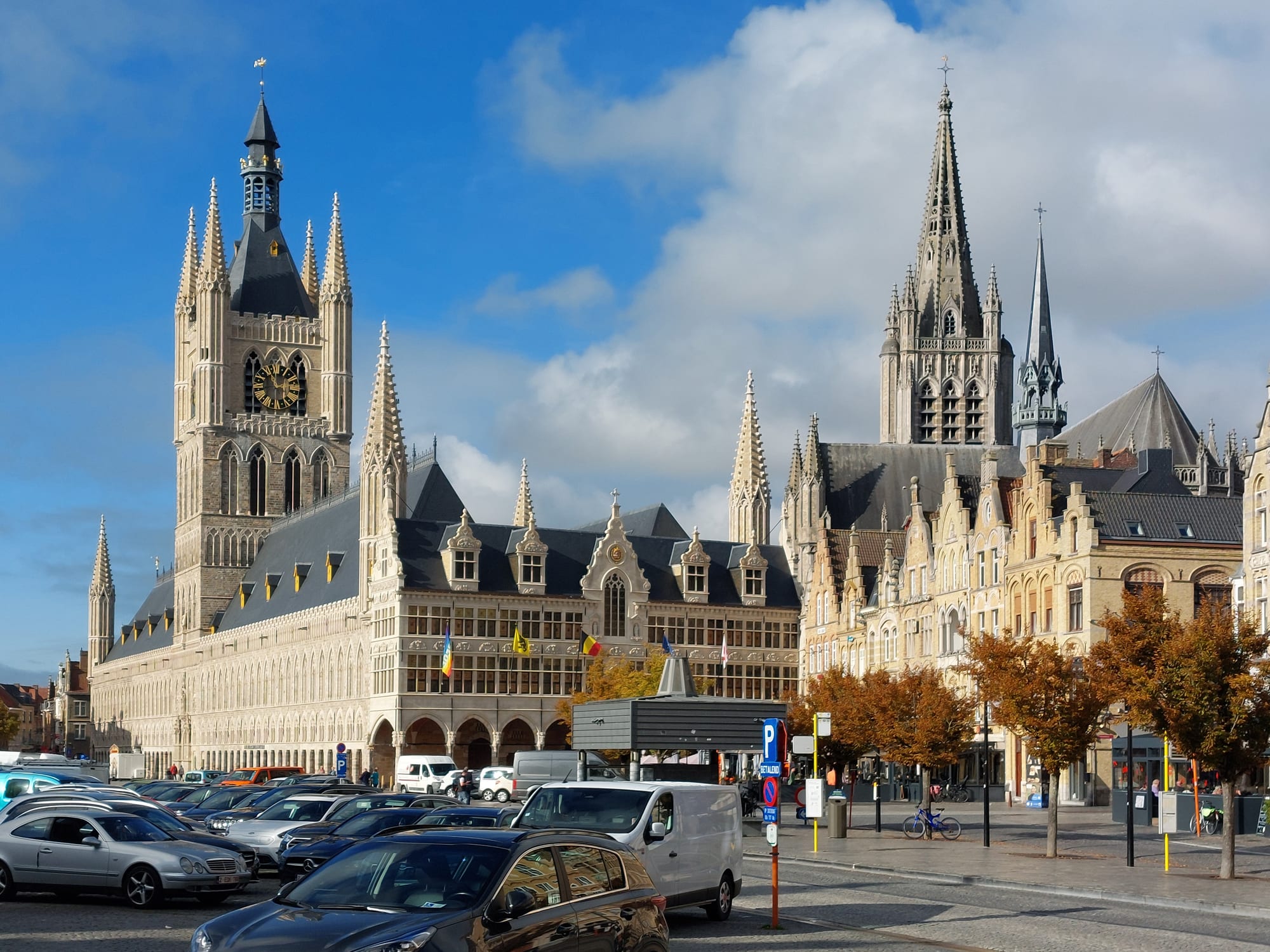
The Cloth Hall and its belfry on the Grote Markt in Ypres, with St Martin's spire and gabled houses behind autumn trees

Brussels & Flanders, Belgium

Ypres

The rebuilt Cloth Hall and St Martin's Church on the Grote Markt in Ypres. (Marc Ryckaert / Wikimedia Commons · CC BY 4.0)

A small city in West Flanders, officially Ieper, that grew rich on cloth in the Middle Ages and was reduced to rubble in the First World War, when it stood at the centre of the Ypres Salient. Rebuilt after the war, it is now the base for visiting the Flanders Fields cemeteries and memorials, with the Last Post sounded at the Menin Gate every evening.

Neighbourhoods

  • Grote Markt and the old centre
    • First-time visitors
    • Historic district
    • Best for food

    The large market square, dominated by the rebuilt Cloth Hall and its belfry, with St Martin's Church just behind. Restaurants, pubs and outdoor tables line the square, and shops selling chocolate and beer fill the streets around it. Most of the town's sights are a few minutes' walk away.

    Open in Maps
  • The ramparts and the Menin Gate
    • Walks
    • War memorials

    The walls and moat that guard the south and east of the town, largely the work of Vauban in the late 17th century. The Menin Gate stands on the eastern exit and the small Ramparts Cemetery beside the Lille Gate to the south, with some early ramparts from 1385 still surviving near it.

    Open in Maps
  • Zillebeke and the outlying villages
    • Quiet and residential
    • Battlefield sites

    The municipality takes in ten villages around the town, among them Zillebeke, Boezinge and Vlamertinge. The battlefield sites of the old Salient are scattered through this farmland, from Hill 60 to the south and Sanctuary Wood to the east to the canal bank north of town.

    Open in Maps

Things to do

Famous landmarks

  • Cloth Halllandmark

    One of the largest commercial buildings of the Middle Ages, 125 metres wide with a 70-metre belfry, reconstructed between 1933 and 1967 and part of the UNESCO-listed Belfries of Belgium and France.

    Open in Maps
  • St Martin's Churchlandmark

    The former cathedral, rebuilt in 1922–1930 to the original plans but with a higher spire, 102 metres tall, and holding the tomb of Bishop Jansenius.

    Open in Maps
  • Menin Gatelandmark

    Reginald Blomfield's memorial arch, unveiled in 1927 and restored between early 2023 and spring 2025, carrying the names of Commonwealth soldiers missing in the Salient with no known grave; the Last Post is sounded beneath it at eight every evening.

    Open in Maps
  • Saint George's Memorial Churchlandmark

    An Anglican church consecrated in 1929 to commemorate the British and Commonwealth troops who died in the Salient, filled with plaques to regiments and individuals.

    Open in Maps
  • Ramparts Cemeterylandmark

    A small Commonwealth war cemetery on the town walls beside the Lille Gate.

    Open in Maps

Museums

  • In Flanders Fields Museummuseum

    The First World War museum in the Cloth Hall, named after John McCrae's poem, which sets out to show the futility of war rather than glorify it.

    Open in Maps

Short trips into the Salient

  • Essex Farm Cemeterylandmark

    A Commonwealth cemetery of more than 1,200 graves within the John McCrae Memorial Site, just north of town.

    Open in Maps
  • Hill 60park

    A battlefield memorial site and park at Zillebeke, about 4.3 km from the centre, with the remains of bunkers and craters from the fighting.

    Open in Maps
  • Tyne Cotlandmark

    The largest cemetery for Commonwealth forces in the world, outside Passendale near Zonnebeke.

    Open in Maps
  • Langemark German war cemeterylandmark

    Where more than 44,000 German soldiers are buried, many in a mass grave near the entrance, close to the site of the first gas attacks of 1915.

    Open in Maps
  • Passchendaele Museummuseum

    A First World War museum in the chateau grounds of Zonnebeke, devoted above all to the Battle of Passchendaele of 1917.

    Open in Maps
  • Poperingeattraction

    The neighbouring hop-growing town, just behind the wartime front, home to the national hop museum and to Talbot House, the soldiers' rest house known as Toc H.

    Open in Maps

Seasonal events

  • KattenstoetSecond Sunday of May, usually every three years

    The Cat Parade, recalling the medieval throwing of cats from the belfry: a parade of cats, witches and townsfolk of past ages, with plush toy cats thrown from the belfry by a jester.

  • IeperfestLast weekend of August

    One of the biggest festivals of the hardcore metal scene in Europe.

Eat and drink

Long-standing places and food districts in Ypres. Hours, ratings and directions come from your maps app, always current.

Food districts and markets

  • Grote Marktneighborhood

    The market square holds a run of restaurants, pubs and outdoor terraces facing the Cloth Hall, busiest in summer.

    Open in Maps
  • Chocolate and beer shopsneighborhood

    The streets around the square have shops selling Belgian chocolates and beer.

    Open in Maps
  • Poperinge's hop countryneighborhood

    The town next door grows most of Belgium's hops and brews its own beer, Hommel, named after the West Flemish word for hops.

    Open in Maps

Experience Ypres

History

Ypres is first mentioned by name in 1066 and probably takes its name from the Ieperlee, the small river on whose banks it was founded. In the Middle Ages it was one of the great cloth towns of Flanders, third in the county after Ghent and Bruges, with a population of about 40,000 in 1200; its textiles reached the markets of Novgorod, and its trade with England earned a mention in the Canterbury Tales. The Cloth Hall, built mainly between 1200 and 1304, served as its market and warehouse. The town was besieged by an English crusading army in 1383, became the seat of a new diocese in 1561, and was taken by Louis XIV in 1678, after which Vauban rebuilt its fortifications.

In the First World War Ypres stood in the path of the German advance and became the centre of the Ypres Salient, surrounded on three sides and shelled for most of the war. The Second Battle of Ypres began on 22 April 1915 with the first German use of poison gas, chlorine, and mustard gas, later called Yperite after the town, was first used nearby in 1917. The Third Battle, Passchendaele, cost nearly half a million casualties on all sides for a few miles of ground. By 1918 the town had been all but obliterated.

Winston Churchill proposed leaving the ruins as a memorial, but the townspeople rebuilt, using German reparations to reconstruct the Grote Markt, the Cloth Hall and the town hall as close to the originals as possible. The Menin Gate was unveiled in 1927. In 1940 the Germans occupied the town again until the 1st Polish Armoured Division liberated it on 6 September 1944.

Culture & Customs

Remembrance shapes the town's identity. At eight every evening traffic stops at the Menin Gate while buglers of the Last Post Association sound the Last Post for the soldiers of the British Empire who died in the Salient. The ceremony was banned during the German occupation and moved to Brookwood Military Cemetery in England, then resumed under the gate on the very evening of liberation in 1944. In 1920 King George V awarded the Military Cross to the city, one of only two municipalities to receive it, and between the wars British veterans of the Ypres League turned the town into a place of pilgrimage. British soldiers called it "Wipers" and named their trench newspaper The Wipers Times.

The town also keeps a stranger medieval memory. Cats, once seen as symbols of the devil and witchcraft, were said to have been thrown from the Cloth Hall, and since 1955 the Kattenstoet, the Cat Parade, has been held on the second Sunday of May, usually every three years: participants dress as cats, witches and townsfolk of the past, and a jester throws plush toy cats from the belfry to the crowd. The belfry's carillon has 49 bells.

Ypres has adopted peace as a civic theme: it hosts the international campaign secretariat of Mayors for Peace, which works to abolish nuclear weapons. Its other calendar fixtures are noisier — the Ieperfest hardcore metal festival each August, and a rally held in the area since 1965.

Daily Life

About 34,900 people live in the municipality, which takes in the town and ten surrounding villages, among them Boezinge, Dikkebus, Vlamertinge, Zillebeke and Zuidschote. Dutch is the official language and Ieper the official name; the French Ypres is the one English speakers know. The rebuilt market square looks medieval, but the rest of the rebuilt town is more modern in appearance.

Visitors to the battlefields are a constant presence. The Cloth Hall museum, the cafés of the Grote Markt and the shops of chocolate and beer depend on them, and every evening the crowd at the Menin Gate swells or thins with the season. The landscape around the town is still full of the war: bomb craters filled with water, trenches and cemeteries sit among the farmland, and Commonwealth and German war graves cover the countryside.

The rhythm is that of a small Flemish provincial town. Trains run hourly to Kortrijk, the nearest larger city and rail junction, and the countryside is criss-crossed by walking and cycling routes. Bellewaerde, a theme park founded in 1954 on the edge of the municipality, draws around 850,000 to 900,000 visitors a year.

Food

Ypres eats as West Flanders and the rest of Belgium do. Carbonade flamande, known in Dutch as stoofvlees or stoverij, is a beef stew made with Belgian beer instead of the red wine of a French bourguignon, and it counts as one of the national dishes alongside moules-frites, mussels steamed with onions and celery and served with fries. Waterzooi, a rich stew of chicken or fish with vegetables, cream and eggs, comes from Ghent but is found across Flanders, as is steak with fries.

Fries themselves are bought at a frituur, served in a paper cone called a puntzak with the sauce on top; carbonade gravy is one of the warm sauces some offer. The restaurants and pubs around the Grote Markt put out terrace tables in summer, and the shops of the centre sell Belgian chocolates and beer, the town's most common souvenirs.

Beer has local roots. Neighbouring Poperinge grows about 80 per cent of Belgium's hops, has a national hop museum, and holds a hop festival and parade every three years in September; its own brew is called Hommel, the West Flemish word for hops.

Planning tools

Budget

Rooms in Ypres can fill well ahead in years of the Cat Parade. The main extra cost is getting out to the battlefield sites, by hire car, bike or guided tour; many of the memorials and cemeteries themselves are free.

Daily Budget Midrange
USD 170–300 (mid-range B&B or hotel, restaurant dinners, museum tickets, a hire car or battlefield tour)
Daily Budget Shoestring
USD 85–140 (hostel, campsite or simple B&B, frituur and bakery meals, bike hire)

Watching the Last Post at the Menin Gate costs nothing; arrive early on summer evenings.

Best Time to Visit

April to June and September bring the brightest weather across Flanders without the summer crowds. Every third May the Cat Parade fills the town, and late August brings Ieperfest. Winter is grey and damp but quiet.

Suggested Number of Days

The town itself can be seen in a day. The battlefield sites are spread across the surrounding countryside, so most visitors who come for the war history stay several days, and the number depends on whether a car, a bike or a guided tour is used.

First Visit
1–2 days
With Surroundings
3–4 days

Transportation

The centre is small and walkable. The cemeteries and memorials of the Salient are scattered across the countryside, and a car, a bike or an arranged tour is the practical way to reach them. The area has many walking and cycling routes, but distances to particular sites are often long for a bike. Parking is available on the market square for a fee, except on market days, and free near the station.

Plan battlefield visits by car or tour; buses to the outlying sites are not a practical way to see several in a day.

Airport & Station Connections

Ieper station, on the line from Kortrijk to Poperinge, has hourly trains to Kortrijk, and the town centre is an easy walk from it. Kortrijk has rail connections to Brussels, Ghent, Bruges, Antwerp and Lille. Drivers from the Channel ports of Calais or Dunkirk take the A16 east and then the A25 towards Lille.

Walkability

The walled centre is compact and flat, and the Grote Markt, the Menin Gate, St Martin's and the ramparts are all within a few minutes of each other. Everything beyond the walls, including most of the cemeteries, needs wheels.

Safety

Belgium is generally safe, with low levels of violent crime against visitors. Ypres is a quiet provincial town where serious crime is rare; the practical hazards are traffic on narrow country roads when cycling between battlefield sites and the crowds at the Menin Gate on busy evenings.

Leave nothing visible in a parked car at remote cemeteries, wear something bright when cycling the country lanes. Check current official travel advice before travelling.

Climate

Maritime and mild, like the rest of Belgium, with significant rain in every season; across the country average temperatures run from about 3°C in January to 18°C in July.

Summer
comfortably warm, averaging about 18°C in July across Belgium, with occasional hot spells
Winter
cool and damp, averaging about 3°C in January across Belgium, with snowfall in decline

Local Customs

Dutch is the official language, and the town's official name is Ieper, though Ypres is the name most used in English. The Last Post at the Menin Gate is a ceremony of remembrance; the cemeteries are places of mourning and are treated as such.

Restaurant service is included in Belgium, so tipping is not expected, though a small tip is a sign of appreciation. Stay quiet during the Last Post and keep off graves in the cemeteries.

Common Payment Methods

Belgium uses the euro. Card and phone payment are widely accepted; carry a little cash for small purchases and the market.