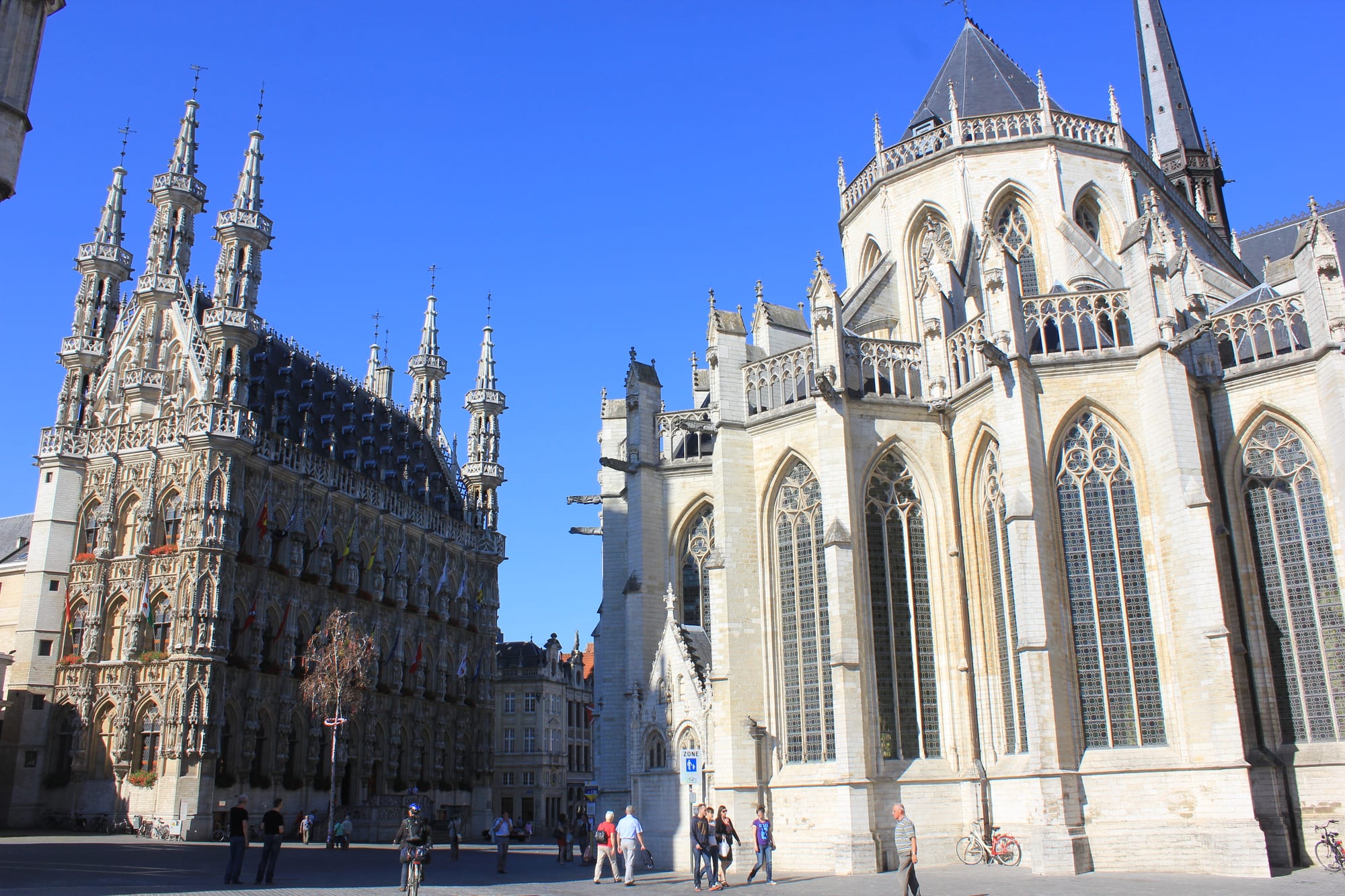
Leuven's ornate Gothic town hall with slender turrets beside the pale stone choir of St Peter's Church under a blue sky

Brussels & Flanders, Belgium

Leuven

The town hall and St Peter's Church on the Grote Markt in Leuven. (Latinista / Wikimedia Commons · CC BY-SA 3.0)

The capital of Flemish Brabant, about 25 km east of Brussels, a cloth town of the dukes of Brabant that has been a university city since 1425. Its late-Gothic town hall, great beguinage and café-lined Oude Markt sit in a compact centre shaped by KU Leuven's tens of thousands of students and by the brewery that makes Stella Artois.

Neighbourhoods

  • Grote Markt and the Oude Markt
    • First-time visitors
    • Historic district
    • Nightlife

    The heart of the city, where the town hall faces St Peter's Church across the Grote Markt, and the rectangular Oude Markt nearby is lined so completely with bars and restaurants that it is called the longest bar in the world.

    Open in Maps
  • Ladeuzeplein and the university quarter
    • Students
    • Museums
    • Markets

    The squares around the university library, whose tower holds one of the largest carillons in the world, with Jan Fabre's Totem in front of it, M Leuven nearby and the Friday market on the Ladeuzeplein and Hooverplein.

    Open in Maps
  • The Great Beguinage
    • Quiet and peaceful
    • Historic district

    A restored quarter of a dozen streets in the south of the centre, about three hectares with some 300 apartments in almost 100 houses.

    Open in Maps
  • Heverlee
    • Green spaces
    • University campus

    The southern sub-municipality, merged into Leuven in 1977, home to the Arenberg castle and campus, Park Abbey and the Heverlee War Cemetery, with woodland beyond.

    Open in Maps
  • Kessel-Lo
    • Quiet and residential
    • Local life

    A residential sub-municipality, merged into the city in 1977, with about 29,000 residents and the former Vlierbeek Abbey.

    Open in Maps

Things to do

Famous landmarks

  • Leuven Town Halllandmark

    Built between 1439 and 1469 in Brabantine late Gothic, famous for facades carved in lace-like detail.

    Open in Maps
  • Saint Peter's Churchlandmark

    A 15th-century Brabantine Gothic church, 93 metres long, opposite the town hall, whose unfinished tower is part of the UNESCO listing of the belfries of Belgium and France.

    Open in Maps
  • Grote Marktlandmark

    The main square, framed by the town hall and St Peter's Church.

    Open in Maps
  • Oude Marktlandmark

    A rectangular square made up almost entirely of bars and restaurants, nicknamed the longest bar in the world, with a statue of the Kotmadam, the landlady, on a bench.

    Open in Maps
  • University Halllandmark

    The medieval cloth hall, later extended, that is now KU Leuven's main administrative building, restored in 1921–1926 after the sack of 1914.

    Open in Maps
  • Great Beguinagelandmark

    One of the largest surviving beguinages in the Low Countries, a completely restored quarter of a dozen streets in the south of the centre.

    Open in Maps

Museums and gardens

  • M Leuvenmuseum

    An art museum opened in 2009 with some 46,000 works, from late-Gothic sculpture and 16th-century local painters to contemporary exhibitions.

    Open in Maps
  • Hortus Botanicus Lovaniensispark

    The city's botanical garden, the Kruidtuin, dating from 1738 and covering 2.2 hectares in the centre.

    Open in Maps

Abbeys and castles

  • Park Abbeylandmark

    A Premonstratensian abbey of 42 hectares at Heverlee, founded in 1129.

    Open in Maps
  • Château of Arenberglandmark

    A Flemish Renaissance château in a park at Heverlee, home of the Arenberg family from 1612 until the First World War and now owned by KU Leuven.

    Open in Maps
  • Keizersberg Abbeylandmark

    A former Benedictine monastery, begun as a house of studies in 1888, on the hill in the north of the town where the castle of Leuven stood until 1782.

    Open in Maps
  • Vlierbeek Abbeylandmark

    A former Benedictine abbey in Kessel-Lo, north-east of the centre, on the site of a priory founded in 1127.

    Open in Maps

Seasonal events

  • Cyclocross LeuvenJanuary

    A cyclo-cross race held in the city each year.

  • BeleuvenissenFridays in July

    A music and culture festival on the squares of the city centre.

  • Marktrockaround mid-August

    A music festival on the Oude Markt and the Ladeuzeplein, once one of Europe's biggest urban festivals.

  • Hapje Tapjefirst Sunday of August

    The day when the city's bars and restaurants set up stalls outside to show what they serve.

  • Jaarmarktfirst Monday of September

    A fair that turns the whole city centre into one big market.

Eat and drink

Long-standing places and food districts in Leuven. Hours, ratings and directions come from your maps app, always current.

Leuven classics

  • Oude Marktneighborhood

    The square of bars and cheaper restaurants where the students eat and drink, busiest on Wednesday and Thursday nights in the academic year.

    Open in Maps
  • Frietkotrestaurant

    The fries stand, where many Belgians go for a quick and cheap bite.

    Open in Maps

Food districts and markets

  • Muntstraatneighborhood

    A narrow street of restaurants with outdoor tables in summer, from classic Belgian and French cooking to Mexican, Italian, Vietnamese, Chinese and Japanese.

    Open in Maps
  • Friday marketmarket

    The weekly market on the Ladeuzeplein and Hooverplein; on Saturdays a flower market sets up in the pedestrian part of the Brusselsestraat.

    Open in Maps

Experience Leuven

History

Leuven first appears in 891, when the Frankish king Arnulf of Carinthia defeated a Viking army here; legend says the city's red and white arms recall the bloodied banks of the Dyle after the battle. A castle on the Keizersberg hill became a stronghold of the dukes of Brabant, and between the 11th and 14th centuries the town grew into the most important trading centre of the duchy. Its cloth was so well known that ordinary linen was called lewyn in late medieval texts.

The founding of the university in 1425 began a new golden age. The town hall and St Peter's Church were built in the 15th century, and by 1500 Leuven was a European centre of learning where humanists such as Erasmus worked and Andreas Vesalius studied medicine. Brewing became an industry too: in 1708 Sebastien Artois became master brewer at the Den Horn brewery, which took his name in 1717 and later created Stella Artois. The castle on the Keizersberg was demolished in 1782.

The 20th century brought two catastrophes. On 25 August 1914 German troops burned much of the city in reprisal for alleged civilian resistance, destroying the university library. A new library on today's Ladeuzeplein, designed by the American architect Whitney Warren as a gift from the American people, opened in 1928, only to be set on fire by shelling on 16 May 1940, when nearly a million books were lost. In 1968 tensions between Dutch- and French-speaking students split the university in two, and in 1977 Heverlee, Kessel-Lo and other villages were merged into the city.

Culture & Customs

The university shapes everything. KU Leuven, the largest Dutch-language university in the world, had more than 65,000 students in 2021–22, with its main campus spread through the city, and term time sets the city's rhythm. A life-size statue of the Kotmadam, the landlady, sits on a bench on the Oude Markt; Fonske, a statue near the centre, is dressed up for special occasions like Manneken Pis in Brussels; and Jan Fabre's Totem, a 23-metre needle impaling a jewelled beetle, towers over the square in front of the library, whose tower holds one of the largest carillons in the world.

Beer is the other pillar of local identity. Leuven is the birthplace of Stella Artois, Leuvense Tripel, Domus and Keizersberg, and its bars, brewpubs and brown cafés pride themselves on their beer lists, one claiming more than 3,000. The calendar is full of street events: Beleuvenissen on summer Fridays, Marktrock in August, the Hapje Tapje day when bars and restaurants set up stalls outside, and the Jaarmarkt in September.

Sport means cycling and football. The Brabantse Pijl race starts here, a cyclo-cross race is held each January, and Oud-Heverlee Leuven is the main football club. The students add their own traditions, from university orchestras to the Earls of Leuven, a Gaelic games club in a city that hosted Europe's Collegiate Gaelic Games in 2022, 2023 and 2024.

Daily Life

About 104,000 people lived in Leuven at the start of 2024: some 30,000 in the centre, 29,000 in Kessel-Lo and 22,500 in Heverlee, with smaller numbers in Wilsele and Wijgmaal. The city has a large international student population, concentrated mainly around the centre.

The economy rests on knowledge. KU Leuven's research has spawned many spin-off companies, IMEC is a major research centre for nano-electronics and digital technology, and firms in biotechnology, robotics and IT cluster on the Arenberg Science Park and the Haasrode Research Park. UZ Leuven, the academic hospital, is a big employer with over 9,000 staff, and as capital of Flemish Brabant the city holds provincial government offices and the regional headquarters of De Lijn. Anheuser-Busch InBev, the world's largest brewer, has its global headquarters here, and its Stella Artois brewery and offices occupy the north-east of the town between the station and the canal to Mechelen.

The rhythm follows the academic year: busy weeknights on the Oude Markt during term, especially on Wednesdays and Thursdays, and bicycles everywhere. Since the October 2024 election Mohamed Ridouani of Vooruit has led a coalition with Groen and CD&V.

Food

Leuven's food culture is closely tied to its beer. Stella Artois traces its roots to the Den Horn brewery, and the city also gave its name to Leuvense Tripel; brown cafés and specialist beer bars are found throughout the centre. Belgian classics such as carbonade flamande, a beef or pork stew made with beer and mustard and often served with fries, and stoemp, potatoes mashed with vegetables and often served with sausages, appear on the menus of the traditional cafés.

The cheapest meals are found where the students eat. The Oude Markt has many smaller restaurants and bars, the frietkot remains the quick and cheap choice, and the Muntstraat, a narrow street near the Grote Markt, has outdoor tables in summer and cooking from classic Belgian and French to Mexican, Italian, Vietnamese, Chinese and Japanese.

Markets supply the rest. A general market fills the Ladeuzeplein and Hooverplein every Friday, a flower market sets up in the Brusselsestraat on Saturdays, and on the first Sunday of August Hapje Tapje puts the city's bars and restaurants out on the street with stalls of their own dishes and drinks.

Planning tools

Budget

Restaurants in Leuven are relatively cheap for Belgium, and the student population keeps plenty of inexpensive bars, frietkoten and cafés in business. Brussels is close enough by train for an easy day trip in either direction.

Daily Budget Midrange
USD 180–320 (mid-range hotel, restaurant dinners, museum tickets, day trips by train)
Daily Budget Shoestring
USD 90–150 (hostel or budget hotel, frites and student cafés, regional trains)

The Grote Markt, the beguinage, the botanical garden and the abbey grounds cost nothing to walk around.

Best Time to Visit

April to June and September bring the brightest weather. The academic year, from late September to early December and from February, fills the Oude Markt on weeknights; July has Beleuvenissen on Fridays, August brings Marktrock and Hapje Tapje, and September the Jaarmarkt and the fair on the Ladeuzeplein. A Christmas market comes in December.

Suggested Number of Days

Many visitors come for a day, often from Brussels, as the centre is compact. Staying a night or two allows a slower pace and time for the outer districts, and a longer stay suits those using Leuven as a base for other Flemish cities.

First Visit
1–2 days
With Surroundings
2–3 days

Transportation

The centre is small enough that public transport is rarely needed, except for the hospital at Gasthuisberg, the Arenberg campus or the woods of Heverlee, which De Lijn buses serve. Leuven is a cycling city, and bicycles can be hired; a car is of little use inside the ring road that follows the old city walls.

Lock bicycles to a fixed object, as bike theft is common, and look for cyclists before crossing.

Airport & Station Connections

Leuven station has frequent trains to Brussels, about 20 minutes away, and lines towards Liège, Hasselt, Aarschot and Ottignies; the high-speed line to Liège begins just outside the city. Brussels Airport is linked to Leuven by buses 91 and 616.

Walkability

The historic centre inside the ring road is compact and easy to walk, from the station to the Grote Markt, the Oude Markt, the Ladeuzeplein and the Great Beguinage. Heverlee and its abbey, castle and campus are a longer walk or a short bus or bike ride to the south.

Safety

Belgium is generally safe, with low levels of violent crime against visitors. Leuven is a relaxed student city; bicycle theft is the most common crime visitors meet, and the bars of the Oude Markt can be loud and crowded late at night.

Lock bicycles well, watch for fast cyclists, and keep belongings close in busy bars. Check current official travel advice before travelling.

Climate

Mild and maritime, with significant rain in every season. Across Belgium average temperatures run from about 3°C in January to 18°C in July, heatwaves have become more frequent, and Belgium's record of 41.8°C was set at Begijnendijk, in Flemish Brabant, on 25 July 2019.

Summer
comfortably warm, averaging about 18°C in July across Belgium, with occasional hot spells
Winter
cool and damp, averaging about 3°C in January across Belgium, with snowfall in decline

Local Customs

Leuven is a Dutch-speaking city with a large international student population. Service is included in restaurant bills, so tipping is modest. Beer is taken seriously, with many local brews and bars that pride themselves on long beer lists.

Tipping is not expected, as service is included, though a small tip is a sign of appreciation. Lock bicycles and keep noise down in residential streets late at night.

Common Payment Methods

Belgium uses the euro. Card and phone payment are widely accepted, but a little cash is useful for markets, frietkoten and small bars.