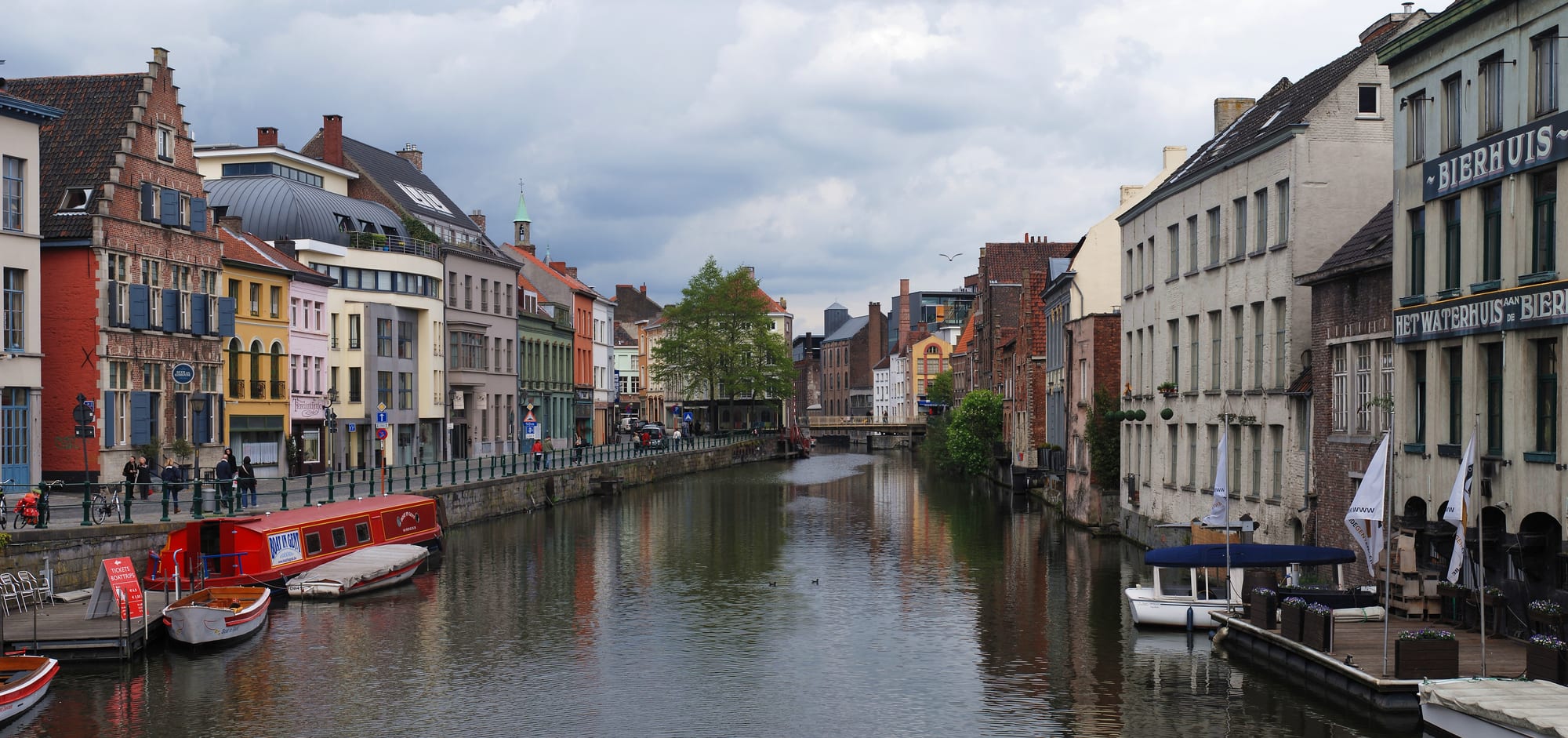
The river Lys in central Ghent lined with tall gabled houses and moored boats under a cloudy sky

Brussels & Flanders, Belgium

Ghent

The Leie (Lys) in the centre of Ghent, seen from the Vleeshuisbrug towards the Kraanlei. (Alvesgaspar / Wikimedia Commons · CC BY-SA 3.0)

The capital of East Flanders, a port and university city that grew at the meeting of the Scheldt and the Leie and was one of the largest cities in northern Europe around 1300. Decline after the 16th century preserved its medieval centre of castle, belfry and guildhall quays; today it is Belgium's second-largest municipality, car-free at its heart and busy with students.

Neighbourhoods

  • Korenmarkt and the Graslei
    • First-time visitors
    • Historic district
    • Café terraces

    The heart of the old town, where the Korenmarkt square meets the Leie and the medieval harbour quays of the Graslei and Korenlei face each other across the water. The three towers of St Nicholas, the belfry and the cathedral rise behind, and café patios fill the quays.

    Open in Maps
  • Patershol and the Gravensteen
    • Best for food
    • Old streets
    • Castle

    A quarter dating back to the 14th century near the Counts' Castle, where many of the city's upmarket restaurants are found. The Kraanlei, the Groentenmarkt and the Huis van Alijn museum are on its edge.

    Open in Maps
  • Vrijdagmarkt and Sint-Jacobs
    • Local life
    • Bars
    • Markets

    One of the oldest squares in the city, named after its Friday market, with the cafés and bars of the streets around the church of Sint-Jacobs nearby. The square played an important part in the city's history.

    Open in Maps
  • Citadelpark and the museum quarter
    • Museums
    • Parks
    • Close to Sint-Pieters station

    The southern side of the city between the centre and Sint-Pieters station, around the Citadelpark with the Museum of Fine Arts, S.M.A.K. and the Kuipke velodrome. The Bijloke site, home to the city museum, is nearby.

    Open in Maps
  • Overpoort and the university quarter
    • Students and nightlife
    • Cheap eats

    The student area south of the centre. Overpoortstraat is lined with more than thirty pubs and bars, busiest on Wednesday and Thursday nights, with cheap places to eat nearby.

    Open in Maps
  • Sleepstraat and the north
    • Best for food
    • Multicultural

    North of the centre, the area around Sleepstraat is the heart of the city's large Turkish community and known for its many Turkish restaurants, in a part of the city where many neighbourhoods have a majority of residents with roots abroad.

    Open in Maps

Things to do

Famous landmarks

  • Gravensteenlandmark

    The Counts' Castle, dating from 1180 and home to the counts of Flanders until 1353, later a court, prison, mint and cotton mill, restored from 1893 and now a museum.

    Open in Maps
  • Saint Bavo's Cathedrallandmark

    The 89-metre Gothic cathedral that holds the Ghent Altarpiece, the Adoration of the Mystic Lamb, completed by 1432 and attributed to Hubert and Jan van Eyck.

    Open in Maps
  • Belfry of Ghentlandmark

    At 91 metres the tallest belfry in Belgium, one of the three medieval towers over the old centre, UNESCO-listed with its adjoining cloth hall.

    Open in Maps
  • St. Nicholas Churchlandmark

    A 13th-century church in the local Scheldt Gothic style beside the Korenmarkt, whose central tower carried the town bells before the belfry was built, with an organ by Aristide Cavaillé-Coll.

    Open in Maps
  • Graslei and Korenleilandmark

    The two quays of the medieval port facing each other across the Leie, lined with guild and merchants' houses and now crowded with café patios.

    Open in Maps
  • Vrijdagmarktlandmark

    One of the oldest squares in Ghent, which still holds the weekly Friday-morning market that gave it its name.

    Open in Maps
  • Great St. Elizabeth Beguinagelandmark

    One of the city's three beguinages, the old enclosure of St Elizabeth near the Rabot; Ghent's beguinages are part of a UNESCO World Heritage Site.

    Open in Maps
  • Boekentorenlandmark

    Henry van de Velde's modernist Book Tower, part of the Ghent University Library, holding three million books.

    Open in Maps

Museums

  • Museum of Fine Artsmuseum

    About 9,000 works from the Middle Ages to the 20th century, centred on Flemish art, including paintings by Hieronymus Bosch and Rubens, on the edge of the Citadelpark.

    Open in Maps
  • S.M.A.K.museum

    The city museum of contemporary art, known for its collection of Francis Bacon, Andy Warhol, Karel Appel and Panamarenko and for provocative exhibitions.

    Open in Maps
  • Ghent City Museum (STAM)museum

    The story of the city, opened in 2010 in the former Bijloke abbey and its new entrance building.

    Open in Maps
  • Design Museum Gentmuseum

    Belgian and international design in an 18th-century mansion and a modern wing in the centre.

    Open in Maps
  • Huis van Alijnmuseum

    A museum of everyday life and local culture in the 20th century, in a former hospital on the Kraanlei.

    Open in Maps
  • Saint Peter's Abbeymuseum

    A former Benedictine abbey founded by Saint Amand in the seventh century, now a museum and exhibition centre.

    Open in Maps

Parks, water and sport

  • Kuipkeattraction

    The indoor velodrome in the Citadelpark, opened in 1927, home of the Six Days of Ghent track race each November and also used for concerts.

    Open in Maps
  • Saint Bavo's Abbeylandmark

    The remains of the seventh-century abbey that Charles V had largely demolished in 1540 to make way for a fortress for Spanish royal troops.

    Open in Maps

Short trips from the city

  • Sint-Martens-Latemattraction

    A village near the city, known as an artists' colony before the Second World War and now one of the wealthiest residential municipalities in Belgium.

    Open in Maps

Seasonal events

  • Gentse Feestenten days in July

    A music and theatre festival held since 1969, with stages on the squares of the old town and street performers, attended by about 1 to 1.5 million visitors.

  • Film Fest GentOctober

    Belgium's largest film festival, first held in 1974, with a focus on film music and the World Soundtrack Awards.

  • Six Days of GhentNovember

    A six-day track cycling race at the Kuipke velodrome.

  • Gentse Floraliënlate April or early May, every five years

    A large botanical exhibition lasting ten days at Flanders Expo.

Eat and drink

Long-standing places and food districts in Ghent. Hours, ratings and directions come from your maps app, always current.

Ghent classics

  • Cuberdon sellers on the Korte Muntmarket

    Street vendors near the Groentenmarkt selling cuberdons, the purple cone-shaped sweets the city calls neuzekes or Gentse neuzen, 'noses'.

    Open in Maps
  • Tierenteyn-Verlentrestaurant

    The shop on the Groentenmarkt selling Tierenteyn, the spicy local mustard similar to Dijon.

    Open in Maps
  • Groot Vleeshuismarket

    The medieval meat hall on the Groentenmarkt, with hams hanging from the timbers of a roof built without nails.

    Open in Maps

Food districts and markets

  • Patersholneighborhood

    The old quarter near the castle where many of the city's upmarket restaurants are found.

    Open in Maps
  • Korenmarkt and Vrijdagmarktneighborhood

    Brasseries and restaurants on the two big squares, many serving Gentse waterzooi.

    Open in Maps
  • Sleepstraatneighborhood

    The street at the centre of the Turkish community, known for its many Turkish restaurants.

    Open in Maps

Experience Ghent

History

The name comes from Ganda, most likely a Celtic word for a confluence,, for the city grew where the Leie flows into the Scheldt. Around 650 Saint Amand founded two abbeys here, St Peter's and St Bavo's, and Ghent developed from these and a merchant settlement beside them. By the 13th century Ghent was Europe's leading centre of woollen cloth, employing some 4,000 weavers and 1,200 fullers. With about 50,000 people in 1300 it was one of the largest and richest cities in northern Europe.

Charles V was born in Ghent in 1500, but when the city rose against him in 1539 he punished it, made its nobles walk before him barefoot with nooses around their necks, and in 1540 demolished St Bavo's Abbey to make way for a fortress for Spanish royal troops. People from Ghent have been called Stroppendragers, "noose-bearers", ever since. After the late 16th century the city lost importance, which left its medieval centre unusually well preserved.

Industry brought a second rise. In 1800 Lieven Bauwens, who had smuggled plans for machines out of England, set up the first mechanical weaving loom on the European continent, and Ghent became a textile city. The Treaty of Ghent, ending the War of 1812 between Britain and the United States, was signed here on Christmas Eve 1814; the university followed in 1816 and a new canal to the sea in 1824–27. After Belgian independence cut the city off from the sea for more than a decade, its economy collapsed and the first Belgian trade union was born here. A world exhibition followed in 1913.

Culture & Customs

The Ghent Altarpiece, finished by 1432 and attributed to the brothers Hubert and Jan van Eyck, is the city's great treasure, and its museums run from the Flemish masters at the Museum of Fine Arts to contemporary art at S.M.A.K. Nineteenth-century Ghent built an opera house and the university's Aula to designs by Louis Roelandt, and Henry van de Velde's Boekentoren gave it a modernist landmark. The beguinages and the belfry with its cloth hall are UNESCO-listed.

The calendar is crowded. The Gentse Feesten, "Gense Fieste" in local dialect, has turned the squares of the old town into ten days of stages and street performance every July since 1969, drawing 1 to 1.5 million visitors. Film Fest Gent, the country's largest film festival, has hosted the World Soundtrack Awards since 2001, the Festival of Flanders brings classical music, and every five years the Floraliën flower show fills Flanders Expo. Track cycling's big event is the Six Days of Ghent, raced at the Kuipke each November, and KAA Gent represents the city in the top football division.

The Stroppendragers nickname is worn with pride. Ghent is also a forward-looking city, with a large student population, the largest designated cycling area in Europe and a meat-free Thursday promoted in city canteens and schools, and in 2024 it was European Youth Capital.

Daily Life

About 270,000 people lived in the municipality at the end of 2024, making it the second most populous in Belgium, and the wider metropolitan area held about 560,000 in 2018. The city takes in suburbs such as Gentbrugge, Ledeberg, Mariakerke and Sint-Amandsberg as well as the historic centre. In the 2020 census about 35 per cent of residents had roots outside Belgium, and neighbourhoods such as Brugse Poort, Dampoort, Rabot and Ledeberg have majority populations of foreign origin, including a large Turkish community around Sleepstraat.

The port in the north of the city, reached by the Ghent–Terneuzen Canal from the Western Scheldt, is the third largest in Belgium and holds a steelworks and Volvo car and truck plants. Ghent University and research-based companies in the centre and south make the city a centre of research, and Flanders Expo is the largest event hall in Flanders.

Daily life moves by bicycle. Residents cycle to work and school on a network of nearly 400 kilometres of paths, and the car-free centre, extended in 2017, is busy with bikes, trams and pedestrians. Students set the evening rhythm, especially in the bars of the Overpoort on Wednesday and Thursday nights, while the Friday market on the Vrijdagmarkt is one of the fixed points of the week. The mayor is Mathias De Clercq.

Food

Gentse waterzooi is the city's signature dish: a rich stew and soup made with vegetables, cream and eggs, originally with freshwater fish from the rivers and creeks around Ghent and nowadays often with chicken instead. Stoverij, the classic Flemish meat stew, is preferably made here with a generous amount of strong brown abbey beer and served with fries. The brasseries on the Korenmarkt and Vrijdagmarkt serve both, while the upmarket restaurants cluster in the Patershol.

Ghent has its own sweets and condiments. Cuberdons, cone-shaped purple sweets with a jelly filling known locally as neuzekes or Gentse neuzen, "noses", are sold by street vendors on the Korte Munt, and a feud between two of the sellers made international news. Babelutten are hard butterscotch sweets, and Tierenteyn is a spicy local mustard similar to Dijon, sold from its shop on the Groentenmarkt. Next door, hams hang from the roof timbers of the Groot Vleeshuis, the medieval meat hall.

The city is known for having a very high number of vegetarian restaurants for its population, encouraged by the meat-free Thursday campaign. The Turkish restaurants of Sleepstraat and the cheap student places around the Overpoort add to a varied, good-value food scene.

Planning tools

Budget

The brasseries on the Korenmarkt and Vrijdagmarkt are reasonably priced, and the student quarter has plenty of inexpensive places to eat and drink.

Daily Budget Midrange
USD 180–320 (mid-range hotel, restaurant dinners, museum tickets, day trips by train)
Daily Budget Shoestring
USD 90–150 (hostel or budget hotel, frites and student cafés, trams and regional trains)

Ghent makes a good base: Bruges, Antwerp and Brussels are all within easy reach by train.

Best Time to Visit

April to June and September bring the brightest weather. July is dominated by the ten days of the Gentse Feesten, festive but crowded and loud; Film Fest Gent comes in October, the Six Days at the Kuipke in November. In term time the student quarter is at its liveliest.

Suggested Number of Days

Two days cover the old centre, the castle, the altarpiece and the museums around the Citadelpark. Three or four allow a slower pace and time for the villages along the Leie or for using Ghent as a base for other Flemish cities.

First Visit
2 days
With Surroundings
3–4 days

Transportation

De Lijn runs the trams and city buses; since 2024 there have been four tram lines, and tram 1 links Gent-Sint-Pieters station with the Korenmarkt. Ghent is built for bicycles, with nearly 400 kilometres of cycle paths and more than 700 one-way streets where bikes may ride against the traffic. In 2017 the city changed its traffic circulation to favour cycling and more than doubled the car-free zone in the old town.

Watch for bicycles and trams before crossing; boat trips on the canals are a good way to see the centre.

Airport & Station Connections

Gent-Sint-Pieters, south of the centre, is the main station, with trains to Brussels in about 30 minutes, to Bruges, Antwerp, Kortrijk and Lille, and direct to Brussels Airport. Gent-Dampoort, on the east side, serves Antwerp and Sint-Niklaas. Brussels South Charleroi Airport is farther away but has many flights.

Walkability

The old town is compact and almost free of cars, so walking is easy and pleasant along the quays, though the streets are cobbled. Sint-Pieters station is a fair walk from the centre, so most people take the tram for that stretch. The many bicycles, rather than cars, are what to watch for.

Safety

Belgium is generally safe, with low levels of violent crime against visitors. Ghent is a relaxed city; the main hazards are fast cyclists and tram tracks in the car-free centre, crowds during the Gentse Feesten.

Look for bicycles and trams before crossing, and keep valuables close in festival crowds. Check current official travel advice before travelling.

Climate

A marine west coast climate with mild differences between highs and lows and rain throughout the year; cloud, drizzle and wind are possible in any month.

Summer
mild to warm; Belgium's July average is about 18°C, with occasional days of 30°C
Winter
cool and damp; Belgium's January average is about 3°C

Local Customs

Dutch is the language of Ghent. Service is included in restaurant bills, so tipping is modest. The city promotes a meat-free Thursday, Donderdag Veggiedag, and has a very high number of vegetarian restaurants for its size.

Rounding up the bill is plenty; a tip is a sign of appreciation rather than an expectation. Keep off the cycle lanes when walking.

Common Payment Methods

Belgium uses the euro. Card and phone payment are widely accepted, but a little cash is useful for street vendors, market stalls and small cafés.