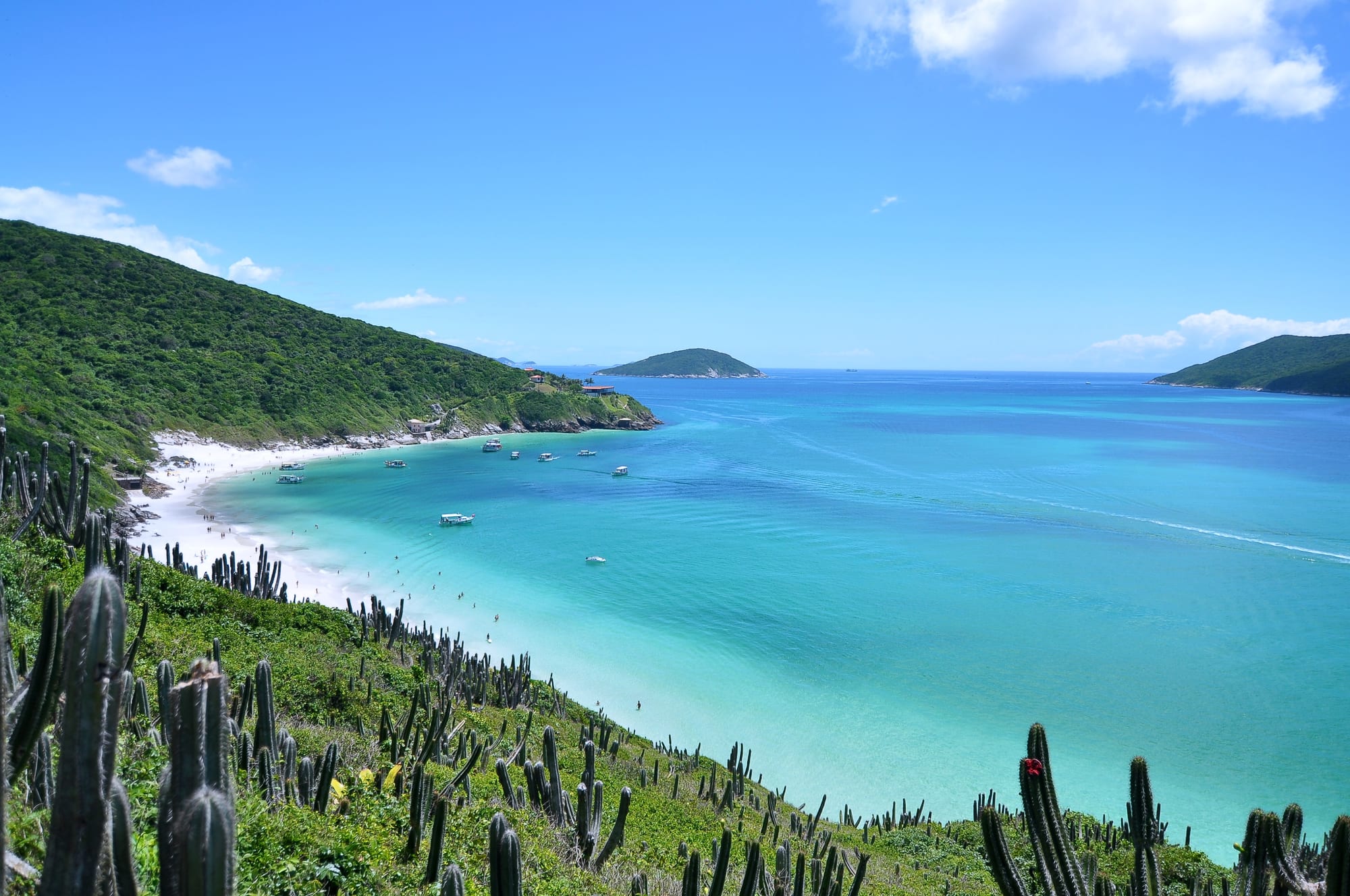
A curved white-sand beach and turquoise bay framed by green hills, seen from a slope covered in cactus

Rio de Janeiro, Brazil

Arraial do Cabo

Praia do Forno, one of the coves of Arraial do Cabo, seen from the trail above it. (Leonardo Shinagawa / Wikimedia Commons · CC BY 2.0)

A small fishing town on a cape in the Lakes Region of Rio de Janeiro state, where Amerigo Vespucci landed in 1503. Cold, nutrient-rich upwelling water keeps its coves clear and full of marine life, and a town of fishermen and a former soda-ash works now lives mainly from boat trips, beaches and diving.

Neighbourhoods

  • Praia dos Anjos and the centre
    • First-time visitors
    • Boat trips
    • Close to public transport

    The old heart of the town on its sheltered bay, where fishing boats crowd the water beside the marina of the Porto do Forno and the tour boats leave. The hilltop church of Nossa Senhora dos Remédios looks over the beach, and the town's high street holds its shops and dive schools.

    Open in Maps
  • Praia Grande
    • Beaches
    • Sunsets
    • Quiet and residential

    A long ocean beach of the town, facing the open Atlantic, with colder water. Streets of guesthouses and homes sit behind it, and a trail from its southern end climbs to lookouts towards the Pontal do Atalaia.

    Open in Maps
  • Monte Alto and Figueira
    • Quiet and residential
    • Local life

    Districts of the municipality away from the town, near the Araruama Lagoon and the long sandbank of Massambaba. They are residential and quieter, with their own beaches and a slower pace than the centre.

    Open in Maps

Things to do

Beaches and coves

  • Praia do Fornobeach

    A cove of white sand and clear water north of the town, reached on foot by a trail or by boat, and one of the places that gives Arraial do Cabo its reputation.

    Open in Maps
  • Prainhas do Pontal do Atalaiabeach

    Small beaches at the Pontal do Atalaia, with clear water, a standard stop on the boat trips round the cape.

    Open in Maps
  • Praia Grandebeach

    A long stretch of open-ocean beach, with colder water than most of Brazil's coast, overlooked by a lookout reached by a trail from its south end.

    Open in Maps
  • Praia dos Anjosbeach

    The harbour beach where, according to local history, Vespucci's ship anchored in 1503 — now the departure point for the boat trips round the cape.

    Open in Maps

Islands and the sea

  • Ilha do Farolpark

    The island off the cape, protected as a municipal biological reserve, with a beach of fine white sand and the ruins of an old lighthouse; visits are restricted, a permit is needed and stays are limited.

    Open in Maps
  • Arraial do Cabo Marine Extractive Reservepark

    The federal marine reserve created in 1997 around the town, protecting traditional fishing and the fish-rich upwelling waters that have earned the town the name of Brazil's diving capital.

    Open in Maps

Short trips from the town

  • Cabo Frioattraction

    The larger neighbouring city to the north, from which Arraial do Cabo separated in 1985, known for its fine white-sand beaches on both the ocean and the lagoon.

    Open in Maps
  • Araruama Lagoonpark

    One of the largest permanent hypersaline lagoons in the world, about 40 km long, lying behind the Massambaba sandbank.

    Open in Maps
  • Costa do Sol State Parkpark

    A state park protecting scattered fragments of coastal Atlantic Forest, restingas and lagoons across six municipalities of the Lakes Region, including Arraial do Cabo.

    Open in Maps
  • Búziosattraction

    The resort peninsula beyond Cabo Frio, a fishing village made famous by Brigitte Bardot's visit in 1964, with more than twenty beaches and the nightlife of Rua das Pedras.

    Open in Maps

Eat and drink

Long-standing places and food districts in Arraial do Cabo. Hours, ratings and directions come from your maps app, always current.

Arraial do Cabo classics

  • Restaurants at Praia dos Anjosneighborhood

    The harbour beach where the boats come in, with restaurants serving the fish and seafood landed by the town's fishing families.

    Open in Maps
  • The main streetneighborhood

    Avenida Leonel de Moura Brizola, the town's high street, with its supermarkets, shops and simple places to eat.

    Open in Maps

Experience Arraial do Cabo

History

The cape was Tamoio land when the Portuguese arrived, and people had lived on its hills for some five thousand years. In 1503 Amerigo Vespucci, sailing with the second Portuguese expedition to the Brazilian coast, anchored at the beach now called Praia dos Anjos. The water and the wind here were far colder than elsewhere on the Brazilian coast, which is why the cape is called Cabo Frio, the cold cape, and Vespucci left 24 men at a small fort. A trading post followed nearby — one of the first in Brazil — and around it grew a modest settlement, the arraial that gave the town its name.

The cape's position made it an important and dangerous landmark in the age of sail, and many ships were wrecked on its rocks and islands from the 16th to the 19th century. A lighthouse was built on the island off the cape in 1833. For centuries the village lived from fishing.

Change came in 1943, when the Companhia Nacional de Álcalis opened a plant here to produce soda ash and salt, bringing jobs and workers from other parts of Brazil. Arraial do Cabo remained a district of Cabo Frio until 13 May 1985, when it became a municipality of its own. Since the 1990s tourism has grown quickly, and in 1997 the surrounding sea was declared a marine extractive reserve to protect the traditional fishing communities.

Culture & Customs

Arraial do Cabo sees itself as different from the other towns of the Lakes Region. Its people, the cabistas, have a recognisable accent and a stock of local words, and conversation in the street is loud, teasing and public. The town is also the only one in the state to mark Thanksgiving, on 23 November, as a local holiday.

Fishing still shapes local identity. In 2002 about 300 registered fishing families had worked these waters for more than a century, and the marine reserve was created for them; within it, only traditional fishing boats are allowed. The rapid growth of tourism since the mid-1990s has brought conflict between these fishermen and the companies running tour boats and dives, a tension that runs through local politics. In 1960 the filmmakers Mário Carneiro and Paulo Cesar Saraceni made a documentary about the town's fishermen.

Diving gives the town its other identity. The upwelling of cold, nutrient-rich water from the deep brings an abundance of marine life — turtles, groupers, rays and dolphins among the islands and coves — and Arraial do Cabo calls itself Brazil's diving capital. Churches such as Nossa Senhora dos Remédios, on the rise above Praia dos Anjos, and the old historical marker recalling Vespucci's landing tie the town to its long past.

Daily Life

Arraial do Cabo had a population of about 30,600 in 2020, spread between the town on the cape and districts such as Monte Alto, Figueira and Pernambuca along the road west. The town's sights are few beyond its beaches and its two churches, Sagrado Coração de Jesus and Nossa Senhora dos Remédios.

Ecotourism is the base of the economy: boat trips, beach kiosks, guesthouses and dive schools employ much of the town, and summer weekends bring large crowds from Rio and beyond. The small port, the Porto do Forno, is really a marina with three piers, through which goods come into the town and the local salt production goes out. Fishing remains important, and the soda-ash works that once drove the economy are part of the town's recent memory.

The rhythm follows the season and the weather. In summer the beaches and boats are packed and the streets busy late into the evening; out of season the town is quieter and closer to the fishing village it was. The pressure of tourism on the fragile beaches and the marine reserve, and the balance between visitors and fishermen, are the town's constant debates.

Food

As a fishing town, Arraial do Cabo eats from the sea. Grilled fish, fried fish served with rice, beans and salad, prawns, squid and octopus fill the menus of the restaurants around Praia dos Anjos and the main street, much of it landed by local boats. Squid fishing is regulated within the marine reserve, and octopus is still caught by divers in the traditional way.

Everyday food follows the Rio de Janeiro coast. Lunch is often a comida a quilo, a self-service buffet paid by weight, or a prato feito, a set plate of rice, beans, salad and a piece of fish or meat. On the beaches, vendors and kiosks sell cold coconut water, grilled cheese on a stick, fried snacks and ice-cold beer.

Evenings are for moqueca — fish stewed with tomato, onion and coriander, in the Bahian style with palm oil and coconut milk, or the lighter capixaba version — and for petiscos, plates of fried fish, bolinhos de bacalhau (salt-cod fritters) or pastéis shared over beer. The caipirinha, made with cachaça, lime and sugar, is the standard drink, and açaí is served frozen in bowls with granola and banana.

Planning tools

Budget

Arraial do Cabo is cheaper than Búzios but priced for visitors in the summer holidays, at New Year and Carnival, when the town fills with weekenders from Rio and beyond. Boat trips and dives are the main extra costs; guesthouses, per-kilo lunches and buses keep the rest modest.

Daily Budget Midrange
USD 100–190 (guesthouse room, seafood dinners, a boat trip or a dive, app taxis)
Daily Budget Shoestring
USD 40–70 (hostel bed, per-kilo lunches, buses, beaches reached on foot)

Weekdays outside the summer holidays are much quieter, on the beaches and on the boats.

Best Time to Visit

The town has little rain for the region, so it works year-round. December to March is the warm beach season and the busiest; April to June and September to November are calmer and cheaper. The sea stays cooler than elsewhere on the coast because of the upwelling, and the clearest water for diving varies with wind and currents.

Suggested Number of Days

Two or three days are enough for most visitors to the town and its coves. Allow four or five to include the neighbouring towns of the Lakes Region, or more for a diving course. Wind and sea conditions can cancel boat trips, so a spare day helps.

First Visit
2–3 days
With Surroundings
4–5 days

Transportation

The town is small and its central beaches are within walking distance of each other. App taxis work in the town, local buses run along the main road, and the boats from Praia dos Anjos are the way to reach the island and the coves along the cape.

Roads around the town have frequent speed bumps, some unmarked and hard to see at night.

Airport & Station Connections

Cabo Frio International Airport is about 10 km from Arraial do Cabo. Most visitors come from Rio de Janeiro: about two hours by car from Galeão airport across the Rio–Niterói bridge, or by intercity bus from the Novo Rio terminal.

Walkability

The centre, Praia dos Anjos and Praia Grande are close together and easy on foot. Praia do Forno is reached by a trail, and the Pontal do Atalaia lookouts by a trail from the south end of Praia Grande. The outer districts need a bus or a car.

Safety

Brazil has high rates of crime, including violent crime, and it is the main practical concern for visitors — though very unevenly distributed. Arraial do Cabo is a small town and calmer than the big cities, but theft from beaches and parked cars happens, and the crowded summer weekends bring pickpocketing. On the sea, wind and swell can change quickly.

Take nothing of value to the beach, follow the boat crews' instructions, and use repellent against dengue. Check current official travel advice before travelling.

Climate

A dry tropical coastal climate, unusual for the region: steady winds keep temperatures moderate, rainfall is low at around 800 mm a year. Summer is December to February. Cold water rising from the deep makes the sea cooler than on most of the Brazilian coast.

Summer
warm and windy rather than very hot — the highest temperature recorded since 2006 is about 35°C
Winter
mild and dry — the lowest temperature recorded since 2006 is about 13°C

Local Customs

Cabistas, as locals call themselves, have their own accent and slang, and the town keeps a strong fishing identity; fishing families have worked these waters for generations. Beachwear belongs on the beach and a shirt is expected in shops and restaurants. Restaurants usually add a 10 per cent service charge.

Ask before photographing fishermen at work, and give their nets and boats space on the beaches.

Common Payment Methods

The currency is the Brazilian real (R$). Cards and the instant Pix transfer system are accepted almost everywhere, though carrying some cash for small stalls and vendors is sensible.