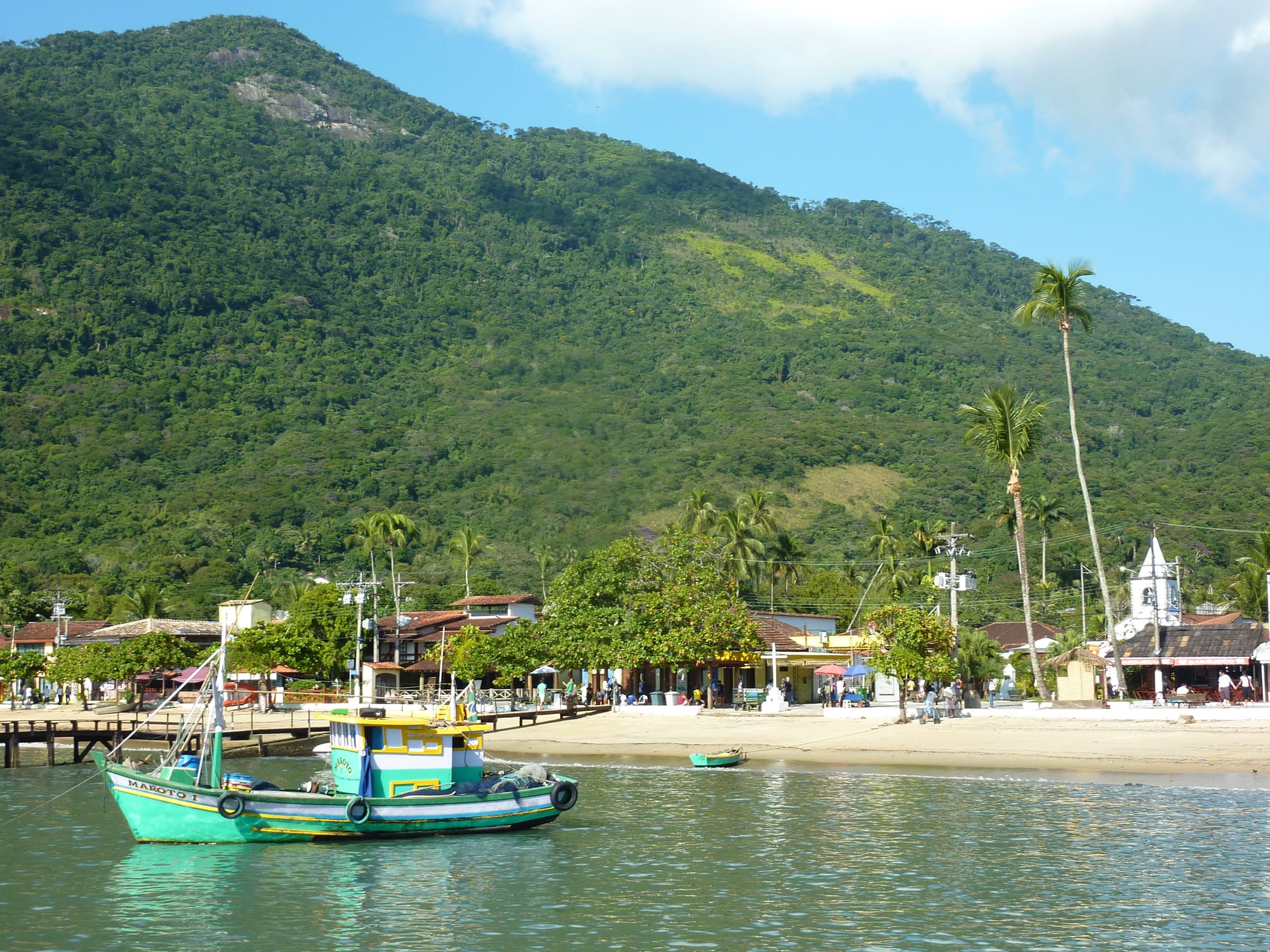
A green fishing boat moored off a sandy beach lined with palms and low houses, below a steep forested mountain

Rio de Janeiro, Brazil

Ilha Grande

Vila do Abraão, the island's main village, seen from the water. (Dave Lonsdale / Wikimedia Commons · CC BY 2.0)

A mountainous, forested island of about 193 square kilometres off Angra dos Reis on the Costa Verde, with no roads and no cars. Closed for most of a century by a quarantine station and a high-security prison, it is now a protected stretch of Atlantic Forest with beaches, trails and fishing villages, listed with Paraty as a UNESCO World Heritage Site.

Neighbourhoods

  • Vila do Abraão
    • First-time visitors
    • Close to the ferry
    • Best for food

    The largest village on the island, home to about 2,000 people, where the boats from the mainland arrive. Most guesthouses, restaurants, shops and the park headquarters are here, around a small beach, the church of São Sebastião and a square where people gather in the evening.

    Open in Maps
  • Dois Rios
    • History
    • Quiet

    A small village on its own beach, built around the ruins of the former Cândido Mendes prison, with the Ilha Grande Ecomuseum.

    Open in Maps
  • Praia do Aventureiro
    • Beaches
    • Remote
    • Traditional community

    A remote beach and small traditional fishing community on the south-west coast, inside a reserve that protects artisanal fishing. It is far from Abraão and suits those looking for isolation rather than convenience.

    Open in Maps
  • Freguesia de Santana and the Lagoa Azul
    • Snorkelling
    • Quiet

    A quiet, out-of-the-way part of the island with small coves, the Santana church, a few isolated places to stay and the clear water of the Lagoa Azul.

    Open in Maps

Things to do

Beaches and the sea

  • Lopes Mendesbeach

    One of the island's most visited beaches, with clear water, reached by a hike of about two hours from Vila do Abraão or by boat to Pouso and a 20-minute, fairly steep path.

    Open in Maps
  • Lagoa Azulattraction

    One of the best-known sights of Angra dos Reis and Ilha Grande, a stretch of clear water visited on boat trips.

    Open in Maps
  • Praia do Aventureirobeach

    A remote beach and fishing village on the south-west coast, protected in a reserve that supports the small traditional community.

    Open in Maps

Forest and trails

  • Ilha Grande State Parkpark

    The state park covering 62.5 per cent of the island, more than 90 per cent of it Atlantic Forest, on an island with more than 150 km of trails and a highest point of 1,031 metres.

    Open in Maps
  • Praia do Sul Biological Reservepark

    A biological reserve at Praia do Sul, about half of it dense Atlantic Forest, with large mangroves.

    Open in Maps

History

  • Dois Rios prison ruins and Ecomuseummuseum

    The remains of the Cândido Mendes prison, which held some of Brazil's most dangerous offenders until 1994, with the Ilha Grande Ecomuseum in the village.

    Open in Maps
  • The Lazaretolandmark

    The site of the 19th-century quarantine station at Vila do Abraão, later used as a prison, part of the island's long history as a place of isolation.

    Open in Maps

Short trips from the island

  • Angra dos Reisattraction

    The mainland port town and municipality to which the island belongs, with more than three hundred islands and the main boat connections.

    Open in Maps
  • Paratyattraction

    The colonial port of cobbled streets and colourful colonial houses that shipped the gold of Minas Gerais, listed with Ilha Grande as a World Heritage Site.

    Open in Maps

Eat and drink

Long-standing places and food districts in Ilha Grande. Hours, ratings and directions come from your maps app, always current.

Island eating

  • Vila do Abraão restaurantsneighborhood

    Most of the island's restaurants, serving fish, seafood and Brazilian plates along the beachfront and the lanes behind it.

    Open in Maps
  • Abraão's square in the eveningneighborhood

    There is no club scene; nights are spent over beer in and around the main square, often with live forró, samba or bossa nova.

    Open in Maps

Experience Ilha Grande

History

Ilha Grande's past includes pirates sheltering in the coves of the bay and the slave trade of the colonial era. Its modern history, though, was shaped by isolation. The government built an immigration quarantine station, the Lazareto, on the island, and the island later became the site of a penal colony at Dois Rios, the Colônia Penal de Dois Rios, later the Instituto Penal Cândido Mendes.

For almost a century the government kept the island off-limits, banning unauthorised entry. The prison held some of the most dangerous offenders in Brazil, and its reputation hung over the island until it closed in 1994. Its closure opened Ilha Grande to visitors, and with tourism came guesthouses, restaurants and boat services in Vila do Abraão.

The same isolation had preserved the forest. Today the state park covers more than three-fifths of the island, and with the other reserves about 87 per cent of it is protected. On 1 January 2010 heavy rain set off mudslides that killed at least 19 people on the island. In July 2019 UNESCO inscribed Paraty and Ilha Grande together as a World Heritage Site for their culture and biodiversity.

Culture & Customs

Island life combines Caiçara fishing traditions with a tourist trade built since the 1990s. The scattered villages — Abraão, Dois Rios, Aventureiro and others — grew around fishing, and Aventureiro's reserve exists partly to protect its small traditional community and its artisanal fishing.

Nature is the culture here. Visitors come to hike, swim and watch wildlife: at least 110 bird species, howler monkeys and marmosets, and in the surrounding sea hawksbill turtles and several kinds of whale. The island is an Important Bird Area, and the seas around it, part of a protected marine area, mix tropical and cooler currents.

Evenings are simple. There is no club scene; people drink beer in Abraão's main square and dance to live forró, samba or bossa nova. The absence of cars sets the pace, with goods carried by hand, cart or boat. Respect for the environment — keeping to the trails, carrying rubbish out — is expected.

Daily Life

About 2,000 people live in Vila do Abraão, the island's largest settlement, and smaller numbers in villages around the coast. The island belongs to the municipality of Angra dos Reis on the mainland. Tourism is the base of the economy — guesthouses, restaurants, boat services and guiding — alongside fishing and work for the park.

Without roads or cars, everything from food and building materials to rubbish moves by boat and by hand, which shapes prices and the rhythm of the day. Mornings in Abraão start with the arrival of the boats from the mainland; in the late afternoon water taxis bring walkers back from the beaches, and the village fills again in the evening. Weekends and summer holidays bring crowds from Rio and São Paulo, while winter weekdays are quiet.

The strict protection of most of the island limits new building, and residents and authorities debate how many visitors the island can take, how to deal with sewage and rubbish, and how to keep the trails safe after heavy rain.

Food

Food on Ilha Grande is coastal Brazilian cooking adapted to an island where everything arrives by boat. Fresh fish and seafood from local fishermen are the staples: fish grilled whole or in fillets, fried shrimp and squid, and stews of fish and seafood served with rice and farofa, toasted cassava flour.

Vila do Abraão has most of the restaurants, from per-kilo buffets and simple plates of rice, beans, salad and fish — the prato feito — to more elaborate seafood restaurants on the beachfront. In the smaller villages, meals are home-style and served in family-run places, and on remote beaches it is wise to carry food and water, since there may be nothing for sale.

Drinks follow the Brazilian beach pattern, and a cold drink on the sand at the end of a long hike is part of the island routine: ice-cold beer, caipirinhas of cachaça, lime and sugar, fresh fruit juices and coconut water.

Planning tools

Budget

Everything on the island arrives by boat, so food and rooms cost more than on the mainland, and prices climb at New Year, Carnival and summer weekends. Guesthouses and hostels in Abraão cover all budgets; boat trips and water taxis are the main extra costs, while the trails and beaches are free.

Daily Budget Midrange
USD 120–230 (guesthouse in Abraão, restaurant dinners, a boat trip or water taxi each day)
Daily Budget Shoestring
USD 40–70 (hostel dorm or campsite, set meals, hiking rather than boats)

Bring enough cash from the mainland, since there are no banks on the island and many places do not take cards.

Best Time to Visit

April to June and August to October are drier and calmer, with fewer visitors — good for hiking. December to March is the beach season, hot and crowded around New Year and Carnival, with heavy rain and slippery trails. July brings Brazilian school holidays.

Suggested Number of Days

Two or three nights suit a first visit, given the half-day journey each way from Rio. Four to six allow for the longer trails and the more remote parts of the island. Rain and rough seas can cancel boats, so leave some slack.

First Visit
2–3 days
With Surroundings
4–6 days

Transportation

There are no roads and motorised vehicles are banned. People walk on more than 150 km of forest trails between the villages and beaches, or use schooners, boat tours and water taxis from Abraão, which pick up from many beaches in the late afternoon.

Carry a torch for trails after dark, water and good shoes; some trails are long and steep, and the park asks walkers to keep to marked paths.

Airport & Station Connections

Boats run to Vila do Abraão from Angra dos Reis and Mangaratiba on the mainland, about 12 km away across the bay; faster private launches also operate. From Rio, buses take a few hours to Angra dos Reis or Mangaratiba, and with the crossing the trip takes most of a day. Use only licensed boats.

Walkability

Vila do Abraão is small and car-free, easy to cross on foot in minutes. Beyond it, everything is reached on foot along forest trails or by boat; the walk to Lopes Mendes takes about two hours each way, and the hikes across to Dois Rios and up the peaks are hilly and humid.

Safety

Brazil has high rates of crime, including violent crime, and it is the main practical concern for visitors — though very unevenly distributed. On Ilha Grande the main risks are natural: long, steep trails, heat, sudden storms, landslides after heavy rain and strong surf on ocean beaches.

Start long hikes early, leave word of the planned route, return before dark, take repellent against dengue and do not swim where waves are strong. Check current official travel advice before travelling.

Climate

Tropical, humid and wet, with forested mountains that draw rain. Summer is December to February: hot, with heavy storms that can trigger landslides. Winter, June to August, is warm and drier.

Summer
hot and humid, with heavy downpours; 28–38°C on the coast of Rio de Janeiro state as a whole
Winter
warm and drier; 18–27°C on the coast of Rio de Janeiro state as a whole

Local Customs

The island is protected and the villages are small. Visitors are expected to take their rubbish back, keep to trails and respect the traditional fishing communities. A service charge is usually added to restaurant bills.

Ask before photographing residents; dress more modestly in the church and the villages than on the beach.

Common Payment Methods

The currency is the Brazilian real (R$). There are no banks on the island, and many hotels, shops and restaurants do not accept cards, so bring cash; Angra dos Reis has cash machines before the crossing.