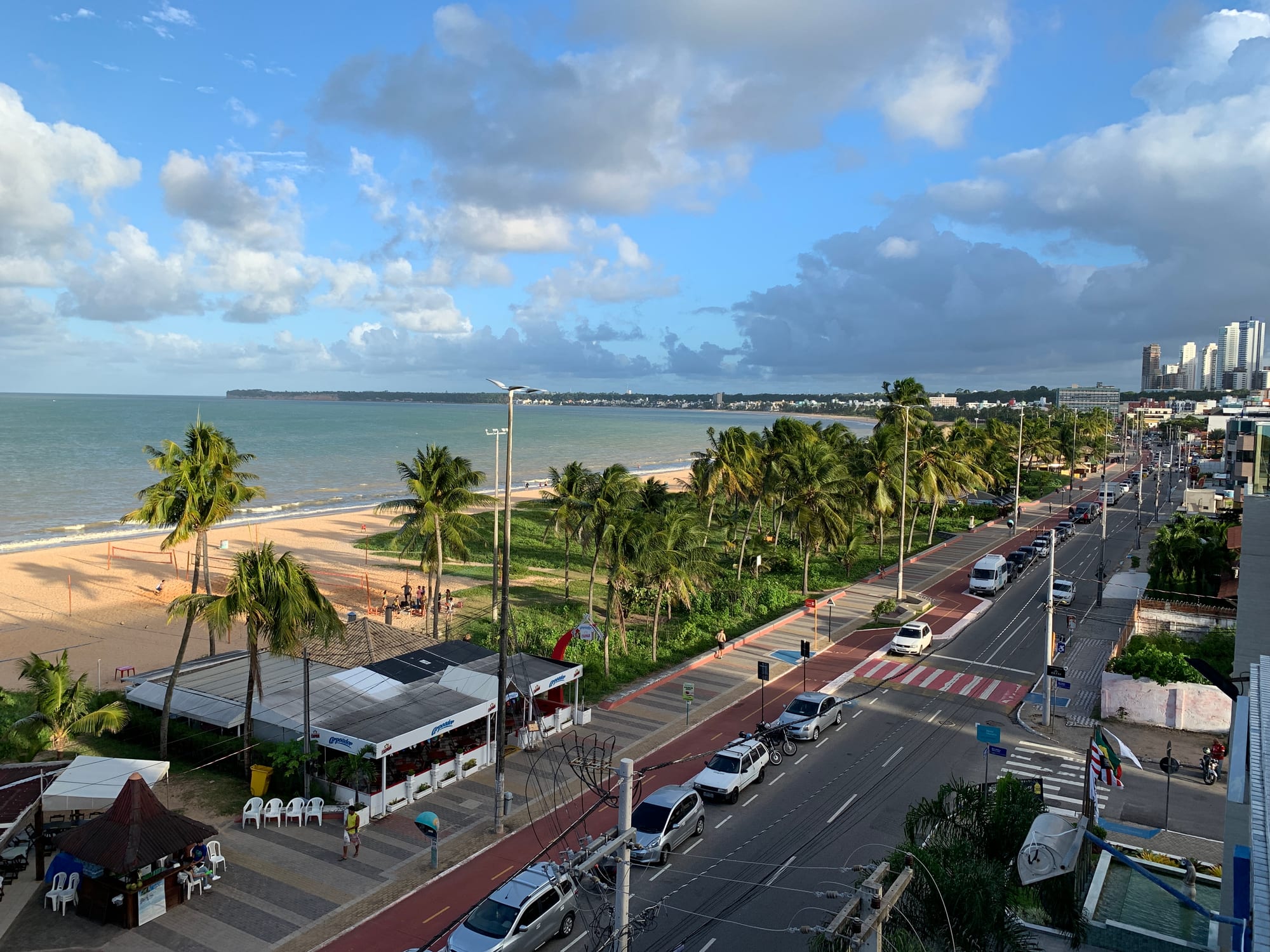
A palm-lined beachfront avenue with a cycle lane and beach kiosks beside a sandy bay, with low cliffs on the far shore

Recife, Natal & the Northeast Coast, Brazil

João Pessoa

The seafront avenue at Tambaú beach in João Pessoa, with the cliffs of Cabo Branco in the distance. (Rosanetur / Wikimedia Commons · CC BY 2.0)

The capital of Paraíba, founded in 1585 on the Sanhauá River and renamed in 1930 after a murdered state governor. Its Baroque old town sits inland, while the city has grown east to low-rise beaches sheltered by reefs, ending at Ponta do Seixas, the easternmost mainland point of the Americas. It is a green, relaxed city known for its crafts.

Neighbourhoods

  • Tambaú
    • First-time visitors
    • Beaches
    • Nightlife

    The busiest city beach and the heart of the tourist seafront, about 7 km east of the centre along Avenida Epitácio Pessoa. Hotels, beach kiosks, the craft markets and the densest cluster of bars are here, and boats leave for the Picãozinho reef pools offshore.

    Open in Maps
  • Cabo Branco
    • Beaches
    • Walks
    • Quiet evenings

    The beach continuing south from Tambaú towards the cliffs, the lighthouse and Ponta do Seixas, with a seafront promenade that can be walked safely in the evening when there are people about. Like the rest of the shore, its buildings are kept low by law.

    Open in Maps
  • Manaíra and Bessa
    • Quiet and residential
    • Beaches
    • Kayaking

    The beaches north of Tambaú. Manaíra is fully urban, with reefs offshore and the city's largest shopping centre inland; Bessa, at the northern end of the city, has over 5 km of calmer, quieter sand, reefs and coconut palms, with kayaking out to the coral.

    Open in Maps
  • Centro and Varadouro
    • Historic district
    • Museums
    • Architecture

    The old city where João Pessoa began, on a hill above the Sanhauá River. Its protected historic centre of some 700 buildings holds the São Francisco complex, the cathedral, Carmelite and Benedictine churches and the Parque Sólon de Lucena; it is quiet at night.

    Open in Maps

Things to do

The historic centre

  • São Francisco Cultural Centermuseum

    The Franciscan church of São Francisco and convent of Santo Antônio, begun in 1589 and completed in the late 18th century, among the most important Baroque ensembles in Brazil, with a museum of sacred and popular art.

    Open in Maps
  • Cathedral Basilica of Our Lady of the Snowslandmark

    The seat of the archdiocese, on the hill where the first settlers built a mud chapel to Our Lady of the Snows in 1586; it was later raised to the status of cathedral.

    Open in Maps
  • Church and Convent of Carmolandmark

    The Carmelite church and convent in the old centre, an example of the city's rococo architecture.

    Open in Maps
  • Monastery of St. Benedictlandmark

    The Benedictine monastery whose construction began around 1600, part of the protected historic centre.

    Open in Maps
  • Casa da Pólvoraviewpoint

    The early 18th-century powder house on the Ladeira de São Francisco, visited for its views of the Sanhauá River and the sunset from its garden.

    Open in Maps

The coast and the easternmost point

  • Ponta do Seixasviewpoint

    The beach that forms the easternmost mainland point of the Americas, with natural pools full of fish and other marine life; it can be reached on foot along the shore or by city bus.

    Open in Maps
  • Cabo Branco Lighthouselandmark

    The lighthouse inaugurated in 1972 on the Cabo Branco cliffs, about 800 metres north of Ponta do Seixas, one of the city's best-known landmarks.

    Open in Maps
  • Estação Cabo Brancomuseum

    The Science, Culture and Arts Station near the lighthouse, one of Oscar Niemeyer's final projects, opened in 2008 as an educational and cultural centre.

    Open in Maps
  • Picãozinhobeach

    A reef about 1.5 km off Tambaú beach that forms natural pools at low tide, reached by boat or catamaran for snorkelling.

    Open in Maps
  • Bessa beachbeach

    The quiet beach at the city's northern end, with calm green water, reefs and coconut palms, and kayaking to the coral known locally as the Caribessa.

    Open in Maps

Crafts and markets

  • Mercado de Artesanato Paraibanomarket

    A craft market in Tambaú, opened in 1991, one of the main places selling the traditional crafts of Paraíba.

    Open in Maps
  • Museu Casa do Artista Popularmuseum

    A museum opened in 2005 as a permanent showcase of the popular art and crafts of Paraíba.

    Open in Maps

Short trips from the city

  • Areia Vermelha Marine State Parkpark

    A protected sandbank and reef off Cabedelo that appears at low tide, reached by boat from the beaches.

    Open in Maps
  • Cabedeloattraction

    The port town at the mouth of the Paraíba River, north of the city, reached by road or urban train, where riverside bars at Jacaré accompany the weekend sunset with Ravel's Bolero played live on saxophone.

    Open in Maps
  • Tambababeach

    A short beach about 29 km south of the city, the first beach in Brazil to allow naturism by municipal law; nudity is required in its family area.

    Open in Maps

Seasonal events

  • Salão do Artesanato ParaibanoJanuary

    A crafts fair held each January by the state government and SEBRAE, bringing together hundreds of artisans from across Paraíba.

  • Carnaval TradiçãoCarnival, February or March

    The traditional street carnival that began in 1914, with groups including the ursas, a carnival tradition typical of the city.

  • Penha processionLast weekend of November

    A pilgrimage followed by thousands of the faithful from the historic centre to the shrine of Our Lady of Penha on Penha beach, held for more than 250 years.

Eat and drink

Long-standing places and food districts in João Pessoa. Hours, ratings and directions come from your maps app, always current.

João Pessoa classics

  • Tambaú and Cabo Branco beach kiosksneighborhood

    The string of beach shacks and kiosks along the Tambaú and Cabo Branco promenade, for seafood, snacks, coconut water and cold drinks by day.

    Open in Maps
  • Penha fishing villageneighborhood

    A fishing community founded in 1763 beside the Penha shrine, where people still live from the sea and fish is sold and served.

    Open in Maps

Food districts and nightlife

  • Bars behind the Tambaú feirinhaneighborhood

    The densest concentration of the city's nightlife, in the streets just behind the craft fair in Tambaú.

    Open in Maps
  • Jacaré riverside barsneighborhood

    Shacks on the bank of the Paraíba River where the sun goes down to a live saxophone version of Ravel's Bolero at weekends.

    Open in Maps

Experience João Pessoa

History

The Portuguese first tried to hold the mouth of the Paraíba River with a fort in 1584, but attacks by French privateers and the Potiguara forced them to abandon it within a year. A peace with the Tabajara people, led by Piragibe, was sealed on 5 August 1585, and settlement began on 31 October that year at Porto do Capim, on the Sanhauá River in today's Varadouro. On the hill above, a chapel to Our Lady of the Snows was begun. In 1588 the town was renamed Filipeia de Nossa Senhora das Neves after Philip II of Spain, who then also ruled Portugal, and from 1599 it was known as Parahyba. Franciscans, Carmelites and Benedictines all built houses here, and the Franciscan church and convent were begun in 1589.

In December 1634 the Dutch took the town, which had about 1,500 inhabitants and nineteen sugar mills, and called it Frederikstad; the Franciscan convent became a fortress. After the Dutch were driven out, the town became Parahyba do Norte, and in 1822 the capital of a province of the new empire.

The present name dates from 1930. On 26 July that year João Pessoa, the state's president, was assassinated in Recife by a political enemy, a killing that helped trigger the Revolution of 1930; that September a bill was put to the state assembly to rename the capital in his honour, a name confirmed in 2024 when a provision for a plebiscite on it was removed. In 1941 a Navy survey confirmed Ponta do Seixas as Brazil's easternmost point. The city grew towards the sea along Avenida Epitácio Pessoa, and in 1970 it overtook Campina Grande as the largest in Paraíba. Its historic centre was listed as national heritage in 2007.

Culture & Customs

Crafts are central to the city's identity, and in 2017 UNESCO named João Pessoa a Creative City for crafts. The Mercado de Artesanato Paraibano and the neighbouring Centro de Artesanato Júlio Rafael in Tambaú sell the state's traditional work; the Museu Casa do Artista Popular shows it as art; and the Sereias da Penha project turns fish scales and leather into jewellery. Each January the Salão do Artesanato Paraibano gathers hundreds of artisans from across the state.

The old city is a monument of Brazilian colonial art. The São Francisco church and convent is among the finest Baroque ensembles in the country, and the historic centre's 700 or so buildings range from Baroque and rococo churches to the art nouveau and art deco of the 1920s and 1930s. The Espaço Cultural José Lins do Rego, named after the Paraíba-born novelist, holds theatres, a planetarium, galleries and a music school.

Carnival comes in two forms: the Carnaval Tradição, a popular street carnival dating from 1914 with its ursas and other traditional groups, and a pre-Carnival street festival that grew up in the 1980s. Religious devotion is strong: for more than 250 years thousands have joined the Penha procession from the old centre to the shrine on Penha beach. Football supporters follow Botafogo, Auto Esporte and CSP.

Daily Life

The 2022 census counted about 834,000 people in João Pessoa, the largest city in Paraíba; an official estimate put the figure at about 889,000 in 2024. The city has long promoted itself as green, claiming more than 7 square kilometres of forested land, including the Atlantic Forest of the Benjamim Maranhão Botanical Garden in the middle of the city.

The shape of the city is unusual for a Brazilian capital. Since 1970 a state rule has limited buildings on the coastal strip, so the seafront from Penha to Cabedelo stays low while the towers rise a few blocks inland. The city has spread well beyond the old centre and the beaches, into districts such as Mangabeira, which grew from a large housing complex opened in 1983.

Tourism, commerce and crafts are important to the economy, and the fishing village at Penha, founded in 1763, still lives from the sea. Hawksbill turtles nest on the beaches of Bessa and Intermares, where a conservation project watches over them. In 2024 Cícero Lucena was re-elected for a fourth term as mayor, the first in the city's history to win four.

Food

The coast sets the table in João Pessoa. Fish and shrimp are fried, grilled or cooked into moquecas and stews; the beach kiosks of Tambaú and Cabo Branco serve them with coconut water and cold beer.

From the sertão and agreste of the interior come the dishes of the northeastern table. Carne de sol, salted and briefly sun-dried beef, is served with macaxeira, boiled or fried cassava, and manteiga de garrafa, a clarified butter. Cuscuz, a steamed maize-flour cake, is eaten at breakfast, and tapioca, a crêpe of cassava starch, is filled with cheese or coconut. Queijo coalho grilled on a skewer is sold on the beaches.

Cachaça, the cane spirit, goes into caipirinhas or is drunk neat, and juices and ice creams are made from local tropical fruit. Evenings out centre on the bars behind the Tambaú craft fair, and at weekends many people cross to the riverside at Jacaré in Cabedelo for sunset over the Paraíba River.

Planning tools

Budget

João Pessoa is one of the more affordable capitals on the coast. Seafront pousadas and hotels cover most budgets, though rock-bottom options are few, and set lunches, beach food and app taxis are cheap. Boat trips to the reef pools and day trips along the coast are the main extras, and prices rise over New Year, Carnival and the July holidays.

Daily Budget Midrange
USD 85–160 (seafront hotel, seafood dinners, a boat to Picãozinho, a day trip along the coast)
Daily Budget Shoestring
USD 35–60 (hostel or simple pousada near the beach, prato feito lunches, app taxis)

Boat trips to the reef pools depend on low tide, so check the tide before booking a day.

Best Time to Visit

September to February is the sunniest and driest period, with clear blue-green water for boat trips to the reef pools and sunsets on the beach. The heaviest rain falls in the southern autumn and winter. The sea is calm along most of the city's shore all year, sheltered by a reef barrier offshore.

Suggested Number of Days

Two or three days cover the historic centre, the seafront and a reef trip. Allow four to six days to add the beaches to the north and south of the city. The tides decide when the offshore pools can be visited, so a spare day helps.

First Visit
2–3 days
With Surroundings
4–6 days

Transportation

App taxis are widely used and are the easiest way between the beaches and the centre. City buses connect the bus terminal in the centre with Tambaú and Cabo Branco, and a diesel urban train runs about 30 km through the city, Cabedelo, Bayeux and Santa Rita. Boats to the reef pools leave from the beaches.

Taxis or app taxis are preferable to buses after dark and when carrying valuables.

Airport & Station Connections

Presidente Castro Pinto International Airport is in the municipality of Santa Rita, about 12 km from downtown; app taxis and taxis link it to the city and the beaches. For more flights, some travellers fly into Recife or Natal and continue by intercity bus. The long-distance bus station is in the centre, with services from Recife, Natal and Campina Grande.

Walkability

The seafront from Manaíra through Tambaú to Cabo Branco is flat and good for walking, with a promenade and wide pavements, and it is possible to walk along the beach to Ponta do Seixas. The historic centre is compact but hilly and some 7 km inland, so most visitors travel between the two by app taxi or bus.

Safety

Brazil has high rates of crime, including violent crime, and it is the main practical concern for visitors — though very unevenly distributed. João Pessoa's seafront is among the calmer parts of the coast, and the Cabo Branco promenade can be walked in the evening where there are people about; buses have been targeted by robbers, and quiet, dark streets are best avoided at night.

Use app taxis rather than buses at night, keep valuables out of sight, avoid dark and empty places, and use repellent against dengue. Check current official travel advice before travelling.

Climate

Hot and humid all year, with sea breezes and little change in temperature. Rain is heaviest in the southern autumn and winter. Since 1931 the lowest temperature recorded has been 16.2°C, in July 1936, and the highest 34.9°C, in January 2024.

Summer
December–February is hot and mostly sunny, around 26–32°C on this coast, with warm, calm water
Winter
June–August is warm and showery, around 22–29°C, with the heaviest rain of the year

Local Customs

A service charge is usually added to restaurant bills, while beach vendors and boatmen are paid directly. Beachwear suits the seafront but not churches or the historic centre. Tambaba beach to the south is an official nudist beach where nudity is required in the main area. English is limited, so some Portuguese helps.

Respect the rules of the Penha procession and the churches of the old centre, and do not stand on or take coral at the reef pools.

Common Payment Methods

The currency is the Brazilian real. Cards and Pix transfers are widely accepted in the seafront districts and the craft markets, but cash is handy for beach vendors, boat trips and buses. Use ATMs inside banks or shopping centres by day.