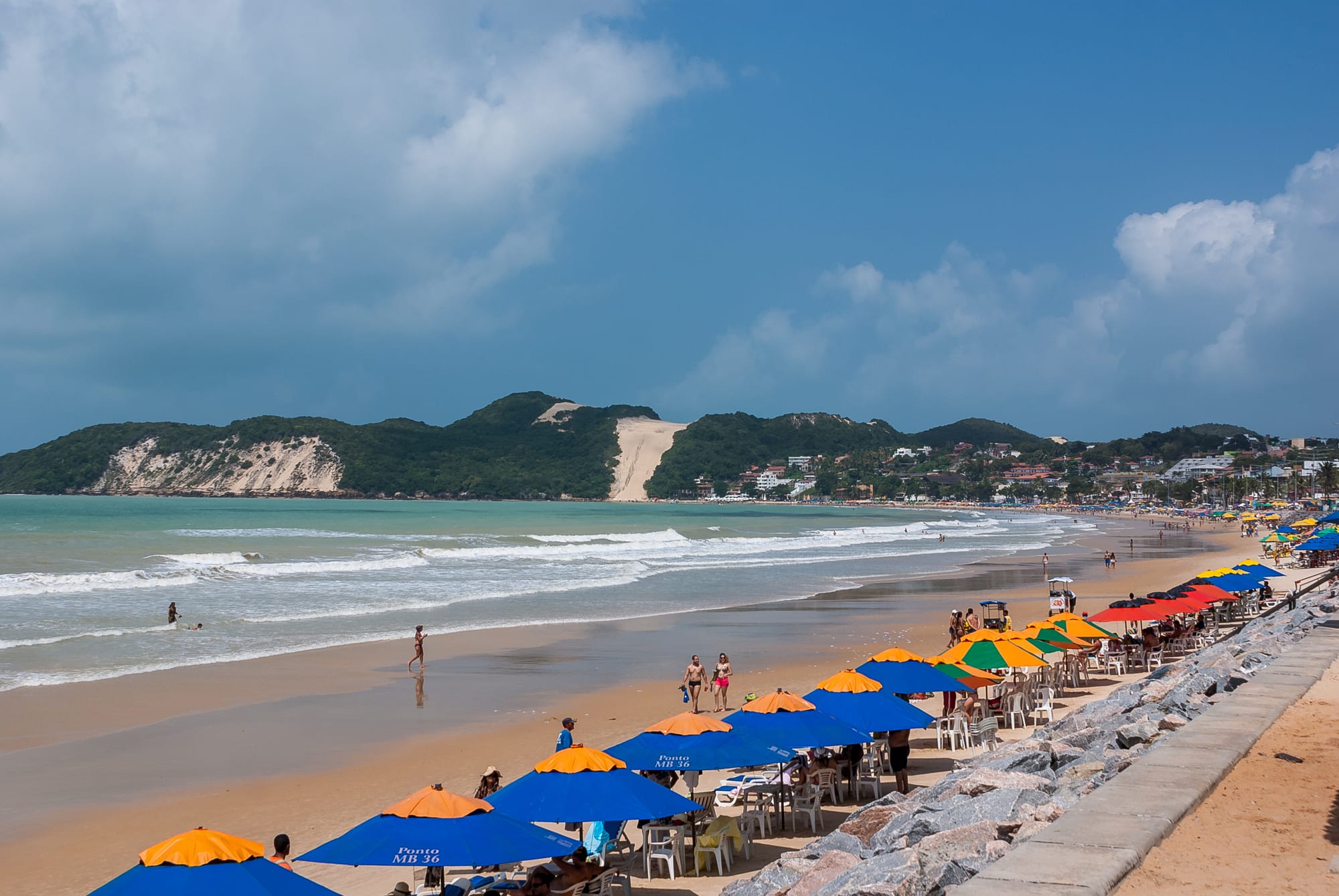
Ponta Negra beach lined with blue and orange umbrellas, with the bare sand slope of Morro do Careca on a green hill beyond

Recife, Natal & the Northeast Coast, Brazil

Natal

Ponta Negra beach in Natal, with the Morro do Careca dune rising at its southern end. (Matti Blume / Wikimedia Commons · CC BY-SA 4.0)

The capital of Rio Grande do Norte, at the mouth of the Potengi River near the north-eastern corner of South America. Founded on Christmas Day 1599 beside a Portuguese fortress, it grew fast as a wartime air base and later as a beach city of dunes, with Ponta Negra and the Morro do Careca at one end and the buggy trails of Genipabu across the river.

Neighbourhoods

  • Ponta Negra
    • First-time visitors
    • Beaches
    • Nightlife

    The city's best-known beach and the district where most visitors stay, with hotels, restaurants, bars and shopping. A boardwalk with kiosks runs along the sand, beach huts serve food and drinks, jangadas are pulled up on the beach, and the Morro do Careca dune closes the view to the south.

    Open in Maps
  • Via Costeira
    • Resorts
    • Beaches

    The coastal avenue opened in 1985 between the ocean and the dunes park, running north from Ponta Negra. Large hotels line the shore side, and the beaches here are continuous with Ponta Negra, so they can be walked from one to the next.

    Open in Maps
  • Cidade Alta and Ribeira
    • Historic district
    • Nightlife
    • Culture

    The oldest neighbourhoods, listed together as the city's historic centre: narrow colonial streets, churches, the old cathedral, the Alberto Maranhão Theatre and buildings in colonial, neoclassical, art deco and modernist styles. Cidade Alta's Beco da Lama is a traditionally bohemian quarter, and Ribeira has bars, clubs and cultural centres.

    Open in Maps
  • Petrópolis and Tirol
    • Quiet and residential
    • Close to the centre

    Districts laid out from 1901 as the Cidade Nova, now residential and commercial neighbourhoods, with some buildings included in the historic centre and Midway Mall, the city's largest shopping centre, in Tirol.

    Open in Maps
  • Redinha
    • Local life
    • Views

    A beach on the north side of the Potengi River, reached by the Newton Navarro Bridge, with a very local feel, views back across the river to the city and a public market known for ginga com tapioca.

    Open in Maps

Things to do

Famous landmarks

  • Forte dos Reis Magoslandmark

    The fortress at the mouth of the Potengi begun on 6 January 1598, the feast of the Three Kings, first in earth and rebuilt in stone by 1614; the starting point of the city.

    Open in Maps
  • Newton Navarro Bridgelandmark

    One of the largest cable-stayed bridges in Brazil, opened in 2007 across the Potengi to the north shore, named after the local artist Newton Navarro and known for its sunset views over the river.

    Open in Maps
  • Natal Cathedrallandmark

    The metropolitan cathedral of Our Lady of the Presentation in Cidade Alta, inaugurated in 1988, with an unusual design of rising trapezoidal lines.

    Open in Maps
  • Historic Center of Natalneighborhood

    About 150 buildings across Cidade Alta and Ribeira, including the old cathedral, the Alberto Maranhão Theatre and the Bela Vista manor house, protected as national heritage since 2010.

    Open in Maps

Museums and culture

  • Memorial Câmara Cascudomuseum

    A historic building on the Praça André de Albuquerque devoted to the life and work of Luís da Câmara Cascudo, the state's most famous folklorist, with his private library of about 10,000 volumes.

    Open in Maps
  • Igreja de Santo Antôniomuseum

    The Baroque church in Cidade Alta built in 1766, nicknamed the Igreja do Galo, the Church of the Rooster, after the metal bird on its tower, and protected as national heritage.

    Open in Maps
  • Centro de Turismo de Natalmarket

    A 19th-century building, later a prison, turned into a crafts centre with shops in the old cells, home to the long-running Forró com Turista night.

    Open in Maps

Beaches, dunes and parks

  • Ponta Negra beachbeach

    A fully urbanised beach with a four-kilometre boardwalk, barracas serving food and drinks, and colourful jangadas on the sand.

    Open in Maps
  • Morro do Carecaviewpoint

    A dune about 120 metres high at the southern end of Ponta Negra, the symbol of the city; it has been closed to climbers since the late 1990s to protect it, and is seen from the beach.

    Open in Maps
  • Natal Dunes State Parkpark

    A protected area of dunes and Atlantic Forest in the heart of the city along the coastal highway, created in 1977 and considered the second-largest urban park in Brazil.

    Open in Maps
  • Natal City Parkpark

    A 64-hectare park on the dunes designed by Oscar Niemeyer, with eco-trails, jogging paths, a library and an orchid house.

    Open in Maps
  • Redinha beachbeach

    The city beach across the river, with a public market and views of the bridge and the skyline.

    Open in Maps

Sport

  • Arena das Dunasattraction

    The stadium built for the 2014 FIFA World Cup on the site of the old Machadão, with a capacity of about 31,000.

    Open in Maps

Short trips from the city

  • Genipabupark

    A beach, lagoon and field of shifting dunes about 20 km north in Extremoz, protected as an environmental area and known for buggy rides and sand-boarding; only authorised drivers should be hired.

    Open in Maps
  • Cashew Tree of Pirangiattraction

    A single cashew tree at Pirangi do Norte whose rooting branches cover more than 7,000 square metres, known as the world's largest cashew tree, though a tree in Piauí has been claimed to be larger.

    Open in Maps

Seasonal events

  • CarnatalDecember

    The largest off-season carnival in Brazil, with bands playing on trios elétricos, sound trucks that move slowly through the streets near the Arena das Dunas.

  • Christmas in NatalDecember

    As the city's name means Christmas, December brings concerts, plays, literary events and Christmas decorations.

Eat and drink

Long-standing places and food districts in Natal. Hours, ratings and directions come from your maps app, always current.

Natal classics

  • Redinha Public Marketmarket

    The market by Redinha beach, the best-known place for ginga com tapioca, the city's typical beach food of fish coated in cornmeal and fried, served with tapioca.

    Open in Maps
  • Ponta Negra barracasneighborhood

    Beach huts and kiosks along the Ponta Negra boardwalk serving seafood, shrimp, snacks and cold drinks.

    Open in Maps

Food districts and markets

  • Saturday farmers' marketmarket

    The city's most traditional open-air market, held on Saturdays where Coronel Estevam and Presidente Quaresma streets cross, with hundreds of sellers of produce, food and household goods.

    Open in Maps
  • Beco da Lama and Ribeiraneighborhood

    The bohemian lanes of Cidade Alta and the bars and clubs of Ribeira, where the old centre comes to life at night.

    Open in Maps

Experience Natal

History

The coast at the mouth of the Rio Grande, today's Potengi, was home to the Potiguara, whose fierce resistance, along with French pirates trading in brazilwood, long held back Portuguese settlement. On 25 December 1597 a Portuguese squadron entered the river mouth, and on 6 January 1598, the feast of the Three Kings, work began on a fortress, the Forte dos Reis Magos. On 25 December 1599 a mass marked the founding of the town, named Natal, Portuguese for Christmas. In 1633 the Dutch seized the fort, renamed it the Castle of Keulen and called the town New Amsterdam, until they were expelled in 1654.

For two centuries Natal stayed small: it had about 700 inhabitants when independence was celebrated in 1823. Cotton brought growth in the late 19th century, the English Bridge of 1916 linked the city to the interior across the river, and from 1927 seaplanes landed on the Potengi. In the Second World War the city's position near the corner of South America made it a vital Allied staging post; in January 1943 the presidents of the United States and Brazil met here at the Potengi Conference, and the population nearly doubled in the 1940s.

In 1965 the Barreira do Inferno rocket launch centre, the first in South America, opened outside the city. The Via Costeira, opened in 1985, turned Ponta Negra from a fishing village into the city's most sought-after district, and tourism grew rapidly. Natal celebrated its 400th anniversary in 1999, opened the Newton Navarro Bridge in 2007, saw its historic centre listed as national heritage in 2010 and hosted matches of the 2014 World Cup.

Culture & Customs

Natal's cultural figurehead is Luís da Câmara Cascudo, the anthropologist, folklorist and historian whose studies of Brazilian popular culture made him the state's best-known intellectual; his memorial stands in the old centre. The city's folk traditions are those of the northeastern coast, and forró, the dance music of the region, is played for visitors in the former prison that is now the Centro de Turismo.

The biggest party of the year is Carnatal, a micareta or off-season carnival held in December, in which bands play on trios elétricos, huge sound trucks that crawl through the streets near the Arena das Dunas followed by dancing crowds. Because the city's name means Christmas, December also brings concerts, plays and festive decorations, and the city hosts the Mada pop-rock festival and a summer festival. The historic centre comes alive in the bohemian Beco da Lama and the bars of Ribeira, and since 2008 an annual historical walk has drawn residents back to its streets.

Football is split between ABC and América, both founded in 1915, whose rivalry is the great local derby. Catholic tradition runs deep: Our Lady of the Presentation, whose image fishermen found on the rocks of the Potengi's bank in 1753, is the city's patron. The people of the state are called potiguares, and the dunes, buggies and beaches are a source of local pride.

Daily Life

The 2022 census counted about 751,000 people in Natal, the most populous municipality in Rio Grande do Norte, and Greater Natal has more than 1.5 million. It is the second-smallest state capital by area, so its population density is high; the Potengi River separates the North Zone from the rest of the city, and a large area is set aside for the Dunes Park.

Tourism is the most important industry, built on the beaches of Ponta Negra, the dunes of Genipabu and the coast to the north and south. Fishing, the growing of tropical fruit such as mangoes, guavas and cashews, and a port that specialises in refrigerated cargo such as fruit, fish and shrimp add to the economy, as do the federal university and the large air force base in neighbouring Parnamirim.

Life starts early and moves to the beach at weekends, and the shopping centres serve as meeting points and transport hubs. A two-line commuter rail system serves the metropolitan area, though most people rely on buses and cars. In 2024 voters elected Paulinho Freire as mayor.

Food

Natal's typical beach food is ginga com tapioca: fish coated in cornmeal and fried, served with tapioca, the pancake of cassava starch eaten across the northeast. It is most associated with the public market at Redinha beach, on the north bank of the Potengi.

Seafood dominates the menus of Ponta Negra and the Via Costeira, with shrimp prominent; the port ships fish and shrimp in cold storage. Among the city's typical dishes are carne de sol, sun-cured meat, baião de dois, a dish of rice and beans, cuscuz with chicken and galinha ao molho pardo.

The cashew is grown around the city for both its fruit and its nut, and the giant tree at Pirangi is one of the region's best-known sights. Mangoes and guavas are grown here too, and the Saturday market at Coronel Estevam and Presidente Quaresma streets, the most traditional in the city, gathers hundreds of sellers of produce and food. The Beco da Lama and Ribeira bars provide cold beer and cachaça late into the night.

Planning tools

Budget

Natal is good value by Brazilian standards. Buses, set lunches and beach food are cheap, and Ponta Negra has accommodation at every level. Prices rise over Christmas, New Year, Carnatal and the July holidays. Buggy trips to the dunes and day tours along the coast are the main extra costs.

Daily Budget Midrange
USD 90–170 (beach hotel, seafood dinners, a buggy trip to Genipabu, app taxis)
Daily Budget Shoestring
USD 35–60 (hostel or simple pousada in Ponta Negra, prato feito lunches, city buses)

Book buggy trips through licensed drivers, and compare a full-day coastal tour with separate shorter trips.

Best Time to Visit

Natal calls itself the City of the Sun, and it is warm all year, with an average temperature of about 27°C and trade winds that keep the heat in check. The dry season runs from about September to January; the heaviest rain falls in the southern autumn and winter. December brings Christmas events and Carnatal, along with the highest prices.

Suggested Number of Days

Three or four days cover the city beaches, the historic centre and a trip to the dunes. Allow five to seven days to add the beaches and villages along the coast north and south of the city. A visit timed for Carnatal or the Christmas season needs an extra day or two.

First Visit
3–4 days
With Surroundings
5–7 days

Transportation

Buses are the cheapest way around and serve all the main tourist areas; the shopping centres act as hubs from which a bus can be found to almost anywhere. A two-line commuter rail system covers about 56 km. Uber and 99 app taxis are widely used, and buggies with drivers run along the beaches and dunes north and south of the city.

Unlicensed buggy drivers do operate and accidents happen; hire only authorised drivers, and say whether a ride 'com emoção' (with thrills) or 'sem emoção' (gentle) is wanted.

Airport & Station Connections

Greater Natal International Airport is in São Gonçalo do Amarante, about 25 km from downtown, reached via the Newton Navarro Bridge; a bus runs from the terminal, and taxis and app taxis are available. Intercity buses arrive at the city's bus terminal from all of Rio Grande do Norte and from other state capitals. Flights to Fernando de Noronha leave from Natal.

Walkability

Ponta Negra is easy on foot along its boardwalk, and the Via Costeira beaches connect to it along the sand. The historic centre of Cidade Alta and Ribeira is compact but some way from the beaches, and the city is spread out, so buses or app taxis link the districts. Midday heat makes long walks tiring.

Safety

Brazil has high rates of crime, including violent crime, and it is the main practical concern for visitors — though very unevenly distributed. In Natal the main tourist areas, above all Ponta Negra, are relatively safe, while deserted streets and beaches are best avoided at night. Buggy accidents involving unlicensed drivers are a risk particular to the dunes.

Watch belongings, keep to well-lit streets at night, use app taxis after dark, hire only licensed buggy drivers, and use repellent against dengue. Check current official travel advice before travelling.

Climate

A tropical climate, hot and humid all year, with an average temperature of about 27°C, a near absence of extremes and steady trade winds. Rain is heaviest in the southern autumn and winter.

Summer
December–February is hot and mostly sunny, around 26–32°C on this coast, with sea breezes
Winter
June–August is warm and showery, around 22–29°C, with the heaviest rain of the year

Local Customs

People from Natal are called natalenses, and people from the state potiguares. Beachwear suits the beach and the boardwalk but not churches or the historic centre. English is not widely spoken outside the hotels, so a few words of Portuguese help.

Respect the closure of the Morro do Careca dune, and in the dunes of Genipabu keep to authorised buggy trails.

Common Payment Methods

The currency is the Brazilian real. Cards are widely accepted in Ponta Negra and the city, but some cash is useful for beach vendors, markets and buses. Not every bank network has a cash machine in Ponta Negra; ATMs inside shopping centres and banks are the safest choice.