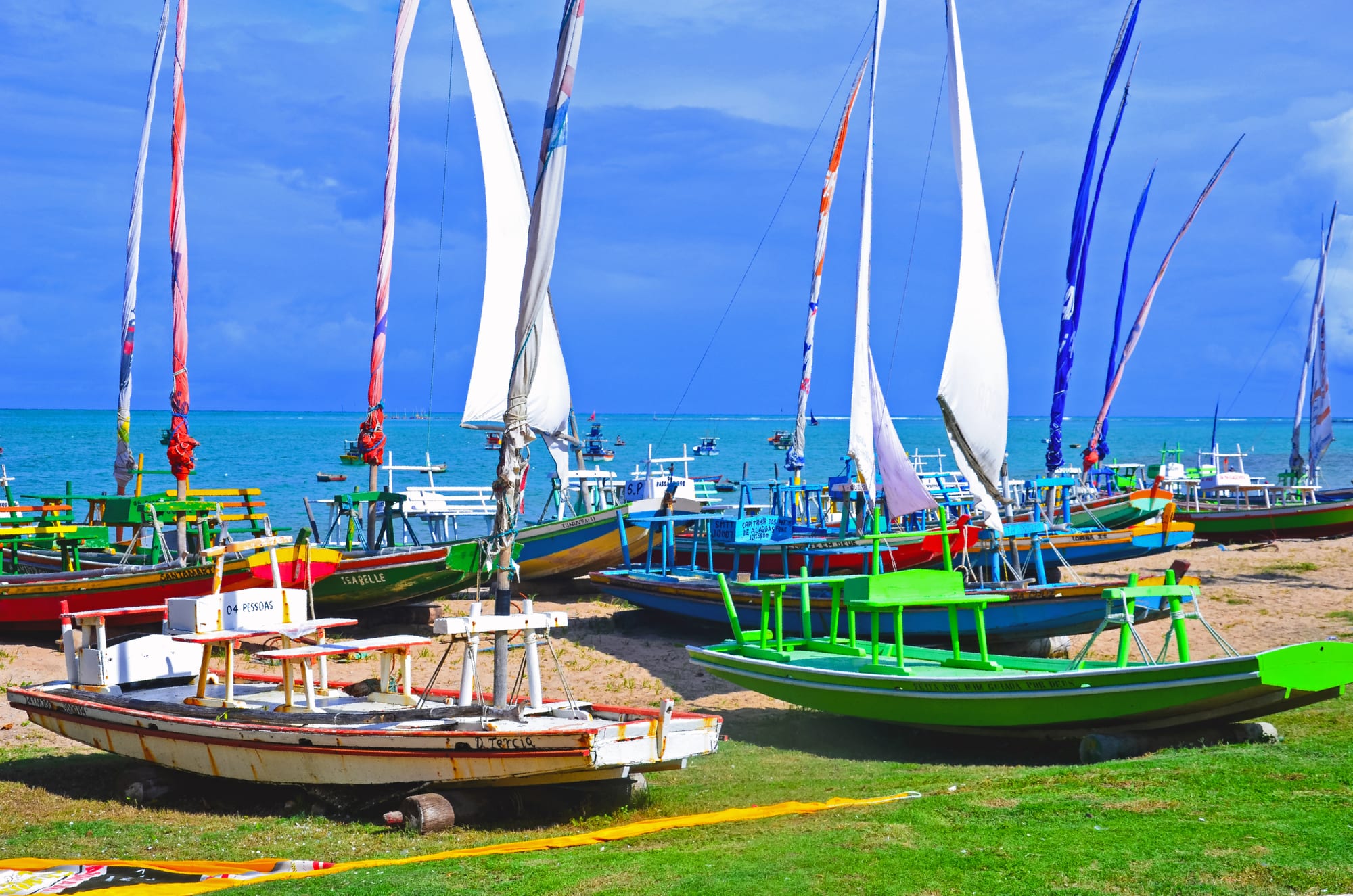
Brightly painted wooden jangadas with tall white sails drawn up on grass beside the turquoise sea at Pajuçara

Recife, Natal & the Northeast Coast, Brazil

Maceió

Jangadas waiting for passengers on Pajuçara beach in Maceió, the departure point for the natural pools. (Claudiorpmsousa / Wikimedia Commons · CC BY-SA 4.0)

The capital and largest city of Alagoas, on a strip of land between the Mundaú Lagoon and the Atlantic. It grew from sugar plantations and the natural harbour of Jaraguá into a port city, and today its palm-lined beaches and offshore reef pools draw visitors from across Brazil, while ground subsidence caused by salt mining has emptied several older neighbourhoods.

Neighbourhoods

  • Pajuçara
    • First-time visitors
    • Beaches
    • Close to the natural pools

    A beach and neighbourhood about 2 km from downtown, with calm water behind the reefs. The jangadas to the natural pools leave from here, beside the arts and crafts fair, and the seafront is lined with hotels, beach bars, restaurants and a running and cycling track.

    Open in Maps
  • Ponta Verde
    • Beaches
    • Best for food
    • Nightlife

    The palm-covered point that gives the neighbourhood its name, and one of the city's most popular beaches. At low tide the reefs form pools near the lighthouse; behind the beach, tall residential and hotel buildings, bars with live music and many of the city's restaurants.

    Open in Maps
  • Jatiúca and Cruz das Almas
    • Beaches
    • Nightlife

    Two of the city's urban beach districts, with apartment towers and a mix of hotels, restaurants and residential streets; Jatiúca also has a lively bar scene.

    Open in Maps
  • Jaraguá
    • Historic district
    • Museums

    The old port district where the city began. It was renewed in the late 1990s and is now a commercial area of banks, colleges and museums, with the city's convention centre, the Artesanato dos Guerreiros craft market and the port itself.

    Open in Maps
  • Pontal da Barra
    • Crafts
    • Lagoon views

    A historic, heritage-listed neighbourhood beside the Mundaú Lagoon, a traditional community of lacemakers, with fish and shellfish restaurants and boat trips on the lagoon.

    Open in Maps

Things to do

Beaches and reef pools

  • Pajuçara natural poolsbeach

    Shallow pools formed by coral reefs about a kilometre offshore, reached by jangada, the traditional wooden sailing raft, with floating bars, snorkelling and fish, sponges and crustaceans in the clear water.

    Open in Maps
  • Ponta Verde beachbeach

    One of the most frequented beaches in the city, with low-tide pools near the lighthouse, snorkelling over the reef and beach bars under the palms.

    Open in Maps
  • Jatiúca beachbeach

    One of the city's urban beaches, in a district of apartment towers and hotels known for its bars.

    Open in Maps

Museums and the old city

  • Museu Théo Brandãomuseum

    A museum of anthropology and folklore in Jaraguá, built on the collection of popular art donated by the folklorist Théo Brandão, with work by Alagoas artists and pieces from the state's popular festivals.

    Open in Maps
  • Museu Palácio Floriano Peixotomuseum

    The former seat of the Alagoas government, opened in 1902, with 18th- to 20th-century furniture, silver, crystal and paintings by Rosalvo Ribeiro and other artists from Alagoas.

    Open in Maps
  • Instituto Histórico e Geográfico de Alagoasmuseum

    The museum of the state historical institute, with documents, about 500 Indigenous artefacts, a section on Afro-Brazilian religions and belongings of the bandit Lampião and Maria Bonita.

    Open in Maps
  • Teatro Deodorolandmark

    The city's historic theatre in the centre, built between 1905 and 1910 and owned by the state of Alagoas.

    Open in Maps

Lagoon, crafts and viewpoints

  • Mundaú Lagoonpark

    An estuarine lagoon of mangroves and small islands on the city's western edge, home to fish, crabs, shrimps and shellfish and to the fishing communities that live from them.

    Open in Maps
  • Mirante São Gonçaloviewpoint

    A lookout beside the São Gonçalo church and the lighthouse, from which the old city, the harbour and the coast from Pajuçara to Pontal da Barra can be seen on a clear day.

    Open in Maps
  • Feirinha da Pajuçaramarket

    The arts and crafts fair on the Pajuçara seafront, near the departure point for the rafts to the natural pools.

    Open in Maps
  • Artesanato dos Guerreirosmarket

    A craft market on the Praça Visconde de Sinimbu in Jaraguá, successor to the Cheiro da Terra market, selling filé lace, ceramics and other Alagoas crafts.

    Open in Maps

Football and nights out

  • Estádio Rei Peléattraction

    The state-owned stadium known as Trapichão, built in 1970 and home to both CRB and CSA, with a sports museum named after the Alagoan footballer Dida.

    Open in Maps

Short trips from the city

  • Marechal Deodoroattraction

    The first capital of Alagoas, founded in 1611 and birthplace of Brazil's first president, with colonial buildings; its coast includes Praia do Francês, a busy beach with waves for surfing.

    Open in Maps
  • Barra de São Miguelattraction

    A small beach town on the south coast of Alagoas, one of the beaches on the coastal road below Maceió.

    Open in Maps

Seasonal events

  • São João MassayóJune

    The city's June festival of forró, formerly called Maceió Forró e Folia.

  • Verão Massayósummer

    The city's summer festival of concerts and events, formerly called Maceió Verão.

  • New Year's Eve31 December

    Large beach parties and réveillon events along the seafront to see in the new year.

Eat and drink

Long-standing places and food districts in Maceió. Hours, ratings and directions come from your maps app, always current.

Maceió classics

  • Tapiocamarket

    Pancakes of manioc starch filled with anything from ham and cheese to chocolate, one of the city's snacks to try.

    Open in Maps
  • Barracas of Pajuçara and Ponta Verdeneighborhood

    Beach restaurants and bars built on the sand under large thatched roofs, serving seafood, cold drinks and coconut water.

    Open in Maps

Food districts and markets

  • Rua Jangadeiros Alagoanosneighborhood

    A street in the Pajuçara and Ponta Verde area with a cluster of galeto restaurants serving grilled young chicken, buffets and snack bars.

    Open in Maps
  • Food trucks at Praça Jornalista Denis Agramarket

    A square where food trucks gather in the evening, one of the city's food-truck spots.

    Open in Maps
  • Restaurant boats at the natural poolsmarket

    Boats moored at the Pajuçara reef pools that sell food and drinks to swimmers and snorkellers.

    Open in Maps

Experience Maceió

History

The name Maceió comes from Tupi and describes the temporary lagoons that form where small streams are blocked by sand at the edge of the sea ; the state of Alagoas itself takes its name from the lagoons along its coast near the city. In the 17th century Portuguese ships anchored in the natural harbour of Jaraguá to load timber from the coastal forests, and sugar mills and plantations grew up around it. The settlement exported sugar, then tobacco, coconut, leather and spices, and its prosperity made it a village in its own right on 5 December 1815, when it was separated from the older Vila de Alagoas, today's Marechal Deodoro.

The port kept the town growing. On 9 December 1839 Maceió became a city and the capital of the province of Alagoas, taking the role from the old colonial capital. Through the 20th century it remained a port and administrative centre, and in the 1950s the Pajussara Yacht Club was built on Pajuçara beach, a venue for balls, carnival dances and gatherings of the Alagoas elite.

In the last few decades tourism has transformed the coastal districts, helped by a new airport terminal opened in 2005. The city's recent history has also been shaped by the sinking of several neighbourhoods. Cracks first appeared in Pinheiro in February 2018; in 2019 the Geological Survey of Brazil linked the subsidence to four decades of rock-salt mining by the petrochemical company Braskem. Around 60,000 people have had to leave their homes, and in December 2023 one of the company's mines beside the Mundaú Lagoon partially collapsed.

Culture & Customs

Maceió is a centre for the folk traditions of Alagoas, the folguedos: the Guerreiro, the Reisado, the Pastoril, the Chegança, the Caboclinho and the Coco Alagoano among them. The Museu Théo Brandão, named after the folklorist who donated its collection, holds a large collection of popular art, and the state historical institute preserves Afro-Brazilian religious objects and relics of the northeastern bandits.

Crafts are part of the city's identity. Filé lace and ceramics are the best-known local crafts, Pontal da Barra beside the Mundaú Lagoon is a traditional community of lacemakers, and crafts are sold at the Pajuçara fair and the Artesanato dos Guerreiros market in Jaraguá. The Teatro Deodoro, completed in 1910, is the historic home of the performing arts.

Football divides the city between CRB, founded in 1912, and CSA, founded in 1913, whose derby is the great local rivalry; both play at the Estádio Rei Pelé, known as the Trapichão. The festival calendar runs from the summer events of Verão Massayó to São João Massayó in June, the season of forró and bonfires, and New Year's Eve fills the beaches. In the 2022 census just over half of residents identified as Catholic and about three in ten as evangelical.

Daily Life

The 2022 census counted about 958,000 people in the municipality, and the metropolitan area, spread over thirteen municipalities, had about 1.35 million in 2024 — the largest in Alagoas. The city is almost entirely urban, divided into about 50 districts that stretch from the seafront to the lagoon shore and the inland neighbourhoods such as Tabuleiro do Martins, home to the industrial district.

The economy rests on tourism, commerce, sugar and ethanol from the surrounding cane fields, and a chlorochemical complex based on rock salt pumped from deep wells. The beach districts of Pajuçara, Ponta Verde and Jatiúca live from hotels, restaurants and beach bars, and the port of Jaraguá still ships sugar.

The ground subsidence is the defining issue of recent years. Five neighbourhoods — Pinheiro, Mutange, Bebedouro, Bom Parto and part of Farol — have been largely emptied, with about 14,000 properties condemned. Braskem, which does not officially admit causing the disaster, agreed in the Alagoas courts to pay more than 12 billion reais in compensation; residents have also sued the company in the Netherlands, and in November 2024 the Federal Police indicted 20 people linked to the company. Sewage pollution in the Mundaú Lagoon, which threatens the fishing communities on its shores, is another long-running concern.

Food

Maceió eats from the sea and the lagoon. Fish, shrimp, crab and shellfish come from the reefs and from the Mundaú Lagoon, whose mangroves support fishing families on its shores, and sururu, a small mussel from the Alagoas lagoons, is cooked in broth. Seafood moquecas and grilled fish fill the menus of the beach districts.

The beach is a place to eat as much as to swim. The barracas of Pajuçara and Ponta Verde, restaurants under great thatched roofs built on the sand, serve fried fish, shrimp and cold beer, and boats moored at the natural pools sell food and drinks to swimmers. Tapioca, a pancake of manioc starch filled with anything from ham and cheese to chocolate, is a snack to try, and queijo coalho, a heat-resistant cheese similar to halloumi, is often eaten grilled.

Away from the sea, everyday food is the buffet and the prato feito, a set plate of rice, beans, salad and meat. Rua Jangadeiros Alagoanos is known for its galeto restaurants, which grill young chicken, and food trucks gather at squares such as Praça Jornalista Denis Agra in the evening. Coconut water, fresh juices of local fruit and cachaça from the sugar country complete the table.

Planning tools

Budget

Maceió is good value by Brazilian standards. Buses, set lunches, tapioca stalls and simple pousadas keep costs low, while the beachfront hotels of Pajuçara, Ponta Verde and Jatiúca rise in price during the summer holidays and over New Year. Raft trips to the pools, beach chairs and day trips along the coast add to the bill.

Daily Budget Midrange
USD 90–170 (beachfront hotel, seafood dinners, a jangada trip, a day trip along the coast)
Daily Budget Shoestring
USD 35–60 (hostel or simple pousada, prato feito lunches, city buses and app taxis)

The natural pools are best at low tide, so plan the raft trip around the tide tables rather than the clock.

Best Time to Visit

September to February is the sunniest time, with the clearest water for the reef pools, which are best on low spring tides. Summer from December to March is hottest and busiest; from May to September there is more cloud and much more rain. The sea stays warm all year.

Suggested Number of Days

Three or four days covers the city beaches, the reef pools and the museums. Allow five to seven days to include the beaches and colonial towns of the north and south Alagoas coast. The tides decide when the pools can be visited, so a few spare days help.

First Visit
3–4 days
With Surroundings
5–7 days

Transportation

App taxis and ordinary taxis are the easiest way around and are widely used. City buses connect the beach districts with the centre and run along the coast road to the northern beaches; some lines need a local transport card. A light rail system of two lines, about 35 km in all, links the city with Satuba and Rio Largo in the metropolitan area, and minibuses run to the southern beaches.

Hiring a car is a good way to explore the beaches along the coast north and south of the city on day trips.

Airport & Station Connections

Zumbi dos Palmares International Airport is about 25 km from downtown, with flights from the large Brazilian cities and some international routes, more of them in the summer season. Most arrivals take a taxi or app taxi; a bus line runs from the airport to Ponta Verde. Intercity buses arrive from Recife and Salvador.

Walkability

The seafront from Pajuçara through Ponta Verde to Jatiúca is flat and pleasant to walk, with a promenade and running and cycling track along much of it. The beach districts are close together, but the old centre and Jaraguá are a short ride away, and the heat makes long walks tiring in the middle of the day.

Safety

Brazil has high rates of crime, including violent crime, and it is the main practical concern for visitors — though very unevenly distributed. In Maceió the beach districts are busy and well used, while the old centre is quieter after dark. The neighbourhoods affected by the ground subsidence — Pinheiro, Mutange, Bebedouro, Bom Parto and part of Farol — have been largely evacuated and are not places to explore.

Use app taxis after dark, keep phones and valuables out of sight on the beaches, and check the tide before walking out on the reefs. Check current official travel advice before travelling.

Climate

A tropical climate, hot and humid all year but tempered by trade winds from the ocean, with an average temperature of about 25°C. Rain falls mostly in the southern autumn and winter, and the sea is warm all year.

Summer
December–February is hot and sunny — January is the warmest month, with average highs of about 32°C and lows of 22°C
Winter
June–August is cooler, cloudier and wet — July averages highs of about 27°C and lows of 17°C

Local Customs

Beach vendors and raft operators are paid directly. Beachwear belongs on the beach and the seafront, not in churches or the city centre. Staff in the large hotels often speak English, but elsewhere a little Portuguese helps.

Ask before photographing lacemakers and craftspeople at work, and do not stand on or take coral from the reef pools.

Common Payment Methods

The currency is the Brazilian real. Cards are widely used in the beach districts, but the regional minibuses take only cash, and small change is useful for beach vendors and the craft fairs. Withdraw cash by day from ATMs inside banks or shopping centres.