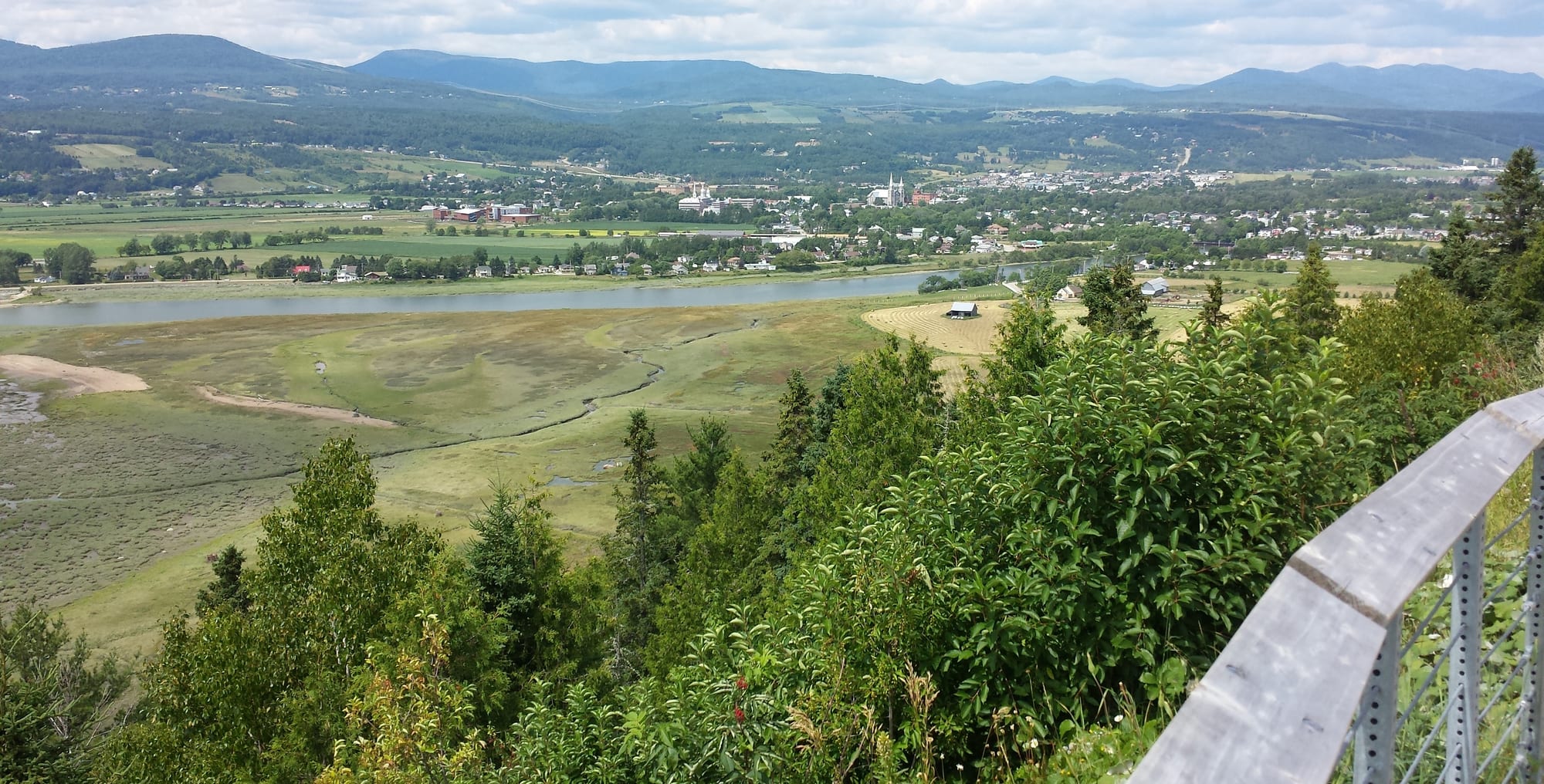
The town of Baie-Saint-Paul with its church spire in a green valley, the Gouffre River and tidal flats in front and hills behind

Quebec, Canada

Baie-Saint-Paul

Baie-Saint-Paul and the Gouffre River valley seen from the lookout on Route 362. (Veillg1 / Wikimedia Commons · CC BY-SA 4.0)

A small town on the north shore of the St Lawrence at the mouth of the Gouffre River, the seat and cultural centre of Charlevoix. Settled around 1650 as one of the first parts of New France to be colonised, it became a painters' town and the birthplace of Cirque du Soleil, and today lives on galleries, food producers and visitors to the hills and river around it.

Neighbourhoods

  • Rue Saint-Jean-Baptiste and the town centre
    • First-time visitors
    • Art galleries
    • Best for food

    The main street between Place de l'Église and Rue Saint-Pierre, lined with old houses turned into art galleries, craft shops, cafés and restaurants. The parish church, the contemporary art museum and the former Franciscan convent are a few steps away.

    Open in Maps
  • The bay and the mouth of the Gouffre
    • Beaches
    • Outdoor activities
    • Quiet

    The flat land where the Gouffre River meets the St Lawrence, with the municipal beach, the quay and the marina on Rue Sainte-Anne. Kayaking, paddleboarding and walks across the tidal flats start here.

    Open in Maps
  • The valley hamlets
    • Countryside
    • Food producers

    Farmland and hamlets such as Saint-Placide and La Mare spread up the wide Gouffre valley below steep, forested hills. Cheese makers, orchards and farms along Boulevard Mgr-de-Laval and the back roads sell their own produce.

    Open in Maps

Things to do

Art and heritage

  • Musée d'art contemporain de Baie-Saint-Paulmuseum

    A contemporary art museum in a prize-winning building opened in 1992, which runs the annual International Symposium of Contemporary Art and holds works by more than 500 artists.

    Open in Maps
  • Espace muséal des Petites Franciscaines de Mariemuseum

    A museum on the history of a religious order of nuns, in the large institutional building they occupied in the town centre.

    Open in Maps
  • Laiterie Charlevoixattraction

    A cheese dairy and cheese économusée on Boulevard Mgr-de-Laval, with a shop selling Charlevoix cheeses and other local products.

    Open in Maps

River and viewpoints

  • Baie-Saint-Paul beachbeach

    A sandy beach on the west side of the bay at the mouth of the Gouffre, beside the marina and quay.

    Open in Maps
  • Charlevoix impact structureviewpoint

    A large eroded meteorite impact structure, estimated at 54 km across when it formed, that shaped the Charlevoix landscape; only part of it is exposed, the rest lying beneath the St Lawrence.

    Open in Maps

Short trips from the town

  • Le Massifattraction

    A ski area at Petite-Rivière-Saint-François directly above the St Lawrence, with a vertical drop of 770 m, the highest in Canada east of the Rockies.

    Open in Maps
  • L'Isle-aux-Coudresattraction

    An island in the St Lawrence facing the town, reached by a free ferry from Saint-Joseph-de-la-Rive, setting of the classic 1963 documentary Pour la suite du monde.

    Open in Maps
  • Grands-Jardins National Parkpark

    A provincial park in the hills north of the town and one of the core areas of the Charlevoix World Biosphere Reserve, with hiking trails and lakes.

    Open in Maps

Seasonal events

  • Le Festif!last weekend of July

    A music festival in the streets and squares of the town that mixes popular music with circus arts.

  • International Symposium of Contemporary Artopens about a week after Le Festif!

    An annual gathering of artists from around the world, organised by the contemporary art museum, which encourages them to work alongside the public.

  • Baie-Saint-Paul Christmas Marketlate November and early December

    A Christmas market of about 40 exhibitors selling crafts and local foods.

Eat and drink

Long-standing places and food districts in Baie-Saint-Paul. Hours, ratings and directions come from your maps app, always current.

Charlevoix producers

  • Laiterie Charlevoixmarket

    A cheese dairy shop selling cheeses from Charlevoix and other regions, honey, cold cuts, bread, pastries and maple products.

    Open in Maps
  • Famille Migneron de Charlevoixmarket

    A family business producing artisan cheeses, wines and farm spirits, with a shop on the edge of town.

    Open in Maps
  • Cidrerie Vergers Pedneaultmarket

    The main-street shop of an orchard and cider maker, selling its ciders.

    Open in Maps

Food streets

  • Rue Saint-Jean-Baptisteneighborhood

    The town's main street of restaurants, cafés and bistros among the galleries, many using Charlevoix produce.

    Open in Maps

Experience Baie-Saint-Paul

History

The bay appears on a map by Pierre Desceliers around 1550 as Baie de l'Ilet, and Samuel de Champlain called it Baie du Gouffre in 1632 after a whirlpool at the mouth of the river; by 1641 the name Baie Saint-Paul was in use. The first settlers arrived around 1650, making the valley one of the first parts of New France to be colonised. The land was divided between two seigneuries on either side of the Gouffre, granted in 1636 and 1682, and the parish of Saint-Pierre-et-Saint-Paul was founded in 1681.

In the 1770s the town gained some prominence when Doctor Philippe-Louis-François Badelard named a disease he was researching the Baie-Saint-Paul malady. A visitor in the early 1800s noted mineral springs in the area. Local government changed shape many times: the village separated from the parish in 1893, gained city status in 1913, lost it in 1922 and regained it in 1961, and in 1996 the city, the parish and Rivière-du-Gouffre were merged into today's Baie-Saint-Paul.

The landscape the settlers farmed was formed long before: the Charlevoix hills are the eroded remains of a huge meteorite impact, part of which lies beneath the St Lawrence. The painters Clarence Gagnon and René Richard are among the town's notable people, and in 1984 the first show under the name Cirque du Soleil was held at the town's fair, La Fête foraine de Baie-Saint-Paul.

Culture & Customs

Baie-Saint-Paul is known above all for its art galleries, which line Rue Saint-Jean-Baptiste, and the painters Clarence Gagnon and René Richard are numbered among its notable people. The contemporary art museum, in a building opened in 1992 on the site of an old cinema, runs the International Symposium of Contemporary Art every year, which brings artists from around the world together with the public; its collection, largely built from the symposium, holds works by more than 500 artists.

Cirque du Soleil was founded in Baie-Saint-Paul on 16 June 1984 by Guy Laliberté and Gilles Ste-Croix, former street performers who had toured Quebec as Les Échassiers, the stilt walkers. The circus is now headquartered in Montreal, but the town keeps the connection alive: Le Festif!, held on the last weekend of July, mixes popular music with circus arts in its streets.

The town is almost entirely French-speaking, with about 97 per cent of residents speaking French as their first language. Charlevoix's regional identity is strong, built on its hills, its farms and its artists, and the Charlevoix World Biosphere Reserve was recognised by UNESCO in 1988.

Daily Life

Baie-Saint-Paul had 7,371 residents at the 2021 census, up about 3 per cent on 2016, spread over a large municipality that takes in the town, the Gouffre valley and hamlets such as Saint-Placide and La Mare. It is the seat of the Charlevoix Regional County Municipality and the region's cultural, economic and administrative centre.

Tourism, the arts and food production underpin the economy. Galleries, restaurants, auberges and outdoor outfitters serve visitors, while farms, cheese makers, orchards and cider makers in and around the valley sell their own produce. The Route des Saveurs links producers of cheese, cider, craft beer, chocolate, duck and organic meat along the Charlevoix roads.

Most residents live in the town centre and in houses along the valley roads. Daily life follows the seasons: busy summers of festivals and visitors, ski weekends at Le Massif in winter, and quieter spring and late-autumn months when many visitor businesses slow down.

Food

Charlevoix is one of Quebec's best-known regions for local produce, and Baie-Saint-Paul is its shop window. Cheese leads: the Laiterie Charlevoix, a cheese économusée, sells Charlevoix cheeses alongside cheeses from other regions, and the Migneron family produce artisan cheeses as well as wines and spirits. Orchards supply cider, including the cidre de glace, ice cider made from frozen apples, that Quebec invented, sold in a cider maker's shop on the main street.

Along the Route des Saveurs, farms and small producers sell duck, organic meat, market vegetables, chocolate and craft beer, and the town's restaurants build menus around them. The older Quebec home cooking is still everywhere: tourtière, the meat pie, pea soup, fèves au lard, beans slow-cooked with bacon and maple syrup, and desserts such as tarte au sucre, sugar pie, and pouding chômeur, a white cake in a maple-syrup pudding.

Rue Saint-Jean-Baptiste holds most of the cafés, bakeries and bistros, and in late autumn the Christmas market brings crafts and local foods into the town centre.

Planning tools

Budget

Baie-Saint-Paul is moderately priced for a Quebec resort town, with auberges, motels and a few larger hotels. Summer and the ski season are the busy times, and rooms across Charlevoix book up in July and August. A car is needed to reach the countryside, the parks and the ski hill.

Daily Budget Midrange
USD 160–290 (auberge, bistro dinners, a hire car, park entry or a lift pass)
Daily Budget Shoestring
USD 75–115 (hostel or campsite, bakery and grocery food, walking and cycling)

The galleries, the beach, the lookouts and the cheese shops cost nothing to visit, and the ferry to L'Isle-aux-Coudres is free.

Best Time to Visit

June to early October for the galleries, the farms and the parks, with the festival season in late July and August and autumn colour in late September and early October. January to March brings skiing at Le Massif. Some businesses close or shorten their hours outside summer.

Suggested Number of Days

One or two days cover the town itself at an easy pace. Allow three to five to include the Charlevoix coast, the parks, the island or a ski trip; a car makes the biggest difference to what can be reached.

First Visit
1–2 days
With Surroundings
3–5 days

Transportation

The town centre is small enough to walk, and bicycles are available for hire. Beyond it, a car is the practical choice: the valley farms, the parks, Le Massif and the coast towards La Malbaie are spread out, and buses between them are infrequent.

Route 138 into the valley descends steep hills; take care in winter, when winter tyres are compulsory in Quebec.

Airport & Station Connections

Baie-Saint-Paul is on Route 138, the road along the north shore from Quebec City through Charlevoix, and most visitors drive. Intercar coaches between Quebec City and the north shore stop in the town. From Tadoussac the drive is about 122 km, crossing the Saguenay by ferry. Quebec City's Jean Lesage International Airport is the nearest major airport.

Walkability

The centre is compact and pleasant on foot: Rue Saint-Jean-Baptiste, the church, the museums and the riverside beach are all close together. The valley farms and lookouts are several kilometres out and need a car or a bicycle.

Safety

Canada is a safe country with low levels of violent crime. In Baie-Saint-Paul the hazards are seasonal and natural: steep, icy roads and heavy snow in winter, cold water and tides in the bay, and changeable weather on the hills.

Drive carefully on the hills in winter, watch the tides on the flats, and check conditions before hiking in the parks. Check current official travel advice before travelling.

Climate

A humid continental climate with large seasonal differences. Summers are mild, moderated by the Gulf of St Lawrence, while winters bring frequent cold waves from the interior and plenty of snow.

Summer
mild, moderated by the Gulf of St Lawrence (20–30°C is typical of Montreal and Quebec City)
Winter
cold and snowy, with frequent cold waves from the interior (around −10°C by day is typical of Montreal)

Local Customs

French is the first language of almost everyone in the town, and a greeting of bonjour is appreciated. Galleries welcome browsers, but ask before photographing artworks. Tipping of 15–20 per cent is expected in restaurants, and sales tax is added at the till.

The parish church is a working place of worship; dress modestly and keep quiet during services.

Common Payment Methods

The currency is the Canadian dollar. Cards and contactless payment are accepted almost everywhere, and cash is rarely needed; cash totals are rounded to the nearest five cents.