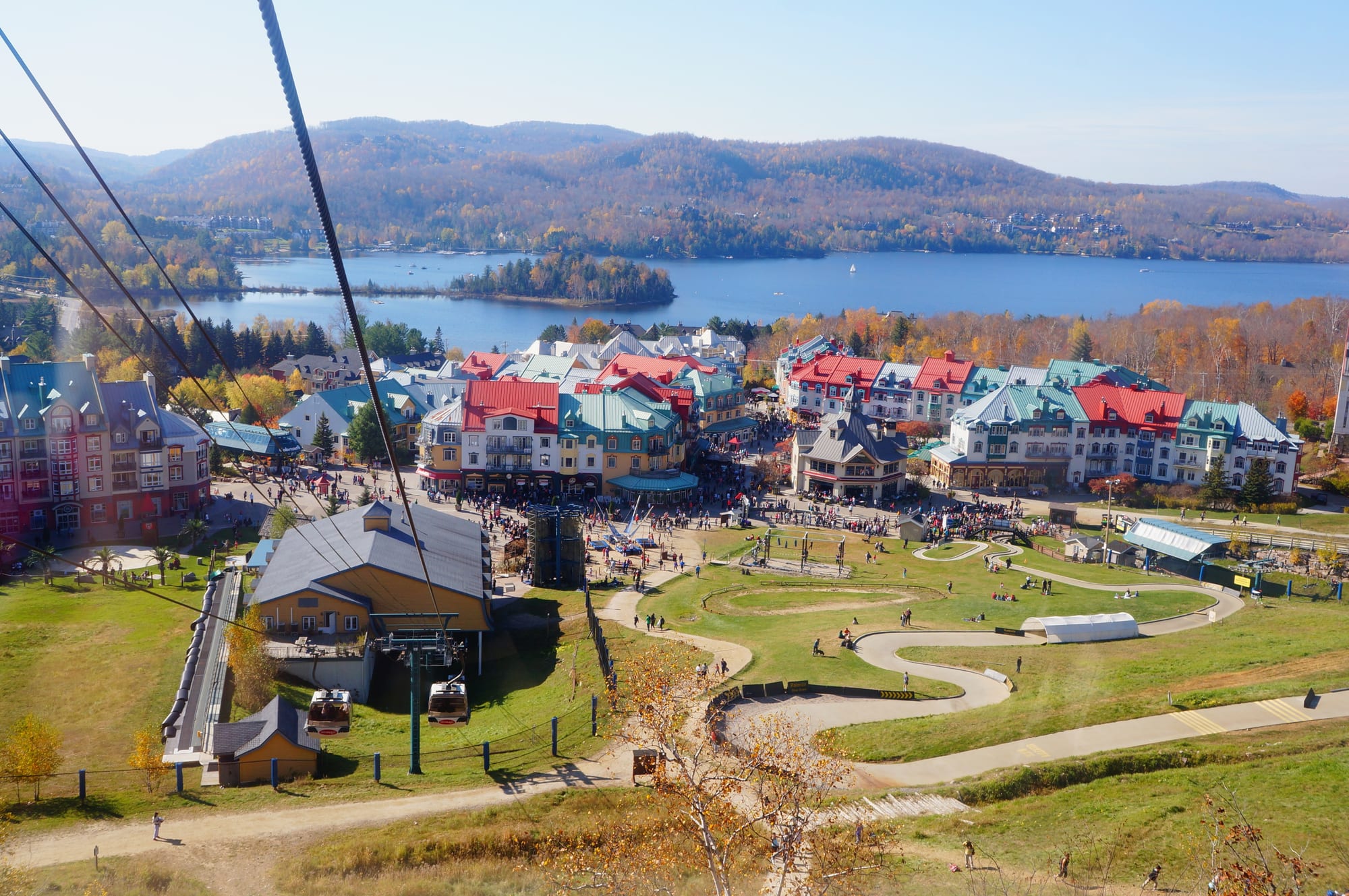
Colourful roofs of the Mont-Tremblant resort village seen from above

Quebec, Canada

Mont-Tremblant

The pedestrian village of the Mont Tremblant resort. (Jiaqian AirplaneFan / Wikimedia Commons · CC BY 3.0)

A small town in the Laurentian Mountains about 130 km north-west of Montreal, below the ski mountain the Algonquins called the trembling mountain. A farming and logging parish reached by railway in the 1890s, it grew around a ski resort opened in 1939 and is now a year-round resort town of lakes, forest, a car-free village and a large provincial park.

Neighbourhoods

  • The pedestrian village
    • Skiing
    • First-time visitors
    • Après-ski

    The car-free resort village at the foot of the mountain, rebuilt from the 1990s in brightly painted buildings that echo traditional Quebec architecture. An open-air gondola links its upper and lower parts, the main gondola climbs to the summit, and its streets hold shops, restaurants, bars and most of the resort's lodging.

    Open in Maps
  • The village by Lac Mercier
    • Quiet
    • Outdoor activities

    The original village, which grew up around the railway station on Lac Mercier after the line arrived in 1904. It is calmer than the resort, with lakeside homes and access to the old railway line, now a cycling and cross-country skiing trail.

    Open in Maps
  • Saint-Jovite (downtown)
    • Local life
    • Shopping
    • Best for food

    The former town of Saint-Jovite, merged into Mont-Tremblant in 2002, now the town's commercial centre. Groceries, shops and restaurants here serve residents and are generally cheaper than in the resort village, and a local bus links it with the resort.

    Open in Maps

Things to do

The mountain, the lake and the resort

  • Mont Tremblant Resortattraction

    A year-round resort opened in 1939, best known for skiing on more than 650 acres of terrain, with gondolas to the summit lodge in winter and summer and two golf courses.

    Open in Maps
  • Mont Tremblantviewpoint

    One of the highest peaks of the Laurentians, whose summit, reached by gondola, gives wide views over lakes and forested hills.

    Open in Maps
  • Circuit Mont-Tremblantattraction

    The second-oldest racing circuit in Canada, a twisting road course of fifteen corners near the ski resort, which has hosted Formula One and other international series.

    Open in Maps
  • Lake Tremblantpark

    A long, narrow lake at the foot of the mountain with about seven islands, surrounded by mixed forest and used for swimming, boating and water sports.

    Open in Maps

Short trips from the town

  • Mont-Tremblant National Parkpark

    Quebec's oldest provincial park, north of the town, with canoeing, kayaking, hiking, backcountry camping, cross-country skiing and clear lakes; it was designated a dark-sky preserve in 2023.

    Open in Maps
  • Le P'tit Train du Nordtrail

    A 200 km rail trail on the former Canadian Pacific line between Saint-Jérôme and Mont-Laurier, used for cycling in summer and cross-country skiing in winter.

    Open in Maps

Eat and drink

Long-standing places and food districts in Mont-Tremblant. Hours, ratings and directions come from your maps app, always current.

Mont-Tremblant classics

  • Pedestrian village restaurantsneighborhood

    Bistros, crêperies, fondue and raclette houses, pubs and après-ski bars at the foot of the slopes, busiest in the ski season.

    Open in Maps
  • Microbrasserie La Diablerestaurant

    A local microbrewery known for its own beers and hearty food such as ribs and sausages.

    Open in Maps

Food districts

  • Saint-Joviteneighborhood

    The town's downtown, with grocers, cafés and restaurants used by residents, and a cheaper place to stock up than the resort village.

    Open in Maps

Experience Mont-Tremblant

History

The Algonquins lived in these hills before European settlement and gave the mountain its name: they described it as rumbling and swaying underfoot, and the French called it mont Tremblant, the trembling mountain. Colonisation began in 1872 under the parish priest Antoine Labelle, who promoted settlement of the Laurentians, and the parish was formally established in 1879. Farming and logging were the main livelihoods. A railway line from Montreal reached the village of Saint-Jovite in 1892 and was extended to Lac Mercier in 1904, and Mont-Tremblant grew around the new station; a hydroelectric dam built in 1905 brought electricity, first to Saint-Jovite.

Skiing changed the town. In 1938 Joseph Bondurant Ryan, a wealthy American from Philadelphia prospecting for gold, climbed the mountain on skis with the journalist Lowell Thomas and resolved to build an alpine village. His ski lodge opened on 12 February 1939 with the resort's first chairlift, and he built the Saint-Bernard chapel at the foot of the slopes in 1940–41. After his death in 1950 his widow ran the resort until 1965, when it was sold to Quebec entrepreneurs. Intrawest bought it in 1991 and rebuilt the pedestrian village in a style recalling traditional Quebec, with new lifts and a gondola, and Alterra Mountain Company has owned it since 2018.

The present municipality took shape through mergers: in 2002 Saint-Jovite town and parish, Mont-Tremblant and Lac-Tremblant-Nord combined, and Lac-Tremblant-Nord separated again in 2006.

Culture & Customs

Mont-Tremblant is a French-speaking town whose life revolves around a resort that draws visitors in every season, so French and English are both heard in the village. Skiing is the local culture as much as an industry: Ryan's son Peter, named to the Canadian Olympic ski team before switching to motor racing, is buried beside the chapel his father built.

Motor sport is the town's other tradition. Circuit Mont-Tremblant, originally known as Circuit Mont-Tremblant–St-Jovite, is the second-oldest racing circuit in Canada, has hosted Formula One, Can-Am and Champ Car races, and is set in the hills near the ski area. The town has also hosted Ironman triathlon races, and the Tremblant International Blues Festival is one of the larger blues festivals in Canada.

Outdoor life sets the rhythm in every season: skiing, snowshoeing and dog sledding in winter, and in summer cycling on the old railway line, canoeing and swimming in the lakes, golf and hiking in the national park, which in 2023 was designated a dark-sky preserve.

Daily Life

Mont-Tremblant had about 11,000 residents at the 2021 census, up 14 per cent from 2016. Of its 8,783 private dwellings, 5,408 were occupied by usual residents, a sign of how many chalets and condos serve visitors and part-time owners.

Tourism is the economy. The ski resort, its hotels and condos, restaurants, shops, golf courses, the racing circuit and outdoor outfitters employ much of the population, and the work follows the seasons, with peaks in winter and summer and quieter months between. Agriculture and logging, the old livelihoods, now play a small part.

Residents live mainly in Saint-Jovite, the town's commercial centre, and around the old village and the many lakes, while the resort village is dominated by visitors. The town has French-language elementary schools, a high school, a vocational training centre and a college campus, and English-language schools are in neighbouring towns. A local bus service links Saint-Jovite, the town's downtown, with the resort.

Food

The town eats in the Québécois tradition, with resort cooking on top. Poutine, fries with cheese curds and gravy, is a staple of snack bars, and tourtière, the spiced meat pie, and split-pea soup belong to the older Quebec kitchen. Maple appears everywhere, from syrup sold in the village shops to sugar-shack treats such as tire d'érable, hot syrup set on snow, in early spring.

In the pedestrian village, restaurants cater to skiers and holidaymakers: Savoyard fondue and raclette for cold evenings, crêperies, pizza, grills and pubs, and cafeterias and a summit lodge on the mountain itself. The town's Microbrasserie La Diable brews its own beers and serves hearty food, and after a day on the slopes the après-ski bars at the foot of the lifts fill up.

Away from the resort, Saint-Jovite has supermarkets, bakeries and everyday restaurants used by residents, and many visitors staying in condos and chalets cook for themselves with produce bought there. Quebec cheeses, local beers and ice cider made from frozen apples are sold in the shops.

Planning tools

Budget

Mont-Tremblant is one of Quebec's more expensive places to stay. Accommodation prices are highly seasonal, lowest on autumn and spring weekdays and highest on winter holiday weekends. Lift passes, equipment hire and meals in the resort village add up quickly, and groceries and meals in Saint-Jovite cost less.

Daily Budget Midrange
USD 170–300 (condo or mid-range hotel, restaurant dinners, a hire car; lift passes extra in winter)
Daily Budget Shoestring
USD 80–130 (hostel bed, groceries and simple meals, local bus, hiking and cycling)

Book early for the ski holidays and long weekends; outside them, rooms in the same buildings can cost a fraction as much.

Best Time to Visit

December to April for skiing, when the resort makes snow from November. June to September for the lakes, hiking, cycling and golf, and late September to early October for autumn colour in the Laurentians. Late autumn and spring are quiet and cheaper but the weather is mixed.

Suggested Number of Days

Two or three days suit a first visit to the resort and the lakes. Allow four or five days for a ski holiday or to spend time in the national park. The season and whether a car is available change the number most.

First Visit
2–3 days
With Surroundings
4–5 days

Transportation

A car is the easiest way to move between the resort village, the old village, Saint-Jovite and the park. A local bus service links Saint-Jovite with the resort. Inside the pedestrian village, everything is on foot or by gondola.

Winter tyres are compulsory in Quebec in winter, and roads in the hills can be snowy; watch for moose on country roads at dusk.

Airport & Station Connections

Mont-Tremblant is about 130 km north-west of Montreal, and most visitors drive up from there along Route 117 or arrive by coach. Montréal–Trudeau is the main airport for the region, and in the ski season shuttles run from it to the resort. The small Mont-Tremblant International Airport is at La Macaza, with direct flights from Toronto.

Walkability

The resort village is entirely car-free and compact, though built on a slope, with gondolas linking its levels. The town's other parts are kilometres apart along roads with little pavement, so walking between them is impractical; the P'tit Train du Nord trail gives a traffic-free route for cyclists.

Safety

Canada is a safe country with low levels of violent crime. In Mont-Tremblant the risks are outdoor ones: deep winter cold, icy roads, ski injuries, sudden weather changes on the mountain and wildlife, including moose and bears, in the park and the forests around it.

Ski within marked trails, check park conditions before hiking or paddling, carry warm layers and water, and keep well away from wildlife. Check current official travel advice before travelling.

Climate

A humid continental climate, colder than Montreal. Winters are long, cold and snowy; summers are warm and pleasant, with cool nights in the hills. Autumn brings early frosts and bright colour, and spring is short and muddy.

Summer
warm, a little cooler than the 20–30°C typical of Montreal, with cool nights
Winter
cold and snowy, colder than the daytime −10°C typical of Montreal, with snow on the slopes from late autumn into April

Local Customs

French is the first language of most residents, and English is widely heard in the resort village. Restaurant staff typically receive tips of 15–20 per cent, and sales tax is added at the till. Après-ski is part of the resort's social life.

A greeting of bonjour is appreciated; in the national park, stay on trails and follow the park's rules on campfires and wildlife.

Common Payment Methods

The currency is the Canadian dollar. Cards and contactless payment are accepted almost everywhere, including at the resort, and cash is rarely needed; cash totals are rounded to the nearest five cents.