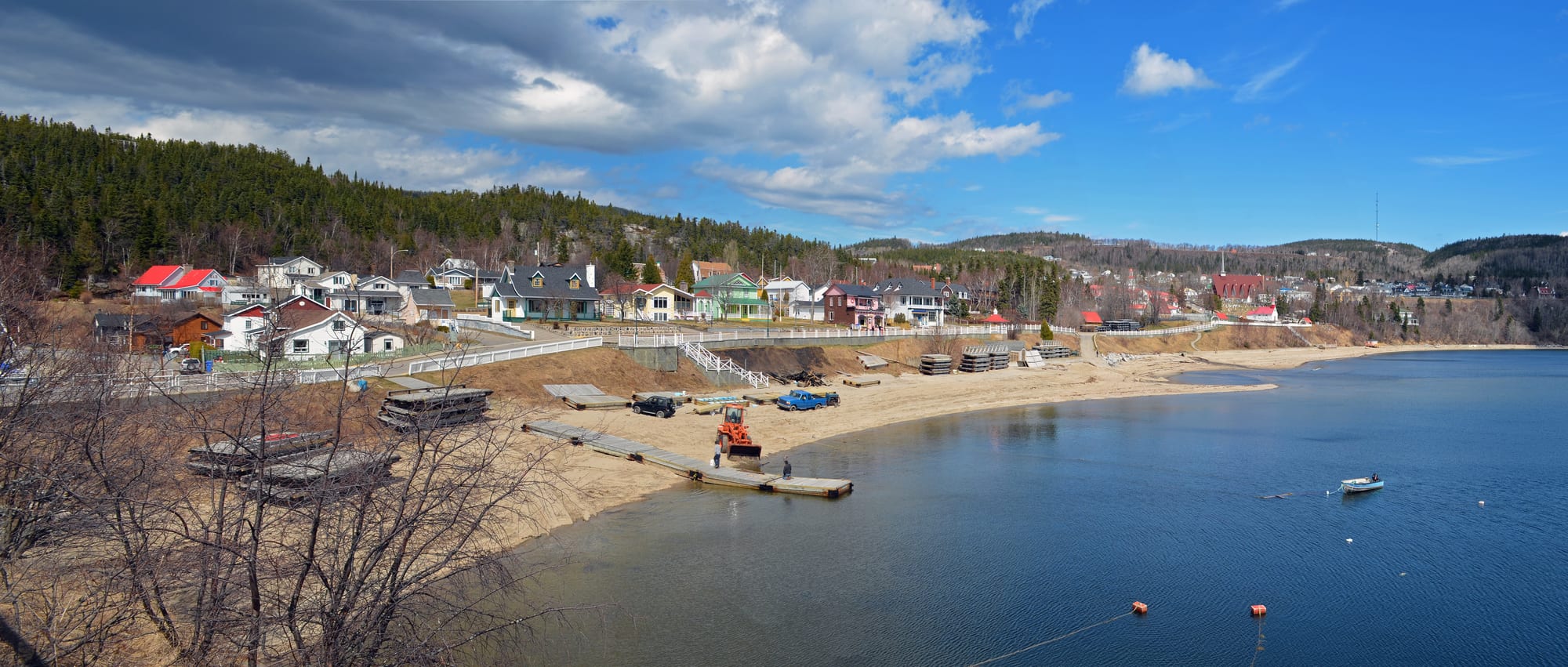
Painted wooden houses on a slope above a sandy beach and a calm bay, with a red-roofed church and forested hills behind

Quebec, Canada

Tadoussac

The village of Tadoussac and its bay at the mouth of the Saguenay. (Selbymay / Wikimedia Commons · CC BY-SA 3.0)

A village of about 800 people in a bay on the north shore of the St Lawrence estuary, at the mouth of the Saguenay fjord. Founded as a French fur-trading post in 1599, it was for decades the busiest meeting place of French and Indigenous traders. Today it lives on summer visitors who come for the whales, the fjord and the sand dunes.

Neighbourhoods

  • The bay and the village centre
    • First-time visitors
    • Historic district
    • Whale-watching boats

    The heart of Tadoussac, around the sandy bay between Pointe de l'Islet and Pointe Rouge. The old chapel, the trading post, the marine mammal centre, the wharf, the marina and most restaurants are along Rue du Bord-de-l'Eau and the streets climbing from it, all within a short walk.

    Open in Maps
  • Rue des Pionniers and the upper village
    • Quiet
    • Restaurants
    • Close to trails

    The main street running up from the bay past houses, cafés and restaurants towards the golf course and the road to the dunes. It is calmer than the waterfront, with views back over the bay.

    Open in Maps
  • The ferry landing and Anse à l'Eau
    • Arrivals
    • Fjord views

    The west side of the village on the Saguenay, where the free ferry from Baie-Sainte-Catherine lands and the trail along the fjord begins beside the small lake of Anse à l'Eau.

    Open in Maps

Things to do

Whales and the shore

  • Saguenay–St. Lawrence Marine Parkpark

    The first park in Canada to protect a purely marine environment, where the Saguenay meets the St Lawrence; boat trips from the village look for belugas, minke, fin and other whales drawn by the rich feeding waters.

    Open in Maps
  • Marine Mammal Interpretation Centremuseum

    An interpretation centre on the whales and other marine mammals of the St Lawrence.

    Open in Maps
  • Tadoussac Dunesviewpoint

    Sand terraces east of the village, raised from the sea after the last ice age, stretching for a little over 2 km above the estuary; a lookout gives wide views, and migrating birds of prey and songbirds are observed here.

    Open in Maps
  • Pointe de l'Islet trailtrail

    A short trail from the wharf onto the rocky point at the western entrance to the bay, with a boardwalk over the rocks beside the mouth of the Saguenay.

    Open in Maps

The historic village

  • Tadoussac Chapellandmark

    The Chapelle des Indiens, a small wooden mission chapel built between 1747 and 1750, one of the oldest surviving wooden places of worship in Quebec and a national historic site.

    Open in Maps
  • Chauvin Trading Postmuseum

    A museum on the bay recalling the fur-trading post founded by Pierre de Chauvin and François Gravé Du Pont at the end of the 16th century.

    Open in Maps

Short trips from the village

  • Saguenay Fjord National Parkpark

    A provincial park running for more than 100 km along the steep shores of the Saguenay fjord beside the marine park, with long trails and viewpoints over the water.

    Open in Maps
  • Baie-Sainte-Catherineattraction

    The village across the mouth of the Saguenay, reached by the free ferry, whose crossing gives views up the fjord.

    Open in Maps

Seasonal events

  • Festival de la chanson de TadoussacJune

    A long-running French-language song festival that fills the village with concerts before the summer season.

  • North Shore Migratory Bird Festivalmid-June

    A birding festival along the coast from Tadoussac to Forestville, run with the Tadoussac Bird Observatory.

Eat and drink

Long-standing places and food districts in Tadoussac. Hours, ratings and directions come from your maps app, always current.

Tadoussac classics

  • Rue du Bord-de-l'Eau and Rue des Pionniersneighborhood

    The village's restaurants, many open only from spring to autumn, serve seafood, fish and game, traditional Quebec dishes and grills, several with terraces over the bay.

    Open in Maps
  • Microbrasserie Tadoussacrestaurant

    A craft brewery opposite the beach in the centre of the village, selling its own beers.

    Open in Maps
  • Casse-croûtesneighborhood

    Roadside snack bars selling fried food, poutine, soft ice cream and crêpes to take away, near the beach and along the main road.

    Open in Maps

Experience Tadoussac

History

Long before Europeans came, the mouth of the Saguenay was a gathering place: when Jacques Cartier arrived in 1535 on his second voyage, he found Innu people using it as a base for hunting seals. Basque whalers followed later in the century, trading hides with the people on shore, and by the end of the 1500s more than a thousand Algonquin, Etchemin and Montagnais came every summer to trade furs, having learned to wait for several competing ships to drive up prices. The historian Bruce Trigger called it the most important fur-trading centre in North America by 1600.

In 1599 the merchant François Gravé Du Pont and the naval captain Pierre de Chauvin de Tonnetuit founded a trading post here under a fur monopoly granted by Henry IV; only five of the first sixteen settlers survived the winter. In 1603 Gravé and Samuel de Champlain met the Montagnais, Algonquins and Etchemins at the feast known as the tabagie of Tadoussac, an alliance that shaped New France. Missionaries arrived in 1615, and for thirty years Tadoussac was the only seaport on the St Lawrence. The present wooden chapel was built in 1747–50.

The post passed to the King's Domain in 1720, then to the North West Company and the Hudson's Bay Company, and served as headquarters of the King's Posts until 1849. As the fur trade declined it became a summer fishing post, and the Hudson's Bay Company left in 1859. Tourism took over: wealthy Québécois built summer villas, a hotel was built in 1864, and the village was incorporated in 1899. Today it is known above all for the rugged beauty of the fjord and for whale watching.

Culture & Customs

Tadoussac is an overwhelmingly French-speaking village, with about 96 per cent of residents speaking French as their first language, and its identity rests on being one of the oldest European settlements in Canada. The Innu, whose seal-hunting camp Cartier found here, remain part of the region's story: the waters of the marine park lie within the land claim of the Innu Essipit First Nation.

Village culture is seasonal. In June the Festival de la chanson de Tadoussac brings French-language singers and audiences, a writing festival follows, and the North Shore Migratory Bird Festival celebrates the migrations along the coast; researchers of the Tadoussac Bird Observatory, founded in 1993, observe birds of prey and songbirds migrating over the dunes.

The whales are central to local pride and work. The St Lawrence beluga, a population of around 900 animals found only in Canada and a species at risk, lives in these waters all year, and scientists, guides and the marine mammal centre make research and conservation part of everyday life. The village has also appeared on screen, from the opening of the Goosebumps television series to the 2017 Quebec film Tadoussac.

Daily Life

Tadoussac had 814 residents at the 2021 census, living in 397 of its 514 private dwellings. The population is small and stable, but the village fills with visitors from late spring to early autumn, when whale-watching companies, restaurants, campsites and inns open for the season.

The economy is almost entirely tourism: cruises and zodiac trips into the marine park, sea kayaking on the fjord, the marina, the golf course and the restaurants. The municipality took over the port of Tadoussac in 2012. In winter the village is quiet, many businesses close, and life centres on the year-round ferry and the road along the coast.

Tadoussac sits where three regions meet, Côte-Nord, Saguenay–Lac-Saint-Jean and Charlevoix, and the ferry across the Saguenay, part of Route 138, is the main link for the whole north shore as far as Sept-Îles. The nearest city is Saguenay, about 100 km west; coaches run daily to Quebec City and Montreal. Residents live with the tension between protecting the belugas and the dunes and relying on the visitors who come to see them.

Food

Seafood and the products of the estuary dominate. Village restaurants serve fish, shellfish and lobster, alongside game such as caribou and the standards of Quebec home cooking: tourtière, the spiced meat pie, pea soup, and maple desserts such as tarte au sucre, sugar pie. Traditional Quebec buffets are served too, and menus lean on regional produce — fish, game and local products — eaten on terraces over the bay in summer. Older Quebec staples include cretons, a spiced pork spread, and fèves au lard, beans baked with salt pork and maple.

Roadside casse-croûtes, the snack bars found in every Quebec village, sell poutine, chips topped with cheese curds and gravy, along with fried food, steamed hot dogs, crêpes and soft ice cream to eat by the beach.

Microbrasserie Tadoussac, opposite the beach, brews craft beer in the village, and Quebec's cheeses and maple products are sold in the shops. Because most restaurants open only from spring to autumn, the choice in winter is limited to a few year-round places.

Planning tools

Budget

Tadoussac is a seasonal resort village, and summer is its expensive time: rooms are limited and fill in July and August, and whale-watching cruises are the biggest extra cost. Many restaurants and businesses open only from spring to autumn, so choice is narrower outside summer.

Daily Budget Midrange
USD 160–290 (auberge or motel, seafood dinners, a whale-watching cruise, a hire car)
Daily Budget Shoestring
USD 75–120 (hostel or campsite, groceries and snack bars, walking the trails and shore)

The ferry across the Saguenay is free, and the shore, the dunes and the fjord trails cost nothing.

Best Time to Visit

Late spring to early autumn. Most whale-watching tours run from May to September, July and August are the busiest months, and September is quieter. In winter much of the village closes.

Suggested Number of Days

One or two days are enough for the village and a boat trip. Allow three or four to walk the fjord trails or kayak, and to give the weather a chance, since fog and wind can cancel cruises.

First Visit
1–2 days
With Surroundings
3–4 days

Transportation

The village is small and easily walked. A car is the usual way to reach it and to explore the coast and the fjord. The ferry across the Saguenay to Baie-Sainte-Catherine is free, frequent and runs all year as part of Route 138, the main road along the north shore.

There are no services and no phone signal on the road along the fjord to Saguenay.

Airport & Station Connections

Most visitors drive along Route 138 from Quebec City through Charlevoix and cross the Saguenay on the free ferry from Baie-Sainte-Catherine. Intercar coaches link the village with Quebec City and Montreal, and from the south shore a ferry crosses the St Lawrence from Rivière-du-Loup to Saint-Siméon. Saguenay, about 100 km west, is the nearest city.

Walkability

Very walkable: the bay, the chapel, the wharf, the restaurants and the short trails around the points are a few minutes apart, though the streets climb from the shore. The dunes lie east of the village and the longer fjord trail leaves from its western edge.

Safety

Canada is a safe country with low levels of violent crime. In Tadoussac the risks are natural: the water of the estuary is very cold, currents and tides are strong where the Saguenay meets the St Lawrence, and fog and wind change conditions quickly.

Kayak only with a guide or proper experience, wear warm layers on boat trips, keep to marked trails on the cliffs, and keep well away from whales and belugas, which are protected. Check current official travel advice before travelling.

Climate

Cooler than Quebec City in summer, when the estuary's cold water keeps temperatures mild. Winters are long, cold and snowy.

Summer
mild, cooler than the 20–30°C typical of Quebec City
Winter
cold and snowy, with daytime temperatures below freezing; for comparison, Quebec City's average winter highs are −5 to −8°C

Local Customs

Almost everyone in the village speaks French as a first language, and a simple bonjour is appreciated, though businesses used to summer visitors deal with English. Restaurant staff typically receive tips of 15–20 per cent, and sales tax is added at the till. The chapel is a consecrated church.

On the water, follow the guides' instructions about approaching whales, and do not disturb seals or nesting birds on the shore.

Common Payment Methods

The currency is the Canadian dollar. Cards and contactless payment are widely accepted, but a little cash is useful for small seasonal snack bars; cash totals are rounded to the nearest five cents.