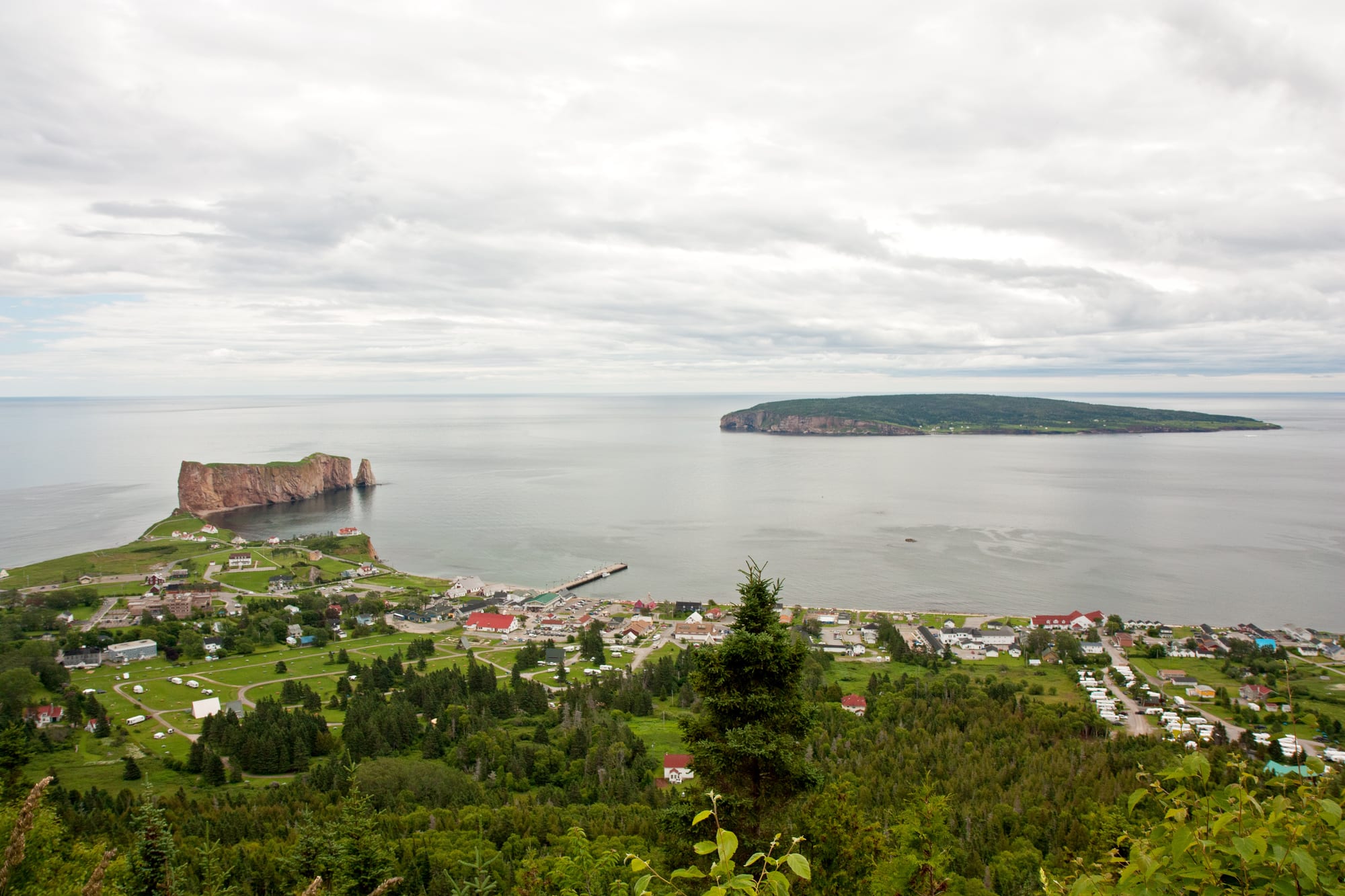
The town of Percé on the shore below a wooded hill, with Percé Rock to the left and Bonaventure Island out at sea under grey cloud

Quebec, Canada

Percé

Percé, Percé Rock and Bonaventure Island seen from Mont Sainte-Anne. (Andrea Schaffer / Wikimedia Commons · CC BY 2.0)

A small town near the tip of the Gaspé Peninsula, facing Percé Rock, a huge limestone arch in the Gulf of St Lawrence, and Bonaventure Island with one of the world's largest gannet colonies. A Mi'kmaq fishing place that became a cod-fishing centre in the 19th century, it now lives mainly on summer tourism.

Neighbourhoods

  • The town centre
    • First-time visitors
    • Views of the rock
    • Boat trips

    The village strung along Route 132 on Percé Bay, facing the rock and the island. The tourist wharf for boat trips, the old Charles Robin buildings, shops, restaurants, the church and the trails up Mont Sainte-Anne are all here, and the streets are busy from mid-June to September.

    Open in Maps
  • L'Anse-à-Beaufils
    • Local life
    • Food and drink
    • Arts

    A small harbour village about 10 km south of the centre, home to an old fish plant turned arts centre and bistro, a microbrewery and a former general store kept as a living museum. It is quieter and more local than the town centre.

    Open in Maps
  • Coin-du-Banc and the northern shore
    • Beaches
    • Quiet

    Scattered communities north of the centre along the coast road, with a long sandy beach; the hiking trail network inland reaches down to it.

    Open in Maps

Things to do

The rock and the island

  • Percé Rocklandmark

    A sheer limestone monolith 433 m long and 88 m high, pierced by a 15 m arch at its seaward end, one of the world's largest natural arches in water; because of rockfalls, visitors are now advised to keep well away from its base.

    Open in Maps
  • Bonaventure Islandpark

    An island of about 4 km² off the coast, reached by boat tours from May to October, home to one of the largest northern gannet colonies in the world, with trails across the island to the colony.

    Open in Maps
  • Île-Bonaventure-et-du-Rocher-Percé National Parkmuseum

    The provincial park created in 1985 to protect the island and the rock; its main interpretation centre is in a restored building in the town known as Le Chafaud.

    Open in Maps

Walks, views and beaches

  • Mont Sainte-Anneviewpoint

    The flat-topped mountain behind the town, climbed by trails from behind St Michael's Church past lookouts, the grotto and the crevasse, with views over the rock, the island and the sea.

    Open in Maps
  • Percé UNESCO Global Geoparkattraction

    A geopark covering the town's whole territory, accredited by UNESCO in 2018 as the first in Quebec, with trails and fossil-bearing rocks.

    Open in Maps
  • Cap-Blanc Lighthouseviewpoint

    A small red-and-white octagonal lighthouse, no longer in service, on the headland about 2.5 km south of the centre.

    Open in Maps
  • Coin-du-Banc beachbeach

    A long sandy beach north of the town centre, one of Percé's two main beaches.

    Open in Maps
  • La Vieille Usineattraction

    An arts centre and bistro in a former fish plant at L'Anse-à-Beaufils, one of the venues of the Percéides film festival.

    Open in Maps

Short trips from the town

  • Forillon National Parkpark

    Quebec's first national park, created in 1970 at the outer tip of the peninsula, with forest, cliffs, salt marshes, dunes and the eastern end of the Appalachians.

    Open in Maps
  • Gaspéattraction

    The town at the tip of the peninsula where Jacques Cartier claimed New France for the French crown in 1534.

    Open in Maps

Seasonal events

  • Les PercéidesAugust

    A film festival launched in 2009, named after the Perseid meteor shower, whose centrepiece is an outdoor screening under the night sky on the town beach.

Eat and drink

Long-standing places and food districts in Percé. Hours, ratings and directions come from your maps app, always current.

Percé classics

  • Seafood restaurants on Route 132neighborhood

    Restaurants along the main road through the centre serve locally caught cod, salmon, scallops, crab, shrimp and lobster.

    Open in Maps
  • Fish chowder on Bonaventure Islandrestaurant

    A restaurant in an old fish storehouse beside the island's landing serves a traditional Gaspé fish chowder flavoured with saffron, as well as lobster and crab sandwiches.

    Open in Maps

Cafés and bars

  • Pub Pit Caribourestaurant

    The town-centre pub of Pit Caribou, a microbrewery based in L'Anse-à-Beaufils whose beers are sold across Quebec.

    Open in Maps
  • Café-Bistro de la Vieille Usinerestaurant

    A bistro in the old fish plant at L'Anse-à-Beaufils cooking with Gaspé seafood, farm produce and local beers.

    Open in Maps

Experience Percé

History

The coast around Percé lies within the homelands of the Mi'kmaq, who called the place Sigsôg, "steep rocks", and Pelseg, "fishing place". Samuel de Champlain sailed past in 1603 and named the great rock Isle Percée, the pierced island. Through the 17th century the bay served mainly as a stopover for ships bound for Quebec, and under New France it was a seasonal fishing station rather than a settlement.

Permanent settlement began in the early 19th century with Irish, French Canadian and Jersey arrivals, and the parish of Saint-Michel-de-Percé was founded in 1801. Percé became the most important fishing place on the Gaspé Peninsula after Charles Robin, a merchant from Jersey, set up his fishing business here; some of the company's old buildings still stand in the town, now part of the national park. During the Second World War the Royal Canadian Navy ran a direction-finding and wireless intercept station at Cap-d'Espoir, taking bearings on German U-boats.

Tourism grew around the rock and the island. In 1971 Percé merged with five neighbouring municipalities and became a town. The national park protecting Bonaventure Island and Percé Rock was created in 1985, and in 2018 UNESCO accredited the Percé Geopark. The rail link to Montreal was suspended in 2013. The rock itself is slowly wearing away, losing an estimated 300 tonnes a year to water and wind, walking out to it at low tide is no longer allowed, and visitors are advised not to approach within 500 m because of the risk of rockfalls.

Culture & Customs

Percé is a member of the association of the Most Beautiful Villages of Quebec, and its identity is bound up with the view: the rock, which from a distance looks like a ship under sail, has long inspired painters, and their work hangs in Le Chafaud, the old waterfront warehouse. Local legend sees a phantom in the rock during storms, the Génie de l'Isle Percée.

The town's people descend from Mi'kmaq, French Canadian, Irish and Jersey families, and French is now the main language. Mont Sainte-Anne behind the town has been a religious site for centuries, with a grotto of the Virgin Mary and a waterfall on the trail.

Summer culture centres on the arts and the outdoors. Les Percéides, a film festival founded in 2009, screens films in August at the art centre and at La Vieille Usine, ending with a gala under the night sky on the beach, named for the Perseid meteor shower that falls at the same time. Birdwatching, whale watching, hiking and diving fill the rest of the season.

Daily Life

Percé had 3,095 residents at the 2021 census, almost unchanged from 2016, in a municipality of more than 430 km² that takes in a string of coastal communities, among them Barachois, Bridgeville, Cap-d'Espoir, Coin-du-Banc and L'Anse-à-Beaufils. It is also the seat of the judicial district of Gaspé.

Tourism is the main economic activity, and the town counts more than 500,000 visitors a year, most of them in the short summer season, when boat operators, restaurants, motels and shops are at full stretch. Fishing built the town in the days of Charles Robin's company, and a microbrewery based in L'Anse-à-Beaufils sells its beer across Quebec.

Life follows the season sharply. From mid-June to September the main street is crowded; outside it, many businesses close and the town returns to a small, quiet community spread along the coast road, where distances to larger towns and services are long and the nearest scheduled flights leave from Gaspé or Bonaventure.

Food

Seafood is what Percé eats. Cod, the fish that founded the town, is still on every menu, alongside salmon, scallops, shrimp, crab and above all lobster, served in summer as whole lobster dinners and in sandwiches. Almost all of it comes from local waters. On Bonaventure Island, a restaurant in an old fish storehouse beside the landing serves an old-style Gaspé fish chowder with a hint of saffron.

Simpler food comes from roadside snack bars selling breaded cod, fish and chips, fried scallops and poutine, chips topped with cheese curds and gravy, and one snack bar is known locally for its seafood pizza. Smoked salmon also appears on local menus, and many places to eat close outside the summer season.

Craft beer has become part of the local table: Pit Caribou, brewed at L'Anse-à-Beaufils, has a pub in the town centre, and the bistro at La Vieille Usine cooks with Gaspé seafood, meat and produce from area farms.

Planning tools

Budget

Percé is the busiest tourist town on the Gaspé, and prices follow the season: rooms and campsites fill and cost most from mid-June to September. The boat trip to Bonaventure Island and park entry are the main extras, and lobster dinners are the big food expense. A car, or the cost of getting one at Gaspé, is the other large item.

Daily Budget Midrange
USD 160–290 (motel or auberge, seafood dinners, the island boat trip and park entry, a hire car)
Daily Budget Shoestring
USD 75–115 (campsite or hostel, groceries and snack bars, hiking the trails)

The views of the rock from the shore and from Mont Sainte-Anne are free; book rooms early for July and August.

Best Time to Visit

The main season runs from mid-June to the end of September, with the warmest weather in July and August and the gannets on Bonaventure Island through the summer. Mid-May to mid-June and late September to mid-October are quieter, with some reduced hours. Many businesses close from mid-October to May.

Suggested Number of Days

Two or three days allow time for the island, the hills and the coast. Allow four to six to add Forillon and the rest of the peninsula; the long drive to reach Percé and the weather for boat trips change the number most.

First Visit
2–3 days
With Surroundings
4–6 days

Transportation

The town centre is small and walkable, but its communities are spread along many kilometres of Route 132, and a car is the practical way to get around and to reach Forillon or Gaspé. Regional buses link Percé with Gaspé and other towns on the peninsula, and Orléans Express coaches stop on the route around the coast.

Distances on the Gaspé are long and services thin; fill the tank before driving between towns, especially outside summer.

Airport & Station Connections

Percé is on Route 132, about 750 km by road from Montreal, roughly eight hours' driving, and about 245 km from the New Brunswick border at Campbellton. The nearest airports with scheduled flights are at Gaspé and Bonaventure, both with car hire; the bus from Gaspé takes about an hour. Passenger trains on the Gaspé line have not run since 2013.

Walkability

The town centre is easy on foot along the waterfront, and the trail network climbs straight from the village into the hills. Outlying communities such as L'Anse-à-Beaufils are several kilometres away along a busy road and are better reached by car or bus.

Safety

Canada is a safe country with low levels of violent crime. In Percé the risks are natural: rockfalls from Percé Rock and the coastal cliffs, cold sea water, sudden fog and wind, and long stretches of road without services.

Keep well away from the base of Percé Rock and cliff edges, follow the boat crews' instructions, and dress warmly on the water. Check current official travel advice before travelling.

Climate

A cool maritime-influenced climate. Summers are mild and July and August are the warmest months; winters are long, cold and snowy. Rain is spread through much of the year.

Summer
mild, cooler than the 20–30°C typical of Montreal and Quebec City
Winter
cold and snowy — in January and February daytime temperatures usually stay below about 3°C

Local Customs

French is the main language, though Percé was settled by Irish and Jersey as well as French Canadian families, and boat tours are narrated in both languages. A greeting of bonjour is appreciated. Tipping of 15–20 per cent is expected in restaurants, and sales tax is added at the till.

Bonaventure Island is a protected bird sanctuary: stay on the trails and keep back from nesting birds.

Common Payment Methods

The currency is the Canadian dollar. Cards and contactless payment are widely accepted, but cash is useful for regional buses and small seasonal businesses; cash totals are rounded to the nearest five cents.