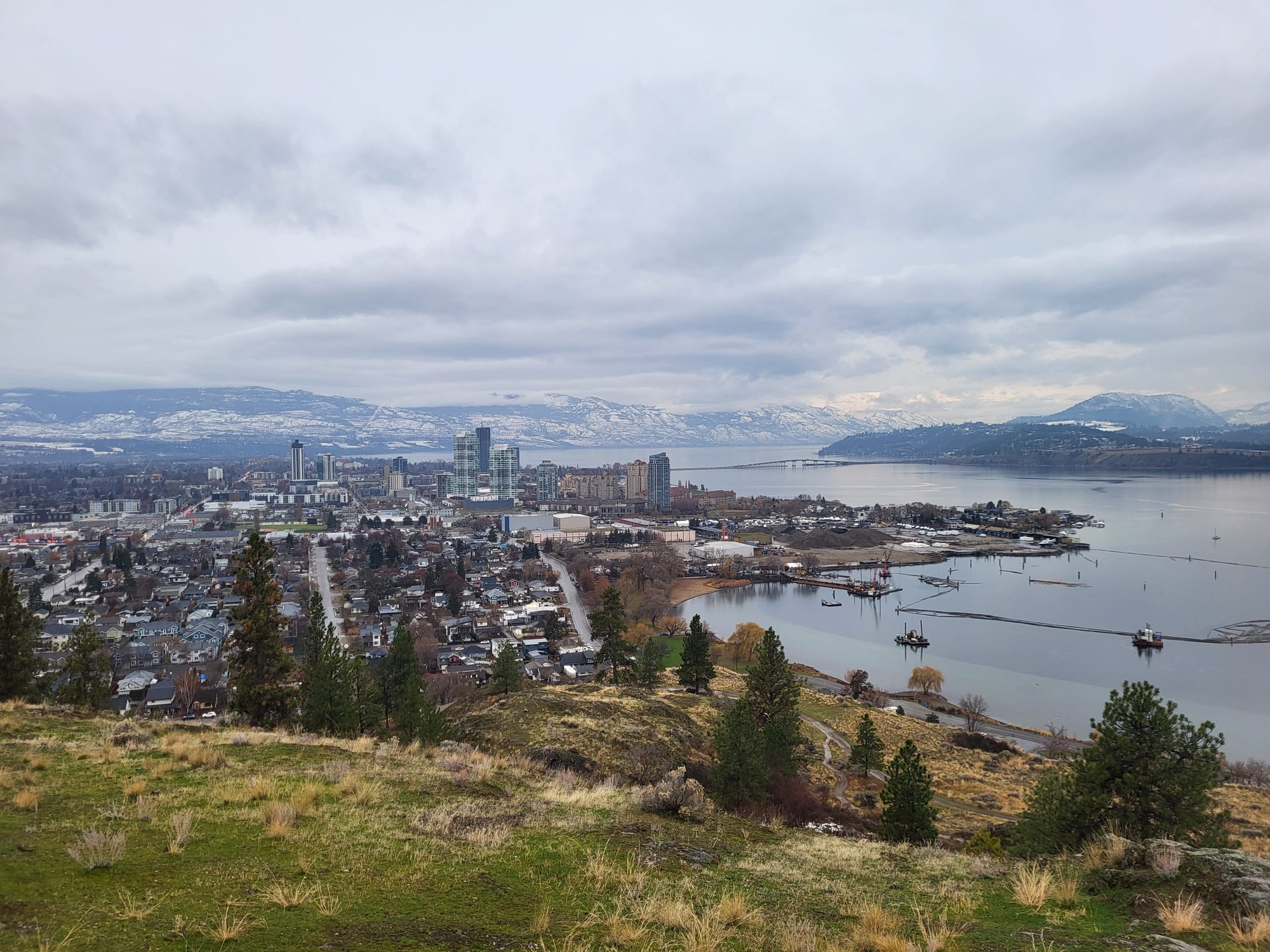
Downtown Kelowna's towers on the shore of Okanagan Lake, with snow-dusted hills beyond, seen from a grassy slope

British Columbia, Canada

Kelowna

Downtown Kelowna and Okanagan Lake from Knox Mountain Park. (Gladgan / Wikimedia Commons · CC BY-SA 4.0)

The largest city of British Columbia's interior, on the east shore of Okanagan Lake in Syilx territory. A mission of 1859 and the orchards that followed made it a fruit town; wine and tourism have since made it the third-largest metropolitan area in the province, with lake beaches, vineyards and a downtown of new towers.

Neighbourhoods

  • Downtown
    • First-time visitors
    • Best for food
    • Waterfront

    The core between the lake and Richter Street, north of Highway 97. Bernard Avenue runs down to the lake with shops and restaurants, and the waterfront has parks, beaches, boardwalks, the marina and Prospera Place arena. New residential towers, the tallest of them 42 storeys, have reshaped the skyline in recent years.

    Open in Maps
  • The Mission
    • Beaches
    • Quiet and residential
    • Families

    The south side of the city, where Father Pandosy founded his mission, once a separate community. The Lower Mission has a commercial centre of shops and cafés, sports grounds and two of the city's most popular beaches, Gyro and Rotary.

    Open in Maps
  • Rutland
    • Local life
    • Quiet and residential

    Kelowna's largest neighbourhood by far, on the north-eastern edge of the core, mostly residential and among the more affordable parts of the city, with its own town centre.

    Open in Maps
  • West Kelowna
    • Wineries
    • Lake views

    A separate city across Okanagan Lake, reached by the bridge, whose slopes hold some of the best-known wineries associated with Kelowna, including Mission Hill and Quails' Gate.

    Open in Maps

Things to do

The lake and the waterfront

  • Okanagan Lakepark

    A lake 135 kilometres long and 4–5 kilometres wide, the centre of summer life for swimming, boating and beaches, and the home of the Ogopogo, the lake monster of local folklore.

    Open in Maps
  • City Parkpark

    The main downtown park on the lakeshore, west of Abbott Street between Bernard Avenue and Harvey Avenue, used for outdoor festivals.

    Open in Maps
  • Gyro Beachbeach

    One of the city's most popular beaches, in the Lower Mission.

    Open in Maps

History and culture

  • Father Pandosy Missionmuseum

    The mission founded by the Oblate missionary Father Pandosy in 1859, the first European settlement in the area, restored as a museum.

    Open in Maps
  • Prospera Placeattraction

    The downtown arena of the Kelowna Rockets of the Western Hockey League, winners of the Memorial Cup in 2004.

    Open in Maps

Hills and trails

  • Knox Mountain Parkpark

    A 235-hectare natural park just north of downtown with ten trails and two lookouts over the city and the lake; the summit can also be reached by car.

    Open in Maps
  • Myra Canyon trestlestrail

    On the Kettle Valley Railway line in the hills above the city, 18 wooden trestles and two tunnels cross Myra Canyon; 12 of the trestles burned in the 2003 fire and were rebuilt, and the route is now a cycling and walking trail.

    Open in Maps
  • Kettle Valley Rail Trailtrail

    A multi-use trail on the abandoned Kettle Valley Railway, developed in the 1990s, of which the Myra Canyon section is one of the most popular.

    Open in Maps
  • Bear Creek Provincial Parkpark

    A 178-hectare provincial park on the west side of Okanagan Lake, north-west of the city.

    Open in Maps

Wineries

  • Mission Hill Family Estateattraction

    A winery in West Kelowna set on top of Mission Hill, overlooking the lake, mountains and vineyards.

    Open in Maps
  • Quails' Gate Wineryattraction

    A lakeshore winery in Westbank known for its Pinot Noir and Chardonnay, with a wine shop and restaurant.

    Open in Maps

Eat and drink

Long-standing places and food districts in Kelowna. Hours, ratings and directions come from your maps app, always current.

Food districts

  • Bernard Avenueneighborhood

    Downtown's main street from Richter Street to the lake, lined with cafés and restaurants for locals and visitors.

    Open in Maps
  • Lower Missionneighborhood

    The southern commercial centre near the beaches, with coffee shops and casual places to eat.

    Open in Maps

Wine country

  • Quails' Gate Old Vines Restaurantrestaurant

    The restaurant of a lakeshore winery best known for Pinot Noir and Chardonnay.

    Open in Maps
  • Kelowna's wineriesneighborhood

    More than twenty wineries in and around the city, from some of the biggest names in BC wine to small boutique producers, many with tasting rooms.

    Open in Maps

Experience Kelowna

History

The Syilx (Okanagan) people are the first known inhabitants of the valley and still live there; the city's name comes from their word kiʔláwnaʔ, a grizzly bear. In 1859 Father Pandosy, a French Roman Catholic Oblate missionary, became the first European to settle, founding a mission at a sandy bay he called l'Anse au Sable. Fruit growing spread in the 1870s, and by the 1890s commercial agriculture was firmly established.

Kelowna was incorporated on 4 May 1905 with a population of 600; by 1909 about 15 per cent of its people were Chinese, and a Chinatown stood downtown until its last traditional business closed in 1978. For most of the 20th century the town lived on orchards, packing houses and the lake, and Sun-Rype, the fruit juice and snack maker, grew up here. A three-lane floating bridge carried traffic across the lake until the W. R. Bennett Bridge replaced it in 2008 to ease summer congestion.

Wildfire has repeatedly shaped modern Kelowna. In August 2003 the Okanagan Mountain Park fire destroyed 239 homes, forced the evacuation of about 30,000 residents and burned 12 of the 18 Myra Canyon trestles, which were later rebuilt. Further fires followed, and in August 2023 the McDougall Creek fire on the west side of the lake forced evacuation orders for more than 2,400 properties, with embers carried across the water to the city. Meanwhile the wine industry, tourism and new residents have made Kelowna the largest city of the interior.

Culture & Customs

Kelowna's identity is bound up with the lake and the valley. Summer means beaches, boats and lakeside parks, and the Ogopogo, the monster said to live in Okanagan Lake, has been traced by some scholars to First Nations and water-monster folklore. The valley's vineyards have earned international recognition, and with its climate and scenery the area is often compared to California's Napa Valley.

Sport centres on the Kelowna Rockets of the Western Hockey League, who won the Memorial Cup in 2004 and play at Prospera Place downtown. The Kelowna Art Gallery, the film festivals and outdoor events in City Park make up much of the cultural calendar, and the University of British Columbia's Okanagan campus and Okanagan College bring a student population. Hiking and cycling on Knox Mountain and the Kettle Valley trails are local habits.

Its moderate size makes it a common place for national businesses to test new products. Debates over growth — sprawl along the highways, the new downtown towers, housing costs and how to live with fire — run through local politics.

Daily Life

Kelowna had about 166,000 people in the city proper and about 255,000 in the metropolitan area in 2025, making it British Columbia's third-largest metropolitan area after Vancouver and Victoria. The city covers 214 square kilometres, spreading from the lakeshore up the surrounding slopes.

Tourism is a billion-dollar industry for the area and the service industry employs the most people, while wine, fruit processing and education also play a part; Okanagan College and the University of British Columbia's campus each have more than 8,000 students. Housing is a defining problem: Kelowna has been rated one of the least affordable housing markets in Canada. After decades of suburban expansion into the hills, the city has encouraged density downtown, and new high-rises have transformed the skyline.

Daily life is car-based, with commuting along Highway 97 and across the bridge, and shopping in Midtown's big-box centres and Orchard Park. Summer evenings are spent at the beaches and parks, winters on the ski hills nearby, and each summer residents watch the hills and the air-quality reports during fire season.

Food

The Okanagan's food is its fruit and its wine. Orchards surround the city, and fruit growing has shaped the valley since commercial agriculture took hold in the 1890s; Sun-Rype, the fruit juice and fruit-bar maker, is a Kelowna company. Wineries in and around the city make Pinot Gris, Pinot Noir, Merlot and icewine, and Quails' Gate, on the west shore, is known for its Pinot Noir and Chardonnay.

Wine tourism shapes the local table. Many wineries have restaurants or patios among the vines, and the harvest season from September to November brings visitors for tastings. Downtown, Bernard Avenue has the greatest concentration of cafés and restaurants, and the Lower Mission has a second cluster near the beaches.

Fruit came first: for most of the 20th century the little wine made in the Okanagan was mostly fruit wine from berries, apples and cherries. Beyond wine, the valley's food is largely its own produce, and a summer meal in Kelowna is often as simple as local fruit eaten by the lake.

Planning tools

Budget

Kelowna is cheaper than Vancouver or Whistler, but summer, when the lake and beaches are busiest, and the harvest weekends push up room prices. Wine tours and tastings are the main extra cost; a car makes the wineries and trails far easier to reach.

Daily Budget Midrange
USD 200–340 (mid-range hotel, restaurant meals, winery tastings or a wine tour, a hire car)
Daily Budget Shoestring
USD 90–140 (hostel or budget motel, self-catering, buses, beaches and trails)

At peak times rooms in Penticton or the smaller lake towns can be cheaper than in Kelowna.

Best Time to Visit

July and August are hot, dry and sunny, ideal for the lake and beaches but busy, and sometimes smoky in fire seasons. September to November is the wine season, when many visitors come to taste the harvest. Winters are cold and grey but mild for the interior, with skiing in the hills nearby.

Suggested Number of Days

Two or three days covers the city, the lakeshore and a few wineries. Four or five allow for the trails above town and the rest of the Okanagan valley. Wine tours and lake time tend to stretch a stay.

First Visit
2–3 days
With Surroundings
4–5 days

Transportation

The Kelowna Regional Transit System runs buses through Kelowna, West Kelowna, Lake Country and Peachland, but the city is spread out — greater Kelowna covers slightly more land than Metro Vancouver — and most visitors drive. Highway 97 runs through the city and across the lake on the bridge; Highway 33 heads east into the hills.

Use a tour, a taxi or a designated driver for winery visits; buses are, at most hours, the only public transport across the lake.

Airport & Station Connections

Kelowna International Airport, one of the busiest in Canada, is about 11.5 kilometres north-east of the city on Highway 97, roughly ten minutes' drive, with flights from Vancouver, Calgary, Toronto, Seattle and other cities. By road the Okanagan is roughly four to five hours' drive east of Vancouver, and intercity buses link Kelowna with Vancouver, Kamloops and Penticton.

Walkability

Downtown is walkable, with Bernard Avenue, City Park and a lakeshore boardwalk close together. Beyond it the city sprawls along highways and big-box strips, and the Mission, the wineries and the trails need a car, a bike or a bus.

Safety

Canada is a safe country with low levels of violent crime. The city has declared a small downtown area a 'red zone' of drug trafficking, assaults and robberies. The larger risk is wildfire: fires in 2003 and 2023 destroyed buildings and forced mass evacuations, and smoke can fill the valley in summer.

Check wildfire and air-quality bulletins in summer, follow evacuation orders, take care on the lake in small boats, and keep valuables out of sight in parked cars. Check current official travel advice before travelling.

Climate

Hot, dry, sunny summers and cold but relatively mild winters for the interior, with an average in the coldest month a little below freezing.

Summer
hot and dry, typically reaching the high 30s °C for at least a few days each summer; the record is 45.7°C, set in June 2021
Winter
cold and often grey, with the coldest month averaging between −3°C and 0°C

Local Customs

Tipping of 15–20 per cent is expected in restaurants and taxis, and sales tax is added at the till. Dress is casual. Kelowna is on the land of the Syilx people, and its name comes from the Okanagan word kiʔláwnaʔ, a grizzly bear.

Ask before photographing people, and respect private orchard and vineyard land.

Common Payment Methods

The currency is the Canadian dollar. Cards and contactless payment are accepted almost everywhere, including at wineries, and cash is rarely needed; cash totals are rounded to the nearest five cents.