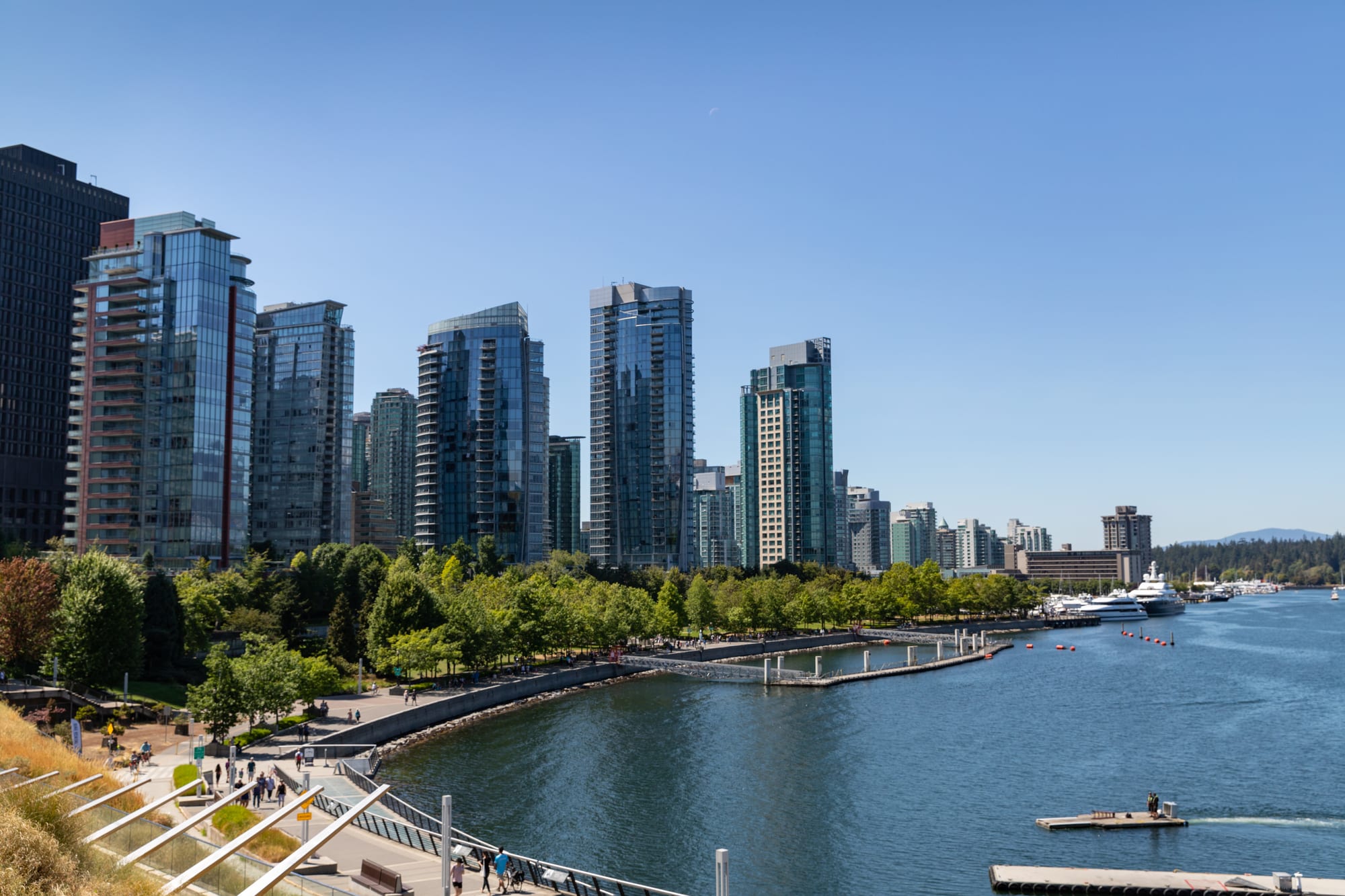
Glass apartment towers above a tree-lined seawall path on Coal Harbour, with moored yachts and calm blue water

British Columbia, Canada

Vancouver

The towers of Coal Harbour and the waterfront path on Burrard Inlet, Vancouver. (dronepicr / Wikimedia Commons · CC BY 2.0)

British Columbia's largest city, on a peninsula between Burrard Inlet and False Creek with the North Shore Mountains rising behind it. A sawmill settlement became the Canadian Pacific Railway's terminus in 1886, and the port made it rich. Today it is Canada's most densely populated city, home to large Asian communities, a film industry and some of the most expensive housing in North America.

Neighbourhoods

  • Downtown and Coal Harbour
    • First-time visitors
    • Close to public transport
    • Waterfront

    The business district on the peninsula, with Robson Square, the Vancouver Art Gallery, Canada Place and the cruise terminal, and Waterfront station for the SkyTrain and the SeaBus. Coal Harbour's glass towers line the inlet towards Stanley Park, with a waterfront path along the shore.

    Open in Maps
  • Gastown
    • Historic district
    • Nightlife
    • Best for food

    The original settlement that grew into the city, now a national historic site of brick and stone buildings on Water Street, with restaurants, bars and shops and the steam clock built in 1977. It forms the north-western part of the Downtown Eastside, where poverty, homelessness and drug use are concentrated a few blocks away.

    Open in Maps
  • Chinatown
    • Historic district
    • Culture

    Canada's largest Chinatown, centred on Pender Street, with the Dr. Sun Yat-Sen Classical Chinese Garden. It remains one of the largest historic Chinatowns in North America, though it has declined as newer Chinese arrivals settled elsewhere in the region.

    Open in Maps
  • West End
    • Beaches
    • Quiet and residential
    • LGBTQ+ community

    A dense residential district of apartment towers and tree-lined streets between the business district, Stanley Park and English Bay. Its beaches and the seawall are a short walk away, and Davie and Denman streets are lined with restaurants.

    Open in Maps
  • Yaletown
    • Best for food
    • Nightlife

    A former district of warehouses and rail yards on False Creek, transformed since Expo 86 into one of the most densely populated parts of the city, with restaurants and bars in the old loading-dock buildings.

    Open in Maps
  • Kitsilano
    • Beaches
    • Quiet and residential

    A largely residential neighbourhood on the south shore of English Bay, named after the Squamish chief August Jack Khatsahlano. West 4th Avenue and West Broadway are its shopping streets, and Kitsilano Beach is one of the city's most popular.

    Open in Maps
  • Mount Pleasant and Main Street
    • Best for food
    • Bars
    • Local life

    A once working-class district that has gentrified since the 1990s, especially around Main Street and Broadway. Along Main Street it mixes shops with light industry, brewing and high-density housing.

    Open in Maps
  • Commercial Drive
    • Best for food
    • Local life

    'The Drive', the main street of Grandview–Woodland in East Vancouver, long a home for immigrants with strong Italian roots. Edwardian buildings hold cafés, ethnic and vegetarian restaurants and alternative shops, and the street hosts its own festivals.

    Open in Maps

Things to do

Landmarks and views

  • Canada Placelandmark

    The waterfront building with fabric roofs shaped like sails, built as Canada's pavilion for Expo 86 and now the convention centre and the terminal for cruises to Alaska.

    Open in Maps
  • Harbour Centreviewpoint

    A 1977 office tower near Waterfront station topped by the Lookout, a 360-degree viewing deck over the city, the inlet and the mountains.

    Open in Maps
  • Dr. Sun Yat-Sen Classical Chinese Gardenpark

    In Chinatown, the first Chinese garden built outside Asia, with a free public park beside a walled garden that charges admission.

    Open in Maps

Museums

  • Museum of Anthropology at UBCmuseum

    On the University of British Columbia campus, a teaching and research museum of world arts and cultures, above all the works of the First Nations of the Pacific Northwest.

    Open in Maps
  • Vancouver Art Gallerymuseum

    The largest art museum in Western Canada by building size, in Francis Rattenbury's former provincial courthouse beside Robson Square.

    Open in Maps
  • Vancouver Maritime Museummuseum

    Opened in 1959 in Vanier Park at the mouth of False Creek, covering the maritime history of Vancouver and the Canadian Arctic.

    Open in Maps
  • Science Worldmuseum

    An interactive science centre at the eastern end of False Creek, in the geodesic building put up as the Expo Centre for Expo 86.

    Open in Maps
  • Vancouver Aquariumattraction

    A public aquarium in Stanley Park that is also a centre for marine research, conservation and the rescue of marine mammals.

    Open in Maps

Parks, gardens and the waterfront

  • Stanley Parkpark

    A 405-hectare forested park filling the north-western half of the downtown peninsula, the city's first park, used by Indigenous peoples for thousands of years and about a fifth larger than New York's Central Park.

    Open in Maps
  • The Seawalltrail

    A walking and cycling path that began as a stone wall around Stanley Park and now runs for about 30 kilometres from CRAB Park around the park and False Creek to Spanish Banks.

    Open in Maps
  • Kitsilano Beachbeach

    A beach on English Bay in Kitsilano, one of the most popular in the city, with views back to the downtown towers.

    Open in Maps
  • Queen Elizabeth Park and Bloedel Conservatorypark

    A park on Little Mountain, about 125 metres above sea level, laid out in former basalt quarries; the domed Bloedel Conservatory at the top, opened in 1969, holds around 500 exotic plants and flowers and more than a hundred free-flying tropical birds.

    Open in Maps
  • VanDusen Botanical Gardenpark

    A botanical garden in Shaughnessy, named after the lumberman and philanthropist Whitford Julian VanDusen.

    Open in Maps
  • Pacific Spirit Regional Parkpark

    An 860-hectare forest around the UBC campus at Point Grey, with more than 55 kilometres of walking trails.

    Open in Maps

Markets

  • Granville Islandmarket

    A former industrial peninsula under the Granville Street Bridge, now a public market, artists' studios and workshops, theatres and a marina, reached by small False Creek ferries.

    Open in Maps

Sport and nights out

  • BC Placeattraction

    The stadium with a retractable roof on False Creek, home of the BC Lions and the Whitecaps, Olympic stadium in 2010 and host of seven matches of the 2026 FIFA World Cup.

    Open in Maps
  • Rogers Arenaattraction

    The downtown arena of the Vancouver Canucks ice hockey team, opened in 1995, which staged the ice hockey of the 2010 Winter Olympics.

    Open in Maps

The North Shore

  • Lonsdale Quaytransit hub

    The SeaBus terminal in North Vancouver, beside the Lonsdale Quay Market, reached by the passenger ferry across Burrard Inlet from Waterfront station.

    Open in Maps
  • Capilano Suspension Bridgeattraction

    A privately run suspension bridge 140 metres long and 70 metres above the Capilano River, which draws more than a million visitors a year.

    Open in Maps
  • Lynn Canyon Parkpark

    A municipal park in North Vancouver with a free suspension bridge over the canyon and forest trails, including part of the Baden-Powell Trail.

    Open in Maps
  • Grouse Mountainviewpoint

    One of the North Shore Mountains, over 1,200 metres high, with a ski area that looks out over Metro Vancouver.

    Open in Maps

Seasonal events

  • Vancouver International Jazz Festivalsummer

    Held every summer since 1985, the largest jazz festival in British Columbia, with concerts in parks, halls, clubs, plazas and neighbourhood streets.

  • Vancouver Pridesummer

    A Pride festival whose parade is the largest parade of any kind in Western Canada.

  • Vancouver Fringe FestivalSeptember

    An alternative theatre festival founded in 1985, with main-stage shows chosen by drawing names from a hat, mostly on and around Granville Island.

  • Vancouver International Film Festivallate September to early October

    A two-week festival that is among the five largest in North America, showing features, shorts and documentaries from around 70 countries.

Eat and drink

Long-standing places and food districts in Vancouver. Hours, ratings and directions come from your maps app, always current.

Vancouver classics

  • Japadogrestaurant

    A small chain of street stands and restaurants that began in Vancouver, selling hot dogs topped with Japanese flavours such as okonomiyaki, yakisoba, teriyaki and tonkatsu.

    Open in Maps
  • Sushi and the BC rollneighborhood

    Sushi restaurants are found all over the city, and many serve the BC roll, an inside-out roll of barbecued salmon and cucumber that is a local speciality.

    Open in Maps

Food districts and markets

  • Granville Island Public Marketmarket

    The covered market on Granville Island, with fish and produce stalls, bakeries and food counters beside the water.

    Open in Maps
  • Chinatownneighborhood

    The historic Chinese quarter around Pender and Main streets, with Cantonese restaurants, bakeries and shops.

    Open in Maps
  • Commercial Driveneighborhood

    East Vancouver's café street, with European-style cafés and a high proportion of ethnic and vegetarian restaurants.

    Open in Maps
  • Richmond's Chinese restaurantsneighborhood

    The neighbouring city by the airport, where most residents are of East Asian descent; the restaurant-lined strip malls of Alexandra Road are known as 'food street'.

    Open in Maps

Cafés and bars

  • Main Streetneighborhood

    The stretch of Main Street through Mount Pleasant, a district that mixes shops with light industry, brewing and housing.

    Open in Maps

Experience Vancouver

History

The Squamish, Musqueam and Tsleil-Waututh peoples, all Coast Salish, have lived here for thousands of years, with villages in what are now Stanley Park, False Creek, Kitsilano, Point Grey and near the mouth of the Fraser River. The first European settlement within today's city was a farm on the Fraser in 1862. In 1867 Edward Stamp's Hastings Mill began cutting timber on Burrard Inlet, and the settlement that grew around the tavern of "Gassy Jack" beside it became known as Gastown.

In 1884 the site, with its natural harbour, was chosen as the western terminus of the Canadian Pacific Railway. The city was incorporated in April 1886 and named after George Vancouver; that June the Great Vancouver Fire razed it, and it was quickly rebuilt. From about 1,000 people in 1881 it grew to more than 100,000 by 1911, living first on logging and then on the port, which was its largest economic sector by the 1930s. During the Second World War the city's Japanese Canadians were interned or deported.

Expo 86 drew more than 20 million visitors and left Canada Place and the SkyTrain behind it; the Expo lands on False Creek and old industrial Yaletown filled with apartment towers. Immigration from Hong Kong and later mainland China reshaped the city, and in 2010 Vancouver hosted the Winter Olympics with Whistler. Since 2002 the city has followed a harm-reduction approach to drug use, including Insite, at the time North America's only legal supervised injection site. In 2026 BC Place hosted seven matches of the FIFA World Cup.

Culture & Customs

Vancouver is one of the most diverse cities in Canada. In the 2021 census 42 per cent of residents were born abroad, mainland China, the Philippines and Hong Kong being the main countries of origin, and only about half grew up speaking English; Cantonese is the next most common mother tongue. Chinese-language daily newspapers serve the city, and Vancouver's Hong Kong community has produced several Cantopop stars. The Musqueam, Squamish and Tsleil-Waututh had villages across what is now the city, and Squamish-language road signs along the Sea-to-Sky Highway carry the Squamish name for Vancouver.

The city is a major film and television centre, nicknamed "Hollywood North", and its cultural year is built around festivals: jazz in summer, the Pride parade, the largest in Western Canada, the Fringe on Granville Island and the Vancouver International Film Festival each autumn. Granville Island and the theatres of the downtown core are the centres of live performance.

Sport and the outdoors shape local identity. The Canucks play ice hockey at Rogers Arena, the BC Lions and the Whitecaps football at BC Place, and on a fine day much of the city is out on the seawall, on the beaches or on the North Shore trails. Vancouverites tend to be casual, environmentally minded and polite, and the protection of parks, rapid transit rather than freeways and harm reduction have broad support across the political spectrum.

Daily Life

About 662,000 people lived in the city at the 2021 census, and about 2.6 million in Greater Vancouver, Canada's third-largest metropolitan area. The city is the most densely populated in the country, packed into a small area of towers downtown and in the West End, with older houses and low-rise streets across the East and West sides.

The Port of Vancouver is Canada's largest and busiest, and the city has added film and television, software, video games, animation and tourism to its older timber and shipping trades. Housing is the defining issue: Vancouver is one of the most expensive cities in Canada and in the world for housing. Homelessness reached its highest recorded level in a 2019 count, and the Downtown Eastside, a few blocks from Gastown, remains the centre of the city's poverty and drug crisis.

The rhythm of the day is relaxed. Car ownership and commuting distances have fallen since the 1990s as more people take the SkyTrain, buses or bicycles, and evenings and weekends are spent on the seawall, at the beaches or up the local mountains. Ken Sim was elected mayor in the 2022 municipal election.

Food

Vancouver's food rests on the Pacific and on Asia. Salmon and crab are British Columbia's signature seafood, and the large Cantonese-speaking community, in the city and in neighbouring Richmond, supports Cantonese cooking such as dim sum. Sushi is everywhere, and the BC roll, an inside-out roll with barbecued salmon, is a local speciality. The Vancouver-based Japanese chef Hidekazu Tojo created it in 1974, using salmon skin in place of the traditional eel, which was hard to obtain on the West Coast.

The city's own street food is the Japadog, a hot dog dressed with Japanese-style toppings such as okonomiyaki, yakisoba or teriyaki, sold from street stands and restaurants. Granville Island's public market sells fish, produce and baked goods, and Commercial Drive mixes European-style cafés with ethnic and vegetarian restaurants. Kitsilano's West 4th Avenue and West Broadway are known for their shops, restaurants and organic food markets.

Drink is local too: brewing is part of Mount Pleasant's mix, and wine lists draw on the Okanagan valley, some four to five hours' drive inland.

Planning tools

Budget

Vancouver is one of Canada's most expensive cities. Hotels are the main cost, high all year and highest in summer and for big events and cruise season. Food can be cheap — noodle shops, dim sum and market lunches — and the SkyTrain, buses and SeaBus mean a car is not needed in the city.

Daily Budget Midrange
USD 220–380 (mid-range hotel, restaurant meals, museum and attraction tickets, transit or the odd taxi)
Daily Budget Shoestring
USD 95–150 (hostel dorm, market and noodle-shop meals, SkyTrain, buses and SeaBus)

Many of the city's best things are free: the seawall, Stanley Park, the beaches, Lynn Canyon and wandering Granville Island.

Best Time to Visit

June to September is the driest and sunniest time, with the festivals, beaches and long evenings on the seawall, and also the busiest and most expensive. Late September and October are quieter. Winter is mild but wet, and the local mountains open for skiing.

Suggested Number of Days

Three or four days covers the city itself. Allow five to seven to add the North Shore mountains and a trip up the coast or across to Vancouver Island. Rainy weather and a love of the outdoors both tend to lengthen a stay.

First Visit
3–4 days
With Surroundings
5–7 days

Transportation

TransLink runs the SkyTrain — the Expo, Millennium and Canada lines — plus buses, the SeaBus ferry to North Vancouver and the West Coast Express commuter train. Small ferries cross False Creek to Granville Island. The city deliberately built rapid transit instead of freeways, and a citywide network of bicycle lanes and routes is used all year.

Mobi, the city's bike-share scheme, is an easy way to ride the seawall.

Airport & Station Connections

Vancouver International Airport is on Sea Island in Richmond, about 12 kilometres from downtown, and the Canada Line SkyTrain runs from the terminals straight into the city. BC Ferries sails to Vancouver Island from Tsawwassen, south of the city, and Canada Place is the cruise terminal for Alaska voyages. Long-distance buses come in from the interior and from Calgary.

Walkability

The downtown peninsula is compact and very walkable — the business district, Gastown, Chinatown, Yaletown and the West End all sit within it, and the seawall links them to Stanley Park and False Creek. Kitsilano, Main Street and Commercial Drive are best reached by bus or SkyTrain. Rain is the main obstacle on foot.

Safety

Canada is a safe country with low levels of violent crime. Vancouver's crime rate has fallen over the years. The Downtown Eastside, next to Gastown and Chinatown, has concentrated poverty, homelessness and drug use, linked to the province's toxic-drug crisis. Car break-ins are common.

Leave nothing visible in a parked car, keep an eye on belongings on busy streets and transit, and watch the tide and cold water on beaches. Check current official travel advice before travelling.

Climate

One of Canada's mildest climates: summers are dry and sunny, winters are cool, cloudy and wet with little snow. Rainfall rises sharply from the airport towards the mountains — North Vancouver gets far more than Richmond.

Summer
dry and mild — the daily maximum averages about 22°C in July and August, and 30°C is rare
Winter
cool, grey and rainy, around 0–8°C on the British Columbia coast; snow falls on about nine days a year on average and seldom lasts

Local Customs

Tipping of 15–20 per cent is expected in restaurants and taxis, and sales tax is added at the till. Dress is casual, even in offices and good restaurants. The city stands on the territory of the Musqueam, Squamish and Tsleil-Waututh peoples. Queuing is orderly, and cyclists and pedestrians expect space on the seawall.

Identification may be asked for when buying alcohol; ask before photographing people, and treat totem poles and Indigenous ceremonies with respect.

Common Payment Methods

The currency is the Canadian dollar. Cards and contactless payment are accepted almost everywhere, including on transit, and cash is rarely needed. Cash totals are rounded to the nearest five cents. ATMs are plentiful.