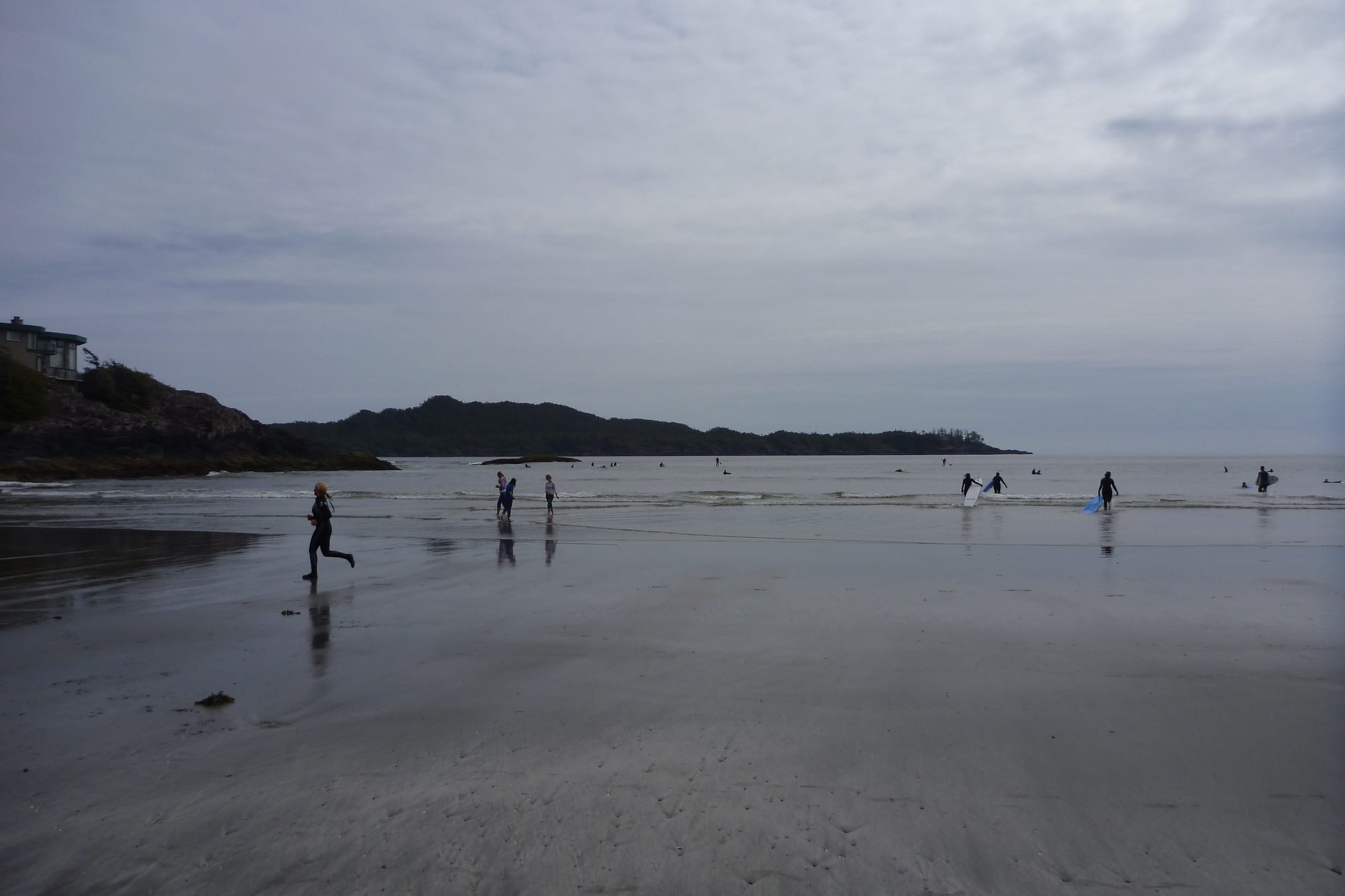
Surfers in wetsuits wading into low surf on the wide, wet sand of Chesterman Beach under a grey sky

British Columbia, Canada

Tofino

Surfers on Chesterman Beach, south of Tofino. (Shaundd / Wikimedia Commons · CC BY-SA 3.0)

A small town at the end of Highway 4 on Vancouver Island's west coast, on the tip of the Esowista Peninsula at the edge of Clayoquot Sound, in Tla-o-qui-aht territory. Once a fishing and logging village reached only by sea, air or a gated logging road, it became the centre of the 1990s logging protests and is now a year-round base for surfing, whale watching and storm watching.

Neighbourhoods

  • The town and harbour
    • First-time visitors
    • Best for food
    • Boat trips

    The village at the tip of the peninsula, facing the islands of Clayoquot Sound and the Tla-o-qui-aht village of Opitsaht across the harbour. Restaurants, shops, galleries and the docks for whale-watching boats, water taxis and floatplanes are all within a few streets.

    Open in Maps
  • The beaches south of town
    • Beaches
    • Surfing
    • Storm watching

    The long sandy beaches along the open Pacific between the town and the national park — MacKenzie Beach, Chesterman Beach and Cox Bay — lined with lodges and holiday homes in the forest. A walking and cycling path runs from town as far as Cox Bay.

    Open in Maps
  • Long Beach and Pacific Rim
    • Beaches
    • Nature

    The national park reserve's largest beach on Wickaninnish Bay, between Tofino and Ucluelet, with campgrounds and picnic areas but no town; the highway runs behind it for its whole length.

    Open in Maps

Things to do

Beaches

  • Long Beachbeach

    The largest and longest beach in Pacific Rim National Park Reserve, exposed to the open Pacific, whose consistent surf made it one of the earliest and most popular surfing spots in British Columbia.

    Open in Maps
  • Chesterman Beachbeach

    About five kilometres from the town centre, partly sheltered by offshore islands, and the usual beach for beginner surfers.

    Open in Maps

Parks and the sound

  • Clayoquot Soundpark

    The sound of inlets and forested islands north of the town, a UNESCO Biosphere Reserve since 2000, travelled by whale-watching boats, kayaks and water taxis.

    Open in Maps
  • Meares Islandpark

    The island across the harbour, reached by boat or water taxi, home of the Tla-o-qui-aht village of Opitsaht; since 2024 much of it has been protected as conservancies.

    Open in Maps
  • Vargas Island Provincial Parkpark

    A provincial park on the west side of Vargas Island, north-west of Tofino, created under the Clayoquot land-use decision of 1995.

    Open in Maps
  • Flores Islandpark

    A large island in the sound, home to the Ahousaht village of Marktosis and one of the largest tracts of old-growth forest on Vancouver Island, reached by water taxi or floatplane.

    Open in Maps

Short trips: Pacific Rim

  • Pacific Rim National Park Reservepark

    A 511-square-kilometre national park reserve opened in 1971, in three separate units; the Long Beach unit of beaches, rainforest and short trails lies south of town along Highway 4, around the Tofino-Long Beach Airport.

    Open in Maps

Seasonal events

  • Pacific Rim Whale FestivalMarch

    Exhibitions, films and tours in Tofino and Ucluelet celebrating the spring migration of thousands of grey whales.

  • Queen of the Peaklate September

    A women's surf championship held toward the end of September.

Eat and drink

Long-standing places and food districts in Tofino. Hours, ratings and directions come from your maps app, always current.

Food in Tofino

  • Restaurants in the town centreneighborhood

    For a town of its size Tofino has drawn many chefs, and the town has a growing choice of restaurants and speciality food shops.

    Open in Maps
  • Cafés along the beach roadneighborhood

    Places to eat along the road south towards the surf beaches, from a visitor-centre café to lodge dining rooms.

    Open in Maps

Experience Tofino

History

Tofino lies in the traditional territory of the Tla-o-qui-aht, one of the Nuu-chah-nulth peoples, whose main village, Opitsaht, across the harbour, is believed to have been lived in for at least 2,000 years; people have occupied Clayoquot Sound for some 4,200. In 1788 the British trader John Meares reported seeing about 800 people gathered in a single longhouse of Chief Wickaninnish. Spanish and British ships began a trade in sea-otter pelts, and in 1854 a trading post on Stubbs Island became the first permanent non-Indigenous settlement. A townsite was laid out on the tip of the peninsula in 1900, and the settlement took its name from nearby Tofino Inlet when the Tofino post office opened in 1909; it was incorporated in 1932.

Fishing and logging sustained the town. From 1917 Japanese Canadian fishermen settled here, forming more than a third of the population by the 1930s, until in March 1942 ninety-five of them were removed from the government wharf; in 2019 the mayor formally apologised. A road to Port Alberni opened in 1959, bringing surfers from the mid-1960s, a counterculture community at Wreck Bay and growing crowds at Long Beach, which became part of Pacific Rim National Park in 1971.

In the 1980s and 1990s Tofino was the focus of protests against old-growth logging in Clayoquot Sound, beginning with Meares Island and culminating in the blockades of 1993, when more than 800 people were arrested. The dispute contributed to the Sound's designation as a UNESCO Biosphere Reserve in 2000. Since the 1990s tourism has become the dominant industry, and Tofino became a resort municipality in 2008.

Culture & Customs

Tofino's culture grew out of the meeting of Nuu-chah-nulth communities, fishing families and the young surfers, artists and back-to-the-land settlers who arrived after the road opened. The Tla-o-qui-aht declared Meares Island a Tribal Park in 1984, and First Nations presence and art remain central to the town's identity.

Surfing is the town's sport and calling card. A local surf culture began in the 1960s, and since the 1990s it has become a large part of the economy, with locally raised competitors reaching international level and surf schools, including a women's school, teaching beginners on the sheltered beaches. The Queen of the Peak women's championship is held each autumn. The Pacific Rim Whale Festival each March celebrates the grey whale migration with exhibitions, films and tours.

Environmentalism runs deep. The protests of the 1990s left a strong conservation ethic, and debates over growth — water supply, sewage treatment and the spread of upscale lodges — are a regular part of local politics. The pace is relaxed, the dress is wetsuits and rain jackets, and winter storms are treated as a spectacle rather than a nuisance.

Daily Life

Tofino had about 2,500 residents at the 2021 census, up by more than a quarter in five years, but its summer population swells to many times its winter size, and the region receives several hundred thousand visitors a year.

Tourism drives almost everything: lodges and holiday rentals, restaurants, surf schools, whale-watching and fishing charters, floatplane operators and guiding. As of 2024 the tourism sector was estimated to generate about $657 million a year. Once dependent on fishing and logging, the town has had to grow its infrastructure fast; a severe drought in 2006 strained the water supply, and construction of a new wastewater treatment plant began in 2022, after years of discharging untreated sewage into the sea.

Life follows the seasons and the tides. Summer is busy, with campers, surfers and day-trippers along the beaches; winter is quiet, the town given over to locals, storm-watchers and surfers in thick wetsuits. Water taxis link the town to Ahousaht, Hot Springs Cove and other communities of the sound, and the long road over the mountains to Port Alberni is the only land route out.

Food

Tofino's food starts with the sea. Salmon, halibut, spot prawns and Dungeness crab are staples of coastal menus in British Columbia, and salmon remains central to First Nations food and ceremony. Despite its size, the town has attracted many chefs and food professionals, and its restaurants and speciality shops are out of all proportion to its population.

For fourteen years the first weekend of June brought the Tofino Food and Wine Festival, which showcased British Columbia wines and the creations of Tofino chefs. Casual food fits a surf town, and food trucks and cafés sit alongside the more formal dining rooms of the town and the beach lodges.

Drink follows the province's pattern of craft beer and cider, with wines from the Okanagan and Vancouver Island. Bannock, a simple fried or baked bread, is served at Indigenous food stalls across the province, and candied salmon, the sweet cured strips sold at markets, is a coastal speciality worth looking for.

Planning tools

Budget

Tofino is expensive for its size, above all in July and August, when the summer population is many times the winter one and rooms are scarce. Boat trips, surf lessons and floatplane flights are the big extra costs. Winter, outside the holidays, is cheaper, and campgrounds in and near the park are the cheapest beds.

Daily Budget Midrange
USD 230–400 (beach lodge or inn, restaurant meals, a whale-watching trip or surf lesson, a hire car)
Daily Budget Shoestring
USD 100–160 (hostel bed or campsite, self-catering, the summer beach shuttle, walking and beaches)

Book summer rooms and campsites well ahead; popular boat trips and surf lessons also fill up in summer.

Best Time to Visit

Summer brings the warmest, driest weather, though morning fog is common. Whale watching runs from late February to late October, with the grey whale migration in spring. Winter is the storm season, when big Pacific swells draw storm-watchers to the beaches and the town is quiet.

Suggested Number of Days

Two or three days suits a first visit to the town and its beaches. Four or five allow for boat trips into the sound, surfing lessons and a visit to Ucluelet. The long drive across the island and the weather on the water both argue for a longer stay.

First Visit
2–3 days
With Surroundings
4–5 days

Transportation

The town centre is walkable, and a dedicated walking and cycling path runs south to Cox Bay. In summer a free shuttle bus with surfboard racks runs to the beaches. A car is useful for Long Beach and Ucluelet, and water taxis and floatplanes serve the islands and villages of the sound.

The path and the summer shuttle make it possible to reach the nearer beaches without a car.

Airport & Station Connections

Tofino is at the western end of Highway 4, which crosses the island from Port Alberni and the east coast; it is about 208 kilometres from Nanaimo, reached by BC Ferries from Horseshoe Bay or Tsawwassen. Buses run from Nanaimo, Victoria and Campbell River. Tofino-Long Beach Airport, beside Long Beach about 11 kilometres south-east of town, has seasonal flights, though summer morning fog can delay them.

Walkability

The village itself is a few streets across and easy on foot. The beaches lie south of town along the highway; the multi-use path makes them reachable on foot or by bike, though Long Beach is a drive.

Safety

Canada is a safe country with low levels of violent crime. The dangers are the ocean: cold water, big surf, rip currents around the rocks of Long Beach, where unsupervised swimming is considered extremely hazardous, and sudden storms. In 2015 a whale-watching boat capsized off Tofino and six passengers died.

Swim and surf only where conditions are safe, watch the tide around beach rocks, keep well back from storm waves and logs on the beach, and use licensed boat operators. Check current official travel advice before travelling.

Climate

A wet, mild oceanic climate — Vancouver Island's west coast is far wetter than Victoria or Vancouver. Summers are mild with morning fog; autumn and winter bring heavy rain and powerful Pacific storms.

Summer
mild, around 18–25°C on the coast, often foggy in the morning
Winter
around 0–8°C on the coast, very wet and stormy, with the biggest Pacific swells

Local Customs

Tipping of 15–20 per cent is expected in restaurants, and sales tax is added at the till. Dress is casual and outdoor. Tofino lies in the traditional territory of the Tla-o-qui-aht First Nations, whose village of Opitsaht is across the harbour.

Ask before photographing people, respect private reserve land and village sites, and follow surf etiquette — wait for a turn and do not drop in on another surfer's wave.

Common Payment Methods

The currency is the Canadian dollar. Cards and contactless payment are accepted in almost all shops and restaurants, and cash is rarely needed; cash totals are rounded to the nearest five cents.