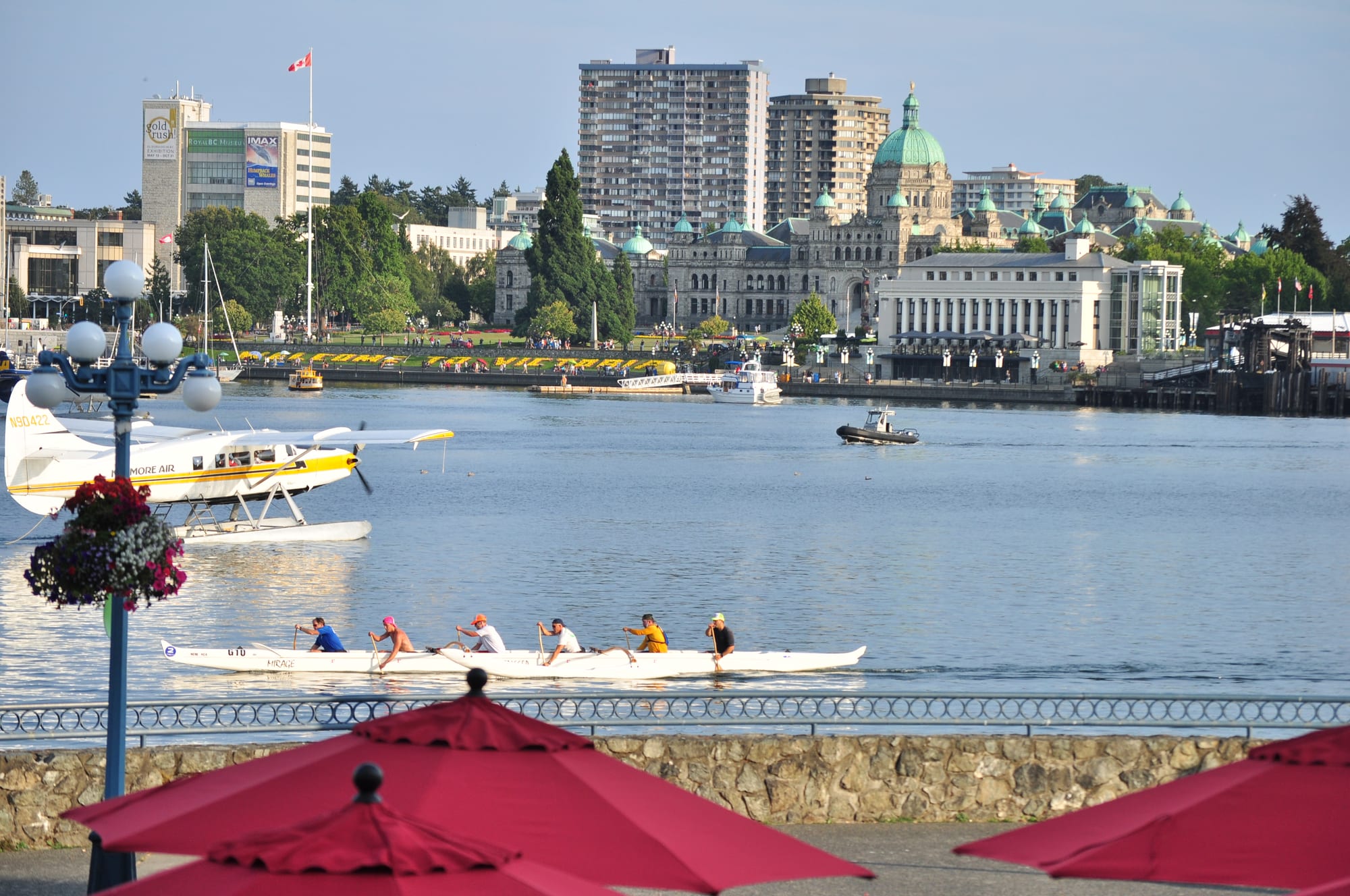
A floatplane and a rowing canoe on the Inner Harbour, with the green-domed Parliament Buildings on the far shore

British Columbia, Canada

Victoria

The Inner Harbour and the British Columbia Parliament Buildings, Victoria. (Joe Mabel / Wikimedia Commons · CC BY-SA 3.0)

British Columbia's capital, on the southern tip of Vancouver Island facing the Strait of Juan de Fuca. A Hudson's Bay Company fort of 1843 grew rich supplying the gold rush and became the seat of government. Known as the Garden City, it keeps an Edwardian centre, the oldest Chinatown in Canada and a working harbour of floatplanes and ferries.

Neighbourhoods

  • Downtown and Old Town
    • First-time visitors
    • Historic district
    • Nightlife

    The regional centre north of the Inner Harbour, with Edwardian commercial buildings left by the boom that ended before the First World War. Restaurants, pubs, theatres and clubs cluster here, around Government Street, Bastion Square and Market Square.

    Open in Maps
  • Inner Harbour and James Bay
    • First-time visitors
    • Waterfront
    • Quiet and residential

    James Bay, on the south side of the Inner Harbour, is the oldest residential neighbourhood on the west coast north of San Francisco. The Parliament Buildings and the Royal BC Museum face the harbour, and its streets run south to Beacon Hill Park and the cruise piers at Ogden Point.

    Open in Maps
  • Chinatown
    • Historic district
    • Best for food

    The oldest Chinatown in Canada and the second oldest in North America, begun by miners arriving from California in the 1850s. Its narrow alleys and courtyards, including Fan Tan Alley, now hold shops, cafés and restaurants.

    Open in Maps
  • Fernwood
    • Local life
    • Cafés

    A residential neighbourhood close to downtown, between Rockland, Fairfield and Oaklands, a short bus ride or walk from the centre.

    Open in Maps
  • Oak Bay
    • Quiet and residential
    • Waterfront

    A separate municipality on the southern tip of the island, east of the city, incorporated in 1906. Mostly residential, it shares the University of Victoria campus with neighbouring Saanich.

    Open in Maps

Things to do

Around the Inner Harbour

  • British Columbia Parliament Buildingslandmark

    The neo-Baroque home of the provincial legislature facing the Inner Harbour, topped by a gold-covered statue of Captain George Vancouver, with free guided tours all year.

    Open in Maps
  • Royal BC Museummuseum

    The provincial museum, founded in 1886, with galleries of natural history, the province's story and First Peoples, with Thunderbird Park beside it.

    Open in Maps
  • Ogden Pointlandmark

    The deep-water port at the south-western corner of the city, Canada's busiest cruise-ship port of call, on the Strait of Juan de Fuca.

    Open in Maps

Old Town and history

  • Fan Tan Alleylandmark

    A Chinatown alley less than a metre wide at its narrowest, known as the narrowest commercial street in North America and once lined with gambling clubs.

    Open in Maps
  • Market Squaremarket

    A town square beside Chinatown surrounded by more than 35 shops, restaurants and clubs.

    Open in Maps
  • Craigdarroch Castlelandmark

    A Victorian-era Scottish baronial mansion, designated a national historic site for its landmark status in the city.

    Open in Maps
  • Emily Carr Housemuseum

    The childhood home of the painter Emily Carr, a national historic site that left a lasting mark on her paintings and writing.

    Open in Maps
  • Art Gallery of Greater Victoriamuseum

    An art museum in the Spencer Mansion in Rockland, collecting work by Canadian and Indigenous artists and artists from around the Pacific Rim.

    Open in Maps

Parks and the shore

  • Beacon Hill Parkpark

    A 75-hectare park on the Strait of Juan de Fuca, with woodland and shoreline trails; the hill at its southern end is míqәn, 'warmed by the sun', to the Songhees.

    Open in Maps
  • Galloping Goose Regional Trailtrail

    A 55-kilometre rail trail that begins at the Johnson Street Bridge, used by walkers, runners and cyclists, paved for its first 13 kilometres.

    Open in Maps

Short trips from the city

  • Butchart Gardenspark

    A floral display garden at Brentwood Bay, opened in 1904, a national historic site that receives more than a million visitors a year.

    Open in Maps
  • Fort Rodd Hill and Fisgard Lighthouselandmark

    An 1890s coastal artillery fort built to defend the naval base at Esquimalt, joined by a causeway to the first lighthouse on Canada's west coast, lit in 1860.

    Open in Maps
  • Hatley Parklandmark

    James Dunsmuir's estate in Colwood, with Hatley Castle, formal gardens and old Douglas fir and cedar forest, now the grounds of Royal Roads University.

    Open in Maps
  • Goldstream Provincial Parkpark

    A forest of large Douglas firs and western red cedars, known for its autumn salmon run and the bald eagles that gather to feed on it.

    Open in Maps

Seasonal events

  • Canada Day1 July

    Celebrations and a fireworks display in the downtown core and around the harbour.

  • Symphony SplashBC Day weekend, in summer

    The Victoria Symphony plays from a barge in the Inner Harbour, finishing with Tchaikovsky's 1812 Overture, cannon fire, a carillon and fireworks.

Eat and drink

Long-standing places and food districts in Victoria. Hours, ratings and directions come from your maps app, always current.

Food districts and markets

  • Chinatownneighborhood

    Restaurants, bakeries and cafés in Canada's oldest Chinatown, around Fisgard Street and Fan Tan Alley.

    Open in Maps
  • Market Squaremarket

    A square of more than 35 shops, restaurants and clubs beside Chinatown.

    Open in Maps

Cafés and pubs

  • Downtown pubsneighborhood

    Downtown is where the city's pubs, bars and restaurants cluster, many in Edwardian buildings.

    Open in Maps
  • Afternoon teacafe

    Tea rooms serving afternoon tea in the British manner are part of the city's long-cultivated image.

    Open in Maps

Experience Victoria

History

Coast Salish peoples, among them the Lekwungen and the W̱SÁNEĆ, lived around the harbours of southern Vancouver Island long before Europeans arrived. Spanish ships visited Esquimalt Harbour in the early 1790s, and in 1843 the Hudson's Bay Company built a trading post at a place called Camosack, "rush of water", renamed Fort Victoria in November that year after the queen. The Songhees built a village across the harbour from the fort, and the colony of Vancouver Island was created in 1849, with the fort's chief factor, James Douglas, later its governor.

When news of gold on the Fraser River reached San Francisco in 1858, Victoria became the port and outfitting base for thousands of miners, and Chinese arrivals from California founded what is now Canada's oldest Chinatown. The city was incorporated in 1862, the year Victoria was the centre of a smallpox epidemic that killed about two-thirds of the First Nations people in British Columbia. The Royal Navy made Esquimalt its North Pacific base in 1865, Victoria was chosen as capital of the united colony in 1868, and it became the provincial capital when British Columbia joined Canada in 1871.

As Vancouver overtook it as the commercial centre, Victoria cultivated a genteel image of gardens and British manners, helped by the Butchart Gardens, opened in 1904. A building boom that ended just before the First World War left the Edwardian streets of the centre. Since the Second World War the region has grown steadily around government, two universities and the navy, and since the 1980s new suburbs such as Langford and Colwood have spread to the west.

Culture & Customs

Victoria is known as the Garden City, and its mild climate lets flowers bloom in late winter while most of Canada is under snow. The city's British image — tea rooms, gardens, double-decker buses and stone public buildings — sits alongside its Indigenous foundations: Thunderbird Park beside the museum, Songhees names such as míqәn for Beacon Hill and the First Peoples Gallery at the Royal BC Museum. Emily Carr, the painter and writer, grew up in Victoria, and her childhood home is now a national historic site.

Cultural life is concentrated downtown, where theatres, pubs and clubs gather and the big public events take place. The Victoria Symphony plays at the Royal Theatre and the university from autumn to spring and stages Symphony Splash on a barge in the harbour each summer. Music festivals, a dragon boat festival, a tall ships festival and the Swiftsure yacht races bring crowds to the waterfront.

The pace is slower than Vancouver's. Victoria has a large retired population and a strong outdoor habit — walking the shore, cycling the Galloping Goose, sailing and kayaking. The city is also one of the most gender-diverse in Canada, and civic politics is often concerned with heritage, housing and how thirteen separate municipalities share one region.

Daily Life

The City of Victoria had about 92,000 people at the 2021 census, and the metropolitan area about 397,000, spread across thirteen municipalities. Almost a quarter of the region's people are over 65, well above the Canadian average.

The provincial government, the navy base at Esquimalt, the University of Victoria and Camosun College are the big employers, and health care and public administration are the largest fields of work. Technology has become the largest revenue-producing private industry, with hundreds of firms, and tourism brings millions of overnight visitors a year. Housing costs and homelessness are pressing local issues: during the COVID-19 pandemic many homeless people camped in parks, including Beacon Hill Park, until in March 2021 the city reinstated a ban on daytime camping in parks and, with the province, pledged to find indoor accommodation for those camping there.

Daily life follows a gentle rhythm. Many people cycle or take the bus to work, and evenings and weekends are spent on the waterfront, in the parks or on the island's trails. Many households, and much of the city's tourist trade, depend on the ferries that link the island to the mainland.

Food

Victoria's cooking draws on the Pacific: wild salmon, eaten grilled, smoked or as candied salmon, the sweet cured strips sold at markets, along with spot prawns, Dungeness crab and halibut. Salmon remains central to First Nations food and ceremony, and in autumn the salmon run up the Goldstream River just outside the city. Seafood is the obvious choice at harbour-side restaurants, within sight of the floatplanes and whale-watching boats.

The city's long-cultivated British image shows in its tea rooms, where afternoon tea is served in the English manner, and in the pubs that cluster downtown. Chinatown, the oldest in Canada, still has Chinese restaurants and bakeries among its alleys and courtyards, and Market Square and the Old Town streets hold cafés and restaurants of many kinds. The Nanaimo bar — a no-bake slice of crumb base, custard icing and chocolate — takes its name from the city of Nanaimo, further up the island.

Vancouver Island produces a smaller amount of wine than the Okanagan, and craft breweries and cideries are part of local drinking life, as they are in every British Columbia town. Bannock, a simple fried or baked bread, is served at Indigenous food stalls.

Planning tools

Budget

Victoria is a little cheaper than Vancouver but still expensive by Canadian standards. Rooms around the Inner Harbour cost most, above all in summer and on cruise-ship days; ferry fares from the mainland add to the bill, especially with a car. Walking the centre is free, and buses cover the rest.

Daily Budget Midrange
USD 210–360 (mid-range hotel, restaurant meals, a whale-watching trip or garden tickets, buses or taxis)
Daily Budget Shoestring
USD 90–140 (hostel bed, Chinatown and market meals, buses, foot-passenger ferry)

Crossing on foot rather than with a car makes the ferry much cheaper, and buses meet the boats at Swartz Bay.

Best Time to Visit

June to September is dry, sunny and mild, the season for whale watching, the harbour festivals and the gardens at their fullest, and also the busiest. Spring comes early, with flowering cherries and bulbs in late winter; October to January is the wet season, but frost and snow are rare.

Suggested Number of Days

Two or three days covers the compact centre and the harbour. Four or five allow time for the gardens, the forts and parks of the western suburbs and a boat trip. Ferry times and the weather on the water can add a day.

First Visit
2–3 days
With Surroundings
4–5 days

Transportation

BC Transit runs the bus network across the city, the Saanich Peninsula and the western suburbs, including double-decker buses. Small harbour ferries and floatplanes use the Inner Harbour, and the Galloping Goose and other trails make cycling easy. A car is useful only for trips further up the island.

Buy a day pass rather than single cash fares if making several bus trips.

Airport & Station Connections

Victoria International Airport is on the Saanich Peninsula about 22 kilometres north-north-west of the city. Most visitors from the mainland come by BC Ferries from Tsawwassen to Swartz Bay — a crossing of about an hour and a half — then by bus or car to the centre, about 50 minutes on the express bus. Floatplanes and helicopters land in the Inner Harbour, the Victoria Clipper runs to Seattle and the Coho to Port Angeles, and cruise ships call at Ogden Point.

Walkability

The centre is small and flat enough to walk easily: the Inner Harbour, Old Town, Chinatown, James Bay and Beacon Hill Park all lie within a short walk of each other, and paths follow the harbour and the shore. Oak Bay, the university and the gardens need a bus, a bicycle or a car.

Safety

Canada is a safe country with low levels of violent crime. Homelessness is visible in parts of downtown; a 2020 count found at least 1,523 homeless people in the region. The main hazards are on the water — cold sea, tides and changing weather on boat trips.

Keep valuables out of sight in parked cars, take care on the rocky shore and breakwater in rough weather, and use licensed operators for boat trips. Check current official travel advice before travelling.

Climate

The mildest and driest climate on the British Columbia coast, sheltered by the Olympic Mountains: summers are fresh, dry and sunny; winters are cool, cloudy and rainy, with most of the rain from October to January. Flowers bloom through late winter and early spring.

Summer
mild, dry and sunny — the driest summers in Canada outside the far north; above 30°C on less than one day a year on average
Winter
cool and wet — January averages about 5°C, frost comes on only about ten nights a year, and snow is light and rarely lasts

Local Customs

Tipping of 15–20 per cent is expected in restaurants and taxis, and sales tax is added at the till. The Lekwungen and W̱SÁNEĆ peoples lived here long before the city, and the Songhees village once stood across the harbour from the fort. Dress is relaxed; the pace is slower than Vancouver's, and the population older.

Ask before photographing people, and treat Indigenous sites and ceremonies with respect.

Common Payment Methods

The currency is the Canadian dollar. Cards and contactless payment are accepted almost everywhere, and cash is rarely needed; cash totals are rounded to the nearest five cents. ATMs are easy to find downtown.