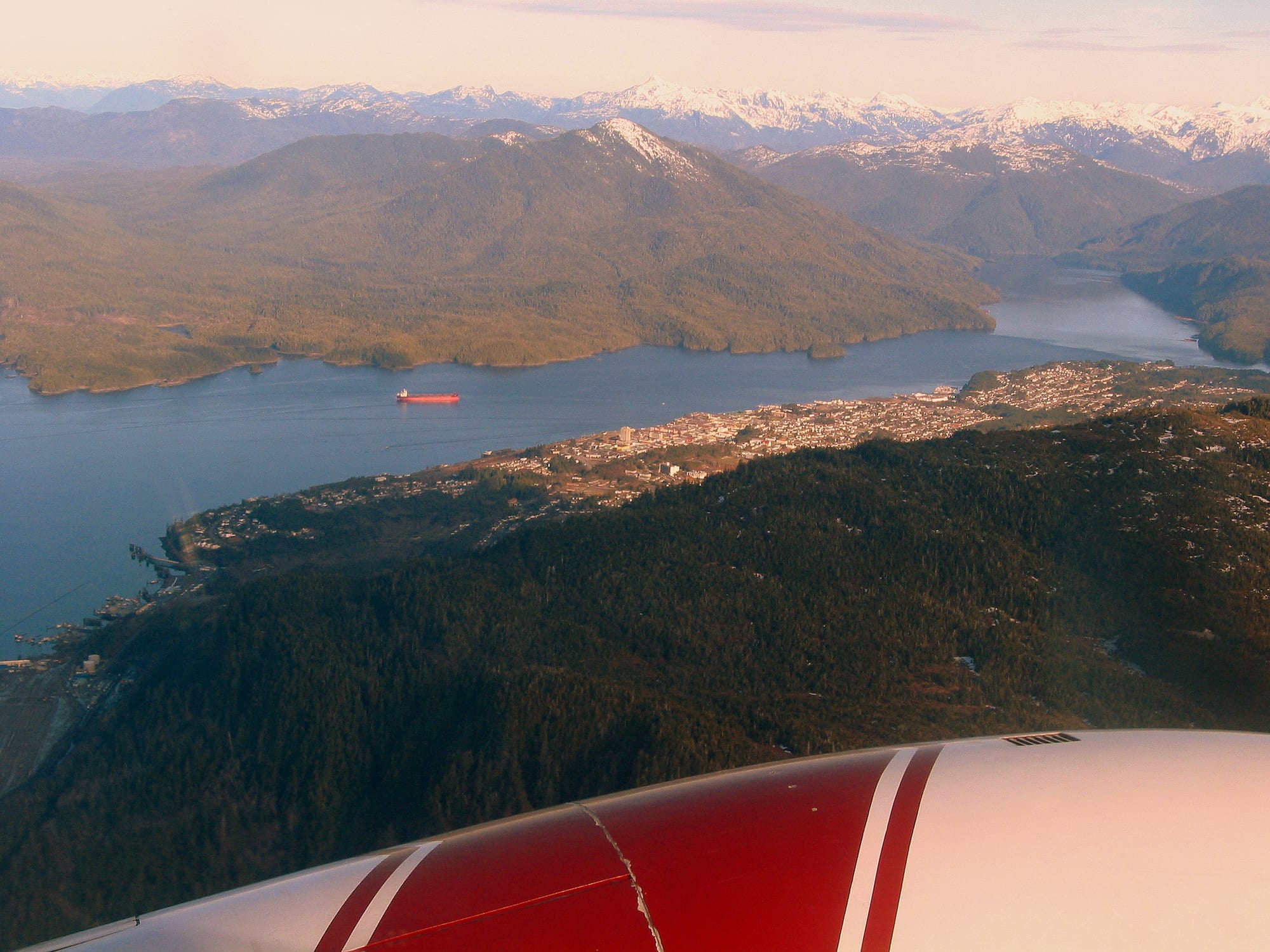
Aerial view from an aircraft, with part of its engine in the lower foreground, of Prince Rupert's houses along a forested shore, a red ship in the harbour and snowy peaks beyond

British Columbia, Canada

Prince Rupert

Prince Rupert and its harbour seen from an aircraft, with snow-capped mountains behind. (Shawn from Airdrie, Canada / Wikimedia Commons · CC BY-SA 2.0)

A port city of about 12,000 on Kaien Island on British Columbia's North Coast, near the Alaska Panhandle. Founded as the western terminus of the Grand Trunk Pacific Railway on land long settled by the Coast Tsimshian, it lived on halibut, salmon and timber; today its deep harbour handles containers, coal and grain, cruise ships call in summer, and ferries leave for Haida Gwaii and the Inside Passage.

Neighbourhoods

  • Downtown and the waterfront
    • First-time visitors
    • Museums
    • Close to public transport

    The grid of streets above the harbour, where most of the shops, restaurants and places to stay are found. The Museum of Northern British Columbia stands on the waterfront at the foot of McBride Street, and the railway station, ferry terminal and the Kwinitsa railway museum lie along the shore to the south.

    Open in Maps
  • Cow Bay
    • Best for food
    • Harbour views
    • Cruise passengers

    A small harbourside quarter just north-east of downtown, up and over a short hill, where the cruise-ship terminal, the Atlin Terminal with its visitor centre and tour desks, cafés, a pub, a sushi bar and gift shops selling Native art are gathered beside the boats.

    Open in Maps
  • Port Edward
    • Industrial heritage
    • Quiet and residential

    A small separate district municipality about 15 km south, near the mouth of the Skeena River, reached by the local bus. It is home to the North Pacific Cannery, the best-preserved survivor of the salmon canneries that once lined this coast.

    Open in Maps

Things to do

Museums and history

  • Museum of Northern British Columbiamuseum

    A museum founded in 1924 and housed in a large cedar longhouse, presenting the history and culture of the Tsimshian, Haida, Kwakwaka'wakw and Tlingit, and organising visits to the Tsimshian village of Metlakatla.

    Open in Maps
  • Kwinitsa Station Railway Museummuseum

    A Grand Trunk Pacific station of 1911, one of 400 identical stations built along the line from Winnipeg, now a railway museum in the waterfront park run by the city museum.

    Open in Maps
  • Prince Rupert stationlandmark

    The waterfront railway station built in 1921–22, a federally designated heritage station and the western end of Via Rail's train from Jasper.

    Open in Maps

Walks and the harbour

  • Pacific Mariners Memorial Parkpark

    A harbourside park near Cow Bay with a bronze mariner's statue and memorial walls, and a small Shinto shrine built for the Kazu Maru, a Japanese fishing boat that drifted across the Pacific from the sister city of Owase.

    Open in Maps
  • Sunken Gardenspark

    Heritage gardens laid out behind the courthouse in the hollow left when an earlier courthouse was moved in the 1920s.

    Open in Maps

Short trips from the city

  • North Pacific Cannerymuseum

    A salmon cannery near Port Edward founded in 1889, which stopped canning in 1968 and closed in 1981, now a national historic site and the most complete survivor of the canneries of the North Coast.

    Open in Maps
  • Metlakatlaattraction

    A small Tsimshian village across the water at Metlakatla Pass, visited on tours organised by the city museum.

    Open in Maps
  • Khutzeymateen Grizzly Sanctuarypark

    A provincial park created in 1994 to protect grizzly bears and the largest continuous stand of old-growth Sitka spruce in the world, with one of the densest remaining grizzly populations in North America.

    Open in Maps

Eat and drink

Long-standing places and food districts in Prince Rupert. Hours, ratings and directions come from your maps app, always current.

Prince Rupert classics

  • Seafood in Cow Bayneighborhood

    Restaurants, a sushi bar and a pub beside the boats in Cow Bay, the obvious place to eat the halibut, salmon and crab landed on this coast.

    Open in Maps
  • Cowpuccino's Coffee Housecafe

    A coffee house on Cow Bay Road, a few minutes from the cruise terminal.

    Open in Maps

Food districts

  • Third Avenue Westneighborhood

    The main downtown street for everyday eating, with Vietnamese pho, coffee shops and family restaurants a short walk from the waterfront.

    Open in Maps

Experience Prince Rupert

History

The Coast Tsimshian have occupied the harbour area for at least 5,000 years, and archaeology shows a marked rise in population around 1500 BC, with larger villages and plank houses. Their influence over the harbour weakened in the early 1830s, and in the 20th century the Grand Trunk Pacific Railway bought a 57-square-kilometre First Nations reserve on Kaien Island, together with a provincial land grant, to build the western terminus of its transcontinental line. Prince Rupert replaced Port Simpson as the planned terminus and Port Essington on the Skeena River as the business centre of the North Coast. A post office opened in 1906, the town was named through a national competition after Prince Rupert of the Rhine, the first governor of the Hudson's Bay Company, and it was incorporated in 1910.

The railway's president, Charles Melville Hays, promised a great port, a grand hotel and a passenger pier, but the property boom collapsed in 1912, the year Hays died in the sinking of the Titanic, and the First World War followed. The highway to Terrace, opened in 1944, was built partly for wartime defence. After the war fishing and forestry took over: from 1912 to the early 1980s Prince Rupert was considered the halibut capital of the world, and a pulp mill opened in 1951. In 1958 anger at police treatment of Indigenous people turned into a riot during the province's centennial celebrations.

The 1990s brought a slump in both fishing and forestry and a falling population after a peak of about 18,000, and the pulp mill closed in the hard years that followed. A new cruise ship dock opened in 2004, a container port was announced in 2005, and coal and grain shipping revived, turning the city towards its role as a trans-Pacific port.

Culture & Customs

Prince Rupert has one of the highest shares of First Nations residents of any Canadian town of its size, and Tsimshian, Haida and other Northwest Coast cultures are visible across it. Totem poles stand in Totem Park and around town, the city museum occupies a cedar longhouse and runs a carving shed, and shops in Cow Bay sell Native art. Neighbouring communities such as Metlakatla and Lax Kw'alaams, reached by water, are Tsimshian villages with their own long histories.

The town calls itself the City of Rainbows, a cheerful name for a place that is known above all for rain, and local life is shaped by the sea. Generations of students paid their way through school working in the fishery, and fishing charters for salmon and halibut are still a big part of the visitor season. The Pacific Mariners Memorial Park remembers those lost at sea, and its small Shinto shrine marks the city's link with Owase in Japan.

The Lester Centre of the Arts is the town's performance venue. Prince Rupert has also had a long South Asian presence since an Indo-Canadian industrialist founded a sawmill on the waterfront in 1958, and Sikhs today form a small but visible community. Life is informal and practical, people tend to know each other, and the arrival of a ferry, a train or a cruise ship is still an event.

Daily Life

The 2021 census counted about 12,300 people in the city, a small rise from 2016 but well below the peak of the early 1990s. Port Edward lies just to the south, and Prince Rupert is the largest town and service centre of the North Coast, with the region's biggest hospital, a college campus and the city-owned telephone and internet company, CityWest.

Commercial fishing, port operations and tourism are the main sectors of the economy. The harbour is the deepest ice-free natural harbour in North America and the closest North American port to key Asian destinations, and container, coal and grain terminals around the harbour, including on Ridley Island, are served by Canadian National's rail line, whose freight capacity was upgraded in 2024. Fish processing continues, but it has moved from canning to fresh and frozen products. In 2022 a ten-year agreement was signed for a private operator to run the cruise terminal.

Daily life follows the weather and the timetables: the town is quiet in the long wet winter and busy in summer, when cruise ships bring tens of thousands of visitors through Cow Bay over the season. Distance is a constant fact of life: the nearest larger town, Terrace, is about 144 km away by road.

Food

Prince Rupert's food is the food of the North Coast sea. Halibut built the town's reputation for most of the 20th century, and salmon fed the canneries of the coast, among them the North Pacific Cannery near Port Edward, founded in 1889. Today the catch goes to fresh and frozen processing rather than tins, and halibut and salmon, along with crab, are what visitors look for on menus.

Cow Bay is the place most people eat: restaurants, a sushi bar, a pub and a coffee house cluster beside the boats, a few minutes from the cruise terminal. Downtown, Third Avenue West has the everyday restaurants, including Vietnamese pho and a mix of Canadian and Asian family places, reflecting the town's mixed population.

Fishing charters out of the harbour aim for salmon and halibut, with catches that can exceed a hundred pounds, and crabbing trips are offered too, so some visitors eat what they have caught themselves. Small coffee houses downtown and in Cow Bay are where the town meets on wet days.

Planning tools

Budget

Prince Rupert is cheaper for rooms and meals than Vancouver or Whistler, but getting here is the big cost: a flight to an island airport, two days on the train from Jasper, or a long ferry voyage. Wildlife tours by boat or floatplane and fishing charters are the main extra expenses, and rooms fill up when cruise ships and ferries are in.

Daily Budget Midrange
USD 170–300 (mid-range hotel or motel, seafood dinners, museum visits, a wildlife or harbour tour)
Daily Budget Shoestring
USD 80–130 (hostel bed or guesthouse bunk, self-catering, local buses)

Plan around the ferry and train timetables, which run on only some days of the week, and arrange a night's room to match the arrival time.

Best Time to Visit

June to September, when the weather is mildest and comparatively least rainy, the cruise ships and wildlife tours are running and the ferries sail most often. Autumn is the wettest season. Winters are damp and mild for Canada, with occasional cold spells and snow that rarely lasts.

Suggested Number of Days

The town itself needs a day or two, and many people pass through between a ferry and the train. Allow three or four days to add boat or floatplane tours and the outlying communities; the infrequent ferry and train schedules often decide the length of a stay.

First Visit
1–2 days
With Surroundings
3–4 days

Transportation

Downtown and Cow Bay are compact enough to cover on foot, and a taxi across town is a short ride. BC Transit runs local buses from Monday to Saturday, including to the ferry terminal, the railway station and Port Edward. A car is useful only for the drive inland along Highway 16; the surrounding coast is reached by boat or floatplane.

Highway 16 east to Terrace and Prince George is long and can be treacherous in winter; drivers unused to winter conditions should avoid it then.

Airport & Station Connections

Prince Rupert Airport is on Digby Island, about 9 km west-southwest of the city, and is reached by a bus and a short ferry from downtown; Air Canada flies from Vancouver, and the whole trip from downtown to Vancouver airport takes about four hours. Via Rail's Jasper–Prince Rupert train runs three times a week, in daylight, over two days with a night in Prince George. BC Ferries sails to Skidegate on Haida Gwaii in about seven to eight hours and down the Inside Passage to Port Hardy on Vancouver Island in 16 to 22 hours, and Alaska Marine Highway ferries head north to Ketchikan, Juneau and Sitka. By road it is about 144 km west of Terrace and 715 km from Prince George.

Walkability

Most of downtown is easy on foot, with the waterfront, the museum and Cow Bay all within a short walk, though the town climbs a hillside and some streets are steep. The ferry terminal and railway station are a bus or taxi ride south of the centre. Rain is the main obstacle: good waterproofs make walking far more pleasant.

Safety

Canada is a safe country with low levels of violent crime. Prince Rupert is a small port city, and the main risks are outdoors: cold water, strong tides and sudden weather on the sea, slippery trails in constant rain, and bears in the surrounding wilderness.

Use licensed operators for boat, floatplane and bear-viewing trips, carry rain gear and warm layers, and keep well away from wildlife. Check current official travel advice before travelling.

Climate

An oceanic climate in a temperate rainforest. Prince Rupert is known as the City of Rainbows and is counted as Canada's wettest city, with roughly 2,600 to 3,100 mm of precipitation a year, rain on about 240 days and very little sunshine. Temperatures are mild for Canada all year, and wind is often strong.

Summer
cool and comparatively less rainy — average highs around 16°C, the coolest summers among Canada's larger cities
Winter
chilly and damp — January's daily mean is about 2°C, with occasional Arctic cold spells and snow that usually melts within a few days

Local Customs

Tipping of 15–20 per cent is expected in restaurants and taxis, and sales tax is added at the till rather than shown on the price. Dress is casual and practical, built around rain gear. The Coast Tsimshian have lived here for at least 5,000 years and a large share of residents are Indigenous; carved poles and longhouse-style buildings are part of the town, and ceremonies and cultural sites deserve the same respect as a place of worship.

Ask before photographing people, ceremonies or carvers at work, and buy Northwest Coast art from galleries that name the artist. Identification is asked for when buying alcohol.

Common Payment Methods

The currency is the Canadian dollar. Cards and contactless payment are accepted almost everywhere, and cash totals are rounded to the nearest five cents.