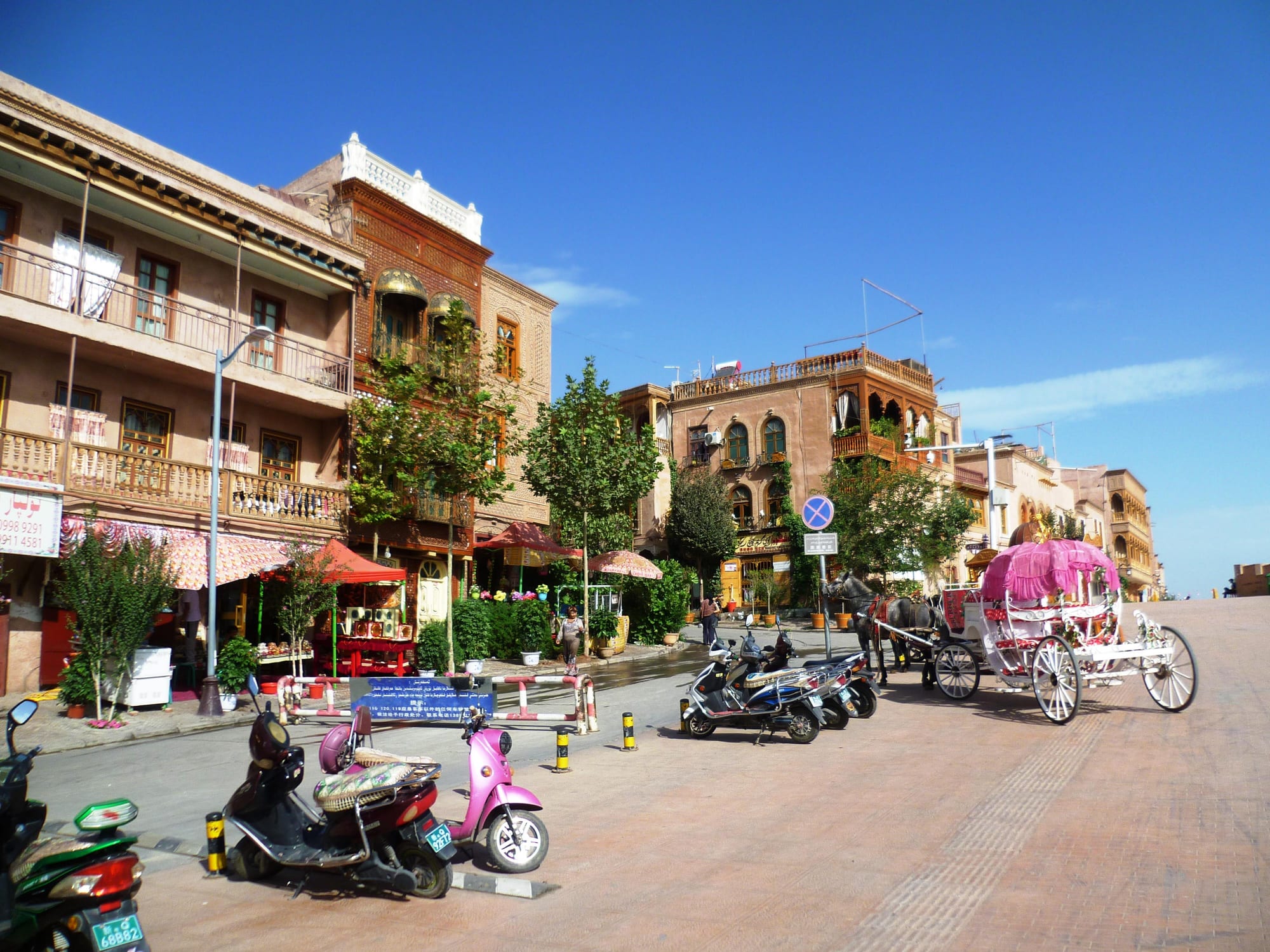
A sunlit square in Kashgar's old city with brick and timber balconied houses, shaded stalls, parked scooters and a horse-drawn carriage

Xi'an, the Silk Road & the Northwest, China

Kashgar

A street in the old city of Kashgar in western Xinjiang. (Radosław Botev / Wikimedia Commons · CC BY 3.0 pl)

An oasis city in far western Xinjiang, on the western rim of the Taklamakan Desert where the northern and southern Silk Road routes met before crossing the Pamirs. Long a Uyghur trading centre, it is known for the Id Kah Mosque, a rebuilt old town of earth-coloured lanes and a weekly livestock market, and it lies under the heavy security that shapes life across the region.

Neighbourhoods

  • The old city
    • First-time visitors
    • Historic district
    • Best for food

    The warren of earth-toned lanes, workshops and balconied houses north and east of Id Kah Square. Most of it was demolished and rebuilt from 2009 under a government programme, and the reconstructed quarter is now gated and ticketed at some entrances; craftsmen, bakeries and tea houses still work along its main streets.

    Open in Maps
  • Id Kah Square and the centre
    • Landmarks
    • Close to public transport

    The wide paved square in front of the yellow-brick Id Kah Mosque, the focal point of the city, with the main shopping streets, hotels and bus routes around it. Security screening is normal at the entrances to the square and the mosque.

    Open in Maps
  • The new city
    • Hotels
    • Quiet and residential

    The grid of broad avenues, apartment blocks and government buildings laid out west and south of the centre since the mid-20th century. It holds most of the larger hotels and the restaurants used by visiting Chinese business travellers, and is where the People's Square and its Mao statue stand.

    Open in Maps
  • The bazaar district and the eastern edge
    • Markets
    • Local life

    The area around the Grand Bazaar on the eastern side of town, busiest on Sundays, with carpet and hat sellers, spice stalls and tinsmiths. The Sunday livestock market is held further out on the city's fringe, among the fields of the oasis.

    Open in Maps

Things to do

Famous landmarks

  • Id Kah Mosquelandmark

    The city's principal mosque, a yellow-brick complex with a portal, minarets and a courtyard of poplars, founded in the 15th century and rebuilt several times since.

    Open in Maps

Tombs and shrines

  • Afaq Khoja Mausoleumlandmark

    A tiled tomb complex begun in 1640 on the north-eastern edge of the city, holding five generations of a ruling Sufi family and set among prayer halls, a lecture hall and a cemetery still in use.

    Open in Maps

Short trips from the city

  • Shipton's Archviewpoint

    One of the tallest natural rock arches in the world, in a gorge in the dry hills north-west of the city, reached by a rough road and a short climb.

    Open in Maps
  • Karakoram Highwaytrail

    The road south from Kashgar towards the Pakistani border, which climbs past sand mountains and glacier peaks into the Pamirs; checkpoints are frequent along it.

    Open in Maps
  • Muztagh Ataviewpoint

    A glaciated 7,546-metre peak in the Pamirs, seen across the high lake at Karakul on the long day trip up the Pamir road from the city.

    Open in Maps
  • Yengisarattraction

    A small town about 60 kilometres south, known throughout Xinjiang for its handmade knives with inlaid handles.

    Open in Maps

Seasonal events

  • Sunday livestock marketevery Sunday, year-round

    Sheep, cattle, horses and donkeys are traded on the city's outskirts in a long-standing weekly market, busiest in the morning.

  • Eid al-Fitrvaries with the lunar calendar

    The end of Ramadan, marked by prayers at Id Kah Mosque and family visits; religious observance in Xinjiang is closely regulated.

  • Melon and grape harvestlate summer to autumn

    Fruit stalls fill the bazaars as melons, grapes, figs and pomegranates from the oasis come in, and much of the crop is dried for winter.

Eat and drink

Long-standing places and food districts in Kashgar. Hours, ratings and directions come from your maps app, always current.

Kashgar classics

  • Laghmanrestaurant

    Hand-stretched wheat noodles topped with lamb or beef stir-fried with peppers, tomato and onion — the everyday meal of Uyghur kitchens across the city.

    Open in Maps
  • Polorestaurant

    The local pilaf of rice cooked with lamb, carrot and oil in a wide pot, ladled out at midday and traditionally eaten with the right hand.

    Open in Maps
  • Nan bakeriesrestaurant

    Round flatbreads stamped in the middle and slapped onto the walls of clay tandoor ovens, baked through the day on street corners in the old city.

    Open in Maps

Markets and food streets

  • Kashgar Grand Bazaarmarket

    The covered and open market on the east side of town selling spices, dried fruit, carpets, hats and copperware, with kebab grills and tea stalls among the aisles.

    Open in Maps
  • The old city food lanesneighborhood

    Streets of bakeries, kebab braziers, samsa ovens and ice-cream churns in the rebuilt old quarter, busiest in the late afternoon and evening.

    Open in Maps

Experience Kashgar

History

Kashgar has been the western gateway of the Tarim Basin for more than two thousand years. Chinese records of the Han dynasty name it Shule, a small oasis kingdom on the route where the caravan roads skirting the Taklamakan to north and south rejoined before crossing the Pamirs towards Ferghana, Bactria and India. Buddhism arrived early, and Tang-era accounts describe hundreds of monasteries in the oasis; it passed repeatedly between local rulers, Chinese garrisons, Turkic confederations and Tibetan armies.

From the 10th century the Karakhanids, who took Kashgar as a capital, adopted Islam, and the city became a centre of Turkic Muslim learning: Mahmud al-Kashgari, born here, compiled the first great dictionary of the Turkic languages after settling in Baghdad, and Yusuf Khass Hajib presented the Kutadgu Bilig to the prince of Kashgar in 1069 or 1070. Sufi lineages, above all the Khoja families commemorated at the Afaq Khoja Mausoleum, held religious and political power into the 18th century. The Qing conquered the Tarim oases in the 1750s and governed the area they called Xinjiang from a distance, through local officials and repeated revolts; Yaqub Beg ruled an independent state from Kashgar from 1865 until Qing armies retook it in 1877.

In the late 19th and early 20th centuries Kashgar was a listening post in the rivalry between Russia and British India, with consulates on either side of the city, and the base for archaeological expeditions into the desert. Short-lived East Turkestan republics were declared in 1933 and 1944. Since 1949 the city has grown, been connected by road, rail and air, and been transformed physically: most of the old city was demolished and rebuilt from 2009 in a programme the government presented as earthquake safety and critics described as the destruction of Uyghur heritage.

Culture & Customs

Kashgar is the cultural heartland of the Uyghurs, a Turkic Muslim people whose language is written in a modified Arabic script and whose oasis towns share a tradition of music, poetry and craft. The muqam, a suite form of song, instrumental music and dance listed by UNESCO as intangible heritage, is the classical music of the region, played on the dutar, rawap and tambur; wedding celebrations and family gatherings are where most people encounter it.

Craft work is concentrated in the old city: coppersmiths, knife makers, hat makers producing the embroidered doppa cap, instrument builders and bakers all keep workshops on the lanes, often passed down within families. Carpets, silk from the southern oases, jade from Hotan and embroidered textiles fill the bazaar. Hospitality is formal and generous, tea is served constantly, and the right hand is used for eating and for passing food.

Religious and cultural life is tightly regulated. Religious practice is restricted across Xinjiang, long beards and face veils are banned, and researchers estimate that thousands of mosques have been razed or damaged, which the government disputes. Chinese state media present the old city and its markets as heritage tourism, and large numbers of domestic visitors now come for exactly that. Visitors are expected to keep away from political subjects; raising them in conversation can create serious difficulties for residents.

Daily Life

About 700,000 people live in the county-level city of Kashgar, within a prefecture of some four million, the great majority of them Uyghur; the Han share of the population is higher in the newer districts and among officials and business owners. Two languages run in parallel, Uyghur on the street and Mandarin in schools, offices and signage, with education increasingly conducted in Mandarin.

The oasis economy rests on farming — wheat, maize, cotton, and above all fruit: melons, grapes, figs, apricots and pomegranates — together with trade, food processing and, more recently, tourism from elsewhere in China. Kashgar was designated a special economic zone in 2010, and cross-border trade with Kyrgyzstan, Tajikistan and Pakistan passes through it when the mountain passes are open. Wages are low by Chinese standards and many young people work elsewhere in the country.

The rhythm of the day is distinctive because the whole country runs on Beijing time while Kashgar lies far to the west: the sun rises and sets about three hours later than the clock suggests, and many Uyghur households keep an informal local time two hours behind. Shops open late in the morning, the evening meal is late, and summer streets are busiest after dark. Daily life is shaped by surveillance and checkpoints, restrictions on religion and travel, and labour transfer programmes criticised by rights groups.

Food

Kashgar eats the food of Central Asia rather than of eastern China. Laghman, hand-stretched wheat noodles under a stir-fry of mutton, peppers, tomato and onion, is the standard meal; suoman is a chopped version cooked together with the sauce. Polo, the rice pilaf with lamb and carrot, is the dish of feasts and of midday. Kebabs of mutton cubes on iron skewers are grilled over charcoal everywhere, and whole sheep are roasted for celebrations.

Bread is central. Nan, baked on the inside wall of a clay tandoor and stamped in a pattern in the middle, comes in many sizes, from thin discs to thick sesame-topped loaves; girde nan is small and ring-shaped. Samsa, lamb and onion pastries, are baked in the same ovens and sold hot from stalls. Offal soups, steamed manta dumplings and chickpeas with rice fill out the street repertoire.

Sweet and cold things matter in the desert heat: hand-churned ice cream from brass drums, shaved ice with syrup and fruit, and mulberries, figs and melons in season. Dried fruit and nuts — raisins in several colours, apricots, walnuts — fill sacks in the bazaar and are the standard gift. Tea is drunk constantly, often with rock sugar or spices, and fresh pomegranate juice is pressed on the street in autumn. Alcohol is uncommon in Uyghur restaurants.

Planning tools

Budget

Food, markets and local transport are cheap, and simple hotels are good value, but the choice of accommodation is narrowed because not every hotel in Xinjiang is licensed to register foreign guests. Getting here is the main cost: Kashgar is about an hour and a half by air from Ürümqi, or far longer by train, and trips along the Karakoram Highway usually mean hiring a car and driver.

Daily Budget Midrange
USD 75–160 (mid-range hotel, restaurants, site tickets, a driver for the mountains or the desert)
Daily Budget Shoestring
USD 30–55 (budget hotel, noodle shops and bazaar food, local buses and shared taxis)

Confirm before booking that a hotel can register foreign guests, and allow extra time everywhere for identity checks and security screening.

Best Time to Visit

May to June and September to October, when days are warm rather than fierce and the light is clear. Autumn brings the fruit harvest to the bazaars and is the best season for the Pamir road south. July and August are very hot and dusty on the plain, though pleasant at altitude. Winters are cold, grey and quiet, and spring often brings sand-laden wind.

Suggested Number of Days

Two or three days is enough for the city itself, and many visitors arrange one of them to fall on a Sunday for the livestock market. Add a couple more for the mountain road south or the desert sites, both of which involve long drives and checkpoint stops.

First Visit
2–3 days
With Surroundings
4–5 days

Transportation

The centre is small and best covered on foot, with cheap taxis, electric three-wheelers and city buses for longer hops such as the Afaq Khoja Mausoleum or the bazaar. Long-distance buses and shared cars serve the oasis towns of the southern Silk Road, and the airport and railway station lie a short drive from the centre. Journeys out of town pass through road checkpoints where passports are inspected.

Keep the passport on the person rather than in a bag at the hotel — it is needed at station gates, hotel desks and road checkpoints, and for buying train and bus tickets.

Airport & Station Connections

Kashgar Laining International Airport lies a short drive north-east of the centre, with daily flights to Ürümqi, roughly an hour and a half away, and seasonal services to other Chinese cities. Trains run to Ürümqi along the southern edge of the Tian Shan, taking the best part of a day and night. Roads lead south-east along the rim of the Taklamakan to Hotan and south over the Pamirs towards the Pakistani border, which opens seasonally.

Walkability

Central Kashgar is flat and compact: Id Kah Square, the old city lanes and the main shopping streets are all within a twenty-minute walk of each other, and the old quarter is best seen slowly and on foot. The new city's avenues are wide and less interesting to walk, and the bazaar, mausoleum and livestock market are far enough out to need a taxi. Expect bag scanners and identity checks at the entrances to squares and markets.

Safety

Ordinary crime is very low. Xinjiang is under pervasive surveillance, with frequent checkpoints, identity scans and armed patrols; foreign visitors may be questioned, have their phones checked or be followed, and conversations about politics can endanger local people. Heat, dust and altitude on the road into the Pamirs are the practical physical risks.

Do not photograph checkpoints, police or detention facilities, avoid political and religious conversations with residents, and follow instructions at security screening without argument. Check current official travel advice before travelling.

Climate

A cold desert climate on the edge of the Taklamakan: very dry, with big differences between day and night, frequent spring and early-summer dust in the air, and little rain at any season. The city sits at about 1,280 metres.

Summer
hot and dry — July days commonly reach the low to middle 30s °C, with cooler nights
Winter
cold — January averages around −6°C, with hard frosts and occasional light snow

Local Customs

Kashgar is overwhelmingly Uyghur and Muslim. Modest dress is expected, shoulders and knees covered, and visitors should not enter the prayer hall of a mosque during prayer or walk in front of people praying. Greetings in Uyghur, beginning with 'yakhshimusiz', are appreciated. Pork is not served in Uyghur restaurants and alcohol is little used. Photography of people, especially women and children, needs permission, and photographing police, checkpoints or military sites is prohibited.

Tipping is not customary; bargaining is normal in the bazaars; and avoid asking residents about politics, religion or security, which can put them at risk.

Common Payment Methods

The currency is the renminbi, counted in yuan. Payment is almost entirely by QR code through Alipay or WeChat Pay, which foreign visitors can link to an overseas card; setting this up before arrival saves a great deal of difficulty. Foreign cards are accepted at a few hotels only, so carry cash for markets and small restaurants, and draw it at bank ATMs in the centre.