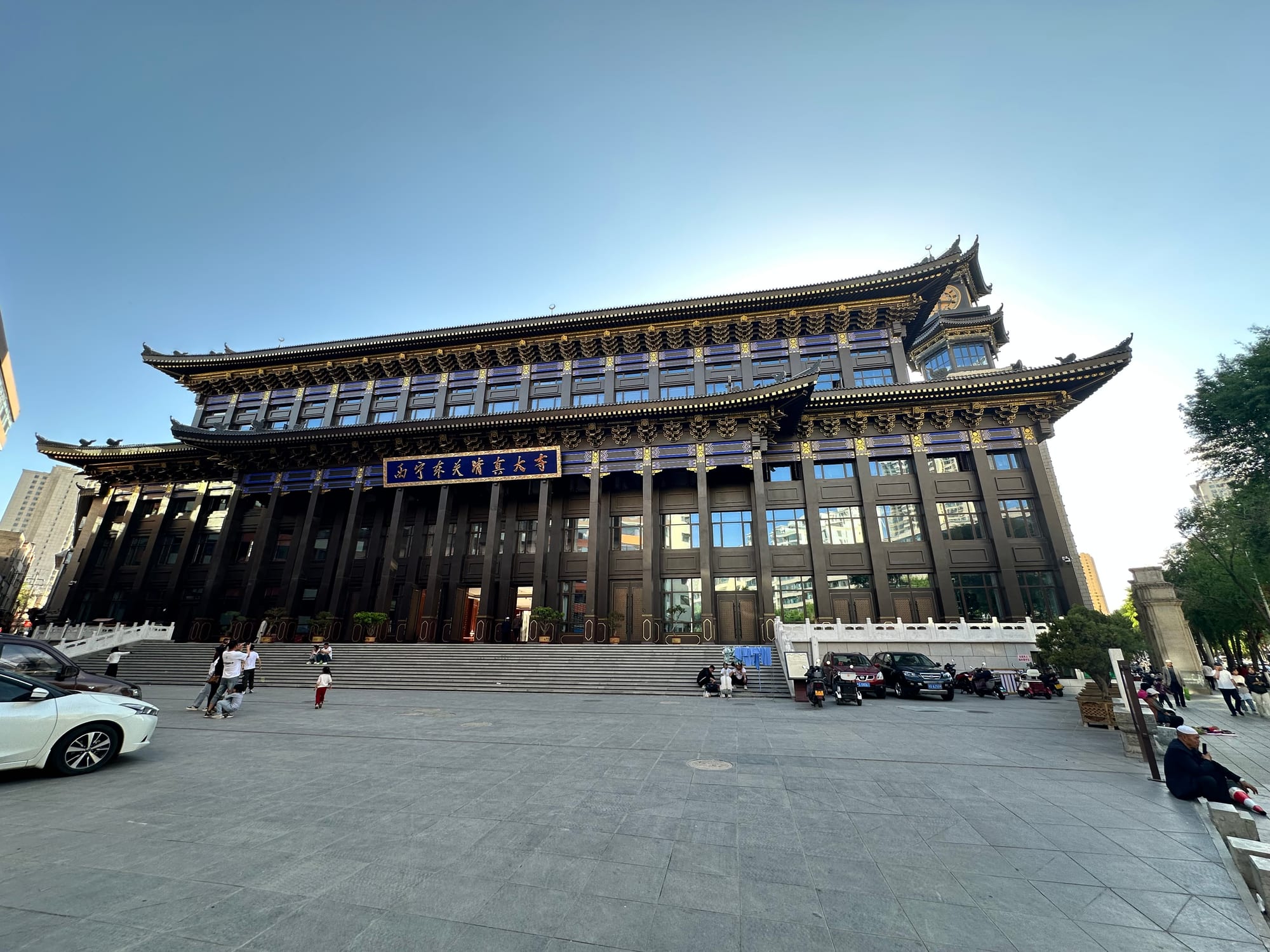
The broad timber-fronted facade of Dongguan Mosque in Xining above a paved square with parked cars and people on the steps

Xi'an, the Silk Road & the Northwest, China

Xining

The Dongguan Mosque, the largest mosque in Qinghai and a centre of Hui Muslim life in Xining. (Michał Beim / Wikimedia Commons · CC BY 4.0)

The capital of Qinghai province, set in a valley at about 2,200 metres where the Huangshui river cuts through the eastern edge of the Tibetan plateau. A Han garrison and later a tea and horse trading town, it is now a highland city of Han, Hui, Tibetan, Tu and Salar communities, the starting point of the railway to Lhasa and the base for Qinghai Lake and the Kumbum monastery.

Neighbourhoods

  • Chengdong and the Dongguan quarter
    • Best for food
    • Historic district
    • Markets

    The eastern district around the Dongguan Mosque, the heart of Hui Muslim Xining, with halal restaurants, bakeries, tea houses and stalls selling prayer caps and dried fruit. It is the busiest and most distinctive part of the city to walk.

    Open in Maps
  • Chengzhong, the central district
    • First-time visitors
    • Close to public transport
    • Hotels

    The commercial centre around the main square and the old market lanes, holding the shopping streets, the provincial museum's neighbourhood, most hotels and the food alleys that fill up after dark. Bus routes and the city's transport converge here.

    Open in Maps
  • The northern hills
    • Walks
    • Views

    North of the Huangshui river the ground rises steeply to Beishan, a ridge of eroded red cliffs with temple buildings cut into them and paths climbing to viewpoints over the valley. Parkland and reservoirs lie behind it.

    Open in Maps
  • The western new town
    • Quiet and residential
    • Transport connections

    Newer districts of apartment towers, universities, offices and malls spreading west up the valley towards the railway station complex and the road to Qinghai Lake. It is where much of the city now lives and works.

    Open in Maps

Things to do

Mosques and temples

  • Dongguan Mosquelandmark

    The principal mosque of Xining and the largest in Qinghai, built in 1380 and rebuilt on a large scale, with a Chinese-style timber prayer hall that fills the surrounding square at Friday prayers.

    Open in Maps

Short trips from the city

  • Kumbum Monasterylandmark

    One of the great Gelug monasteries of Tibetan Buddhism, about 25 kilometres south at Huangzhong, built at the birthplace of the reformer Tsongkhapa and known for its butter sculptures.

    Open in Maps
  • Qinghai Lakeattraction

    China's largest lake, a saline expanse at 3,205 metres about 100 kilometres west of the city, ringed by grassland, with rapeseed flowering on its shores in summer and bird colonies on its islands.

    Open in Maps

Short trips to the grasslands

  • Huzhu Tu Autonomous Countyattraction

    Hill country north-east of the city and the centre of the Tu people, known for embroidered dress, wrestling and barley spirits.

    Open in Maps
  • Datong Hui and Tu Autonomous Countyattraction

    A county of forested mountains and alpine meadow north of Xining, the nearest walking and summer-flower country to the city.

    Open in Maps

Seasonal events

  • Monlam prayer festival at Kumbumthe first lunar month, usually February or March

    Days of prayer, masked dance and the display of a giant appliqué thangka at the monastery south of the city, drawing large crowds of pilgrims.

  • Rapeseed bloom around Qinghai LakeJuly

    Fields of yellow rapeseed flower along the lake shore, the single busiest tourist period of the Qinghai year.

  • Tour of Qinghai Lakesummer

    An international road cycling race starting in Xining and run at high altitude around the lake and across the province.

  • Summer escape seasonJune to August

    Visitors from hotter Chinese provinces fill the city's hotels for its cool highland summer, and prices rise accordingly.

Eat and drink

Long-standing places and food districts in Xining. Hours, ratings and directions come from your maps app, always current.

Xining classics

  • Hand-grabbed muttonrestaurant

    Shouzhua yangrou, plateau mutton boiled on the bone and eaten with salt, garlic and a knife — the dish Qinghai is proudest of.

    Open in Maps
  • Gamianpianrestaurant

    Small squares of dough pinched by hand into a mutton and vegetable soup, the standard home-style meal of the province.

    Open in Maps
  • Niangpirestaurant

    Cold wheat-starch noodles cut into strips and dressed with vinegar, garlic and chilli oil, sold from stalls and eaten year-round.

    Open in Maps

Food streets and markets

  • Mojia Streetneighborhood

    A central lane of snack stalls and small restaurants where much of the city eats in the evening, from mutton skewers to yoghurt and fried pastries.

    Open in Maps
  • Shuijingxiang marketmarket

    A long-standing market street near the centre selling dried fruit, goji berries, caterpillar fungus, yak jerky and Tibetan groceries alongside food stalls.

    Open in Maps
  • Halal restaurants of Dongguanneighborhood

    The streets around the mosque are lined with Hui kitchens serving hand-pulled beef noodles, mutton soups, flatbreads and milky eight-treasure tea.

    Open in Maps

Experience Xining

History

Xining began as a Han dynasty outpost. As Chinese forces pushed west along the Hexi Corridor in the last two centuries BC, a county called Linqiang was established in the Huangshui valley to control the Qiang peoples of the plateau. The valley changed hands repeatedly over the following centuries between Chinese dynasties, Xianbei and Tuyuhun kingdoms, the Tibetan empire, which held it during the Tang, and later Tangut and Mongol rulers. The name Xining, meaning peace in the west, was given when the Song recovered the valley in 1104.

Its importance was commercial as well as military. The valley carried a southern branch of the Silk Road and, more lastingly, the trade in which Chinese tea and grain were exchanged for horses, wool, hides and salt from the plateau. Muslim merchants settled from the Yuan and Ming periods, founding the community whose descendants still dominate the eastern districts, and Tibetan Buddhism spread through the surrounding hills; the Kumbum monastery was begun in 1583 at the birthplace of Tsongkhapa, the founder of the Gelug school. Qing control was enforced through campaigns against Mongol and Tibetan forces in the 1720s, and the Muslim uprisings of the 1860s and 1890s brought severe fighting to the valley.

For much of the first half of the 20th century Qinghai was ruled by the Ma family, Hui Muslim warlords based in Xining. The province was formally organised in 1928 and the city became its capital; after 1949 it grew quickly as an industrial and administrative base, with heavy industry, migration from eastern China and, later, the railway to Golmud in 1984 and on to Lhasa in 2006, which made Xining the gateway to the plateau.

Culture & Customs

Few Chinese cities hold as many communities in one valley. Han residents form the majority, but Hui Muslims are a large and visible presence in the east of the city, Tibetans from Amdo — the north-eastern Tibetan world, of which Qinghai is the heart — come in from the grasslands, and the Tu and Salar peoples, both found almost nowhere else, live in the counties nearby. Mosques with Chinese timber roofs stand a few streets from Buddhist temples, and the markets sell prayer caps, thangkas, barley flour and dried yak meat side by side.

Tibetan Buddhism gives the region its great festivals. At Kumbum, the Monlam prayer gatherings bring masked cham dance, butter sculptures shaped from coloured yak butter, and the unrolling of an enormous appliqué thangka on a hillside. Muslim life is ordered by Friday prayers at Dongguan, where the square fills with worshippers, and by Ramadan and the two Eids. The Tu are known for embroidery, wrestling and the Nadun harvest festival, the Salar for their distinct Turkic language.

Everyday manners are plainer and less formal than in eastern China, closer to those of the plateau: direct speech, quick hospitality, tea offered at once, and an evening spent walking, eating on the street and dancing in squares. Sensitive subjects — religion, Tibet, ethnic policy — are not discussed with strangers, and visitors should not press them.

Daily Life

About 2.5 million people live in the Xining municipality at the 2020 census, close to two million of them in the built-up districts along the valley — some two-fifths of Qinghai's entire population in one city. It is the province's centre for government, hospitals, universities and transport, and people come in from grassland prefectures the size of European countries for services unavailable at home.

The economy mixes administration and services with older heavy industry — steel, aluminium, chemicals and machinery — and newer plateau specialities: solar and wind power on the dry basins to the west, lithium and potash from the salt lakes, Tibetan medicine, barley processing and the trade in caterpillar fungus, goji berries and wool. Tourism has grown strongly, concentrated in the summer months.

The valley shapes the city: development is squeezed into a narrow strip between steep, dry hills, so Xining is long, dense and heavily built, with tower blocks running for kilometres along the Huangshui. Altitude, thin air and strong sun are ordinary facts of life, as are cold winters heated by coal and gas. Migration runs both ways, with Han and Hui families long established here and Tibetan families moving in from pastoral districts as herding gives way to town work and schooling.

Food

Qinghai's food is plateau food: mutton, beef, wheat, barley and dairy, with little that is sweet and less that is delicate. Shouzhua yangrou, hand-grabbed mutton, is boiled on the bone and eaten with salt and raw garlic, the meat valued because the sheep graze at altitude. Gamianpian, pinched dough squares in a mutton broth with potato and greens, is the everyday bowl, and hand-pulled beef noodles from the Hui kitchens are eaten at any hour.

Cold dishes and street snacks fill the gaps: niangpi, the chewy wheat-starch noodle dressed with vinegar, garlic and chilli oil; mutton skewers grilled with cumin; stuffed sheep's intestine; and yoghurt sold thick and sour in small bowls, often topped with sugar. Bread is a heavy baked flatbread called kang guo mo in the countryside, and Hui bakeries sell sesame rings and fried pastries.

From the Tibetan side come tsampa, roasted barley flour kneaded with butter tea, yak butter and cheese, and dried yak meat sold in strips in the markets. Highland barley, qingke, is also distilled into a clear spirit and brewed into a mild beer. Eight-treasure tea, a glass of green tea with rock sugar, longan, jujube, raisins and goji berries, is the drink offered to visitors in Hui homes and teahouses, and goji berries from the province's irrigated basins are sold everywhere by the bag.

Planning tools

Budget

Xining is inexpensive for food, transport and simple hotels, and cheaper than the big eastern cities for almost everything. Costs rise sharply in July and August, when domestic visitors arrive for the cool weather and the lake; hotel prices can double. Day trips to Qinghai Lake and the monastery usually mean a hired car, a tour or a long bus ride.

Daily Budget Midrange
USD 70–150 (mid-range hotel, restaurants, monastery and lake tickets, a car and driver for a day)
Daily Budget Shoestring
USD 25–50 (hostel or budget hotel, noodle shops and market food, city buses and trains)

Book rooms and onward train seats well ahead for July and August; the Lhasa trains and the lake area sell out first.

Best Time to Visit

May to October. The city's summer is mild while the rest of China swelters, which is exactly why it is busy, and the grasslands and lake are at their best from late June to early September. May and late September are quieter and still comfortable. Winter is cold, dry and bright, with the Monlam festival at Kumbum as the main draw.

Suggested Number of Days

One or two days suit the city itself. Three to five are more usual for visitors who add the monastery, the lake and the grassland counties, or who are acclimatising before continuing onto the plateau, which takes time at this altitude.

First Visit
1–2 days
With Surroundings
3–5 days

Transportation

City buses are cheap and frequent, taxis and ride-hailing are inexpensive, and there is no metro. Buses run to Huangzhong for the monastery, and long-distance coaches and hired cars serve Qinghai Lake and the counties around. Trains from the main station head west across the plateau and east down the corridor towards Lanzhou.

Carry the passport for hotel registration, station entry and ticket collection; foreigners need a Tibet Travel Permit, arranged through a tour operator, to continue into the Tibet Autonomous Region.

Airport & Station Connections

Xining Caojiapu airport lies about 30 kilometres east of the centre, with flights to the main Chinese cities. High-speed trains reach Lanzhou in about an hour and Xi'an in under five, and the city is the eastern end of the Qinghai–Tibet railway, from which trains run across the plateau to Golmud and Lhasa. Roads lead west to the lake and south into the Tibetan prefectures.

Walkability

The central districts are compact and flat along the valley floor, and the mosque quarter, the market lanes and the main square are easily walked in an afternoon. The altitude makes stairs and the climb up Beishan harder work than the distances suggest until the body adjusts. The newer western districts are spread out and better covered by bus.

Safety

Crime is low and the city is calm. The main concern is altitude: at about 2,200 metres most people feel only mild effects, but those continuing to Qinghai Lake, the grasslands or the plateau gain another thousand metres or more and should take it slowly. Strong ultraviolet light, cold nights and dry air affect visitors year-round, and winter roads can be icy.

Allow a day or two to acclimatise before going higher, use strong sun protection, avoid political and religious discussions, and do not photograph police or security installations. Check current official travel advice before travelling.

Climate

A cold highland semi-arid climate, dry and sunny, with big day-to-night temperature swings, thin air and most of the modest rainfall arriving in summer. The city is famous within China for its cool summers.

Summer
mild — July averages about 18°C, with afternoons in the middle 20s, cool nights and occasional showers
Winter
cold and dry — January averages about −8°C, with sunshine and little snow

Local Customs

Xining is a mixed city. Around the mosque, modest dress matters, pork is not served and alcohol is absent; at Tibetan monasteries visitors walk clockwise around shrines and chortens, do not touch religious objects and ask before photographing monks or interiors, where cameras are often forbidden. Tipping is not customary, though monasteries accept donations.

Keep politics, Tibet and religion out of conversation with strangers, and remove hats and lower voices inside prayer halls.

Common Payment Methods

The currency is the renminbi, counted in yuan. Payment is overwhelmingly by QR code through Alipay or WeChat Pay, which foreign visitors can link to an overseas card before arriving. Foreign cards work at a few hotels only, so carry cash for markets, monastery tickets, small restaurants and rural bus fares, and withdraw it from bank ATMs in the centre.