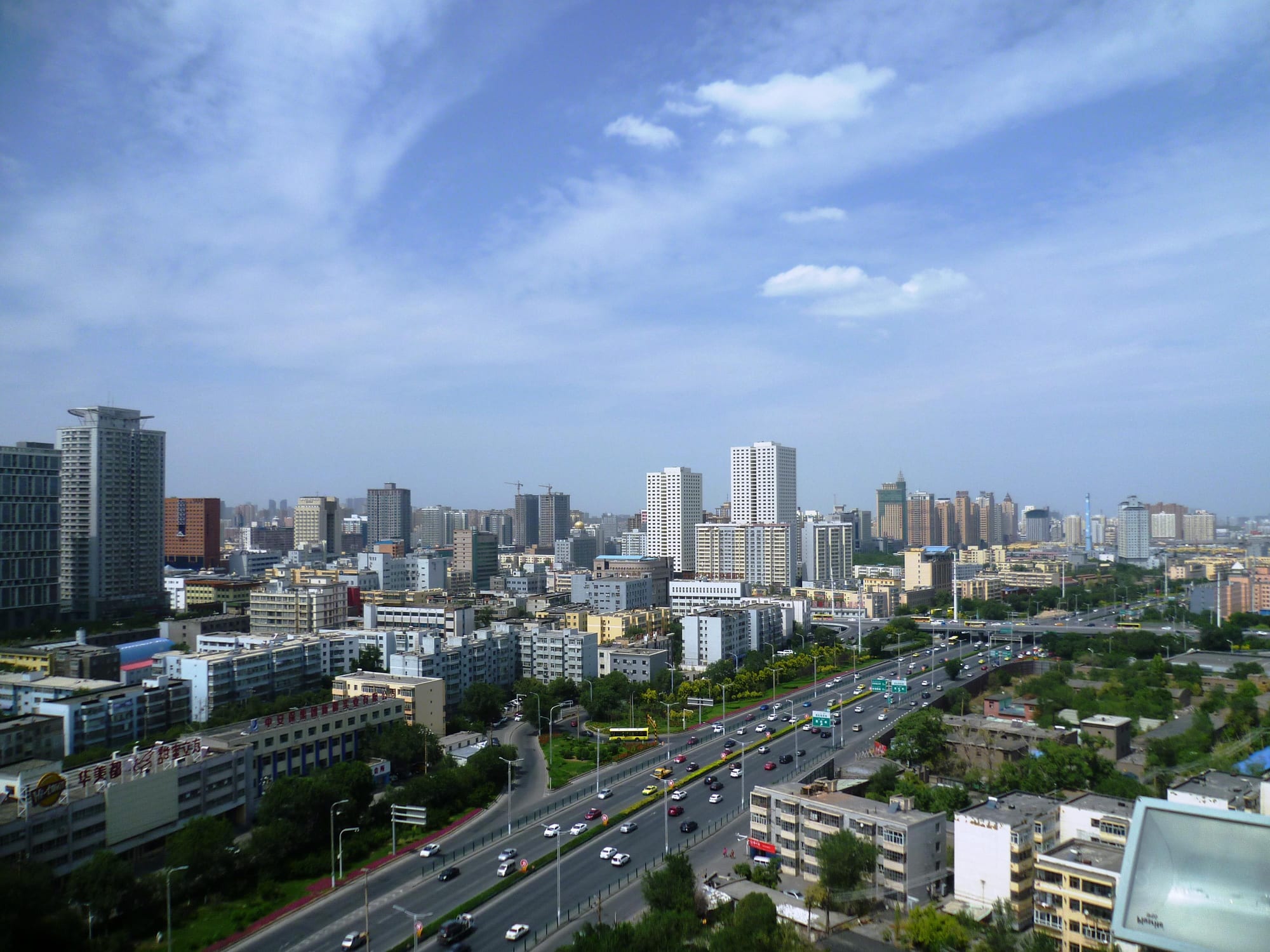
A wide view over Ürümqi from a hill, with tower blocks, low flat-roofed buildings and a busy multi-lane road running through the valley

Xi'an, the Silk Road & the Northwest, China

Ürümqi

The centre of Ürümqi seen from Hongshan in the middle of the city. (Radosław Botev / Wikimedia Commons · CC BY 3.0 pl)

The capital of Xinjiang, spread along a valley on the northern side of the Tian Shan between the Junggar Basin and the mountains. About 2,500 kilometres from the nearest coastline, it is the major city closest to the Eurasian pole of inaccessibility, and it grew from a Qing garrison into an industrial and administrative centre of some four million people, and is the transport hub through which almost all travel in the region passes.

Neighbourhoods

  • Tianshan District
    • First-time visitors
    • Best for food
    • Markets

    The old commercial heart on the eastern side of the valley, taking in the Grand Bazaar and the Erdaoqiao quarter, historically the Uyghur and Hui part of town. Markets, mosques, kebab grills and department stores sit close together, and most of the sights a short visit takes in are here.

    Open in Maps
  • Saybagh District
    • Museums
    • Hotels
    • Close to public transport

    The central business district on the west bank, with Hongshan park and its hill, the main shopping streets, offices and a large share of the hotels. The Xinjiang Museum stands in this district, and metro and bus lines converge here.

    Open in Maps
  • Xinshi and the northern new town
    • Quiet and residential
    • Transport connections

    Newer districts spreading north down the valley towards the airport and the high-speed railway station, built as grids of apartment towers, malls and wide avenues. There is little for a visitor to see, but it is convenient for early departures.

    Open in Maps
  • The southern valley
    • Views
    • Walks

    Where the city runs up against the foothills of the Tian Shan, with parks, reservoirs and the road towards the mountain pastures. The air is cleaner than in the centre and the mountains rise directly behind the last apartment blocks.

    Open in Maps

Things to do

Museums

  • Xinjiang Museummuseum

    The regional museum, best known for the well-preserved desert mummies from the Tarim Basin, along with textiles, manuscripts and displays on the peoples of Xinjiang.

    Open in Maps

Parks and viewpoints

  • People's Parkpark

    A landscaped park of lakes, willows and pavilions in the centre, laid out on Qing garden grounds and used daily for exercise, chess and dancing.

    Open in Maps

Markets and mosques

  • Xinjiang International Grand Bazaarmarket

    A large market complex built in 2003 in Central Asian style, selling dried fruit, nuts, carpets, hats and jade, with restaurants and a viewing tower.

    Open in Maps

Short trips from the city

  • Heavenly Lake of Tianshanattraction

    An alpine lake ringed by spruce forest at 1,907 metres, in the Bogda range about 45 kilometres east of the city.

    Open in Maps
  • Bogda Peakviewpoint

    The snow and ice summit of over 5,400 metres that rises above Heavenly Lake and is visible from the city on clear days.

    Open in Maps

Seasonal events

  • Summer at the mountain pasturesJune to August

    Kazakh herders move to the high grasslands south and east of the city, and weekend visitors go up for horse riding, yurts and grilled lamb.

  • Autumn fruit seasonSeptember and October

    Melons, grapes, pomegranates and figs from the oases arrive in the markets, and much of the crop is dried for the winter trade.

  • Eid al-Fitrvaries with the lunar calendar

    The end of Ramadan, marked with prayers and family visits among Uyghur and Hui residents; religious observance in Xinjiang is closely regulated.

  • Ski seasonDecember to March

    Resorts in the hills around the city operate through the long, snowy winter, drawing skiers from across northern China.

Eat and drink

Long-standing places and food districts in Ürümqi. Hours, ratings and directions come from your maps app, always current.

Ürümqi classics

  • Dapanjirestaurant

    Big-plate chicken, stewed with potatoes, peppers and chilli and finished by adding wide belt noodles to the sauce — a Xinjiang dish now eaten all over China.

    Open in Maps
  • Laghmanrestaurant

    Hand-stretched noodles under a stir-fry of mutton or beef with peppers, tomato and onion, the everyday meal in Uyghur restaurants across the city.

    Open in Maps
  • Kebabs and nanrestaurant

    Mutton grilled on iron skewers with cumin and chilli, eaten with round tandoor-baked flatbread, sold on street corners and in every bazaar restaurant.

    Open in Maps

Markets and food streets

  • Xinjiang International Grand Bazaarmarket

    Stalls of dried fruit, nuts, spices and sweets alongside restaurants serving pilaf, kebabs and samsa, with the busiest trade in the evening.

    Open in Maps
  • Erdaoqiaoneighborhood

    The old market quarter around the bazaar, where bakeries, kebab grills, offal soup stalls and ice-cream churns line the side streets.

    Open in Maps
  • Hui noodle housesneighborhood

    Hand-pulled beef noodle shops run by Hui Muslim families are found on almost every street, serving the Lanzhou-style bowl with radish and coriander.

    Open in Maps

Experience Ürümqi

History

Ürümqi is a young city by Chinese standards. The valley lay on a minor northern branch of the Silk Road and was grazing country for nomadic peoples for centuries, but the modern settlement dates from the Qing conquest of the Dzungars in 1755, when a garrison was built to control the northern side of the Tian Shan; settlers expanded it into a walled city in the 1760s and renamed it Dihua. Chinese, Hui and Manchu soldiers, convicts and merchants were settled around it, and it became the administrative centre of the new frontier territory.

When Xinjiang was made a province in 1884, Dihua became its capital. The city passed through the turbulent warlord decades of the early 20th century under a succession of governors who ruled the province almost independently, balancing Soviet and Chinese influence; Russian and Soviet trade dominated the local economy for a time. Short-lived East Turkestan republics rose in Xinjiang in 1933 and 1944, the second of them based far to the north-west in Ghulja rather than here.

In 1954 the name Ürümqi was restored, an Oirat Mongol name understood as beautiful pasture, and the city grew very fast. Coal, oil, steel and chemical industries were built, the railway from Lanzhou was completed in 1962 and opened to traffic in 1966, and migration from eastern China multiplied the population many times over. Riots in July 2009 between Uyghur and Han residents left 197 people dead by the official count, and led to curfew and a lasting security presence. Security across Xinjiang was tightened sharply in the years that followed, and the apparatus built then still shapes movement through the city.

Culture & Customs

Ürümqi is the meeting point of the region's peoples: Han Chinese from every province, Uyghurs, Hui, Kazakhs, Mongols, Kyrgyz, Russians and others, whose languages, foods and holidays overlap in the same streets. Signs are written in Chinese and in Uyghur Arabic script, the call to prayer and the sound of Chinese pop are heard in the same quarter, and the working week keeps Beijing time even though the sun stands two hours behind it.

Uyghur culture is most visible in the eastern districts — the bazaar, the kebab grills, the muqam music played in restaurants, the embroidered doppa caps — while Kazakh traditions of horses, felt and dombra music belong to the grasslands just outside the city. Religious practice is tightly restricted across the region. Politics, Xinjiang's recent history and religion are subjects residents cannot discuss safely with strangers.

For the many Han residents, this is a northern Chinese industrial capital with mountains on the doorstep: skiing and skating in winter, barbecues and grasslands in summer, square dancing in the parks, and a strong culture of eating out late. The city has universities, a symphony orchestra and a lively domestic tourism trade built around the museum, the bazaar and the mountain lake.

Daily Life

About four million people live in the Ürümqi municipality, which stretches far beyond the built-up valley. It is by a wide margin the largest city in Xinjiang and the administrative, medical, educational and transport centre for a region the size of western Europe; anyone in the south or north of Xinjiang needing a hospital, a university or a flight generally comes here.

The economy rests on energy and heavy industry — coal, petrochemicals, steel, power generation and equipment for the oil fields of the Junggar and Tarim basins — together with government, logistics and a growing wholesale trade with Central Asia. The Xinjiang Production and Construction Corps, a semi-military organisation, runs farms and enterprises around the city. Wages are respectable by regional standards, and much of the workforce arrived from other provinces within the past two generations.

Daily life runs on two clocks, Beijing time officially and an informal local time two hours behind in many Uyghur households, so office hours, school runs and evening meals all fall late by eastern Chinese standards. Winter dominates the year: heating comes on in autumn and off in spring, air quality drops sharply in the cold months, and streets are cleared of snow rather than emptied by it. Security screening at stations, markets and building entrances is part of the ordinary routine of getting through a day.

Food

Ürümqi eats Xinjiang food, which means lamb, wheat and bold spicing rather than rice and delicate sauces. Dapanji, big-plate chicken, is the dish the city is most identified with: chicken stewed with potato, green pepper and dried chilli in a wide dish, with hand-pulled belt noodles slid into the remaining sauce at the end. Laghman noodles, suoman, and polo, the rice pilaf with lamb and carrot, fill out the Uyghur repertoire, and manta dumplings and samsa pastries are sold from steamers and tandoors on the street.

Grilled meat is everywhere. Mutton cubes on iron skewers, seasoned with cumin, salt and chilli flakes, are cooked over charcoal on pavements from spring to autumn; whole lamb is roasted for occasions, and offal soups are a winter standby. Bread is the tandoor-baked nan, stamped in the centre and used to mop up everything else. Hui restaurants add hand-pulled beef noodles and steamed buns, and restaurants from Sichuan, Shaanxi and the north-east serve the large Han population.

Fruit is the region's pride and fills the bazaar: Hami melons, Turpan grapes and raisins, Korla pears, figs, pomegranates and apricots, fresh in season and dried the rest of the year. Milk tea with salt is drunk in Kazakh and Mongol homes, sweet black tea with rock sugar in Uyghur ones, and local beer and Xinjiang wine are sold widely in the Han districts.

Planning tools

Budget

Food and city transport are cheap, and mid-range hotels are reasonable, though the choice for foreign visitors is narrowed because not every hotel in Xinjiang is licensed to register them. The real costs are distances: Ürümqi is the hub from which flights and long train journeys reach the rest of the region, and day trips to the mountains usually mean a hired car or an organised tour.

Daily Budget Midrange
USD 75–160 (mid-range hotel, restaurants, museum and site tickets, a driver for the mountains, some flights)
Daily Budget Shoestring
USD 30–55 (budget hotel, noodle shops and bazaar food, metro and buses)

Confirm that a hotel can register foreign guests before booking, and allow extra time at stations, bazaars and road exits for security screening.

Best Time to Visit

May to October. Summer is warm and dry in the city and is the season for the mountain lakes and pastures, which stay cool. September and October bring the fruit harvest and clear air. Winter is long, grey and very cold, with heavy pollution during the heating season, though the ski resorts in the surrounding hills operate through it.

Suggested Number of Days

The city itself is usually seen in a day or two, since most travellers use it as a hub. Add a couple more for the mountain lake and the grasslands, or for onward connections, which often involve waiting for a flight or an overnight train.

First Visit
1–2 days
With Surroundings
3–4 days

Transportation

A metro line runs the length of the valley from the airport area through the centre, supported by bus rapid transit corridors, ordinary buses and cheap taxis and ride-hailing. Traffic on the main north-south roads is heavy at peak times. Security checks at metro and bus stations, bazaar entrances and building doors are routine and add time to every journey.

Carry the passport at all times — it is required for security screening, hotel registration, train tickets and road checkpoints outside the city.

Airport & Station Connections

Ürümqi's international airport lies about 15 kilometres north-west of the centre and is the region's main air gateway, with flights across China, to Kashgar and the other Xinjiang cities, and to some Central Asian capitals. High-speed trains run east through Turpan and Hami to Lanzhou and beyond, and ordinary trains serve Kashgar and the northern towns. Long distance buses cover the rest of the region.

Walkability

The centre around Hongshan and the bazaar district is walkable, flat enough and served by pavements, and short walks between markets, parks and restaurants work well. The city as a whole is long and strung out along the valley, with wide multi-lane roads, so crossing between districts is a job for the metro or a taxi. Winter pavements are icy for months.

Safety

Ordinary crime is low. Xinjiang is under pervasive surveillance, with frequent checkpoints, identity scans and armed patrols; foreign visitors may be questioned, have their phones checked or be followed, and conversations about politics can endanger local people. Winter air pollution, icy streets and altitude on mountain trips are the everyday physical concerns.

Do not photograph checkpoints, police or detention facilities, avoid political and religious conversations with residents, and comply calmly with identity checks. Check current official travel advice before travelling.

Climate

A cold semi-desert climate at about 800 metres, with a long, severe winter, a short spring and a warm, dry summer. Little rain falls at any season, and the city's bowl-like setting traps coal smoke and vehicle fumes in the cold months.

Summer
warm and dry — July averages about 24°C, with hot afternoons and comfortable evenings
Winter
long and very cold — January averages about −12°C, with snow lying for months

Local Customs

Ürümqi is mixed, with a Han majority and large Uyghur and Hui communities, so customs vary by district. Modest dress is sensible near mosques and in the bazaar quarter, halal restaurants serve no pork and little alcohol, and the right hand is used for eating in Uyghur places. Tipping is not customary. Photographing police, checkpoints, government buildings and security equipment is prohibited.

Ask before photographing people, keep politics, religion and security out of conversation, and be aware that the whole region runs on Beijing time although the sun rises and sets about two hours later.

Common Payment Methods

The currency is the renminbi, counted in yuan. Almost all payment is by QR code through Alipay or WeChat Pay, which foreign visitors can link to an overseas card; setting this up before arriving avoids real difficulty. Foreign cards are accepted at some larger hotels only, so carry cash for markets and small restaurants and draw it from bank ATMs in the centre.