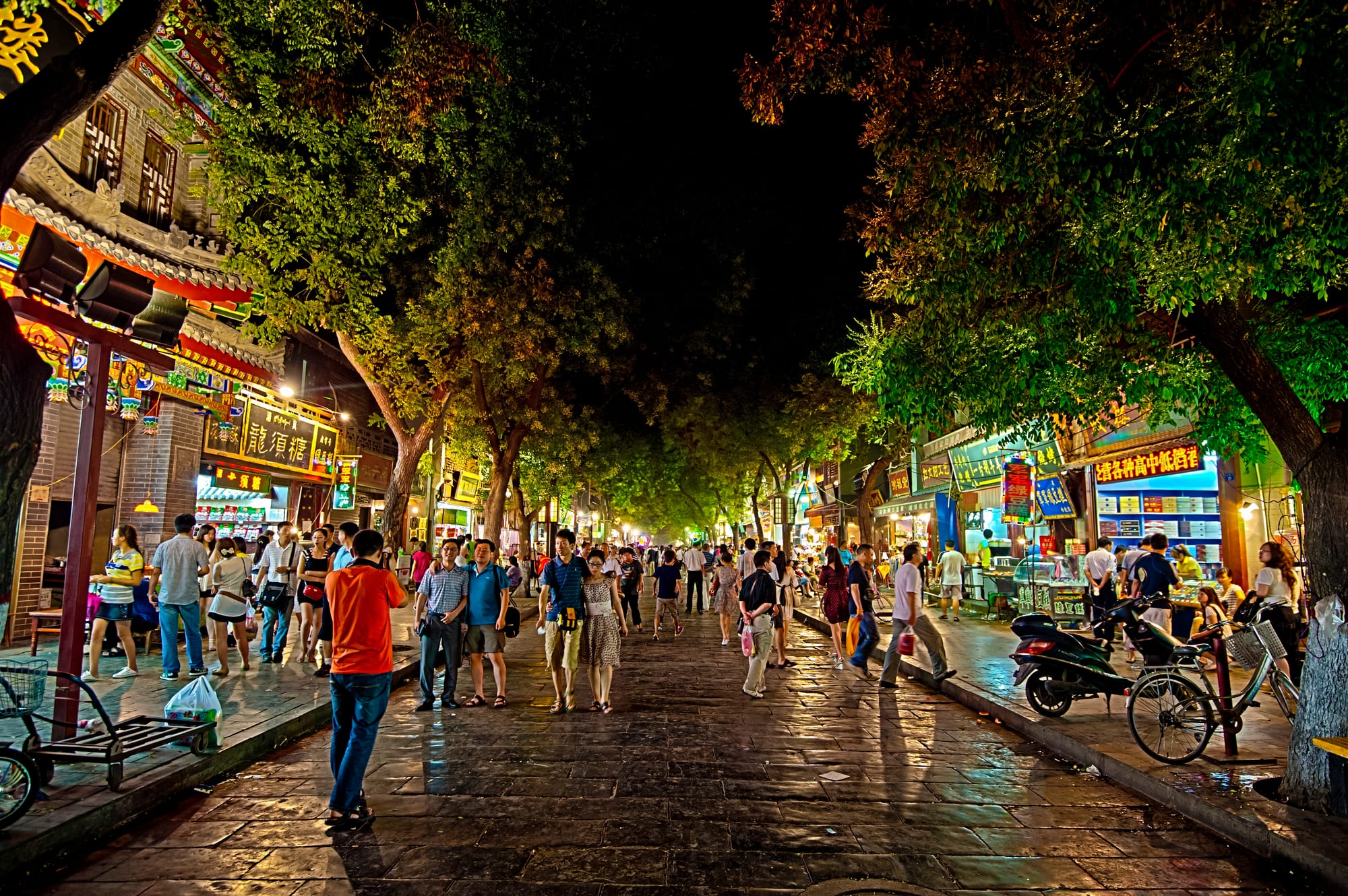
A tree-lined pedestrian street at night lined with lit food stalls, shopfronts and Chinese signboards, with people walking on flagstones

Xi'an, the Silk Road & the Northwest, China

Xi'an

An evening on a food street in the Muslim Quarter of Xi'an. (chensiyuan / Wikimedia Commons · CC BY-SA 4.0)

The capital of Shaanxi province, on the Wei river plain in north-central China, and one of the country's oldest capitals — the Chang'an of the Han and Tang dynasties and the eastern end of the Silk Road. A complete Ming wall still rings the old centre, the Terracotta Army lies in fields to the east, and the city of some thirteen million now lives on universities, aerospace industry and tourism.

Neighbourhoods

  • Inside the city wall
    • First-time visitors
    • Historic district
    • Close to public transport

    The rectangle of streets enclosed by the Ming fortifications, with the Bell Tower at its centre and the Drum Tower beside it. Most of the hotels aimed at visitors, the main shopping streets and the two great towers are here, and metro lines cross under the walls at the old gates.

    Open in Maps
  • The Muslim Quarter
    • Best for food
    • Nightlife
    • Markets

    The lanes north-west of the Drum Tower, home to Xi'an's Hui Muslim community for centuries and the centre of its street food. Bread ovens, noodle shops and skewer grills run along the busiest alleys, and the Great Mosque stands in a quiet courtyard just off them.

    Open in Maps
  • Around the Giant Wild Goose Pagoda
    • Temples and museums
    • Parks
    • Evenings out

    A district a few kilometres south of the wall built around the 7th-century pagoda and the temple beside it, with wide squares, fountains and Tang-themed streets of restaurants and shops. The Shaanxi History Museum is a short walk away.

    Open in Maps
  • Qujiang
    • Parks
    • Families
    • Quiet and residential

    The southern district of lakes, gardens and new apartment blocks laid out on the site of a Tang pleasure quarter, with the Tang Paradise gardens at its heart. It is greener and more spacious than the centre, and connected by metro.

    Open in Maps
  • Xiaozhai and the university district
    • Students and nightlife
    • Shopping
    • Local life

    A busy crossroads south of the wall surrounded by universities, shopping centres, cheap restaurants and bars. It is where a good deal of the city's student population eats and shops, and where the Small Wild Goose Pagoda stands in its park nearby.

    Open in Maps
  • Gaoxin and the western districts
    • Business
    • Modern city

    The high-technology zone west and south-west of the centre, with office towers, international hotels and the campuses of electronics and aerospace firms. It shows the working, modern Xi'an that most visitors otherwise miss.

    Open in Maps
  • Lintong
    • Day trips
    • Ancient sites

    The outlying district about 30 kilometres east of the centre where the Terracotta Army, the first emperor's burial mound and the Huaqing hot springs lie within a few kilometres of each other, below the wooded slopes of Mount Li.

    Open in Maps

Things to do

Famous landmarks

  • Fortifications of Xi'anlandmark

    The Ming city wall of the 14th century, about 14 kilometres around and wide enough on top to cycle, with gate towers, a moat and a walkway circling the old city.

    Open in Maps
  • Bell Tower of Xi'anlandmark

    A timber tower on a brick platform at the central crossroads, built in 1384 and moved to this spot two centuries later, lit at night above the traffic.

    Open in Maps
  • Drum Tower of Xi'anlandmark

    The 14th-century companion to the Bell Tower, standing at the entrance to the Muslim Quarter and housing a collection of drums.

    Open in Maps
  • Great Mosque of Xi'anlandmark

    One of the largest premodern mosques in China, founded in the Tang period and largely rebuilt under the Ming, laid out like a Chinese temple with courtyards, pavilions and a pagoda-like tower in place of a minaret.

    Open in Maps
  • Giant Wild Goose Pagodalandmark

    A brick pagoda first built in 652 to hold the scriptures the monk Xuanzang brought back from India, rebuilt in the Tang period and part of a UNESCO World Heritage listing of Silk Road sites.

    Open in Maps
  • Small Wild Goose Pagodalandmark

    A slender early 8th-century pagoda in a quiet garden beside the Xi'an Museum, its top storeys lost in an earthquake.

    Open in Maps

Museums

  • Shaanxi History Museummuseum

    The province's main museum, covering the Zhou, Qin, Han and Tang dynasties with bronzes, gold and silver hoards, tomb figures and Tang murals.

    Open in Maps
  • Stele Forestmuseum

    A museum in a former Confucian temple holding nearly three thousand inscribed stone tablets, including Confucian classics carved between 833 and 837 and a stele recording a Christian community in Tang Chang'an.

    Open in Maps
  • Xi'an Museummuseum

    The city's own museum, sharing its grounds with the Small Wild Goose Pagoda and the remains of the Tang Jianfu Temple, and holding well over a hundred thousand objects from the city's past.

    Open in Maps

Ancient sites east of the city

  • Terracotta Armyattraction

    Thousands of life-size clay soldiers, horses and chariots buried with China's first emperor and found by well-diggers in 1974, displayed in the pits where they stand.

    Open in Maps
  • Mausoleum of the First Qin Emperorattraction

    The unexcavated burial mound of Qin Shi Huang, described in Han histories as containing rivers of mercury, at the centre of a very large complex of pits and graves.

    Open in Maps
  • Huaqing Poolattraction

    Imperial hot-spring pools at the foot of Mount Li, associated with the Tang emperor Xuanzong and Yang Guifei, and the place where Chiang Kai-shek was seized in the 1936 Xi'an Incident.

    Open in Maps
  • Banpoattraction

    A Neolithic village site of the Yangshao culture on the eastern edge of the city, with excavated house floors, kilns and painted pottery under a museum roof.

    Open in Maps

Parks and Tang districts

  • Daming Palacepark

    The foundations of the vast Tang imperial palace north of the wall, now a heritage park of platforms, lawns and a museum on the scale of the vanished complex.

    Open in Maps
  • Tang Paradisepark

    A large park of lakes, pavilions and gardens opened in 2005 in Qujiang, its Tang-style buildings modern interpretations set beside the ground of the Tang Furong garden, with evening performances and lights.

    Open in Maps

Short trips from the city

  • Mount Huatrail

    A granite mountain of five peaks famous for steep stairways, cable cars and plank paths cut into cliffs, long sacred in Daoism.

    Open in Maps
  • Famen Templelandmark

    A temple west of the city whose collapsed pagoda revealed a sealed crypt in 1987 containing Tang reliquaries and imperial treasures.

    Open in Maps
  • Qianling Mausoleumlandmark

    The hillside tomb of the Tang emperor Gaozong and the empress Wu Zetian, approached by an avenue of stone figures and never excavated.

    Open in Maps

Seasonal events

  • Chinese New YearJanuary or February

    The city's biggest holiday, with lantern displays along the city wall, temple fairs and crowds at the Bell Tower.

  • Lantern FestivalFebruary or March

    The end of the New Year period, marked with lantern displays, sweet glutinous rice balls and evening crowds in the Tang-themed streets.

  • Mid-Autumn FestivalSeptember or October

    Mooncakes, family gatherings and lit gardens in the parks around the Giant Wild Goose Pagoda.

Eat and drink

Long-standing places and food districts in Xi'an. Hours, ratings and directions come from your maps app, always current.

Food districts and markets

  • Beiyuanmen and the Muslim Quarter streetsneighborhood

    Lanes of Hui-run stalls and shops behind the Drum Tower selling lamb skewers, flatbreads baked on the spot, persimmon cakes and cold noodles, busiest in the evening.

    Open in Maps
  • Restaurants around the Bell Towerneighborhood

    The blocks at the centre of the walled city, where old dumpling houses, noodle shops and modern restaurants sit among the department stores.

    Open in Maps

Xi'an classics

  • Paomo and roujiamo shopsrestaurant

    Places specialising in yangrou paomo, a mutton soup poured over bread the diner crumbles by hand, and roujiamo, stewed meat chopped into a flatbread.

    Open in Maps
  • Noodle shopsrestaurant

    Counters serving biangbiang mian, wide belt-like noodles under chilli and hot oil, along with youpo mian and other Shaanxi wheat dishes.

    Open in Maps
  • Liangpi stallsmarket

    Cold, slippery wheat or rice noodles dressed with vinegar, garlic, chilli oil and bean sprouts, sold from small stands across the city in warm weather.

    Open in Maps

Experience Xi'an

History

The plain around Xi'an has held capitals for longer than almost anywhere in China. The Western Zhou ruled from Haojing nearby in the 11th century BC; the Qin governed their unified empire from Xianyang across the river, and their first emperor was buried east of the modern city with the army of clay figures found in 1974. From 202 BC the Han built Chang'an on the site, a walled capital of markets and palaces from which Zhang Qian's missions opened the routes west that became the Silk Road.

Tang Chang'an, laid out from 582 on a grid of walled wards, was the high point: a planned city of perhaps a million people within the walls, with foreign merchants, Sogdian traders, Persian and Central Asian communities, Nestorian Christians, Zoroastrians and the Buddhist translation workshops of the monk Xuanzang, who returned from India in 645 and whose scriptures were housed in the Giant Wild Goose Pagoda. Rebellion and the fall of the Tang in 907 ended the city's imperial role, and the capital moved east for good.

Xi'an became a provincial centre. The Ming rebuilt its walls in the 14th century on a smaller footprint than Tang Chang'an, and those walls still stand. Hui uprisings devastated Shaanxi in the 1860s. In December 1936 the Xi'an Incident, in which Chiang Kai-shek was detained by his own generals at Huaqing, forced the united front against Japan. After 1949 the city was rebuilt as an industrial and aerospace centre, and since the 1980s the Terracotta Army has made it one of the most visited places in China, with metro lines, high-speed rail and new districts spreading far beyond the wall.

Culture & Customs

Xi'an treats its imperial past as a living identity. Tang dress is worn for photographs in the streets around the pagodas, Tang-style shopping quarters have been built in Qujiang and near the east gate, and the city's museums, steles and tomb figures are part of everyday civic pride rather than a specialist interest. Shaanxi's older performing traditions survive alongside: Qinqiang, a loud, direct form of opera accompanied by wooden clappers, shadow puppetry, paper cutting and drum troupes from the villages to the north.

The Hui Muslim community, settled here since the Silk Road centuries, is central to the city's character. Its mosques are built in Chinese temple style, its cooks run much of the best-known food, and the Muslim Quarter is a residential neighbourhood of families, schools and businesses as well as a place visitors come to eat. Xi'an is also a university city, with a large student population that fills the bars and cafés around Xiaozhai and gives the place a young feel out of proportion to its age.

Local manners are those of inland China: meals ordered for the table, tea poured for others before oneself, and a blunt, humorous Shaanxi speech that people elsewhere find distinctive. Hospitality is generous and insistent, and guests are expected to be pressed to eat and drink more than they intend.

Daily Life

Around 13 million people live in the Xi'an municipality, which spreads from the Wei river across the plain to the foot of the Qinling mountains. Most of them live in apartment blocks well outside the wall, in districts that have grown enormously since the 1990s, commuting by metro, bus or electric scooter to work in the technology parks, universities and factories of the south and west.

The economy rests on aerospace and defence engineering, electronics and semiconductors, car manufacturing, higher education and research — the city has one of the largest concentrations of universities in inland China — and on tourism, which employs large numbers around the wall and in Lintong. Wheat, maize and fruit farming continue on the plain, and its orchards supply markets elsewhere in China.

The day starts early with breakfast bought at a street stall, and ends late: the food streets run until midnight and older residents dance and exercise in the squares and parks in the cool of the evening. Winter is dominated by the heating season and the haze it brings, and summer by heat that pushes life outdoors after dark. Current concerns are air quality, water supply on a dry plain, traffic, the cost of housing, and the pressure of visitor numbers on a small historic core.

Food

Xi'an's food is wheat-based, strongly spiced and distinct from the rice cooking of southern China. The signature dish is yangrou paomo, a mutton or beef broth poured over a flatbread that diners crumble into small pieces by hand at the table, served with pickled garlic and chilli paste. Roujiamo, sometimes called a Chinese hamburger, is stewed pork, or cumin-scented beef in the Muslim Quarter, chopped into a baked flatbread; liangpi are cold, slippery noodles of wheat or rice starch in vinegar, garlic and chilli oil; and biangbiang mian are belt-wide hand-stretched noodles whose name is written with one of the most complicated characters in Chinese.

The Hui kitchens of the Muslim Quarter supply much of this and more: lamb skewers with cumin, nan-style breads baked against the sides of ovens, fried persimmon cakes, mutton dumpling soup, and sweet rice with dates. Soup-filled dumplings and a banquet of many small dumpling varieties are Xi'an restaurant traditions, and older Shaanxi restaurant dishes appear on formal menus.

Drinking is straightforward: tea, hot soy milk at breakfast, local beer, rice wine and, increasingly, coffee in the student districts. Pomegranates and persimmons, walnuts and other fruit from the countryside around the city, and mijiu, a sweet fermented rice drink sold hot from the stalls, round out what the city offers on its streets.

Planning tools

Budget

Xi'an is good value by Chinese standards: street food and noodle shops are cheap, metro fares are low and hotels inside the wall cost far less than in Beijing or Shanghai. The main expenses are entry tickets, which are significant at the Terracotta Army, the museums and the wall, and transport out to the sites in Lintong and beyond.

Daily Budget Midrange
USD 75–160 (mid-range hotel inside the wall, restaurant meals, site tickets, a driver for day trips)
Daily Budget Shoestring
USD 30–50 (hostel or budget hotel, noodle shops and street food, metro and buses)

Entry tickets are the largest daily cost after a hotel, and the national holiday weeks in early May and early October are the busiest time at every site.

Best Time to Visit

April to early June and September to October are the most comfortable, with mild days and clear skies; the blossom in the parks comes in spring and the colour on Mount Hua in autumn. Summer is hot and humid, winter cold and often hazy during the heating season. The national holiday weeks in early May and early October bring very large crowds.

Suggested Number of Days

Two or three days cover the walled city and the sites east of it. Four or five allow the museums a proper visit and a day out to the mountains or the Tang tombs. Travel time to the outlying sites, and ticket limits at the busiest of them, shape the total more than anything else.

First Visit
2–3 days
With Surroundings
4–5 days

Transportation

A growing metro network connects the wall, the railway stations, the airport and the southern districts, and is the quickest way across the city. Buses are cheap and reach everything else, including a direct service to the Terracotta Army. Taxis and ride-hailing are inexpensive but slow in the rush hour. Bicycles can be hired on top of the city wall for the circuit.

Carry the passport: it is needed to buy train tickets, to enter museums with ticket checks and at hotel check-in.

Airport & Station Connections

Xi'an Xianyang International Airport lies north-west of the centre, within the city of Xianyang, and is linked by metro, airport buses and taxi. The city is a major junction on the high-speed rail network, with services to Beijing, Shanghai, Chengdu, Zhengzhou and Lanzhou from Xi'an North station, and ordinary trains from the older station beside the city wall. Most domestic visitors arrive by train.

Walkability

The walled city is flat and easy to walk, and the Bell Tower, Drum Tower, Muslim Quarter and Stele Forest are all within a couple of kilometres of one another. Beyond the gates the scale changes to wide, busy avenues where the metro or a taxi is quicker. The top of the wall makes a 14-kilometre circuit on foot or by hired bicycle.

Safety

Crime against visitors is rare and the streets are busy and well lit late into the evening. The practical problems are pickpocketing in crowded food streets and at the sites, heavy traffic at junctions where scooters ignore signals, summer heat, and winter air pollution during the heating season. Queues and crowds at the Terracotta Army in holiday periods can be overwhelming.

Keep bags closed in the crowded lanes, use the metro at peak times rather than taxis, and check air quality in winter if sensitive to pollution. Check current official travel advice before travelling.

Climate

Continental and monsoon-influenced, with four distinct seasons. Summers are hot and humid with thunderstorms, autumn is mild and often the clearest season, winter is cold and dry with grey, hazy days, and spring is pleasant but sometimes dusty.

Summer
hot and humid, typically 30–35°C by day in July and August, with heavy showers
Winter
cold and dry, around 0–5°C by day, with frost at night and frequent haze

Local Customs

Tipping is not customary in restaurants, taxis or hotels. Queueing is informal, and meals are ordered for the table and shared. The Muslim Quarter is a residential as well as a tourist district: pork is not sold there, dress modestly around the Great Mosque, and ask before photographing worshippers or stallholders at work. Temples ask for quiet, and shoes are not removed in Chinese Buddhist halls but photography inside is often forbidden.

Business cards and gifts are passed and received with both hands; police and security checkpoints should not be photographed, and politics is best left out of conversation with new acquaintances.

Common Payment Methods

The currency is the Chinese yuan renminbi, and payment by phone app is the norm for everything from metro fares to street stalls; the main apps can now be linked to foreign cards, which is worth setting up before arrival. Cards are accepted in hotels and large shops, cash must legally be accepted everywhere though small vendors may have little change, and there are cash machines throughout the city.