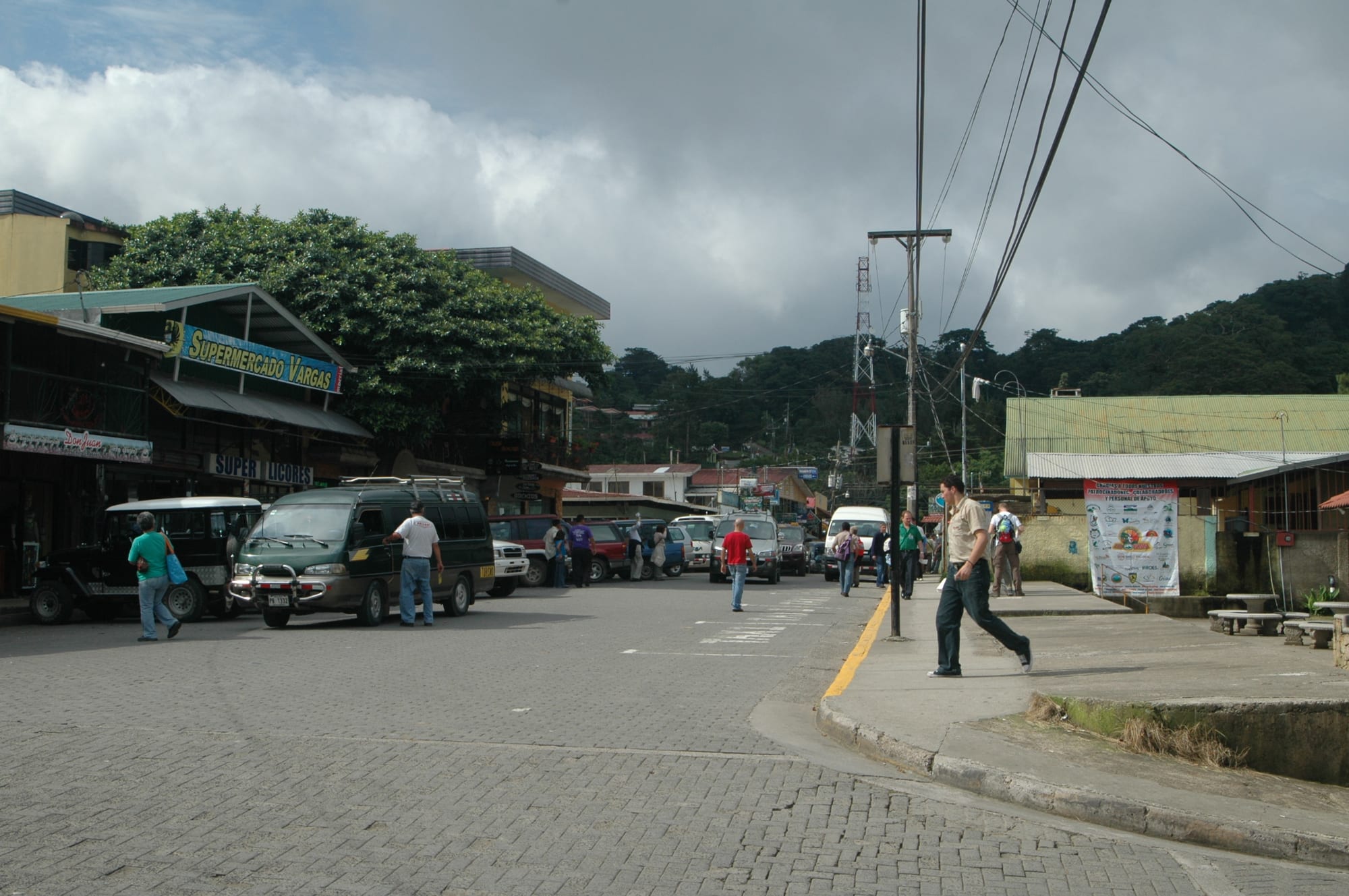
A paved street in Santa Elena with shops, parked jeeps and pedestrians, green forested hills beyond under grey cloud

Manuel Antonio, Monteverde & the Pacific Coast, Costa Rica

Monteverde

The main shopping street of Santa Elena, the town at the centre of the Monteverde area. (Erebus555 / Wikimedia Commons · CC BY-SA 3.0)

A cool, misty ridge-top community in the Tilarán mountains of north-west Costa Rica, settled in the early 1950s by American Quakers who came to farm dairy cattle and set aside forest that became the Monteverde Cloud Forest Reserve. Today the small town of Santa Elena and its neighbouring hamlets serve a quarter of a million visitors a year who come for the cloud forest.

Neighbourhoods

  • Santa Elena
    • First-time visitors
    • Best for food
    • Budget stays

    The head town of the district and the area's main tourist hub, with the bus stop, banks, supermarkets, bakeries, tour offices and most of the cheaper guesthouses along a short paved main street. Restaurants here range from sodas serving Costa Rican food to sushi, tapas and burgers.

    Open in Maps
  • Cerro Plano
    • Quiet stays
    • Close to the reserves

    The stretch of hillside between Santa Elena and the old Quaker settlement, where lodges, cafés, galleries and small nature attractions line the road up towards the Monteverde reserve.

    Open in Maps
  • Monteverde proper
    • Nature
    • Quiet and residential
    • History

    The original community founded by the Quakers in the 1950s, closest to the entrance of the Monteverde Cloud Forest Reserve. Farms, the Friends school and meeting house, and lodges set among the trees give it a quieter, rural feel.

    Open in Maps
  • San Luis
    • Rural life
    • Walks

    A lower and warmer valley below the ridge, settled by farming families in the early 20th century, with a waterfall walk, a botanical garden and research and study-abroad programmes.

    Open in Maps

Things to do

Cloud-forest reserves

  • Monteverde Cloud Forest Reservepark

    Founded in 1972 and covering more than 10,500 hectares on the Continental Divide, 90 per cent of it virgin forest, with well-kept trails and hanging bridges; the quetzal lives here seasonally.

    Open in Maps
  • Santa Elena reservepark

    A smaller reserve north of Santa Elena that draws fewer visitors than the Monteverde reserve, with a field station and, when the cloud lifts, views towards Arenal Volcano.

    Open in Maps
  • Children's Eternal Rainforestpark

    Bosque Eterno de los Niños, a private preserve of around 23,000 hectares east of Monteverde, run by a non-profit conservation league and funded by schoolchildren around the world.

    Open in Maps

Canopy walks and nature attractions

  • Canopy tours and hanging bridgesattraction

    Several operators around Santa Elena run zip-line courses high above the forest canopy, and many also have hanging bridges and forest trails that give slower, better views of wildlife.

    Open in Maps
  • San Luis waterfalltrail

    A waterfall in the San Luis valley below the ridge, reached on foot or on horseback through farmland and forest.

    Open in Maps
  • Night walkstrail

    Guided walks after dark on forest trails around the reserves, looking for the frogs, insects and mammals that are hard to see by day.

    Open in Maps

Short trips from Monteverde

  • Arenal Volcanopark

    The conical volcano to the north, often reached from Monteverde by a road-and-boat crossing of Lake Arenal; on clear days it can be seen from the Santa Elena reserve.

    Open in Maps
  • Lake Arenalpark

    The large reservoir between Monteverde and La Fortuna, crossed by boat on the popular combined route between the two.

    Open in Maps

Eat and drink

Long-standing places and food districts in Monteverde. Hours, ratings and directions come from your maps app, always current.

Monteverde classics

  • Monteverde cheesemarket

    The dairy farming that brought the Quakers here long supplied a local dairy factory, and Monteverde cheese has been sold across Costa Rica since the 1960s.

    Open in Maps
  • Panadería Jiménezcafe

    A bakery on Santa Elena's main street selling bread, pastries and coffee at modest prices.

    Open in Maps
  • CASEMrestaurant

    A women's art cooperative selling wooden crafts and other handiwork, with a small restaurant at the back serving home-style Costa Rican food.

    Open in Maps

Food districts

  • Santa Elena's main streetneighborhood

    The centre of Santa Elena has most of the area's restaurants, from sodas with casados and gallo pinto to Italian, Argentine and Japanese cooking.

    Open in Maps

Experience Monteverde

History

People farmed and hunted in these mountains long before the Spanish arrived; archaeological finds in the wider Arenal area point to villages that rose and declined over thousands of years. In the first decades of the 20th century Costa Rican families settled the area in small numbers, many of the men working in the gold mines at Guacimal below, while others farmed the warmer valley of San Luis.

The modern community began in the early 1950s, when a group of Quakers from the United States, most of them from Fairhope, Alabama, left the country rather than be drafted before the Korean War. They chose these mountains for a cool climate suited to dairy farming and for Costa Rica's army-free constitution, and in 1951 built a meeting house that also served as a school and general store. They farmed a large tract of land and set part of it aside for conservation; that land became the Monteverde Cloud Forest Reserve, founded in 1972. Improved roads in the 1960s let them send cheese and beef to the rest of the country, but overgrazing brought the dairy industry down in the 1970s, and many farmers turned to coffee.

Tourism changed everything. Fewer than a hundred visitors came in 1975; by the mid-1990s there were about 50,000, and an estimated 250,000 now arrive each year. In 2005 an armed robbery at the bank in Santa Elena ended in a hostage siege in which ten people died, an event that strained relations between Nicaraguans and Costa Ricans nationally. Long governed from distant Puntarenas, Monteverde pressed for self-government and became a canton of its own in 2022, electing its first municipal government in 2024.

Culture & Customs

Monteverde's identity rests on two things: its Quaker roots and its cloud forest. The meeting house built in 1951 grew into the Monteverde Friends School, which still teaches about 120 pupils bilingually, and the Quaker presence, along with several bilingual schools, means English is widely spoken alongside Spanish. A secular, bilingual Cloud Forest School, with local and international pupils, opened in 1991.

The forest has made the town a centre of science as well as tourism. Many foreign-born scientists live here, university field programmes and research groups work in the reserves and the San Luis valley. The reserve is famous among biologists for its orchids and for the golden toad, found only here and now extinct, which became a symbol of the worldwide decline of amphibians. In 2007 Costa Ricans voted Monteverde one of the Seven Wonders of the country.

Crafts are another local tradition: a women's art cooperative in the area sells wooden ware and other crafts. The pace of life is unhurried, conversation turns easily to birds and weather, and visitors are expected to respect the reserves' rules and the quiet of the forest.

Daily Life

The canton of Monteverde had an estimated population of about 5,400 in 2022 (4,155 at the 2011 census), spread across one district that takes in Santa Elena, Cerro Plano, Monte Verde, San Luis and several smaller settlements. Santa Elena is the head town, with the schools, banks, shops and most of the services, and much of the local economy has come to depend on tourism.

Agriculture, long the area's main income, still matters: dairy farms have long supplied the local dairy factory, and coffee growers in the area earned some of the highest prices in the world for their beans by the 1990s. Most jobs, though, are now in tourism — hotels, guiding, transport, canopy tours and restaurants — which has run here since the early 1990s.

Days begin early, with guided walks starting at dawn when the birds are most active, and evenings are quiet, with night walks the main entertainment. Roads have been partially paved in recent years, but the long climb from the highway still sets the rhythm of supplies and travel, and residents balance the income tourism brings with pressure on water, land and the forest.

Food

Monteverde's own products come from its farms. The Quaker settlers came to make cheese, and Monteverde cheese has been sold across Costa Rica since the 1960s; local coffee, grown in the surrounding hills, is roasted and sold in the town, and small chocolate makers offer bean-to-bar tastings. Bakeries on Santa Elena's main street sell bread and pastries.

Everyday eating follows the Costa Rican pattern. Sodas, small family-run diners, serve gallo pinto, rice and black beans fried together, for breakfast, and the casado at lunch: rice, beans, salad, fried plantain and a piece of chicken, fish or beef. Batidos and frescos, fruit blended with milk or water, come with most meals, and the cool climate makes a cup of local coffee welcome at any hour.

Tourism has broadened the menu. Santa Elena's centre has Italian, Argentine, Japanese and international restaurants alongside the sodas, and lodges in Cerro Plano and Monteverde cook for guests who come back from evening walks. The women's cooperative serves home-style Costa Rican food as an alternative to the tourist fare.

Planning tools

Budget

Monteverde is not a cheap stop. Reserve entry, guided walks, night tours and canopy courses add up quickly, and much of the spending goes on activities rather than rooms. Santa Elena has hostels and simple cabinas, and its sodas and bakeries keep food costs down.

Daily Budget Midrange
USD 140–280 (lodge in Cerro Plano or Monteverde, restaurant dinners, a guided reserve walk and a canopy tour)
Daily Budget Shoestring
USD 50–85 (hostel bed in Santa Elena, soda meals and bakery breakfasts, local bus, one reserve walk)

Book tours directly with the reserve or operator where possible, since hotel desks often earn a commission on what they sell.

Best Time to Visit

Monteverde can be visited all year. The dry season, roughly December to April, brings the clearest views but also the most visitors; the wetter months are quieter and greener, with more mist and rain. Wind and drizzle blow across the ridge in any season.

Suggested Number of Days

Two or three days suit a first visit, allowing for mornings lost to cloud and rain. Add a day for the lower valleys or for a slower pace of guided walks; the journey in and out is long, so very short stays are hard work.

First Visit
2–3 days
With Surroundings
3–4 days

Transportation

Local buses run up and down the hill between Santa Elena and the reserve through the day, and several taxi companies work from Santa Elena. A hire car is useful but not essential once there.

Roads beyond the paved centre are rough gravel; in the wet season a four-wheel-drive or a car with good ground clearance is the safer choice.

Airport & Station Connections

Monteverde lies at the end of a long climb into the Tilarán mountains, partly on unpaved road. Long-distance buses on the highway stop at the La Irma junction, where local buses connect up the hill. Shared shuttle vans run from most tourist centres, and a combined road-and-boat route across Lake Arenal links it with La Fortuna.

Walkability

Santa Elena's centre is compact and easy on foot, and Cerro Plano can be walked from it along the road. The reserves lie a few kilometres uphill on unpaved roads, so most people take the bus or a taxi there and walk once inside. Paths are often wet and muddy, and the road has little in the way of pavements.

Safety

Costa Rica still compares well with its Central American neighbours, and crime that reaches visitors is usually petty theft or the occasional armed robbery — break-ins to parked rental cars, bag-snatching on beaches, and pickpocketing in San José. Along the Pacific coast theft is the main risk, above all from parked cars. Monteverde itself is a small, calm community; pickpockets work on the public buses, and the mountain roads are winding and often in cloud.

Keep bags on the lap rather than in the overhead rack on buses, leave nothing visible in a parked car, and avoid driving the mountain roads after dark. Check current official travel advice before travelling.

Climate

At roughly 1,400 metres the climate is never hot: trade winds from the Caribbean blow across the ridge and keep it cool, windy and misty. The mean annual temperature is about 18°C, rainfall averages around 3,000 mm a year, and humidity stays high.

Summer
dry season (December–April): breezy and brighter, around 16–22°C at Monteverde, with mist and drizzle still common
Winter
green season (May–November): frequent rain and mist on the ridge, cool and damp all year, with a mean annual temperature of about 18°C

Local Customs

The Quaker community remains part of local life, with its meeting house and bilingual Friends school, and English is widely spoken alongside Spanish. Greetings matter: a 'buenos días' before any question is expected. Dress for cool, wet weather rather than the beach.

Stay on marked trails in the reserves, keep voices low on guided walks, and check whether a service charge is already included before adding a tip.

Common Payment Methods

The currency is the Costa Rican colón. US dollars are widely accepted for tours and lodging, usually with change given in colones, and cards are accepted in most hotels and restaurants. Santa Elena has bank branches and cash machines; carry colones for buses, sodas and small purchases.