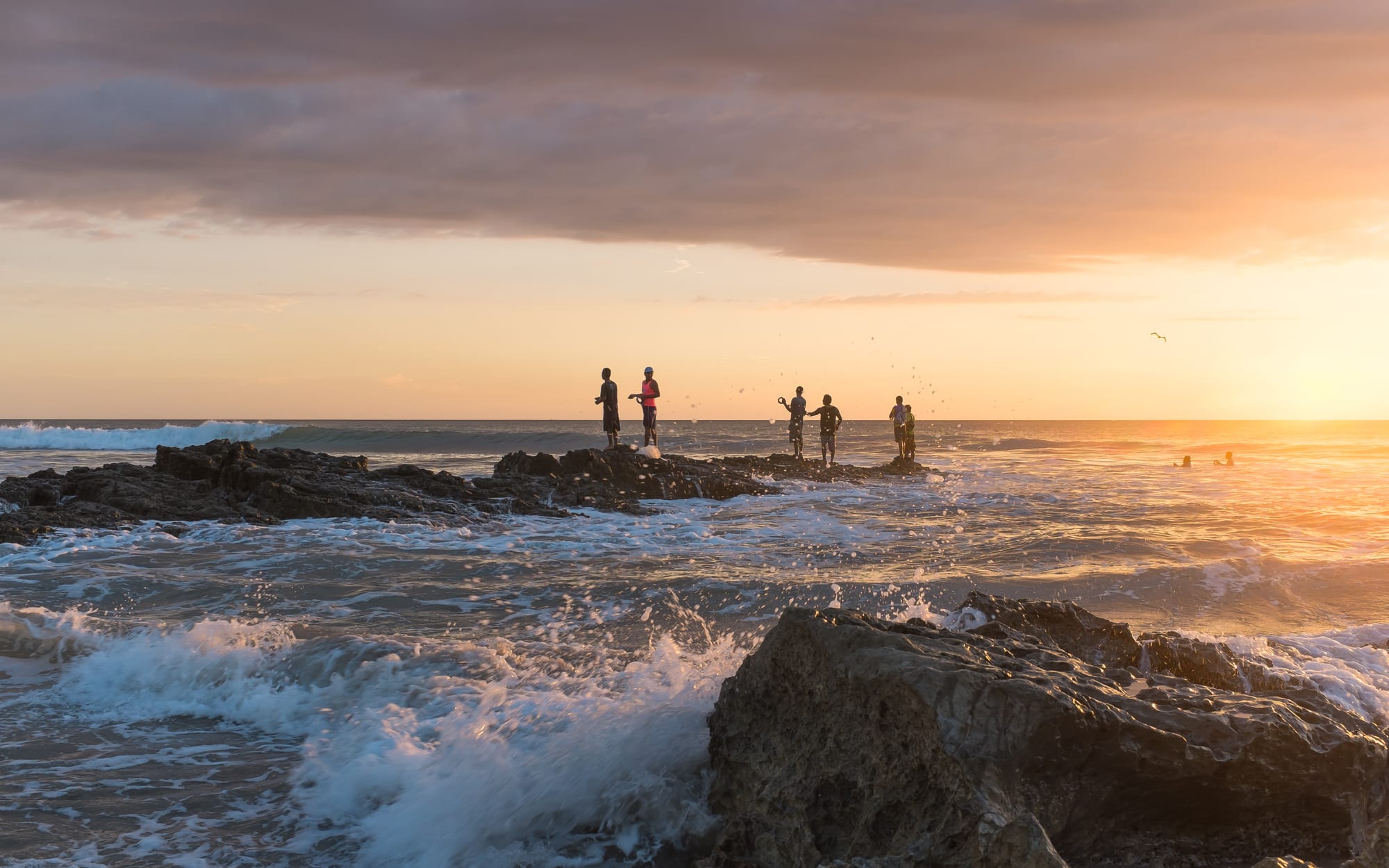
Small silhouetted figures fishing from dark rocks as waves break around them under an orange sunset sky

Manuel Antonio, Monteverde & the Pacific Coast, Costa Rica

Santa Teresa

Fishing from the rocks at sunset on Playa Santa Teresa, on the Nicoya Peninsula. (Christopher Crouzet / Wikimedia Commons · CC BY-SA 4.0)

A small surf town near the southern tip of the Nicoya Peninsula, strung out for several kilometres along the Pacific shore beside neighbouring Mal País. A remote fishing and farming village until budget travellers found it in the early 1990s, it now lives from surf camps, yoga retreats and restaurants run by cooks from around the world.

Neighbourhoods

  • Santa Teresa
    • First-time visitors
    • Surfing
    • Best for food

    The main stretch of the town along the coast road, with most of the restaurants, surf shops, supermarkets and places to stay. Paths lead down between the buildings to Playa Santa Teresa, where the best-known breaks are.

    Open in Maps
  • Mal País
    • Quiet stays
    • Fishing village feel

    The neighbouring community to the south, joined to Santa Teresa by the coast road. Its long beach has consistent waves and draws surfers, as well as fishing, diving and snorkelling trips.

    Open in Maps

Things to do

Beaches and surf

  • Playa Santa Teresabeach

    A long beach of gold-grey sand with surf all year; conditions are generally best at mid to high tide.

    Open in Maps
  • Suck Rockbeach

    One of Santa Teresa's best-known surf breaks, a right-hand point break that works when the swell is large and can turn hollow.

    Open in Maps
  • La Lorabeach

    A consistent beach break on white sand just south of Suck Rock, among the most reliable waves in town.

    Open in Maps
  • Mal País beachbeach

    The shore of Mal País to the south, about 6 km long, with consistent waves that make it popular with surfers, and fishing, diving, kitesurfing and snorkelling trips.

    Open in Maps

Short trips from Santa Teresa

  • Cabo Blanco Absolute Natural Reservepark

    Forest and sea at the southern tip of the Nicoya Peninsula, protected since 1963 as Costa Rica's first major conservation project, with a biological research station.

    Open in Maps
  • Montezumaattraction

    A former fishing village on the peninsula's eastern shore, popular since the 1980s with budget travellers for its beaches, rivers and the waterfalls around it.

    Open in Maps

Eat and drink

Long-standing places and food districts in Santa Teresa. Hours, ratings and directions come from your maps app, always current.

Santa Teresa classics

  • Sodas on the main roadneighborhood

    Simple local diners along the coast road serving gallo pinto, casados and fresh fish.

    Open in Maps
  • International restaurantsneighborhood

    Many of the town's restaurants were started by cooks who moved here from abroad, and the choice runs from pizza and seafood to vegetarian and vegan menus.

    Open in Maps

Experience Santa Teresa

History

For most of its history the southern Nicoya Peninsula was remote and thinly settled. In the colonial period the whole peninsula belonged to the Partido de Nicoya, now Guanacaste, but early in the 20th century the southern part was transferred to Puntarenas, because it was faster to reach Paquera by boat from Puntarenas than to travel overland to Nicoya. Cóbano, the district that includes Santa Teresa, was created in 1971.

Like other villages on this coast, Santa Teresa began as a remote fishing settlement, living from agriculture, cattle ranching, small-scale fishing and logging. Conservation came early to the area: in 1963 the forest at the peninsula's tip became the Cabo Blanco reserve, the country's first major conservation project.

Budget travellers discovered the town in the early 1990s, drawn by its surf, and it has grown fast ever since. Visitor numbers in the district rose from under a hundred a year in 1975 to about 25,000 by the mid-1990s and around 150,000 in recent years. Investors have bought beachfront and land for large projects, displacing some long-standing residents, and the tourism boom brought another ferry service between Puntarenas and Paquera. As of 2025 the main road through Santa Teresa and on to Mal País has been paved, replacing a rough mix of worn paving and gravel.

Culture & Customs

Surfing is at the centre of Santa Teresa's identity. With neighbouring Mal País it is one of the country's leading surf spots, with swell reaching its beaches all year and breaks for every level, from the beach breaks in front of town to the point break at Suck Rock. The district has produced notable competitive surfers, and surf camps, shops and instructors line the main road.

Yoga is the town's other identity. Retreats and daily classes draw visitors for weeks at a time, and many places to stay combine surfing and yoga. The international mix is unusual even for Costa Rica: visitors and settlers come from the rest of the country, other Latin American countries, the United States and Canada, Europe and Israel, and many restaurants and businesses are run by people who arrived as travellers and stayed.

Beneath the international surface Santa Teresa remains a Costa Rican coastal community, with a football pitch, small shops and families whose roots go back to the fishing and farming village. Daily life follows the tides, since surf conditions are generally best at mid to high tide.

Daily Life

Santa Teresa is part of Cóbano district, which had an estimated population of about 9,700 in 2022 and takes in the beach communities of Santa Teresa, Mal País, Montezuma and Tambor as well as farming villages inland. Most public services are in Cóbano, the district's head town, about 12 km away.

Tourism is now the main source of income for most families. Hotels, from simple cabinas to luxury villas, surf schools, yoga studios, restaurants, small supermarkets and vehicle hire employ much of the population. The district's local government opened a tourism and culture office in 2025 to promote sustainable, sport and rural tourism. Rising land prices and large investments in beachfront property have changed who can afford to live near the sea.

Life is outdoors and on the move: ATVs, scooters and, more recently, shared electric bicycles along the main road, boards strapped to racks, and a steady flow of new arrivals. Improvements to the main road have cut travel times in town, though the long journey from the rest of the country still shapes the town's sense of distance.

Food

Santa Teresa's food reflects its mixed population. Many of its restaurants were started by cooks who moved here from other countries, so a short stretch of road offers pizza, seafood and international cooking, and vegetarian and vegan menus beside the Costa Rican basics. Fresh local fish and seafood are widely served.

The traditional base is still found in the sodas, small family-run diners, along the main road. Gallo pinto, rice and black beans fried together with onion and pepper, is the breakfast, and the casado — rice, beans, salad, fried plantain and a piece of fish, chicken or beef — is the standard lunch.

Coastal favourites include ceviche, white fish cured in lime with onion and coriander, whole fried fish with patacones, flattened fried green plantain, and arroz con camarones, rice with prawns. In Costa Rica ceviche is usually made with corvina or prawns. Fresh fruit is blended into batidos with milk or frescos with water.

Planning tools

Budget

Santa Teresa covers every budget, from campsites and surf hostels to expensive beach villas, and prices rise in the dry season. Restaurants are fairly inexpensive by Costa Rican tourist standards, and board rental is cheap; transport — an ATV, a hire car or a private transfer — is often the largest extra cost.

Daily Budget Midrange
USD 140–280 (beach hotel or lodge, restaurant dinners, surf lessons, a trip to Cabo Blanco)
Daily Budget Shoestring
USD 50–85 (hostel or campsite, soda meals, board rental, shared e-bike)

Ask surf shops near the main breaks about board rental by the day, and book transfers or flights to Tambor in advance in the dry season.

Best Time to Visit

The dry season, roughly December to April, brings the most sunshine and the most visitors. The rest of the year is the green season, with heavy afternoon and night rain and quieter beaches. Swell reaches the coast in every month, so surfers come all year.

Suggested Number of Days

The journey takes most of a day, so three or four days is a sensible minimum. Allow a week to add the reserve at the peninsula's tip and the villages on its eastern shore; surf and yoga courses often run longer.

First Visit
3–4 days
With Surroundings
5–7 days

Transportation

As of 2025 the main road through Santa Teresa has been paved, along with a continuous road to Mal País, though side roads to some beaches are still rough gravel. ATVs, scooters, shared electric bicycles and hire cars are the usual ways to get around, and public buses connect the town with Cóbano, Montezuma and Mal País.

A four-wheel-drive is still advisable for beaches further north or south, where roads remain rough.

Airport & Station Connections

Santa Teresa is about 185 km from San José by road. The usual overland route crosses the Gulf of Nicoya by ferry from Puntarenas to Paquera, a crossing of about an hour and a quarter, followed by roughly the same again by road. Direct buses run from San José in about six hours, and shuttle vans and private transfers are common. Small planes fly from San José to Tambor Airport, about 45 minutes' drive away.

Walkability

The town stretches for more than 5 km along the coast road, so walking from end to end takes time, and the road carries ATVs and cars. Paths down to the beach are not always marked or lit, and some remain rugged. Most visitors walk within their own stretch of town and the beach, and ride the rest.

Safety

Costa Rica still compares well with its Central American neighbours, and crime that reaches visitors is usually petty theft or the occasional armed robbery — break-ins to parked rental cars, bag-snatching on beaches, and pickpocketing in San José. Along the Pacific coast theft is the main risk, including break-ins to cars at beach car parks, and rip currents are strong on many open beaches. The main road is busy with ATVs and scooters, and beach paths are often unlit at night.

Keep valuables out of sight, ask surfers or surf shops about currents and rocks before going in, and carry a torch on unlit paths after dark. Check current official travel advice before travelling.

Climate

Like the rest of the central Pacific coast, Santa Teresa has a clear dry season from about December to April and heavy rains from May to November. Low-lying parts of the district average about 27°C over the year; the warmest months are March and April, averaging about 28.5°C, and the coolest are September and October.

Summer
dry season (December–April): hot and sunny on the central Pacific coast, around 30–33°C
Winter
green season (May–November): heavy afternoon and night rain, still hot and humid, with the year's lowest averages, below the district's low-lying yearly mean of about 27°C, in September and October

Local Customs

The town is informal and international, with visitors and residents from Costa Rica, Latin America, North America, Europe and Israel, but it remains a Costa Rican community: greetings in Spanish are appreciated, and beachwear belongs on the beach. Surf etiquette matters in the line-up — wait for a turn and do not drop in on others.

Check whether a service charge is already on the bill before tipping, and ask before photographing residents.

Common Payment Methods

The currency is the Costa Rican colón, and US dollars are widely accepted by hotels, tour operators and many restaurants, usually with change in colones. Cards are accepted in most hotels and larger restaurants; carry colones for sodas, buses and small purchases, and some cash in case a machine is out of service.