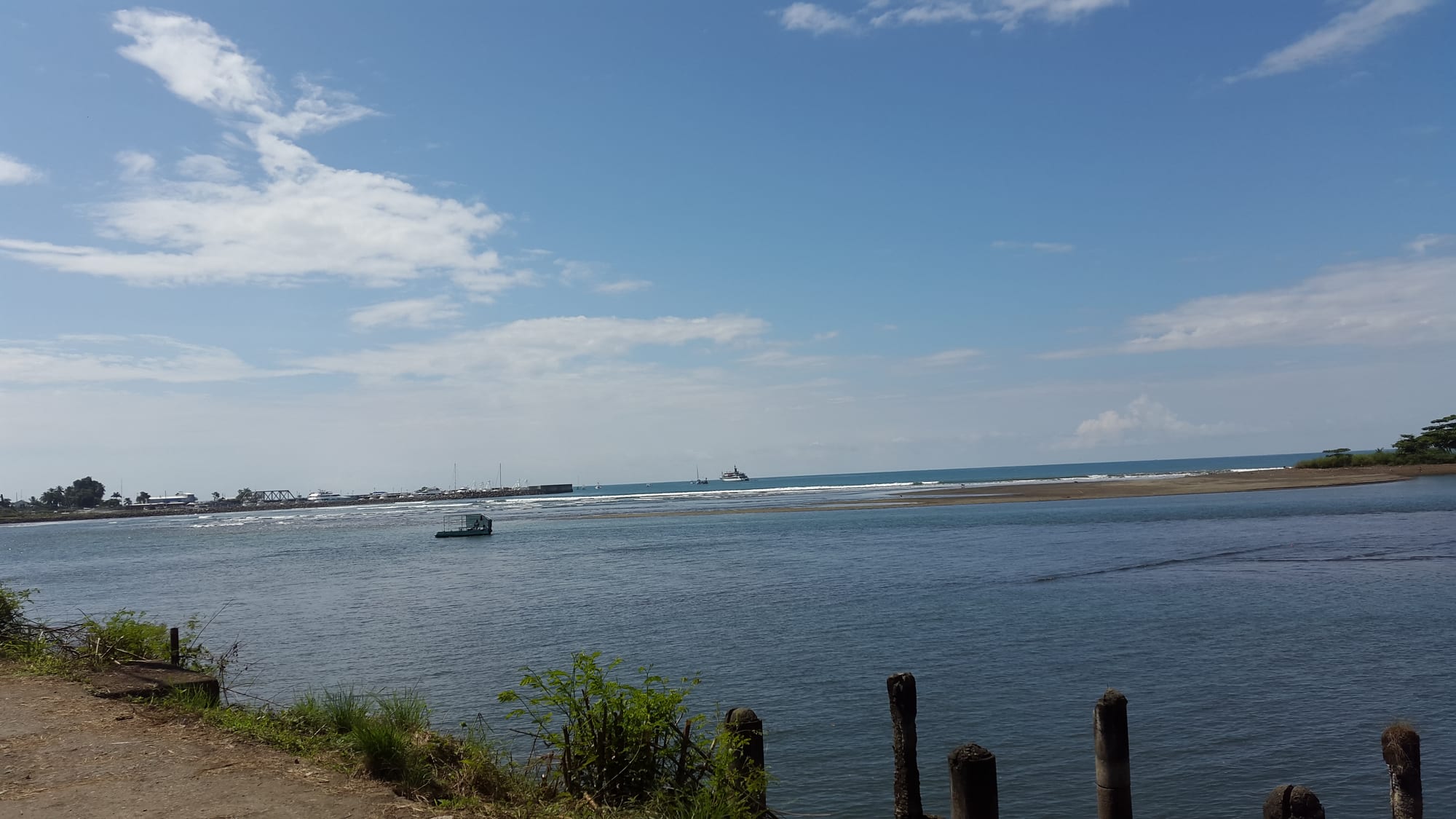
A wide calm estuary under a blue sky with scattered cloud, looking across the water to the low buildings and boats of a port

Manuel Antonio, Monteverde & the Pacific Coast, Costa Rica

Quepos

The port of Quepos seen across the water on the central Pacific coast. (Rodtico21 / Wikimedia Commons · CC BY-SA 4.0)

A port town on Costa Rica's central Pacific coast, about 157 km by road from San José, named after the Quepo people who lived here before the Spanish. It grew as a banana-exporting port in the 1930s and 1940s, and is now a sport-fishing base and the gateway to Manuel Antonio National Park, where rainforest runs down to white-sand coves.

Neighbourhoods

  • Quepos town centre
    • Budget stays
    • Best for food
    • Close to public transport

    The compact grid by the sea around the bus terminal and the market, with sodas, bars, banks, tour offices and the cheapest places to stay. It is a working Costa Rican town, busy with fishing and tourism, and lively at night.

    Open in Maps
  • The road to Manuel Antonio
    • Views
    • Hotels

    The hilly road from Quepos to the national park, where hotels, restaurants and holiday homes look out over the forest and the Pacific. Local buses run along it frequently through the day.

    Open in Maps
  • Manuel Antonio village
    • Beaches
    • First-time visitors
    • Nature

    The small settlement at the end of the road beside the park entrance, with places to eat, small hotels and craft stalls just outside the protected area.

    Open in Maps

Things to do

Manuel Antonio National Park

  • Manuel Antonio National Parkpark

    A small national park established in 1972 just south of Quepos, with white-sand coves, rocky islands, trails and forest, and the most visited national park in Costa Rica; it is open every day except Tuesdays, and tickets are sold only online, with ID.

    Open in Maps
  • Park beachesbeach

    Four beaches lie inside the park — Manuel Antonio, Espadilla Sur, Tesoro and Playita — and Manuel Antonio and Espadilla Sur have tidal pools for snorkelling.

    Open in Maps
  • Punta Catedralviewpoint

    A forest-covered headland, once an island, about 100 metres high inside the park, reached by a hike of roughly an hour from Espadilla.

    Open in Maps

On the water

  • Sport fishingattraction

    Quepos is known for its offshore fishing, above all for sailfish and marlin, with the peak billfish season from November to April.

    Open in Maps
  • Isla Damaspark

    A small island near Quepos known for its mangrove-lined estuaries, explored by boat and kayak, where white-faced monkeys, iguanas and crocodiles live.

    Open in Maps

Short trips from the town

  • Rafting on the Naranjo and Savegre riversattraction

    Rivers inland from Quepos that are run on rafting trips from the town.

    Open in Maps

Eat and drink

Long-standing places and food districts in Quepos. Hours, ratings and directions come from your maps app, always current.

Quepos classics

  • Quepos marketmarket

    The market beside the bus station, where small stalls sell local food and a cevichera serves ceviche, raw diced fish in lime juice.

    Open in Maps
  • Sodas of the town centreneighborhood

    Small family diners in the centre serving gallo pinto at breakfast and casados at lunch, cheaper than the restaurants on the Manuel Antonio road.

    Open in Maps

Restaurants with a view

  • Manuel Antonio road restaurantsneighborhood

    Restaurants and bars along the hill road between Quepos and the park, many looking over the forest to the ocean.

    Open in Maps

Experience Quepos

History

Quepos is named after the Quepo people, who lived on this stretch of coast before the Spanish arrived and made their living from farming, fishing, turtle hunting and pearl diving. In 1563 Spanish conquistadors led by Juan Vázquez de Coronado settled the area, founded San Bernardino de Quepo and subjugated the local people under an encomienda. By 1746 the surviving Quepo had been moved to a reservation shared with another Indigenous group, and the area was only resettled from the late 19th century.

The town was reborn with bananas. In the 1930s the United Fruit Company moved banana operations from the Caribbean to the southern Pacific, building offices, workshops and hospitals, first at Parrita and then at Quepos, which with Golfito became one of the main Pacific ports for banana exports. The company's subsidiary installed a power plant and completed a hospital here in 1940; the hospital passed to the state in 1962. As the population grew, Quepos became a district in 1941, and its first church was built in 1943.

After the civil war of 1948, the founding junta of the Second Republic made Quepos the head of a new canton, named Aguirre after Rolando Aguirre Lobo, a local man who had worked for the banana company and was killed in the civil war; the canton took the name Quepos in 2015. Small-scale fishing and tourism became the mainstays of the economy, helped by the creation of Manuel Antonio National Park in 1972, when the local community sought to protect the coast from development.

Culture & Customs

Quepos combines a working port with one of the country's busiest tourist areas. In the centre, fishermen, market traders and bus crowds set the pace, and the town has many bars and restaurants and a lively nightlife. Along the hill road to Manuel Antonio, life is shaped by visitors, with hotels, restaurants and tour stalls among the forest.

Sport fishing is part of the town's identity. Quepos is known for its offshore fishing, especially for sailfish and marlin, but also for snapper, wahoo, dorado, bigeye tuna and roosterfish.

Manuel Antonio National Park is the other point of pride. Founded in 1972 after local people pushed to protect the coast, and after protests against restrictions placed on the beaches by foreign owners, it is the most visited national park in Costa Rica, drawing more than 4.3 million visitors between 2012 and 2022. Its sloths and three of the country's four monkey species are a major feature, and visitors are told never to feed the animals.

Daily Life

Quepos district had about 19,900 people at the 2011 census, and a 2022 estimate put it at about 21,500; it has one of the highest population densities on the central Pacific coast. Besides the town itself, the district includes Manuel Antonio, Cerros, Damas, Paquita, Boca Naranjo and many other villages.

The economy rests on small-scale fishing and tourism. Hotels, restaurants, tour operators, park guides, fishing charters and boat tours employ many people, alongside the port, the market and the services of the canton's main town, including its hospital. Much of the hotel trade is up the hill on the Manuel Antonio road, while most workers live in the town and the surrounding villages.

The day follows the sea and the park. Fishing boats head out early, visitors make for the park in the morning, and buses shuttle between town and the beaches all day. The heavy rains of most of the year shape life too, with downpours common outside the short dry season from January to March.

Food

Quepos is a fishing town, and fish is what it does best. Ceviche, raw diced fish cured in lime juice with onion and coriander, is sold cheaply at a cevichera in the market beside the bus station and in many restaurants, and the fish landed by the town's boats ends up grilled or fried on many menus.

At the sodas, the small family diners of the centre, the day starts with gallo pinto, rice and beans fried together and often seasoned with Salsa Lizano, a thin, light-brown sauce. Lunch is the casado, a plate of rice, beans, salad, fried plantain and a piece of fish, chicken or beef.

Fresh fruit is blended into frescos with water or milk. Along the Manuel Antonio road, restaurants serve international menus to visitors with views over the forest and the ocean, while the market and sodas in the centre remain the cheaper, everyday choice.

Planning tools

Budget

The hillside hotels and restaurants around Manuel Antonio are expensive, but Quepos town has cheaper hostels and sodas. Park entry, guided walks, fishing charters and boat tours are the main extra costs.

Daily Budget Midrange
USD 140–280 (hotel on the Manuel Antonio road, restaurant meals, a guided park visit or boat tour)
Daily Budget Shoestring
USD 50–85 (hostel in Quepos, soda meals, local buses)

Stay in Quepos rather than on the Manuel Antonio hill to save money, and use the frequent local bus to the park.

Best Time to Visit

The dry season from about December to April is the best and busiest time for the park's beaches, and January to March has the least rain. The rest of the year brings heavy rain but fewer visitors, greener forest and lower prices. The peak sport-fishing season for billfish runs from November to April.

Suggested Number of Days

Two or three days allow a visit to the park and time on the beaches. Four or five leave room for boat trips, fishing, rafting and the mangroves. Because the park is closed on Tuesdays, a stay that spans one needs an extra day.

First Visit
2–3 days
With Surroundings
4–5 days

Transportation

The town centre is small and walkable. Local buses run between Quepos and Manuel Antonio about every half hour during the day, and taxis are easy to find. Buses link the town with Jacó and Puntarenas, and tourist shuttle vans run to other destinations along the coast and inland.

Buy park tickets in advance through the official online system, with an ID document, and ignore people on the road selling tickets, parking or guide services.

Airport & Station Connections

Quepos La Managua Airport, about 3 km east of the town, has domestic flights from San José. By road the town is about 157 km from San José through Atenas, Orotina and Tárcoles, and buses from the capital take about three and a half to four and a half hours. Private shuttle vans also run from San José and other tourist towns.

Walkability

Quepos town is flat and compact, with the market, bus terminal and sodas a few minutes apart. The road to Manuel Antonio is hilly, busy and best covered by bus or taxi. Inside the park the trails and beach paths are easy walking, though hot and humid.

Safety

Costa Rica still compares well with its Central American neighbours, and crime that reaches visitors is usually petty theft or the occasional armed robbery — break-ins to parked rental cars, bag-snatching on beaches, and pickpocketing in San José. On this coast theft is the main risk: car break-ins at beach car parks and bags taken on the sand at Manuel Antonio. Puntarenas province has seen rising drug-related violence in recent years, mostly among local gangs. Rip currents are strong on many open beaches.

Keep valuables out of sight, swim only at patrolled or sheltered beaches, and never feed the monkeys. Check current official travel advice before travelling.

Climate

Quepos has a tropical monsoon climate, with moderate to little rain from January to March and heavy to very heavy rain in the rest of the year. On the central Pacific coast the dry season runs from about December to April and the rains from May to November.

Summer
dry season (December–April): around Manuel Antonio, hot and sunny, with average highs around 33°C and little rain
Winter
green season (May–November): around Manuel Antonio, still hot, with average highs around 33°C, humid and very wet, with September and October the wettest months

Local Customs

Quepos is a working port town as well as a tourist base, and Spanish is the everyday language in the centre, though English is common in hotels and tour offices. Beachwear belongs on the sand rather than in town. Inside the park, wildlife is wild: keep a distance from the animals and never feed them.

Follow the park's rules and rangers' instructions, take only what is allowed into the park, and take all rubbish out.

Common Payment Methods

The currency is the Costa Rican colón, and US dollars are widely accepted for larger purchases, usually with change in colones. Cards are accepted in hotels, restaurants and tour offices, and the town has banks with cash machines. Local buses take colones, so carry small notes and coins.