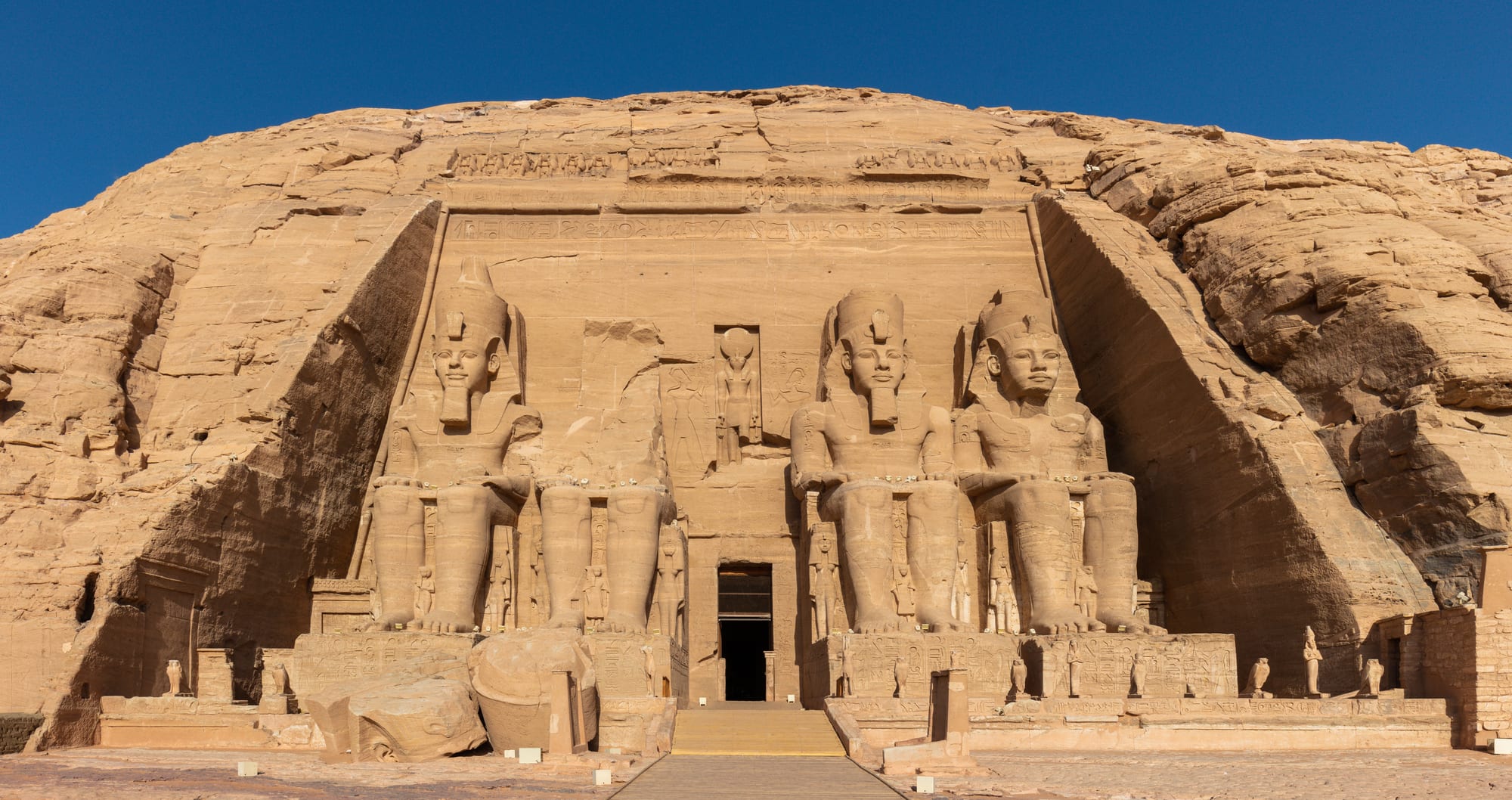
Four colossal seated statues of Ramesses II carved into a sandstone cliff either side of a dark temple doorway under a deep blue sky

Luxor, Aswan & the Nile Valley, Egypt

Abu Simbel

The facade of the Great Temple of Ramesses II at Abu Simbel, rebuilt on higher ground above Lake Nasser. (Diego Delso / Wikimedia Commons · CC BY-SA 4.0)

A small village in Egypt's far south, close to the Sudanese border and about 300 kilometres by road from Aswan, built beside the two rock-cut temples of Ramesses II. Both temples were cut from the cliff, lifted and rebuilt on higher ground in the 1960s before Lake Nasser rose over their original site, and the modern settlement grew from the camp that housed that work.

Neighbourhoods

  • The temple terrace
    • First-time visitors
    • Historic district

    The walled site above the lake, where the two temples stand inside artificial hills of concrete and rock. A path curves around the back of the domes so that the facades come into view all at once, and the ticket office, shade and a small cluster of stalls sit at the entrance.

    Open in Maps
  • The village
    • Local life
    • Quiet and residential

    A grid of low houses, a mosque, a market street, schools and small cafés a few kilometres inland from the temples. Most of the population is Nubian, and much of the work is at the site, at the airport or on the lake.

    Open in Maps
  • The lakeshore
    • Views
    • Quiet and residential

    A scatter of hotels and guesthouses on rising ground between the village and Lake Nasser, some looking straight across the water to the temples. Evenings here are silent apart from the wind, and the desert begins a few hundred metres behind.

    Open in Maps

Things to do

The temples

  • Abu Simbel templeslandmark

    Two temples cut into the cliff for Ramesses II in the 13th century BC — the Great Temple with four seated colossi of the king, and the smaller temple for Nefertari and the goddess Hathor — sawn into blocks and rebuilt 65 metres higher between 1964 and 1968.

    Open in Maps

The lake and the desert

  • Lake Nasserattraction

    The reservoir created by the Aswan High Dam, one of the largest artificial lakes in the world, which drowned the Nubian villages of the valley and now laps below the temple terrace.

    Open in Maps
  • Aswan High Damlandmark

    The dam completed in 1970 that made the lake and forced the rescue of the temples, at the far northern end of the water and usually seen on the way in or out from Aswan.

    Open in Maps

Practicalities

  • Abu Simbel Airporttransit hub

    The small airport just north of the village, built to bring visitors in from Aswan by air rather than by the desert road.

    Open in Maps

Seasonal events

  • The sun alignment at the Great Temple22 February and 22 October

    On two mornings a year the rising sun shines down the axis of the Great Temple and lights the seated gods in the sanctuary, drawing crowds, music and dancing to the terrace before dawn.

  • Ramadanvaries with the lunar calendar

    The month of fasting changes the rhythm of the village entirely, with quiet days, shops opening late and the streets busy after the sunset meal.

  • Eid al-Adhavaries with the lunar calendar

    The feast that follows the pilgrimage season, marked with family gatherings, new clothes and shared meat.

Eat and drink

Long-standing places and food districts in Abu Simbel. Hours, ratings and directions come from your maps app, always current.

Where people eat

  • The village market streetneighborhood

    A short run of grills, bread ovens, juice stands and grocers in the village, where the food is Egyptian standards — ful, ta'meya, grilled chicken, rice and salads.

    Open in Maps
  • Nubian home cookingrestaurant

    Several guesthouses cook Nubian meals for their guests and for visitors who ask — okra and meat stews, flatbread baked on a griddle, and fish from the lake.

    Open in Maps
  • Tea houses by the temple roadcafe

    Simple places for strong sweet tea, hibiscus and coffee, busiest in the cool hours before the site opens and after the last coaches leave.

    Open in Maps

Experience Abu Simbel

History

Abu Simbel's story begins with a cliff on the west bank of the Nile, about 240 kilometres south-west of Aswan, where Ramesses II had two temples cut into the sandstone in the 13th century BC — one for himself and the gods Amun, Ra-Horakhty and Ptah, the other for his queen Nefertari and the goddess Hathor. This was Nubia, the land Egypt ruled and quarried for gold, and the colossi facing the river were as much a statement to travellers from the south as an act of worship. The temples were abandoned with the old religion, and drifting sand buried the facade until the Swiss traveller Johann Ludwig Burckhardt recorded them in 1813; Giovanni Belzoni dug his way into the Great Temple four years later.

The modern village exists because of the second great engineering project of the place. When the Aswan High Dam was built in the 1960s, the rising waters of Lake Nasser would have covered the temples entirely. Between 1964 and 1968 an international campaign co-ordinated by UNESCO cut both temples into more than a thousand blocks, lifted them about 65 metres and rebuilt them against artificial hills of concrete, reproducing the original orientation. The camp that housed engineers and workers became a permanent settlement.

The same waters drowned the Nubian villages of the valley, and most of their people were resettled in the areas of Aswan and Kom Ombo. The village that grew from the workers' camp is a Nubian settlement on a lakeshore standing where the old fields were, and with almost no farmland left it now lives from the temples. In 1979 the temples were inscribed on the UNESCO World Heritage list as part of the Nubian Monuments, from Abu Simbel to Philae.

Culture & Customs

This is a Nubian village, and the difference from Egypt further north is heard immediately: Nubian languages are spoken alongside Arabic at home and in the street, and families trace themselves to villages that no longer exist above water. Songs about the lost land, the tar drum and the oud are a part of weddings and of long evenings outdoors, and houses are often painted in bright colours with decorated doorways, the domestic style Nubians carried with them when they moved.

Life is Muslim and conservative in the ordinary sense — the mosque sets the hours, Ramadan reorders the day, Eid empties the shops and fills the houses. Hospitality is taken seriously in a place where visitors have always come from a long way off, and refusing tea takes more effort than accepting it. Men in galabiyas sit out in the cool of the evening; women's social life runs through the family compounds.

The temples give the village its second identity. Nearly every household has some connection to the site, as a guard, guide, driver, cook or stallholder, and the two sun alignments in February and October are the village's own festival as much as an archaeological curiosity, with drumming, dancing and stalls on the terrace in the dark before sunrise. People here are used to crowds arriving at dawn and gone by noon, and to the silence that follows.

Daily Life

A few thousand people live in Abu Simbel, which makes it a village rather than a town, and almost everyone depends directly or indirectly on the temples, the airport and the lake. Work follows the visitors: an early start to meet the first coaches and flights, a long pause through the middle of the day when the heat makes outdoor work impossible, and activity again in the late afternoon and evening. Fishing on Lake Nasser, some small-scale farming on irrigated plots, government jobs and the school make up most of the rest.

The village is laid out in blocks of single-storey housing with a market street, a mosque, a clinic and a football pitch. Supplies come by road from Aswan, which makes some things expensive and others simply unavailable, and power and water are reminders of how far out this is. Mobile coverage is good; the desert beyond the last houses is not.

The quiet years of the trade are felt sharply here, because there is no other industry to fall back on. Regional crises that keep visitors away from Egypt empty the hotels within weeks. Against that, the village has grown steadily since the 1960s, and a generation that has never known the old Nubian valley now runs the guesthouses, the boats and the stalls.

Food

Eating in Abu Simbel is a mix of standard Egyptian food and Nubian home cooking. The everyday plates are ful medames, slow-cooked fava beans eaten with bread for breakfast, ta'meya, the Egyptian falafel made from fava beans, grilled chicken and kofta, rice, and salads of tomato and cucumber. Bread is the round flat aish baladi, and in Upper Egypt the sun-risen aish shamsi appears as well.

Nubian cooking is the local speciality and is found mostly in guesthouses rather than restaurants: okra stews, meat cooked slowly with tomato, flatbread baked on a griddle, and dishes built around lentils and beans. Fish from Lake Nasser — Nile perch and tilapia — is grilled or fried and is as fresh as anything in the country, since it is caught within sight of the village.

Drinks are what the heat demands. Tea is strong, dark and heavily sweetened, karkadeh, the deep-red hibiscus infusion, is served hot in winter and iced in summer, and sugarcane juice is pressed to order. Dates are the standard sweet, and the syrupy Egyptian pastries — basbousa and konafa — appear at feasts. Alcohol is served in a few hotels but is not part of village life.

Planning tools

Budget

Most people come for a few hours and spend little beyond the ticket and the transport, which is the real cost: a seat in a shared car or minibus from Aswan, or a short flight. Staying the night is cheap by Egyptian standards, with a handful of small hotels and guesthouses and very few places to spend money in the village itself.

Daily Budget Midrange
USD 75–170 (lake-view hotel, a private car and driver or a flight, a guide, site tickets)
Daily Budget Shoestring
USD 25–45 (guesthouse room, village food, shared road transport from Aswan, the site ticket)

Bring more water than seems necessary, and cash — the village has very few places that take cards.

Best Time to Visit

October to April, when days are warm rather than punishing. December and January are the coolest and busiest. The two sun alignments in February and October fill the village. Summer is fierce here, hotter than Aswan, and the site is best seen soon after it opens.

Suggested Number of Days

Most visits last a morning, arriving early and leaving before the heat. A night in the village turns it into two days and allows a quieter second look at the temples and time by the lake.

First Visit
1 day
With Surroundings
2 days

Transportation

The village is small enough to cross on foot, and everything else is done by car, minibus or the occasional tuk-tuk. Nearly all visitors arrive on an organised road trip or a flight and are driven the short distance between the airport, the village and the temple gate.

Agree the fare and the waiting time with any driver before setting off.

Airport & Station Connections

Abu Simbel is about three hours by road from Aswan across open desert, a trip that fills a full day there and back, or a short flight to the village's own airport. Cruise boats on Lake Nasser also call here. The Sudanese border lies a short distance south and is not a route for visitors.

Walkability

Flat, quiet and easy on foot in the cool hours, with the village streets a few kilometres from the temples and no pavement worth the name between them. There is almost no shade on the walk, so most people take a vehicle to the gate and walk only inside the site.

Safety

The temple site and the road from Aswan are heavily policed, and the village is calm. The heat and the sun are the practical dangers, along with the emptiness of the desert either side of the road. The area close to the Sudanese border is restricted, all the more since the war in Sudan began in 2023.

Follow police instructions on escorts in Middle Egypt, stay away from the border zone south of Lake Nasser, and drink plenty of water in the heat. Check current official travel advice before travelling.

Climate

One of the hottest and driest inhabited places in Egypt. Rain is effectively unknown, the sky is clear almost every day, and the lake does little to soften the air. Nights in winter can be surprisingly cold.

Summer
extremely hot and dry, regularly above 40°C by day
Winter
warm and sunny by day, around 22–26°C, with cold desert nights

Local Customs

This is a conservative Nubian and Muslim village. Covered shoulders and knees are expected away from hotel grounds, greetings are unhurried, and an invitation to tea is meant. Small tips, baksheesh, are part of daily exchange for services of every size. Photography inside the temples is controlled by the site's own rules, which change, and people should be asked before being photographed.

Alcohol is served in some hotels but is not part of village life, and during Ramadan eating, drinking and smoking in the street by day is avoided.

Common Payment Methods

The currency is the Egyptian pound. Cash is essential: only the larger hotels take cards reliably, ATMs are few, and small notes are needed for tips, taxis and the market. Change money in Aswan before coming.