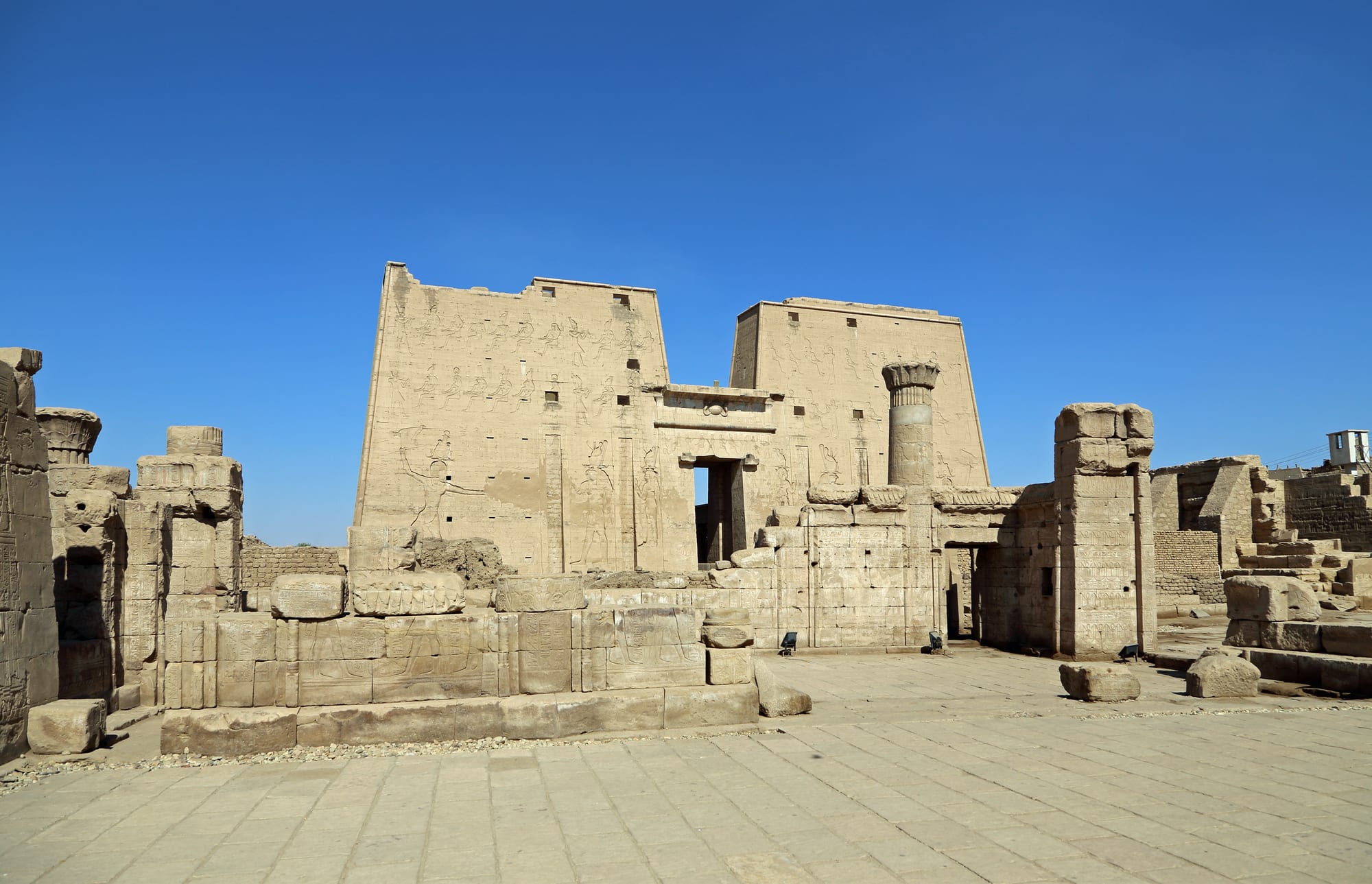
The tall stone pylon of the temple of Horus at Edfu, carved with large figures, rising behind low ruined walls under a deep blue sky

Luxor, Aswan & the Nile Valley, Egypt

Edfu

The pylon of the temple of Horus at Edfu, seen across the forecourt of the ancient complex. (Marc Ryckaert / Wikimedia Commons · CC BY-SA 4.0)

A farming and market town on the west bank of the Nile between Luxor and Aswan, built beside the Ptolemaic temple of Horus — among the best preserved of Egypt's ancient temples, and the reason almost every river cruise ties up here. Behind the temple wall the town is a working place of sugarcane fields, a busy market and a long riverside quay.

Neighbourhoods

  • The temple quarter
    • First-time visitors
    • Historic district

    The streets that press up against the temple enclosure, where the site entrance, the alabaster and papyrus shops and the carriage stands are concentrated. It is the busiest part of town in the morning, when cruise passengers come up from the river, and quiet again by lunchtime.

    Open in Maps
  • The corniche and the quay
    • Views
    • Close to public transport

    The riverfront where cruise boats moor several abreast and feluccas work the bank, with a road running along the water and the bridge to the east bank at one end. Families walk here in the evening once the heat drops.

    Open in Maps
  • The market and the town centre
    • Local life
    • Best for food

    Inland from the temple, a grid of narrow commercial streets with vegetable and spice stalls, bakeries, tea houses and workshops. This is where the surrounding villages come to buy and sell, and where prices are local rather than for visitors.

    Open in Maps
  • The sugarcane villages
    • Quiet and residential
    • Countryside

    Beyond the last streets the fields begin — cane, wheat and vegetables cut through by irrigation channels, with mud-brick and breeze-block hamlets, donkeys and the narrow-gauge cane railway that runs to the refineries.

    Open in Maps

Things to do

The temple

  • Temple of Edfulandmark

    The temple of Horus, begun in 237 BC and finished around 57 BC under the Ptolemies, with its roof, pylon, columned courts and inscribed walls almost intact because sand and later houses buried it for centuries.

    Open in Maps
  • Tell Edfuattraction

    The mound of the ancient settlement beside the temple, dug by archaeologists since the 20th century, where houses, granaries and administrative buildings show how the town lived around its sanctuary.

    Open in Maps

The river and the town

  • The Nile quay and cornicheviewpoint

    The mooring front where cruise boats stack up and feluccas cross to the east bank, giving the standard view of the river and the green fields opposite.

    Open in Maps

Short trips from the town

  • El Kabattraction

    A walled ancient town and rock tombs on the east bank downstream, settled since prehistoric times and the cult centre of the vulture goddess Nekhbet.

    Open in Maps
  • Hierakonpolisattraction

    Nekhen, the predynastic capital where the Narmer Palette was found, spread over a wide desert site of early cemeteries, a temple enclosure and a painted tomb.

    Open in Maps
  • Gebel el-Silsilaattraction

    The sandstone gorge upstream where the quarries that supplied Egypt's great temples cut into both banks, alongside rock chapels and stelae.

    Open in Maps
  • Temple of Esnalandmark

    The temple of Khnum downstream at Esna, its hypostyle hall sunk below the level of the modern town, known for the painted astronomical ceiling cleaned in recent years.

    Open in Maps
  • Temple of Kom Ombolandmark

    The double temple upstream shared between the crocodile god Sobek and the falcon god Haroeris, standing on a bend of the river with a museum of mummified crocodiles beside it.

    Open in Maps

Seasonal events

  • Ramadanvaries with the lunar calendar

    The fasting month changes the town's hours, with shops shut through the afternoon, the market reopening after sunset and lamps strung across the streets.

  • Eid al-Adhavaries with the lunar calendar

    The feast of sacrifice, when families slaughter and share meat, visit relatives and fill the riverside in the evenings.

  • The sugarcane harvestwinter, roughly December to April

    Cane is cut in the fields around the town and hauled by tractor and light railway to the refineries, which puts trailers of cane on every road and the smell of boiling sugar in the air.

Eat and drink

Long-standing places and food districts in Edfu. Hours, ratings and directions come from your maps app, always current.

Edfu classics

  • The town marketmarket

    Vegetables, dates, spices, cheese and fresh bread sold from stalls and handcarts in the streets behind the temple, with sugarcane juice pressed on the corners.

    Open in Maps
  • Grill and koshari shops in the centrerestaurant

    Small kitchens serving the everyday food of Upper Egypt — grilled chicken and kofta, koshari, ful and ta'meya with bread and pickles.

    Open in Maps
  • Tea houses on the cornichecafe

    Riverside coffee houses where men sit over strong sweet tea, hibiscus and shisha, busiest in the hours after sunset.

    Open in Maps

Experience Edfu

History

Edfu grew up around one of Upper Egypt's long-occupied settlement mounds. As Behdet, and later as the capital of the second nome of Upper Egypt, it was the cult centre of the falcon god Horus, and the mound beside the modern temple holds the remains of the town that grew up around earlier sanctuaries: houses, silos, workshops and administrative buildings layered on top of one another from the Old Kingdom onwards. In the desert about five kilometres south of the town stands a small step pyramid of the Third Dynasty, one of seven built along the valley, evidence of how early the place mattered.

The temple that stands today is far younger. Work began in 237 BC under Ptolemy III and continued, with interruptions, until about 57 BC — Greek-ruled Egypt building in a deliberately pharaonic style, on the site of an older sanctuary. Its walls carry long inscriptions about the temple's own construction and rituals, including the annual festival when the image of Hathor was brought upriver from Dendera to meet Horus. Under the Romans the town was known as Apollinopolis Magna, the Greeks having identified Horus with Apollo.

When the old religion ended the temple was abandoned, defaced in places, and gradually buried by sand and silt until houses were built over the roof. Auguste Mariette cleared it in the 1860s, and the villagers living on top were moved off. The modern town grew as a market and sugar centre on the riverbank, and since the 20th century a steady share of its living has come from the boats that stop for the temple.

Culture & Customs

Edfu is a Sa'idi town, and the manners of Upper Egypt are strongly felt: extended families, respect for elders, a slow and formal style of greeting, and pride in hospitality. Men in galabiyas gather in the coffee houses after sunset, weddings take over whole streets with drumming and lights, and the mosque sets the shape of the day. There is a Coptic Christian minority here, as throughout the valley, with its own churches and calendar of feasts.

The horse carriage is part of the town's image, and drivers, guides and shopkeepers have dealt with foreign visitors for well over a century. That long exposure produces a brisk commercial culture around the temple that is entirely separate from the quieter, courteous life of the market streets a few hundred metres away, and visitors who walk into the town find a different Edfu from the one that meets the quay.

Beyond the temple, culture is rural: sugarcane and the harvest, the cane railway, football on dusty pitches, moulids and saints' days for both Muslims and Christians, and the music of Upper Egypt, including the stick game tahtib performed as a dance at celebrations. Sa'idi identity is worn with some defiance, and jokes made at its expense in Cairo are returned with interest.

Daily Life

Edfu is a town of some tens of thousands of people and the market centre for a much larger farming population in the villages around it. Agriculture is the base of the economy — sugarcane above all, along with wheat, vegetables and dates — and the sugar refineries and the narrow-gauge lines that feed them dominate the winter months. Tourism supports a visible minority: carriage drivers, guides, guards, stallholders and the crews servicing the moorings.

The day starts before sunrise, and much of the outdoor work is finished by late morning. The middle of the day empties the streets; the market and the corniche come back to life in the late afternoon and stay busy well into the night. Transport is by minibus, tuk-tuk, donkey cart and motorbike, and the bridge over the Nile links the town to the railway station and the villages on the east bank.

The town's problems are those of Upper Egypt generally: young people leaving for Cairo, the Red Sea resorts or the Gulf for work, thin public services, and an economy squeezed by inflation and repeated devaluations of the pound. Quiet years for the cruise trade are felt immediately in a town where a single morning's arrivals can make the week's income.

Food

Edfu eats what Upper Egypt eats. Bread is the centre of every meal: aish baladi, the round flat loaf baked in every neighbourhood and torn to scoop up what else is on the table. Ful medames, fava beans stewed slowly overnight and dressed with oil, lemon and cumin, and ta'meya, the fava-bean falafel, are the standard breakfast, sold from carts and hole-in-the-wall kitchens. Koshari — rice, lentils, macaroni, chickpeas, fried onions and spiced tomato sauce — is the cheap filling meal of the middle of the day.

Meat is not an everyday food. Grilled chicken, kofta and liver sandwiches are the town's treats, and roast pigeon appears at celebrations. Mahshi, vegetables and vine leaves stuffed with spiced rice, and molokhia, the green soup of jute leaves served over rice with bread, are home cooking rather than restaurant dishes. Fish from the Nile is fried and eaten with bread and salad.

Sugarcane shapes the sweet side of local life. Fresh cane juice is pressed on street corners, and 'asal iswid, dark molasses boiled down from the cane, is eaten with tahini as a dip for bread. Tea is taken strong and very sweet, karkadeh, the hibiscus infusion, is served hot or iced, and dates from the palms along the river are sold loose by the kilo.

Planning tools

Budget

Edfu is cheap. The temple ticket and the ride up from the quay are the main outlays for most visitors, and food and tea in the town cost very little. Hotels are few and simple, because nearly everyone sleeps on a cruise boat or in Luxor or Aswan, so anyone staying pays less than in either city.

Daily Budget Midrange
USD 75–170 (cruise cabin or a Nile-view room, a guide, several site tickets, a car and driver)
Daily Budget Shoestring
USD 25–40 (simple hotel, market food, trains or shared minibuses, the temple ticket)

Agree the price of a carriage or taxi from the quay to the temple, including the wait, before getting in.

Best Time to Visit

October to April, and the town is busiest when the cruise season peaks between December and February. Mornings are the time to see the temple, before the heat and before several boats' worth of visitors arrive at once. Summer is very hot and quiet, with lower prices and fewer boats.

Suggested Number of Days

Most people see Edfu in a few hours between boat and temple. A night in the town, or a base here, stretches it to a day or two and makes the quarry and temple sites up and down the river reachable.

First Visit
Half a day
With Surroundings
1–2 days

Transportation

The centre is small enough to walk. Horse carriages, calèches, work the route between the cruise quay and the temple and are the traditional way to cover it; taxis, tuk-tuks and shared minibuses do the same job. Trains on the Cairo–Aswan line stop at Edfu station on the east bank, across the bridge from the town.

Settle every fare in advance, including the return and the waiting time, and expect to be asked firmly for extra at the end.

Airport & Station Connections

Edfu sits on the main road and rail line between Luxor, about 110 kilometres north, and Aswan, about 105 kilometres south, with a station on the east bank and frequent buses and service taxis. Most visitors arrive by cruise boat between the two cities. The nearest airports are at Luxor and Aswan.

Walkability

Flat and compact, with the temple a short walk from the market and around a kilometre and a half from the mooring front. Pavements are broken or absent, traffic is mixed with carriages and donkey carts, and shade is scarce, so walking is comfortable early and late rather than in the middle of the day.

Safety

Edfu is a quiet provincial town and the temple is policed like the other major sites. The persistent problem is commercial pressure rather than crime: carriage drivers, shopkeepers and guides compete hard for a small number of visitors who are in town for only an hour or two. Traffic and the heat are the real hazards.

Follow police instructions on escorts in Middle Egypt, stay away from the border zone south of Lake Nasser, and drink plenty of water in the heat. Check current official travel advice before travelling.

Climate

Hot desert climate with almost no rain, tempered slightly by the river and the irrigated fields. Skies are clear nearly all year, spring can bring dusty khamsin winds, and winter nights are cool.

Summer
extremely hot and dry, commonly 40°C and above by mid-afternoon
Winter
warm and sunny, about 22–26°C by day, with nights that can fall below 10°C

Local Customs

Upper Egypt is conservative, and Edfu is a Sa'idi town rather than a resort. Covered shoulders and knees are the norm for men and women alike, greetings come before business, and small tips, baksheesh, are expected for many small services. Photographing people, and especially women, needs permission first.

During Ramadan avoid eating, drinking or smoking in the street by day; alcohol is sold on cruise boats rather than in the town.

Common Payment Methods

The currency is the Egyptian pound, and Edfu runs on cash. Cards are of little use outside a cruise boat, ATMs exist but can be out of money or out of order, and small notes are needed for tips, carriages and the market.