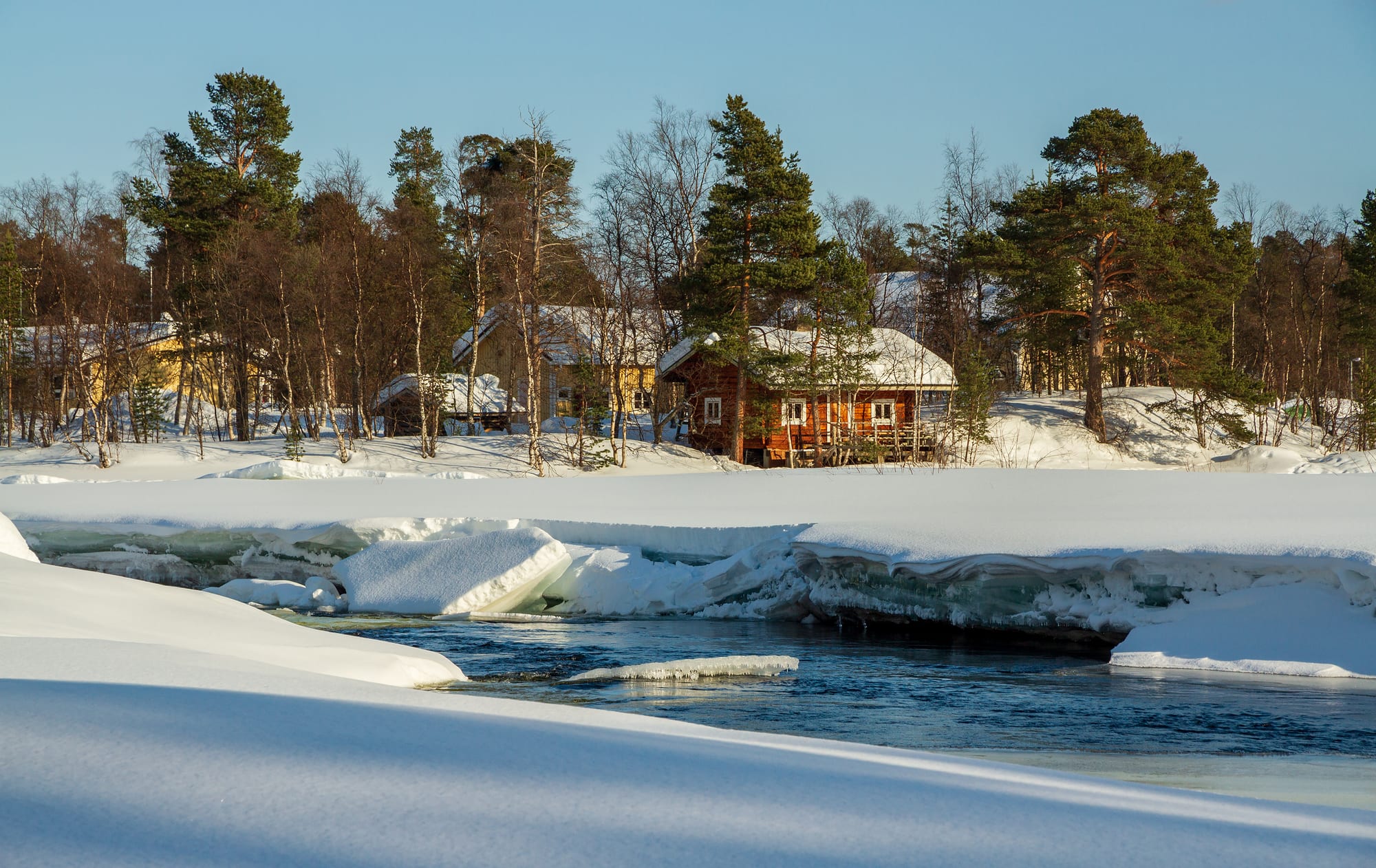
Red and yellow wooden houses among pines and birches above the snowy banks of a partly frozen river in sunshine

Lapland & the North, Finland

Inari

Houses beside the partly frozen Juutuanjoki river in Inari village in March. (Ximonic (Simo Räsänen) / Wikimedia Commons · CC BY-SA 4.0)

A small village in Finnish Lapland where the Juutuanjoki river flows into Lake Inari, the third-largest lake in Finland. An old trading and market place on the waterways, it is now the centre of Sámi culture in Finland, home to the Siida museum and the Sajos building of the Sámi Parliament, and a base for the lake, the fells and the wilderness.

Neighbourhoods

  • Village centre
    • First-time visitors
    • Sámi handicrafts

    A short main street along national road 4, with a supermarket, a few hotels and cafés, and shops and workshops selling Sámi duodji handicrafts and goods made from wood, gold, reindeer and berries. In summer it fills with travellers heading north to the Arctic Ocean.

    Open in Maps
  • Juutuanjoki riverside
    • Sámi culture
    • Museums
    • Nature trails

    The banks of the river where it flows into the lake hold the Sajos cultural centre and the Sámi Education Institute, and the Oi Juutua nature trail begins by the bridge. Upstream are the Jäniskoski rapids and the path to Otsamo fell.

    Open in Maps
  • Lakeshore and Vuopaja
    • Lake views
    • History

    The lakeside edge of the village, where the Siida museum stands and Stone Age dwelling sites have been found at Vuopaja. Cruises and boat trips leave from the harbour in summer.

    Open in Maps

Things to do

Sámi culture

  • Siidamuseum

    The Sámi Museum and Northern Lapland Nature Centre, opened in 1998 on the lakeshore, covering Sámi history and culture and the nature of the north, with an open-air museum of traditional dwellings.

    Open in Maps
  • Sajoslandmark

    The Sámi cultural and administrative centre on the Juutuanjoki, completed in 2012 to a design inspired by Sámi traditions; it houses the Sámi Parliament of Finland, the Sámi Archives and a Sámi library.

    Open in Maps
  • Pielpajärvi Wilderness Churchlandmark

    A wooden church of 1760 at the former winter village of Inari, one of the oldest buildings in northern Lapland, reached by a forest trail of about 5 km or by ski track in winter.

    Open in Maps

The lake and the river

  • Ukko islandlandmark

    A small but tall island about 11 km from the village that was a sacred site of the Inari Sámi, with a sacrificial cave; out of respect for the site, tours have not landed on the island since 2020.

    Open in Maps
  • Juutuanjoki and the Jäniskoski rapidstrail

    The river that links Lake Solojärvi with Lake Inari, followed by the 7.5 km Oi Juutua nature trail, which tells of the people and fishing of the river.

    Open in Maps
  • Otsamoviewpoint

    A 418-metre fell reached on a 9 km trail from the village through old pine forest and fell birch to a treeless summit with wide views.

    Open in Maps
  • Korkia-Maura Ice Caveattraction

    A 15-metre cave on an island in Lake Inari with a permanent floor of ice several metres thick, reached by boat in summer or over the ice in winter.

    Open in Maps

Short trips from the village

  • Lake Inaripark

    The largest lake in Sápmi, covering about 1,040 square kilometres with more than 3,000 islands, starting to freeze in late October, with some ice sometimes left in June, and fished for trout, Arctic char, whitefish and grayling.

    Open in Maps
  • Lemmenjoki National Parkpark

    Finland's largest national park and one of the largest in Europe, along the Lemmenjoki river, where around a hundred people still dig for gold each summer.

    Open in Maps
  • Ivaloneighborhood

    The largest village and administrative centre of Inari municipality, on the Ivalo River south of Lake Inari, with the airport nearby.

    Open in Maps

Seasonal events

  • Skábmagovatlate January

    An indigenous film festival held in the village during the polar-night season, at which the Skábmagovat Prize honours contributions to Sámi culture.

  • Ijahis IdjaAugust

    An indigenous music festival whose name means 'nightless night', held in the village each summer.

Eat and drink

Long-standing places and food districts in Inari. Hours, ratings and directions come from your maps app, always current.

Inari classics

  • Restaurants in Inari villageneighborhood

    A handful of hotel restaurants and cafés along the main street and the river, with fish from Lake Inari and reindeer on many menus.

    Open in Maps
  • Restaurant at Siidarestaurant

    The museum's own restaurant, serving lunch to visitors beside the lake.

    Open in Maps
  • Café at Sajoscafe

    A café inside the Sámi cultural centre, next to a shop selling authentic Sámi handicrafts.

    Open in Maps

Experience Inari

History

People lived on the shores of Lake Inari thousands of years before the present village: Stone Age dwelling sites have been found at Vuopaja, beside today's Sámi museum. The village grew up on a route that followed the waterways, at the point where the Juutuanjoki flows into the lake, and over the centuries it became a busy trading and market place for the Inari Sámi. Their winter village lay at Pielpajärvi, where a wooden church built in 1760 still stands in the forest. When Inari municipality was founded in 1876, the village became its centre.

The road from Ivalo reached the village in 1925, and the road to Petsamo on the Arctic Ocean, finished in 1931, opened the region up. The Finnish Tourist Association opened a lodge on the Juutuanjoki in 1937, but retreating German troops burned it late in 1944 during the Lapland War. After the war Finland lost Petsamo to the Soviet Union, and its Skolt Sámi were resettled in Inari municipality. Ivalo grew into the municipal centre, but Inari village did not decline.

For a century and a half gold has been part of village life: prospectors from Lemmenjoki came to buy supplies and meet their fellows, and dozens of them lie in their own plot in the village cemetery. Inari's modern role took shape around Sámi institutions — the Siida museum opened in 1998, and in 2012 the Sajos centre was completed to house the Sámi Parliament, established in 1996.

Culture & Customs

Inari is widely known as the capital of Sámi culture. The municipality is the only one in Finland with four official languages: Finnish, Northern Sámi with about 700 speakers, and Inari Sámi and Skolt Sámi with about 400 each. Inari Sámi is the language traditionally spoken around the lake, and the Sámi Education Institute in the village is one of the few places where anyone can study Sámi languages and culture. In 2019 about 2,100 registered Sámi lived in the municipality, roughly 31 per cent of its people.

Sámi handicraft, duodji, is visible everywhere in the village, alongside a growing number of products made from wood, gold, gemstones, reindeer, berries and herbs. Gákti dress and joik singing are living traditions, and the tourism industry in Finland has been criticised for turning Sámi culture into a marketing tool, so visitors are asked to treat it with respect. The island of Ukko in the lake was an important sieidi, a sacred natural site, possibly used for offerings into the 19th century.

The calendar has two cultural peaks. In late January, in the depth of the polar night, the Skábmagovat indigenous film festival brings filmmakers to the village, and in August the indigenous music festival Ijahis Idja, the "nightless night", fills it with music.

Daily Life

Inari village had about 630 people in its built-up area at the end of 2022, the second-largest settlement in the municipality after Ivalo. The municipality as a whole, the largest in Finland by area at more than 17,000 square kilometres, had about 7,200 inhabitants at the end of 2025 and is one of the most sparsely populated; unusually for Lapland, its population has been growing since 2012, largely thanks to tourism.

Tourism, services and cold-climate testing are the main sources of income. In summer tens of thousands of travellers pass along the main street on their way to the Arctic Ocean, and Siida, Sajos and the craft shops draw many of them in. The Sámi Parliament, the Sámi Archives and the education institute also bring year-round work to the village.

The year swings between extremes of light. From early December to mid-January the sun does not rise, and on clear nights the northern lights fill the sky; from late May to late July it does not set. The lake freezes in late autumn and can hold ice into June, and life moves by snowmobile and ski in winter and by boat in summer.

Food

Lake Inari shapes what is eaten here. Trout, lake salmon, Arctic char, whitefish, grayling, perch and pike live in the lake, and trout, char and grayling are the main catch for the anglers who come to fish its waters and the Juutuanjoki. Fish appears on the menus of the village's restaurants.

Reindeer is the other staple. The best-known dish is poronkäristys, sautéed reindeer, perhaps the most famous traditional meal of Sápmi: the meat is sliced thinly while still frozen, fried in fat, seasoned with black pepper and salt, simmered with a little water, cream or beer until tender, and served with mashed potato. Its Northern Sámi name is báistebiđus.

Coffee is drunk constantly, and outdoors it may be taken from a guksi, kuksa in Finnish, a cup traditionally carved from birch burl as Sámi duodji. Leipäjuusto, a fresh squeaky "bread cheese" made in Northern Finland, is eaten with cloudberry jam, and cloudberries, bilberries and lingonberries are picked in the surrounding forests and mires in late summer.

Planning tools

Budget

Inari is a small, remote village, so accommodation is limited and prices are high in the busy seasons — the summer road-trip months and the winter aurora season. Guided husky, boat and snowmobile trips add up; walking the nature trails, visiting the free parts of Sajos and watching the northern lights cost nothing.

Daily Budget Midrange
USD 200–420 (hotel or cabin, restaurant meals, museum entry and one guided trip)
Daily Budget Shoestring
USD 80–135 (cabin or campsite, self-catering, coaches, free trails)

Book rooms early for summer and the winter festivals, as the village has only a few hotels.

Best Time to Visit

June to August for the midnight sun, boat trips on the lake, canoeing and hiking — with mosquitoes. September brings ruska colour and the return of the northern lights, which can be seen until March. Late January has the Skábmagovat film festival; late winter offers snow, longer days and husky trips.

Suggested Number of Days

Two days are enough for the museum, the cultural centre and a walk or two. Allow longer to spend time on the lake, reach the national parks or wait for clear skies for the aurora; wilderness trips need several days.

First Visit
2 days
With Surroundings
4–6 days

Transportation

The village is small enough to walk. Coaches on the E75 between Rovaniemi and northern Norway stop here, and taxis can be booked, but a car is the practical way to explore the wider municipality. In summer canoes and bikes can be hired and boat trips run; in winter skis, snowshoes and husky sleds take over.

A boating chart is needed for Lake Inari's maze of islands; go with a guide or a local operator if unsure.

Airport & Station Connections

The nearest airport is at Ivalo, the municipal centre about 40 km to the south, with flights from Helsinki; coaches link Ivalo and Inari. Coaches from or via Rovaniemi pass through Inari on their way to Utsjoki, Nordkapp and Kirkenes, but the full journey from Helsinki by bus takes more than 15 hours. Many travellers take the sleeper train to Rovaniemi and drive or take the coach north.

Walkability

The village is compact: the main street, Siida, Sajos and the riverside are a short walk apart, and nature trails start from the village. Paths are snowy and icy from autumn to spring, and in midwinter there is little daylight.

Safety

Finland is consistently rated one of the safest countries in the world, with very low crime. Around Inari the real hazards are extreme cold, polar-night darkness, thin ice on the lake and rivers, sudden weather on open water and the long distances to help in the wilderness.

Dress for severe cold, check ice conditions before going onto the lake, tell someone the planned route before wilderness trips and watch for reindeer on the roads. Check current official travel advice before travelling.

Climate

A chilly, humid subarctic climate with cold winters and cool summers; it is also among the driest places in Finland. The midnight sun lasts from late May to late July and the polar night from early December to mid-January. Lake Inari freezes in late autumn, and ice can linger into June.

Summer
cool — even in July the average daytime temperature is only about 17°C, though Ivalo Airport has recorded 31.8°C
Winter
severely cold — in Sodankylä, to the south, temperatures usually fall to about −20°C, and Ivalo Airport has recorded −48.9°C

Local Customs

Inari municipality has four official languages — Finnish, Inari Sámi, Skolt Sámi and Northern Sámi — more than any other in Finland. Sámi culture is living culture, not a show: gákti dress, duodji crafts and reindeer herding belong to the people who practise them. Ukko island and other sites around the lake are sacred to the Sámi. Tipping is not expected.

Ask before photographing people, buy duodji from Sámi makers, and respect sacred sites. Strong alcohol is sold only in Alko shops.

Common Payment Methods

Finland uses the euro. Cards and mobile payment are accepted in shops, hotels and cafés, and many places no longer take cash.