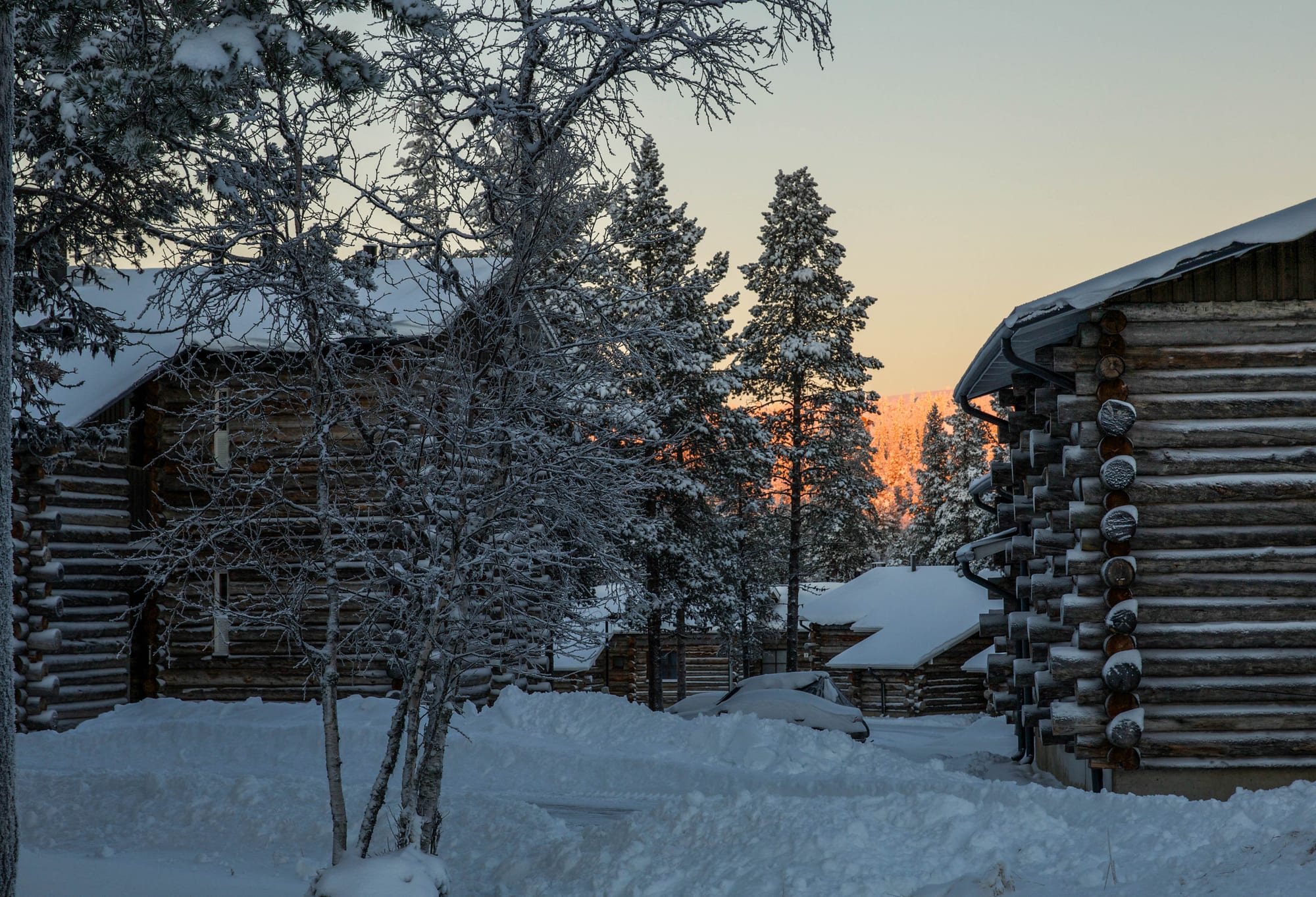
Snow-covered log buildings among pines and birches in Saariselkä, with a fell glowing orange in low winter sun

Lapland & the North, Finland

Saariselkä

Log buildings in Saariselkä village on a short winter day. (Ninara from Helsinki, Finland / Wikimedia Commons · CC BY 2.0)

A fell village in Inari municipality, Finnish Lapland, about 30 km south of Ivalo at the edge of Urho Kekkonen National Park. Gold prospectors came first, in the 1870s; ski lifts followed in 1970. Today it is a compact resort of log buildings, ski slopes and tracks, a base for wilderness hiking, husky and reindeer safaris and northern-lights watching.

Neighbourhoods

  • Saariselkä village
    • First-time visitors
    • Easy on foot

    A compact strip of hotels, cabins, shops and restaurants in a valley beside national road 4, with a petrol station. Almost everything is within walking distance, and the ski slopes are about a kilometre away.

    Open in Maps
  • The slopes of Kaunispää and Iisakkipää
    • Skiers
    • Views

    The two fells just north-east of the village carry the ski lifts and pistes, many of them floodlit, and the long sledding run down Kaunispää. The summit of Kaunispää has a café and views across the fells.

    Open in Maps
  • Laanila
    • Quiet and residential
    • Gold-rush history

    A small settlement about 3 km south of the centre, where the Prospektor gold company set up its office and mine shaft in 1902. Cabins and the start of trails into the national park lie among the forest.

    Open in Maps
  • Kakslauttanen and Kiilopää
    • Wilderness
    • Hiking and skiing

    Two places further south, linked to Saariselkä by trails, ski tracks and the bus. Kiilopää, a 546-metre fell with no lifts, is one of the main starting points for trips into Urho Kekkonen National Park.

    Open in Maps

Things to do

Fells and trails

  • Kaunispääviewpoint

    The 438-metre fell beside the village, reached on foot or by road, with a café on top and wide views; in clear weather mountains in Russia can be seen.

    Open in Maps
  • Iisakkipää nature trailtrail

    A 6 km nature trail to the top of Iisakkipää and back, explaining the traces left by the Ice Age; in winter the route is marked for snowshoes.

    Open in Maps
  • Rumakurutrail

    A steep, rocky Ice Age gorge about 6 km from the village by marked trails or ski tracks, with a day hut from around 1900, probably built by gold diggers.

    Open in Maps
  • Prospector's trailtrail

    A trail near Laanila to the old mine and mine hut of the Prospektor gold company, continuing into the national park's trail network.

    Open in Maps
  • Magnetic Hill road museumlandmark

    A preserved stretch of the old Highway 4 to Petsamo, so steep that 1940s lorries struggled up it and drivers believed a magnetic force was draining their engines.

    Open in Maps

Short trips from the village

  • Urho Kekkonen National Parkpark

    One of Finland's largest protected areas, established in 1983, with easy marked paths in the west and wilderness for long, demanding trips; reindeer herding is still common here.

    Open in Maps
  • Tankavaaraattraction

    A gold-prospecting village 30 km south of Saariselkä on the E75, a tourist attraction since the 1970s with the Gold Prospector Museum.

    Open in Maps
  • Hammastunturi Wilderness Areapark

    A protected fell and forest wilderness between Urho Kekkonen and Lemmenjoki national parks, established in 1991, whose history includes the gold-rush village of Kultala on the Ivalo River.

    Open in Maps
  • Ivaloneighborhood

    The municipal centre of Inari, 30 km north on the Ivalo River, with shops, services and the airport nearby.

    Open in Maps

Eat and drink

Long-standing places and food districts in Saariselkä. Hours, ratings and directions come from your maps app, always current.

Saariselkä classics

  • Restaurants in Saariselkä villageneighborhood

    Hotel and village restaurants with reindeer meat on most menus, along with fish from the northern rivers and lakes.

    Open in Maps
  • Kota dinnersrestaurant

    Set dinners cooked over a fire inside a Lappish kota tent or hut, offered by a number of tour operators around the village.

    Open in Maps
  • Siulan Riista ja Kalacafe

    A game and fish delicatessen in the Siula shopping centre, with a café serving one of the village's simpler lunches.

    Open in Maps

Experience Saariselkä

History

For centuries the fells of Saariselkä saw little but the passage of Sámi reindeer herders. That changed in 1865, when the crown bailiff Konrad Planting, who carried a gold pan on his travels, found gold on the Lutto River at the foot of Kaunispää. The Finnish gold rush followed. The first claim at Saariselkä was staked in 1871 by Johan Alfred Piponius, who dug 329 grams of gold in a summer, and in 1902 the Prospektor company built an office and a mine shaft at nearby Laanila. In 1935 the largest gold nugget ever found in Finland, weighing 393 grams, was found on the Lutto.

A road from Sodankylä to Ivalo was finished in 1914, with small state inns along the way that began to take tourists in the 1920s, and the Arctic Ocean road to Petsamo brought more traffic after 1931. In autumn 1944, during the Lapland War, retreating German troops burned the inns, and Finnish and German forces fought around Kaunispää in early November.

After the war the Finnish Tourist Association moved an old army barrack to the gully below Kaunispää and opened a lodge there in 1949; a second lodge on the summit followed in 1954. The first ski lift opened in December 1970, a building plan was approved in 1972, and people have lived here year-round since 1973. Finnish companies built their own lodges, and the resort became known for corporate hospitality and visits by senior politicians. Urho Kekkonen National Park was established on its doorstep in 1983. In February 2022 the village's main shopping centre burned down.

Culture & Customs

Saariselkä lies in Inari municipality, part of the Sámi homeland in Finland, and reindeer herding remains a common way of life in the surrounding national park. Visitors meet reindeer on sleigh rides and at reindeer farms. Tour operators run husky safaris, reindeer sleighs, snowmobile and snowshoe treks and ice fishing, often with a meal cooked in a wilderness cabin.

Compared with the fast-growing resorts of Levi and Ylläs, Saariselkä has kept the character of a traditional fell centre where cross-country skiing matters as much as downhill: the slopes are modest, but a network of skiing tracks, many of them lit, runs through the forests and over the fells. The long sledding run down Kaunispää, whose lighting won an international award in 2019, is one of the village's favourite pastimes.

Lapland weddings are another local speciality. Couples come in winter for a "white wedding", sometimes arriving at the chapel by husky or reindeer sledge, and small chapels in and around the village are popular venues. Gold panning, a reminder of the area's first boom, is still offered to visitors.

Daily Life

Saariselkä has only about 200 permanent residents, but in season it holds many times that number: by 2012 the resort had around 13,500 beds. Hotels, cabin rentals, restaurants, ski lifts and safari companies provide most of the work, and the year follows their seasons — skiing in late winter and at Easter, Christmas visitors in December, aurora watchers through the dark months and hikers in the September ruska. In between, the village is quiet.

Life is shaped by distance. The municipal centre and airport are near Ivalo to the north, Rovaniemi is about three hours away by road, and national road 4 is the lifeline for buses and supplies heading for the Norwegian border. The closure of the Russian border in 2023 cut off the old routes east.

The light rules the calendar. Around midwinter the sun barely rises or does not rise at all, and the village is lit by snow, streetlights and, on clear nights, the aurora; in summer the midnight sun lasts into late July. People get around on skis, bikes and snowmobiles.

Food

Reindeer meat is the dish visitors are urged to try, and it appears on almost every menu in the village. The best known preparation is poronkäristys, sautéed reindeer: the meat is sliced thinly while still frozen, fried in fat, seasoned with black pepper and salt, simmered with a little water, cream or beer until tender, and served with mashed potato. Fish from the northern rivers and lakes and game from the forests appear alongside it, and a game and fish delicatessen in the village sells local products.

A set dinner in a kota — a Lappish tent or hut — cooked over an open fire is a popular evening outing, and safari companies often serve a reindeer lunch in a hunter's or fisherman's cabin. Lohikeitto, salmon soup with cream, is one of the most popular salmon dishes in Finland.

Leipäjuusto, a fresh "bread cheese" with a squeaky texture traditionally made from cow's colostrum, is often eaten with cloudberry jam and coffee. Cloudberries, lakka in Finnish, grow in bogs and also flavour liqueurs such as lakkalikööri. Coffee outdoors is often drunk from a kuksa, a cup carved from birch burl in the Sámi tradition.

Planning tools

Budget

Saariselkä is expensive in winter, above all around Christmas and in the February and Easter school holidays. Guided husky, reindeer and snowmobile safaris and aurora tours cost a great deal per person, and food in Lapland is dear. Hiking, cross-country skiing and the national park's open huts cost little or nothing, and summer and autumn are cheaper.

Daily Budget Midrange
USD 220–460 (hotel or log cabin, restaurant meals, one guided activity a day)
Daily Budget Shoestring
USD 85–145 (shared cabin or hostel, self-catering, buses, free trails and huts)

Book Christmas and the winter holiday weeks well ahead, and use the free marked trails and ski tracks to balance the cost of guided tours.

Best Time to Visit

Peak skiing comes in the school winter holidays and at Easter, and the downhill season ends in early May. The aurora draws visitors through most of the winter, though cloud often hides it. September's ruska autumn colour is the high season for hiking and mountain biking, and the midnight sun can be seen into late July.

Suggested Number of Days

Three or four days allow some skiing or walking on the fells and a couple of guided outings, with several nights' chances of clear skies for the aurora. Hikers heading into the national park need a week or more, and short midwinter days make everything take longer.

First Visit
3–4 days
With Surroundings
6–8 days

Transportation

The village itself is easy to walk. A ski bus links the village and the slopes roughly hourly in season and also serves Kakslauttanen, Kiilopää and Ivalo, and coaches on national road 4 stop at Saariselkä, Laanila and Kakslauttanen several times a day. Bikes and skis are useful, with routes through the centre; the terrain is hilly.

Taxis can be booked by phone or app; outside the centre, check whether accommodation is on the ski bus route.

Airport & Station Connections

Ivalo Airport, the northernmost airport in Finland and the EU, is about 25 km north and has flights from Helsinki and seasonal international flights, with a bus connection of about 20 minutes. Saariselkä is on national road 4 (E75), with several coaches a day from Rovaniemi, about three hours away; many travellers take the overnight train to Rovaniemi and continue by coach.

Walkability

The village is a compact strip that can be walked end to end, and the slopes are about a kilometre away. Trails, ski tracks and cycleways lead out to Laanila and into the national park. Paths are snowy and often icy for much of the year, and midwinter days are very short.

Safety

Finland is consistently rated one of the safest countries in the world, with very low crime. Around Saariselkä the real risks are extreme cold, whiteouts on the open fells, the short midwinter days, snowmobile accidents and thin ice, and the long distances to help in the wilderness.

Dress in layers, leave word of the planned route before hiking or skiing into the national park, follow guides on snowmobile trips and watch for reindeer on the road. Check current official travel advice before travelling.

Climate

A subarctic climate with short, cool summers and long, cold winters. Around midwinter the sun barely rises or does not rise at all, and in summer the midnight sun can be seen into late July. Snow covers the fells for much of the year.

Summer
short and cool — in Sodankylä, to the south-west, the temperature usually stays below about 19°C
Winter
long and cold — in Sodankylä temperatures usually fall to about −20°C, and Ivalo Airport has recorded −48.9°C

Local Customs

Tipping is not expected in Finland. Saariselkä lies in Inari municipality, within the Sámi homeland, and reindeer belong to herders even when they wander along the roads. Sauna is part of daily life, and Finns tend to be quiet and reserved with strangers.

Strong alcohol is sold only in the state-owned Alko shops. Do not disturb reindeer, and ask before photographing herders or people in Sámi dress.

Common Payment Methods

Finland uses the euro. Cards and mobile payment are accepted almost everywhere, including taxis and safari companies, and many places no longer take cash.