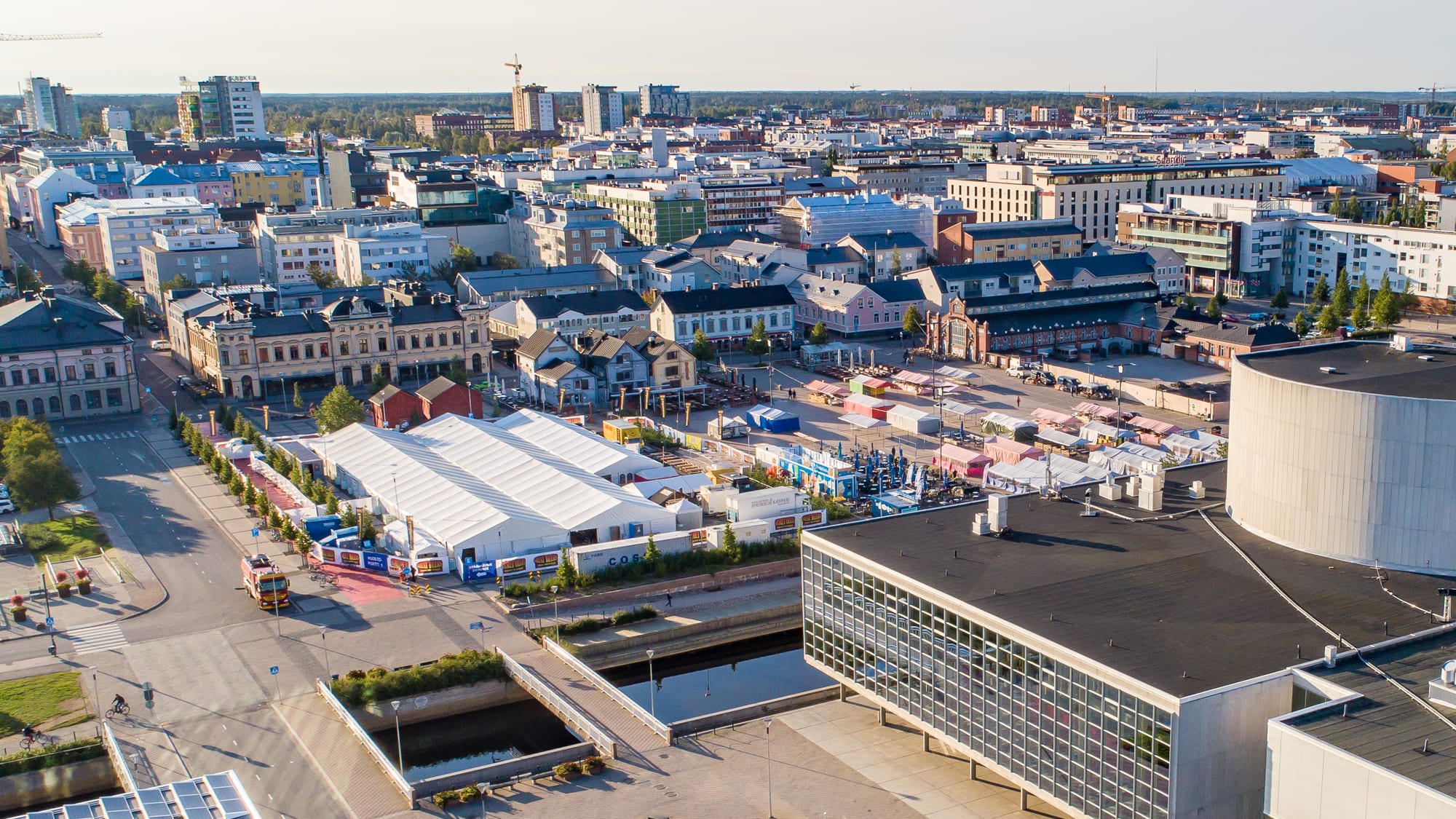
Aerial view of Oulu's Market Square with white market tents, red granaries and the city centre's mid-rise blocks beyond

Lapland & the North, Finland

Oulu

Oulu's Market Square and the city centre seen from the air in September. (Arto häkkilä / Wikimedia Commons · CC BY-SA 4.0)

The largest city in northern Finland, at the mouth of the Oulu River on the Bothnian Bay. Founded in 1605 and grown rich on tar and salmon, it was rebuilt after the fire of 1822 to C. L. Engel's plan, and is now a university and technology city known for year-round cycling, air guitar and its year as a European Capital of Culture in 2026.

Neighbourhoods

  • City centre
    • First-time visitors
    • Shopping
    • Close to public transport

    A grid of about 14 blocks laid out after the fire of 1822, running down to the Market Square on the water. The Rotuaari pedestrian streets, the cathedral, Mannerheim Park, shopping centres and most restaurants and bars are here, with newer residential towers rising among the older low buildings.

    Open in Maps
  • Myllytulli and Hupisaaret
    • Parks
    • Museums
    • Families

    Just east of the centre, the river delta breaks into small islands linked by white wooden bridges. The city park, the Northern Ostrobothnia Museum, the art museum and the Tietomaa science centre in a former leather factory are all here.

    Open in Maps
  • Pikisaari
    • Historic district
    • Arts and crafts

    A small island in the river mouth between the Market Square and Hietasaari, named after a 17th-century pitch works and once lined with shipyards. Burned by the British in the Crimean War, it is now home to artists, craftspeople and a crafts school in an old wool mill.

    Open in Maps
  • Tuira
    • Local life
    • Riverside walks

    The district across the Oulu River to the north, linked to the centre by bridges since 1869. Once a quarter of wooden townhouses, it was largely rebuilt from the 1970s, and its riverside beach is popular with locals in summer.

    Open in Maps
  • Nallikari and Hietasaari
    • Beaches
    • Families

    An island seaside area north-west of the centre, with a sandy public beach of about half a kilometre, a camping area with cottages, a lighthouse and a winter village. City buses run there all year.

    Open in Maps
  • Raksila
    • Sport
    • Close to the railway station

    The district just east of the railway station, mixing high-rise flats and a few blocks of older wooden townhouses with the city's main sports centre — the ice hall, swimming pool, Ouluhalli arena and pesäpallo stadium.

    Open in Maps
  • Linnanmaa
    • Students
    • Technology

    About five kilometres north of the centre, the main campus of the University of Oulu and the Technopolis science park together form a work and study community of about 20,000 people, with the university's botanical gardens on the shore of Lake Kuivasjärvi.

    Open in Maps

Things to do

Famous landmarks

  • Oulu Cathedrallandmark

    The Lutheran cathedral, first built in 1777 and rebuilt on its old stone walls to C. L. Engel's design after the fire of 1822; its most notable treasure is a portrait of Johannes Messenius painted in 1611.

    Open in Maps
  • Oulu Castle ruinslandmark

    The remains of the castle on Linnansaari island, destroyed when lightning blew up its powder magazine in 1793; a sea captains' observatory of 1875 on top has been a café since 1912.

    Open in Maps
  • Toripolliisilandmark

    Kaarlo Mikkonen's 1987 bronze of a stout market-square policeman, paid for by public subscription and now the city's best-known symbol.

    Open in Maps
  • Rotuaarineighborhood

    The pedestrian streets of the centre, created in 1987 and named after the French trottoir, with the central square where most of Rotuaari's festivals and events are held.

    Open in Maps

Museums

  • Tietomaamuseum

    Finland's first science centre, opened in 1988 in an old leather factory, with a 45-metre former water tower that visitors ride up in a glass lift.

    Open in Maps
  • Northern Ostrobothnia Museummuseum

    The regional history museum in Hupisaaret park, founded in 1896, with a large model of the city centre as it was in 1938, before the wartime bombing.

    Open in Maps
  • Oulu Museum of Artmuseum

    An art museum focused on northern Finnish artists, in a red-brick former glue factory of 1921 on the edge of Hupisaaret park.

    Open in Maps
  • Turkansaari Open-Air Museummuseum

    An island in the Oulu River, once a market place for Russian traders, where old rural buildings gather around a church of 1694; every summer tar is burned in a pit the traditional way.

    Open in Maps

Parks and the waterfront

  • Hupisaaret Islandspark

    A city park on small islands in the river delta, laid out from the 1860s, with white bridges, fountains, a greenhouse café and an open-air theatre used since 1957.

    Open in Maps
  • Nallikari beachbeach

    Oulu's sandy seaside beach, a public beach since 1946, where a snow-sculpture competition is held at the winter village.

    Open in Maps
  • University of Oulu Botanical Gardenspark

    One of the northernmost scientific gardens in the world, with more than 4,000 plant species and the pyramid-shaped greenhouses Romeo and Julia.

    Open in Maps

Markets

  • Oulu Market Hallmarket

    The covered market of 1901 on the Market Square, built to bring the butchers in from the open square, beside old granaries converted into craft shops.

    Open in Maps

Music, sport and nights out

  • Raksila sports centreattraction

    The city's main sports centre, with the Oulu Ice Hall, the swimming pool, the Ouluhalli arena and the artificial rink that was the main venue of the 2001 Bandy World Championship.

    Open in Maps

Short trips from the city

  • Hailuotoattraction

    An island municipality in the Bothnian Bay, still rising from the sea through post-glacial rebound; since June 2026 it has been joined to the mainland by an 8.4 km causeway-and-bridge link that replaced the ferry and the winter ice road.

    Open in Maps
  • Raaheattraction

    A coastal town about 60 km south-west of Oulu, known for its historic wooden town centre.

    Open in Maps

Seasonal events

  • Oulun TervahiihtoMarch

    An annual ski marathon held since 1889; terva is Finnish for tar, the product that made the city's fortune.

  • Terwa Marathon & RunMay

    A city running event held every year since 1989.

  • Qstockend of July

    A two-day music festival first held in 2003 and owned by the Kärpät hockey club, the biggest summer event in northern Finland.

  • Air Guitar World ChampionshipsAugust

    Competitors from around the world mime guitar solos under the motto 'Make Air Not War'; first held in 1996 as part of the Oulu Music Video Festival.

  • The Irish Festival of OuluOctober

    A festival of Irish music and culture held each autumn.

Eat and drink

Long-standing places and food districts in Oulu. Hours, ratings and directions come from your maps app, always current.

Oulu classics

  • Oulu Market Hallmarket

    The historic covered market on the Market Square, opened in 1901 with 62 wooden shop stalls under one roof.

    Open in Maps
  • Market Square cafés and stallsmarket

    In the brief summer the square's terraces, cafés and market booths fill up beside the red granaries and the Toripolliisi statue.

    Open in Maps

Food districts

  • Rotuaari and the city centreneighborhood

    The pedestrian streets and the blocks around them hold most of Oulu's restaurants, cafés and bars, from Finnish lunch places to international kitchens.

    Open in Maps

Experience Oulu

History

The mouth of the Oulu River was a trading place long before the city existed, and for centuries both Sweden and Novgorod claimed it. The Novgorodians built a castle here in 1375, and the Swedes built another on an island in the delta in 1590; the Treaty of Teusina in 1595 confirmed Swedish rule. King Charles IX founded the town on 8 April 1605 and granted it city privileges in 1610. Oulu grew on the export of tar and salmon, and in 1765 it won the right to trade directly abroad. It was the capital of the Province of Oulu from 1776 until 2009.

After the great fire of 1822, which destroyed much of the wooden city, Carl Ludvig Engel drew the plan that still shapes the centre, and rebuilt the cathedral on its old walls. During the Crimean War a British fleet raided the harbour, destroying ships and burning the tar stores and the shipyards on Pikisaari. On 3 February 1918 the city was the scene of the Battle of Oulu between Whites and Reds in the Finnish Civil War, and it was bombed in the Second World War.

The founding of the University of Oulu in 1958 changed the city's direction, and from the late 20th century it became a high-tech centre in information technology and wellness technology. Neighbouring municipalities were merged into the city in 2009 and 2013, and in 2026 Oulu is a European Capital of Culture together with Trenčín in Slovakia.

Culture & Customs

Oulu has a cultural life out of proportion to its distance from the capital. Its most famous event is the Air Guitar World Championships, held every August since 1996, whose motto "Make Air Not War" sums up the city's taste for the unconventional; the shouting male choir Mieskuoro Huutajat and the metal band Sentenced are other well-known exports. Qstock in July is one of Finland's largest music festivals, the Oulu Sinfonia plays at the Madetoja Hall, named after the composer Leevi Madetoja, and there are the Oulu Music Video Festival, an Irish festival and an international children's film festival.

Sport matters too. Ice hockey is the most popular spectator sport, and Kärpät, eight times Finnish champions, is the most successful club of the 21st century; Oulu also has strong bandy and football traditions. The Tervahiihto ski marathon, first held in 1889, recalls the tar trade, and the city's 1987 bronze market policeman, Toripolliisi, has become its symbol.

Oulu is a monolingual Finnish-speaking city where Conservative Laestadianism, a revival movement within the Lutheran church, has a strong following. Oulu has been called the "capital of Northern Finland", and it is known for year-round cycling: the Winter Cycling Federation was founded here in 2013, and bike commuting stays strong through the cold, dark and snow.

Daily Life

About 217,000 people live in the city of Oulu and about 265,000 in the wider sub-region, making it the fifth most populous municipality in Finland and the largest in the north. It is the third northernmost city of over 100,000 people in the world, after Murmansk and Norilsk. Around 7 per cent of residents have a foreign background, most often from the former Soviet Union, Sweden, China, India, Iraq, Iran and Vietnam.

The University of Oulu and the University of Applied Sciences give the city a large student population, and the Technopolis science park beside the university campus anchors a technology economy built on information technology and wellness technology. Wood processing, chemicals, pharmaceuticals, paper and steel remain important, and the port is one of the busiest on the Bothnian Bay. The city centre has grown denser in the 21st century with new residential towers, and a new transport hub and arena are planned at Raksila.

Daily life runs on bicycles and buses. Around one trip in five is made by bike, and the paths are cleared of snow before the roads. Summer evenings are spent on the beaches, the river islands and the terraces of the Market Square under the white nights; winter brings ice hockey, skiing and short, dim days.

Food

Oulu's traditional dishes were named in the 1980s as rössypottu, salmon soup and sweet cheese. Rössypottu is the city's own: a simple stew of potatoes and some pork with rössy, a blood bread made of blood, beer, rye flour and spices, and it is still little known in southern Finland. Lohikeitto, salmon soup with cream, is one of the most popular salmon dishes in Finland and a reminder of the salmon that once made the river famous.

The Market Square is the traditional heart of eating in Oulu. The Market Hall of 1901 was built to move butchers off the open square under new food-safety rules, and the old granaries around it now hold craft shops. In summer the square fills with market booths, cafés and terraces by the water.

As elsewhere in Finland, bilberries and lingonberries are picked in the forests, and leipäjuusto, a squeaky fresh bread cheese, is served with cloudberry jam and coffee. Lunch menus in the restaurants of the centre and the Rotuaari pedestrian streets are where many residents eat out.

Planning tools

Budget

Oulu is priced like other Finnish cities — expensive by European standards, but cheaper than the Lapland resorts. Hotels fill for big events such as Qstock and the Air Guitar World Championships. The city's parks, beaches, cycle paths and the Market Square cost nothing, and lunch menus are the cheapest way to eat out.

Daily Budget Midrange
USD 190–360 (city-centre hotel, restaurant dinners, museum tickets)
Daily Budget Shoestring
USD 80–130 (hostel or budget hotel, lunch menus and supermarkets, buses or a hired bike)

Book early for festival weekends in July and August, and use a bike — the cycle network is the best way to see the city.

Best Time to Visit

June to August, for the white nights, the beaches, terraces on the Market Square and the summer festivals. Late winter, from February to March, is good for snow, ski events and the sight of locals cycling through it. Midwinter is cold and very dark, with only a few hours of daylight.

Suggested Number of Days

Two days are enough for a first look at the centre, the river islands and the museums. Allow three or four to include the surrounding coast and islands, or to fit a festival or an ice hockey game into the visit.

First Visit
2 days
With Surroundings
3–4 days

Transportation

Oulu is one of Finland's cycling capitals, with more than 950 km of pathways and over 300 underpasses and bridges for walkers and cyclists, ploughed before the roads in winter; about one winter trip in eight is made by bicycle. City buses link the centre with the university, Nallikari and the airport, and in summer a road train runs to Nallikari and Hupisaaret.

Cyclists must give way to pedestrians on the Rotuaari pedestrian streets; bikes can be hired at Nallikari and in the centre.

Airport & Station Connections

Oulu Airport, the third busiest in Finland, is about 11 km south-west of the centre, with around ten flights a day to Helsinki; city buses and taxis connect it with the centre. The railway station is about a kilometre east of the Market Square, with trains to Helsinki in about five and a half hours at fastest and on to Rovaniemi and Kolari; long-distance buses leave from beside it. Highway 4 runs through the city.

Walkability

The compact centre, the Market Square and the Hupisaaret islands are easy on foot, linked by bridges and parks. Further sights — the university, Nallikari, Turkansaari — are better reached by bike or bus. Part of the Rotuaari pedestrian street is heated to stay free of ice, but pavements elsewhere are often icy in winter.

Safety

Finland is consistently rated one of the safest countries in the world, with very low crime. In Oulu the main hazards are winter cold, ice on paths and roads, thin ice on the river and sea, and darkness in midwinter.

Use bike lights and winter tyres in the dark months, and keep off river and sea ice unless it is known to be safe. Check current official travel advice before travelling.

Climate

A subarctic climate bordering a humid continental one, with cold, snowy winters and short, mild summers. Around midsummer the day lasts about 22 hours and the nights stay light; at midwinter the day is only a few hours long, and December averages a quarter of an hour of sunshine a day.

Summer
mild and light — July averages about 16.5°C, and the city has reached 33.3°C
Winter
cold and dark — January averages about −9.6°C, and the record low is −41.5°C

Local Customs

Tipping is not expected in Finland. Laestadianism, a conservative Lutheran revival movement, is strong in the city and the surrounding region. Finnish is almost universally the first language, and English is widely spoken.

Strong alcohol is sold only in the state Alko shops. Cyclists move fast on shared paths — keep to the walking side.

Common Payment Methods

Finland uses the euro. Cards and mobile payment are accepted almost everywhere, including buses and market stalls, and many places no longer take cash.